
A table egg business plan in Ghana is a written model of one thing: whether the eggs your hens lay will earn more than the feed, pullets, labour and overheads it takes to produce them — and how many months of feeding you must fund before that happens. The heart of it is a single hard fact: feed is roughly 70–80% of your running cost, so the plan lives or dies on how efficiently your flock turns feed into eggs, and on your having enough cash to keep buying feed through the long, loss-making months before the birds hit peak lay. A workable plan therefore sizes the flock to your capital, budgets feed honestly at today's prices, finds the break-even eggs-per-day, and — crucially — carries enough working capital to feed the flock from day-old (or point-of-lay) all the way to peak production. This guide shows how to build that plan with realistic Ghanaian assumptions.
Written by the Agro Prime Ghana poultry team and reviewed against current sector references (Ghana layer economics research, USDA FAS and layer management guides). Last updated September 2026.
Key takeaways
Build the plan around four numbers. One: feed is about 70–80% of operating cost (Ghana sector research), so model feed first and precisely — a hen eats ~110–120 g/day. Two: there is a long cash-negative runway — from about 18–20 weeks of rearing before the first egg, and later still before peak — that you must fully fund. Three: revenue is a daily egg stream (a crate is 30 eggs) plus a spent-hen sale at the end. Four: profit is thin and scale-sensitive — one study found mean profit of about GH¢2.63 per bird with wide variation, and economies of scale improving up to several thousand birds. Size the flock to the feed you can finance, not the house you can build.
What is a table egg business plan?
A table egg business plan is a document that turns "I want to keep layers" into numbers you can bank on: how many birds, in what housing, fed what, funded how, selling to whom, and at what point it starts making money rather than eating it. It has the usual sections — executive summary, market, operations, and financials — but for a layer farm the financial model is everything, because layer farming is a capital-hungry, slow-return business with a famously tight margin. Ghanaian research on the sector found layer producers earning a mean profit of only about GH¢2.63 per bird (ranging from around GH¢1.07 to GH¢9.49), and operating on average well below their efficiency potential — which tells you two things: the margin is real but slim, and the gap between a well-run and a poorly-run flock is enormous. A good plan is what puts you in the profitable half. For the wider business fundamentals, pair this with our general poultry business plan and starting a poultry farm guides; here we focus on the layer-specific economics.
Why feed dominates the whole plan
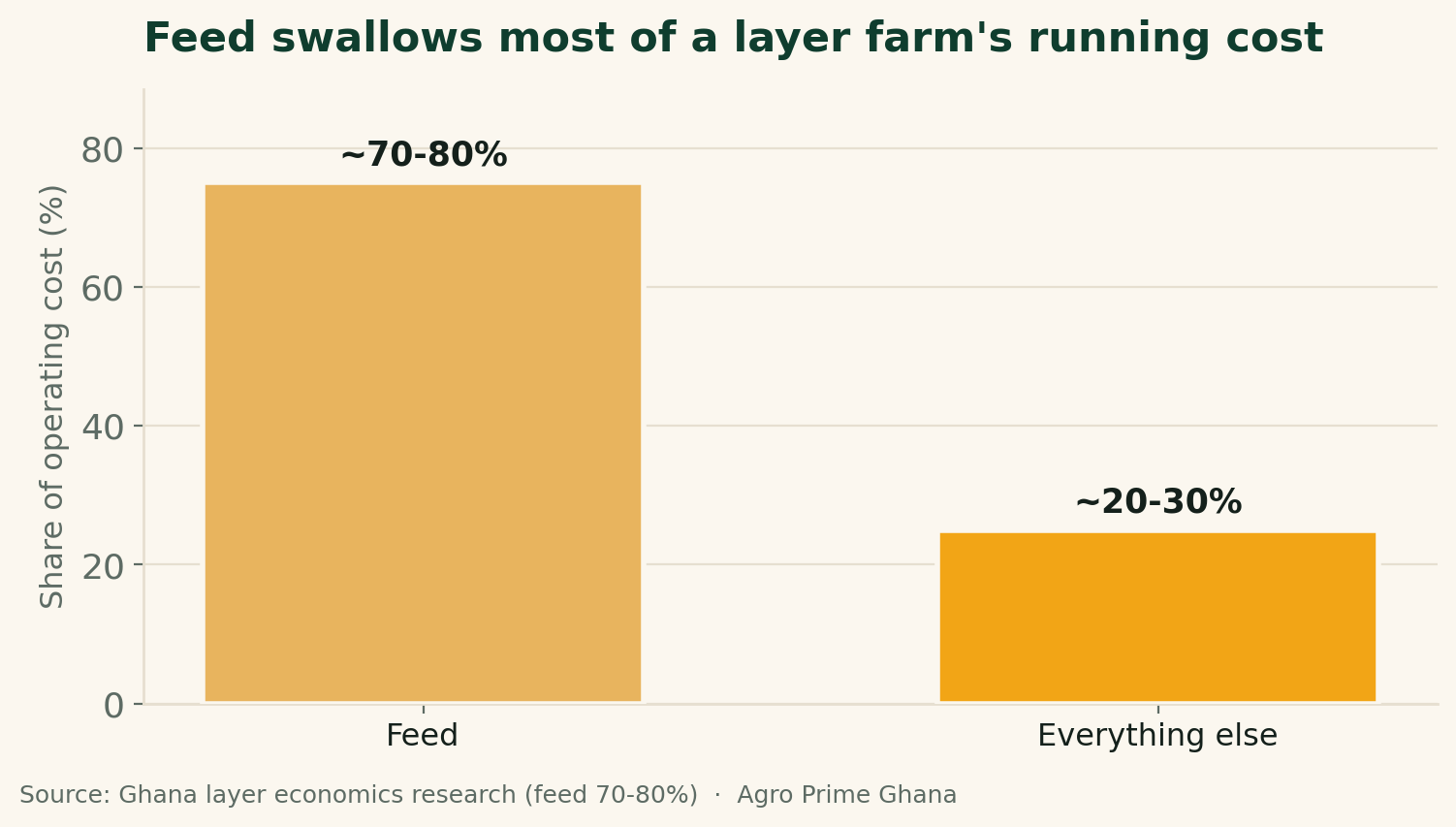
Before sizing anything else, understand what you are really financing: feed. Across the poultry sector, feed is consistently the single largest cost — the FAO calls it "the most important input for intensive poultry production," and Ghanaian layer research puts feed at roughly 70–80% of operational costs. Everything else — pullets, labour, drugs and vaccines, depreciation on the house and cages, electricity and water, transport — shares the remaining fifth or so. This single fact reshapes how you plan. It means small savings on feed conversion swing your bottom line far more than haggling over minor overheads; it means a spike in the maize price can turn a profitable flock loss-making overnight; and it means your biggest financial risk is not building the house but running out of money to buy feed before the birds pay you back. Plan feed first, in detail, and the rest of the model falls into place around it.
Sizing the flock to your capital
The most common — and most fatal — planning mistake in Ghanaian layer farming is sizing the flock to the house you can afford to build, then discovering you cannot afford to feed it to peak. Do it the other way round: size the flock to the feed and working capital you can reliably finance for at least a year. Work out the all-in cost of carrying one bird from point-of-lay pullet (or day-old) through to the point where daily egg sales cover daily feed — including the pullet, all the feed to peak, vaccines, labour and a margin for error — then divide your available working capital by that per-bird runway cost. That is roughly the flock you can safely start. Layer farming does reward scale — the Ghana profit-efficiency study found increasing returns to scale, with economies improving toward several thousand birds — but a right-sized flock you can feed to peak beats an ambitious flock you starve halfway. Many Ghanaian farmers therefore start with a few hundred to a couple of thousand layers and grow in batches, funding each expansion partly from the cash flow of the last. Our note on how many layers to start with works this through.
Field note: buying point-of-lay pullets changes your cash flow shape
There are two ways to stock a layer farm, and they have very different cash-flow profiles. Rearing from day-old is cheaper per bird and gives you full control of pullet quality, but it means feeding non-laying birds for 16–18 weeks with zero income and higher early mortality risk — a long, deep cash hole. Buying point-of-lay pullets at 16–18 weeks costs more up front per bird but shortens your cash-negative runway to just a few weeks before the first egg, and hands you birds someone else has already reared through the risky brooding stage. For many first-time and cash-constrained farmers, POL pullets are the lower-risk route; a plan should state clearly which you are modelling, because it changes both the upfront capital and the length of the loss-making period.
The break-even: how many eggs a day pays the bills
The core calculation in the plan is your break-even — the level of daily egg sales at which revenue covers cost. Because feed is the dominant cost and hens eat every day, a useful way to frame it is: how many eggs must the flock sell each day to cover that day's feed plus a share of overheads? Build it from the ground up. Take your flock size, multiply by the ~110–120 g of feed each hen eats daily to get daily feed weight, and cost that at the current price per bag of layer feed to get your daily feed bill. Add a daily slice of labour, health, depreciation and other overheads. Then divide by your net price per egg (crate price ÷ 30, less selling costs). The result is the number of eggs — and therefore the flock lay percentage — you must achieve daily just to break even. The lesson usually jumps out immediately: at a healthy 85–90%+ lay a flock clears break-even comfortably, but let production sag to 60–70% through poor feeding, heat or disease and the same feed bill now sits on far fewer eggs, tipping the flock into loss. Break-even is not a fixed number; it moves every time feed or egg prices move, which is why you recompute it whenever the maize price jumps.
| Plan component | What to budget for | Notes for Ghana |
|---|---|---|
| Capital (one-off) | House, cages/litter setup, feeders, drinkers, lighting, water storage, fencing | Cages cost more but ease labour & egg cleanliness |
| Stocking | Point-of-lay pullets (or day-old chicks + rearing feed) | POL shortens the loss-making runway; day-old is cheaper per bird |
| Feed (biggest) | Layer ration at ~110–120 g/hen/day for the whole cycle | ~70–80% of running cost; price swings are your main risk |
| Health | Vaccines (Newcastle, Gumboro, fowl pox, IB), drugs, deworming, vet | Small % of cost but protects the whole investment |
| Labour & overhead | Wages, electricity, water, transport, litter, misc. | Electricity/water unreliability is a real Kasoa-area constraint |
| Working capital | Cash to feed the flock from stocking to peak lay | The number most plans get fatally wrong |
Building the cash flow
A layer plan needs a month-by-month cash-flow projection, not just a single profit figure, because the timing of money is what breaks farms. The shape is predictable and unforgiving: heavy outflow up front (housing, pullets, and feed for birds that are not yet laying), a deepening cash hole through rearing and early lay, a turning point when daily egg sales begin to cover daily feed, then — if the flock lays well — a long stretch of positive monthly cash flow, capped by the spent-hen sale at the end. Two revenue streams feed the plan: the daily egg income across roughly 12–16 months of lay, and the spent-hen sale when the flock is retired — a meaningful lump sum, since spent layers supply the majority of Ghana's domestically produced chicken meat according to the USDA FAS 2024 data. The single most important output of the cash flow is the maximum cash deficit — the deepest point of the hole — because that, plus a safety margin, is the working capital you must have secured before you place a single bird.
Financing the plan realistically
Be honest in the plan about where the money comes from, because financing shapes what is survivable. Ghanaian poultry is largely self-financed: the 2024 Kasoa study found about 69% of farmers funding operations from personal savings, only around 19% from bank loans, and the rest from family — and the same study named inadequate funding as a leading bottleneck, alongside disease and unreliable electricity. Two planning implications follow. First, if you are self-funding, do not stock more birds than your savings can feed to peak with a buffer — undercapitalisation is the classic way layer farms fail, starving good flocks off production at exactly the wrong moment. Second, if you borrow, remember that a layer flock does not service a loan for months, so match the repayment schedule to the cash-flow curve — a loan demanding repayments during the rearing phase, before any eggs are sold, is a trap. Our poultry farm financing guide covers the options.
Point-of-lay pullets, layer feed and flock-sizing help from Agro Prime
The two riskiest lines in any table-egg plan are your birds and your feed — and those are exactly what we supply and advise on. Agro Prime Ghana provides strong point-of-lay layer pullets, quality layer feed, and practical help sizing your flock to the capital and feed you can finance, so your plan is built on real numbers rather than optimistic guesses. If you are drafting a plan and want a sanity-check on flock size, feed budget or setup, tell us your capital and target market. Message us on WhatsApp (+233 24 915 1503) or book a visit to our Kasoa farm to talk it through.
Field note: stress-test the plan before the market does
The plans that survive in Ghana are the ones that were pessimistic on paper. Before committing, we always run the model twice more: once with feed a good deal dearer than today (because the maize price will move against you at some point), and once with the flock laying several points below target (because heat, a lighting slip or a disease scare happens to most flocks eventually). If the plan still survives both — and survives them happening together — it is robust. If it only works at cheap feed and a flawless 90% lay, it is a hope, not a plan. Build in that margin now, on paper, where it costs nothing.
The market section: who buys your eggs
A plan that models production but hand-waves the market is only half done. Eggs are a commodity sold by the crate of 30, so your market section should name concrete channels — farm-gate buyers and wholesalers, retail shops and market sellers, hotels, restaurants and caterers, schools, and direct household sales — and be realistic about price. You compete not on a unique product but on reliability, freshness, cleanliness and consistent size, so the plan should describe how you will secure and keep buyers (steady supply, clean crates, fair dealing) rather than assume eggs sell themselves. Because prices move with season and with feed costs, model a range, not a single optimistic price, and stress-test the plan against a lower egg price and a higher feed price at the same time — the squeeze that has caught many Ghanaian egg farmers. Our poultry marketing and selling table eggs guides develop the sales side.
Record-keeping: the plan is only as good as your numbers
A business plan is a forecast; records are what tell you whether reality is matching it in time to act. From day one, track daily egg production (as a lay percentage), daily feed use, mortality, feed and egg prices, and cash in and out. These let you compute the two ratios that decide a layer farm's fate — feed cost per crate and lay percentage — and spot a problem while it is still fixable rather than after a season of quiet losses. Farms that keep good records can see a flock slipping off peak, or feed conversion drifting, and respond; farms that do not, discover it only when the money runs short. Treat the plan as a living model you update against real records, not a document you file after the loan comes through. Our guide to record-keeping on the poultry farm sets out a simple system, and the cost of egg production guide shows exactly which costs to capture.
The bottom line on a table egg business plan
A sound table egg business plan in Ghana is not an optimistic brochure — it is a stress-tested cash-flow model built on one uncomfortable truth: feed is 70–80% of your cost, the flock does not pay you back for months, and profit per bird is slim enough that only well-run, well-fed flocks clear a worthwhile margin. Size the flock to the feed you can finance through to peak, budget feed honestly at today's prices, compute a break-even that moves with the maize market, carry enough working capital to survive the deepest point of the cash hole, and plan for both revenue streams — daily eggs and the spent-hen sale. Do that, keep real records against the plan, and you put yourself firmly in the profitable half of Ghana's egg farmers rather than the half that runs out of feed money before the birds ever reach their peak.
Frequently asked questions
How much capital do I need to start a layer farm in Ghana?
Why is feed such a big part of the cost?
How do I calculate break-even for a layer flock?
Should I buy point-of-lay pullets or rear from day-old?
How profitable is layer farming in Ghana?
How do I fund a layer farm?
What should the market section of my plan include?
How big should my starting flock be?
Sources & further reading
- Aidoo et al., Profit efficiency of layer production in Ghana (mean profit per bird, cost drivers, returns to scale).
- FAO — Nutrition and feeding (feed as the most important input in intensive poultry).
- Open Journal of Business and Management — Bottlenecks and Prospects of Poultry Production in Kasoa, Ghana (2024) (financing sources, feed prices, bottlenecks).
- USDA Foreign Agricultural Service — Ghana Poultry Voluntary Update 2024 (spent-layer share of domestic meat).
- Agro Prime Ghana guides: poultry business plan, poultry farm financing, cost of egg production, and record-keeping.
About Agro Prime Ghana
Agro Prime Ghana Limited runs a poultry hatchery and mixed agribusiness in Kasoa, supplying day-old chicks (broilers and layers), point-of-lay pullets, quality feed and hands-on farm support across Ghana. These guides combine day-to-day farm experience with current sector research. This article is general educational information, not financial or professional advice — build your plan on your own verified local prices. Planning a table-egg farm? Book a visit or message us on WhatsApp (+233 24 915 1503) to order point-of-lay pullets, layer feed or help sizing your flock.


