
Day-old chick delivery in Ghana works on a tight biological clock: a good hatchery hatches, sorts and (where required) vaccinates the chicks, packs them into ventilated boxes, and gets them to your brooder ideally within the first day or two of life, because a freshly hatched chick carries only a small residual yolk sac — roughly 4–5 grams — that sustains it for about 72 hours before it must be eating and drinking. Get delivery and placement right and the flock starts strong; get the timing, temperature or handling wrong and you can lose growth, uniformity and birds before week one. This guide explains exactly how chick delivery works in Ghana, how the timing is set, what to prepare before the chicks arrive, and how to receive and settle a batch so every chick you paid for gets off to the best possible start.
Written by the Agro Prime Ghana hatchery team and reviewed against current industry references (Aviagen and Royal Pas Reform hatchery guidelines). Last updated September 2026.
Key takeaways
A day-old chick hatches with a residual yolk sac (about 4–5 g) that keeps it going for roughly 72 hours — so the aim is delivery and placement well inside that window, ideally within a day of hatch. Chicks cannot regulate their own temperature: during transport the air around them should sit near 22–28°C with 50–60% humidity, while the temperature inside the box at chick level stays around 30–35°C. A healthy chick's own body (vent) temperature is about 40°C; panting means too hot, huddling means too cold. Before chicks arrive, your brooder floor should already be warmed to 32–35°C with clean water down. Research on 19,200 chicks found livability was not harmed by journeys of up to 60 hours when the climate was right — proof that conditions, not just distance, decide the outcome. Count, inspect and settle the batch on arrival, and give water before feed.
How day-old chick delivery actually works
Chick delivery is the last, most fragile link in a 21-day chain. It begins long before your order: fertile eggs from a breeder flock are set in an incubator for about 18 days, transferred to a hatcher, and pull ("hatch") over roughly the next three days. On hatch day the chicks are taken off, dried, graded to remove weak or defective birds, sexed if you have ordered pullets or cockerels, and — depending on the hatchery and the vaccine programme — given their first vaccinations such as Marek's disease before they ever leave the building. Only then are they counted into clean, ventilated chick boxes (usually 100 chicks per box, in compartments that stop them piling) and dispatched.
From that point the chicks are on a countdown. They are not fed or watered in the box, because they are living on the yolk reserve absorbed just before hatch. Aviagen puts that residual yolk at roughly 4–5 grams, enough to carry a chick through holding and transport to its first feed. The practical rule every serious hatchery works to is simple: the sooner a chick is under a warm brooder with water and feed, the better it performs for the rest of its life. In Ghana, where most buyers are within a few hours of a hatchery or a distributor, that is entirely achievable — the risk is rarely distance and almost always handling: chicks left in a hot car boot, a delayed pickup, or a brooder that was not ready. For the buyer's side of that handling, see our guide to transporting day-old chicks in Ghana.
Why timing and temperature matter so much
A day-old chick is not yet able to control its own body temperature, so it depends entirely on the climate you provide — in the box, in the vehicle and in the brooder. Royal Pas Reform's handling and transport guidance sets the target air temperature around the chicks at about 22–28°C with relative humidity of 50–60%, while keeping the temperature inside the box, at chick level, in the region of 30–35°C. That gap matters: because a crowd of chicks generates a surprising amount of heat, the temperature inside a packed box can run 8–14°C higher than the air in the truck, which is exactly why a vehicle that feels comfortable to a person can be dangerously hot for boxed chicks with no airflow.
The chicks themselves tell you when the climate is wrong. A healthy chick's internal (vent) temperature sits around 40°C; when they overheat they open their beaks and pant, which evaporates water from their airways and dehydrates them fast, and they spread out, become noisy and restless. When they are too cold they go quiet and huddle in a pile, and the chicks in the middle can smother. Neither state is harmless — both cost you performance before the birds even reach the brooder. The reassurance in the science is real, though: in trials simulating transport of 19,200 chicks, livability was not affected by journeys of up to 60 hours when the climate was properly controlled. In other words, a well-run two- or three-hour delivery in Ghana carries very little risk if — and only if — the chicks are kept in the right temperature and airflow the whole way.
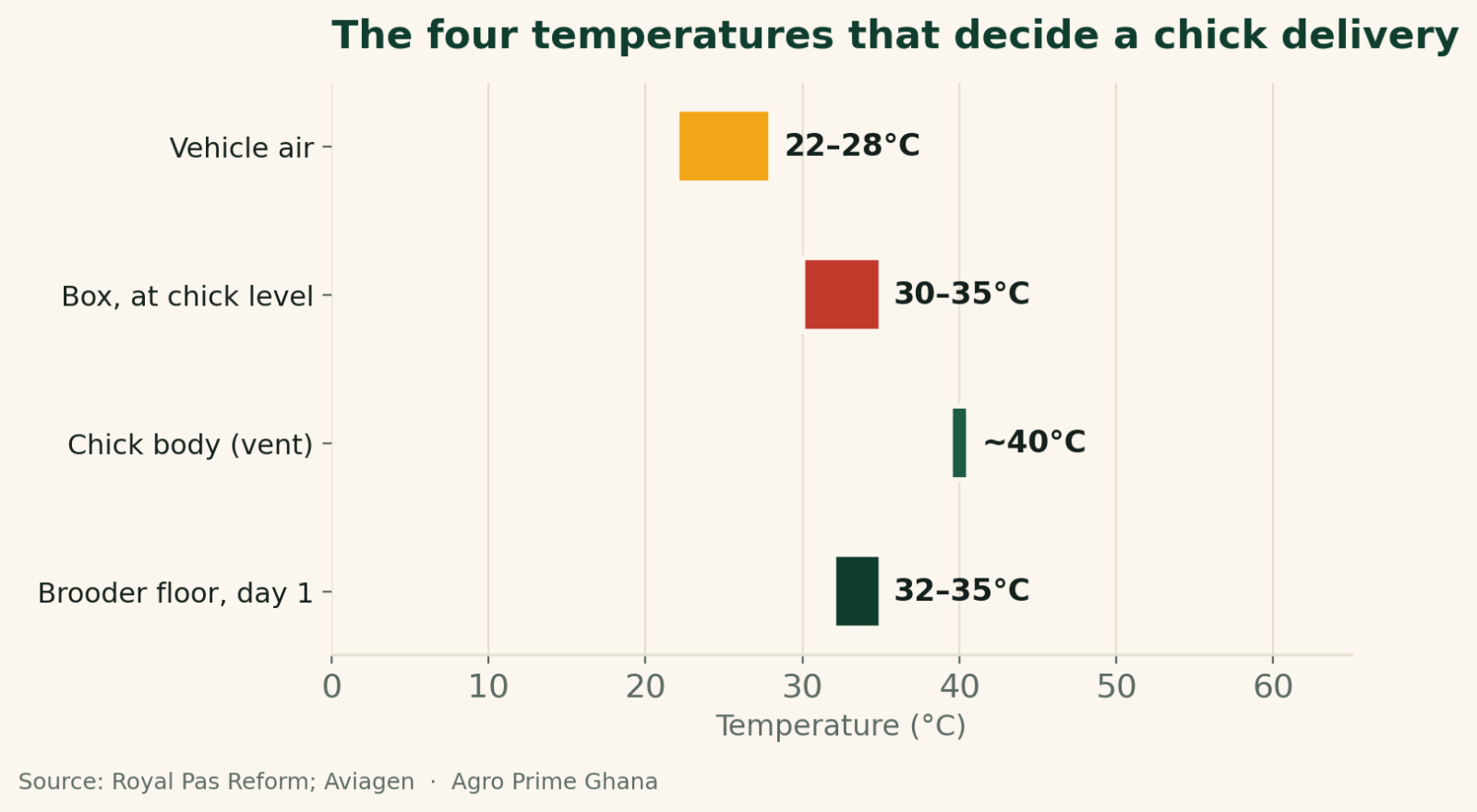
The four temperatures that decide a delivery
Successful delivery is really about hitting four different temperature targets at four points in the chick's journey, from the box to the brooder floor. Keep the table below in mind when you receive a batch — each band comes from published hatchery guidance.
| Where | Target temperature | Why it matters |
|---|---|---|
| Air around the chicks (vehicle) | ~22–28°C | Chicks can't thermoregulate; box heat sits well above this |
| Inside the box, at chick level | ~30–35°C | The temperature the chicks actually feel; packed boxes self-heat |
| Chick's own body (vent) | ~39.4–40.6°C | A quick vent check tells you if a chick is chilled or overheated |
| Brooder floor at placement | ~32–35°C | Must be pre-warmed before chicks arrive, not after |
What to prepare before the chicks arrive
The single biggest cause of avoidable first-week losses is a brooder that was set up when the chicks arrived instead of the day before. Preparation is where the delivery is won. At least 24 hours before the agreed delivery time, the brooder house should be cleaned, disinfected and dried, with the litter down, the guard ring in place and the heat source running long enough to bring the floor and litter under the heat to around 32–35°C. Warming the litter, not just the air, matters because cold litter chills chicks through their feet and belly. Our brooder temperature chart for Ghana and full brooding guide walk through the week-by-week targets.
Have clean, cool water down before the chicks land, ideally with a little glucose or a vitamin–electrolyte supplement to help rehydrate birds that have travelled. Water goes down first; feed follows once the chicks have found water and settled. Put feed on clean chick trays, egg-flat lids or paper so newly placed chicks can find it easily rather than searching a deep feeder. Check that drinkers are at the right height and number, that there are no gaps in the guard where chicks can escape the heat, and that the house is free of draughts, rats and ants. A short checklist before the vehicle arrives — heat on, litter warm, water down, feed ready, guard closed, house secure — prevents almost every common placement problem.
Field note: the brooder should be warm before the chicks, not after
On our hatchery side we can pack, vaccinate and deliver a perfect box of chicks, but the outcome still turns on what waits for them at the other end. The batches that stumble are almost always the ones placed into a cold house because the heat was only switched on when the vehicle pulled up. We tell every buyer the same thing: light the brooder the evening before, put your hand flat on the litter under the heat in the morning, and only confirm delivery once that litter feels genuinely warm. Chicks placed onto pre-warmed litter spread out, drink and start eating within the hour — that quiet, busy, evenly-spread brooder is exactly what you are paying us to make possible.
How to receive and settle a batch on arrival
When the vehicle arrives, work quickly but calmly, because the chicks are still on the clock. First, count the chicks against your order and the delivery note before anything else — reputable hatcheries pack accurately and often add a few extras, but you should verify the number you are signing for. Then inspect: a good batch is alert, noisy, dry and fluffy, standing firmly, with bright eyes and clean, healed navels. Set aside any that are clearly weak, unhealed at the navel, or have splayed legs, and raise them with the hatchery straight away rather than after they have died. Handling and transport can also be checked against our guide to choosing healthy day-old chicks.
Place the chicks under the heat inside the guard ring, spreading them evenly rather than tipping a whole box in one spot. Dip a few beaks in the water to show the batch where to drink, then leave them to settle. For the next hour, read the chicks, not the thermometer: chicks spread evenly and moving about means the temperature is right; a tight pile under the heat means too cold; chicks pressed to the edges, panting, means too hot; and all the chicks crowded to one side usually means a draught. Adjust the heat and close any gaps accordingly. Within a few hours a well-received batch should have soft, full crops — feel a sample that evening to confirm the birds are eating and drinking.
Order strong, vaccinated chicks — and let us plan your delivery window
Half of a smooth delivery is the chick, and half is the timing. Agro Prime Ghana hatches and supplies day-old broiler and layer chicks from Kasoa, graded for vitality and delivered inside the window that keeps them performing. Tell us your placement date and location and we will plan the hatch and the delivery around it — including the vaccinations your programme needs and honest advice on how many chicks your brooder is genuinely ready for. Message us on WhatsApp (+233 24 915 1503) or book a visit to set up a delivery that arrives ready to thrive.
Common delivery mistakes in Ghana — and how to avoid them
Most delivery losses trace back to a short list of avoidable errors. The most common is heat without airflow: boxes stacked tightly in a closed car boot on a hot Kasoa afternoon, where the self-heating of the chicks pushes box temperature far past safe levels. Chicks need ventilation as much as warmth, so boxes must be arranged with space for air to move through them, never sealed in an airless space. The second is delay: a pickup that drifts to late afternoon, or chicks left in a parked vehicle while the buyer runs errands, both eat into the yolk-reserve window. The third is chilling — carrying chicks in an over-air-conditioned cab or a cold harmattan morning without insulating the boxes. And the fourth, as above, is a cold, unready brooder at the destination. Every one is a handling decision, not bad luck, which is why a little planning removes almost all of the risk.
How delivery ties into Ghana's poultry demand
Reliable chick delivery matters more in Ghana than many keepers realise, because the whole sector is built on getting young stock into brooders efficiently. Domestic chicken-meat production was estimated at around 70,000 metric tonnes in 2024 against consumption of roughly 340,000 tonnes, according to the USDA Foreign Agricultural Service — a large gap currently filled by imports. Every locally raised bird that helps close it started as a day-old chick that had to be delivered and brooded well, and demand swings sharply around the festive season, so timely placement in the weeks before Christmas can decide whether you hit that market. For where hatcheries and distributors cluster, see our guide to where to buy day-old chicks in Ghana.
The bottom line on chick delivery
Day-old chick delivery is a race against a 72-hour biological clock, run in the language of temperature. A good hatchery does its part by hatching, grading and vaccinating strong chicks and dispatching them promptly in ventilated boxes; the buyer does the rest by keeping the boxes at the right temperature and airflow in transit, and — above all — by having a warm, watered, secured brooder waiting before the chicks arrive. Read the chicks rather than only the thermometer, give water before feed, count and inspect on arrival, and settle the batch under pre-warmed heat, and the vast majority of first-week problems simply never happen. In Ghana's conditions the distance is rarely the enemy; careless handling is. Plan the delivery, prepare the brooder, and your chicks arrive ready to grow.
Frequently asked questions
How long can day-old chicks survive without food and water during delivery?
What temperature should day-old chicks be kept at during transport?
How soon after hatching should chicks be delivered and placed?
What should I prepare before my day-old chicks arrive?
Should chicks get feed or water first when they arrive?
How do I know if the temperature is right after placement?
How many chicks come in a box, and should I count them on arrival?
Can I collect chicks myself instead of having them delivered?
Sources & further reading
- Royal Pas Reform — Maintaining the ideal climate for chick handling and transport (transport temperature, humidity, box vs. air temperature, panting and huddling).
- Aviagen — Transporting chicks around the world with diligence and care (residual yolk of 4–5 g, vent and box temperatures, 60-hour livability trial).
- USDA Foreign Agricultural Service — Ghana poultry sector reports (domestic production, imports and consumption of chicken meat).
- Agro Prime Ghana guides: transporting day-old chicks, brooder temperature chart, how to brood day-old chicks, and choosing healthy day-old chicks.
About Agro Prime Ghana
Agro Prime Ghana Limited runs a poultry hatchery and mixed agribusiness in Kasoa, hatching and delivering day-old chicks and supporting poultry keepers across the country. We supply healthy day-old chicks (broilers and layers), point-of-lay pullets, quality feed and hands-on farm support, and we plan deliveries around your placement date so chicks arrive ready to thrive. This article is general educational information, not a substitute for professional veterinary or extension advice. Ready to start or expand? Book a visit or message us on WhatsApp (+233 24 915 1503) to order chicks, feed or advice.