You walk into the layer house one morning and notice a few birds with small grey warts around the comb, wattles and eyelids — nothing dramatic, and the flock is still eating. Two weeks later a quarter of the pen has crusty black scabs on their faces, some birds have swollen shut eyes, egg numbers have slipped, and a handful are gasping with yellow cheesy plaques in the mouth. That slow-burning march is the signature of fowl pox, a viral disease that rarely explodes overnight the way Newcastle can, but instead grinds through a flock for weeks. In Ghana, where mosquitoes are never far away, it is one of the more predictable poultry diseases — and one of the most preventable with a single, cheap vaccine. This guide explains the two forms of fowl pox, how mosquitoes drive it, and exactly how to keep it out of your birds under local conditions.
Written by the Agro Prime Ghana poultry team and reviewed against current veterinary references (MSD/Merck Veterinary Manual and Hy-Line technical guidance). Last updated September 2026.
Key takeaways
Fowl pox is a slow-spreading viral disease that comes in two forms: the common dry (cutaneous) form — wart-like scabs on the comb, wattles and other bare skin, usually low mortality — and the dangerous wet (diphtheritic) form, with cheesy plaques in the mouth and throat that can suffocate birds and cause up to 50–60% mortality in unvaccinated flocks. The incubation period is about 4–10 days, and an outbreak drags through a flock over 2–8 weeks. Mosquitoes and other biting insects are the main spreaders in a warm climate like Ghana's, carrying the virus mechanically from bird to bird. There is no treatment for the virus itself — the whole game is prevention through a cheap live vaccine given by the wing-web method, mosquito control and biosecurity. Vaccinating still limits spread if you act while fewer than 20% of birds have lesions.
What fowl pox actually is
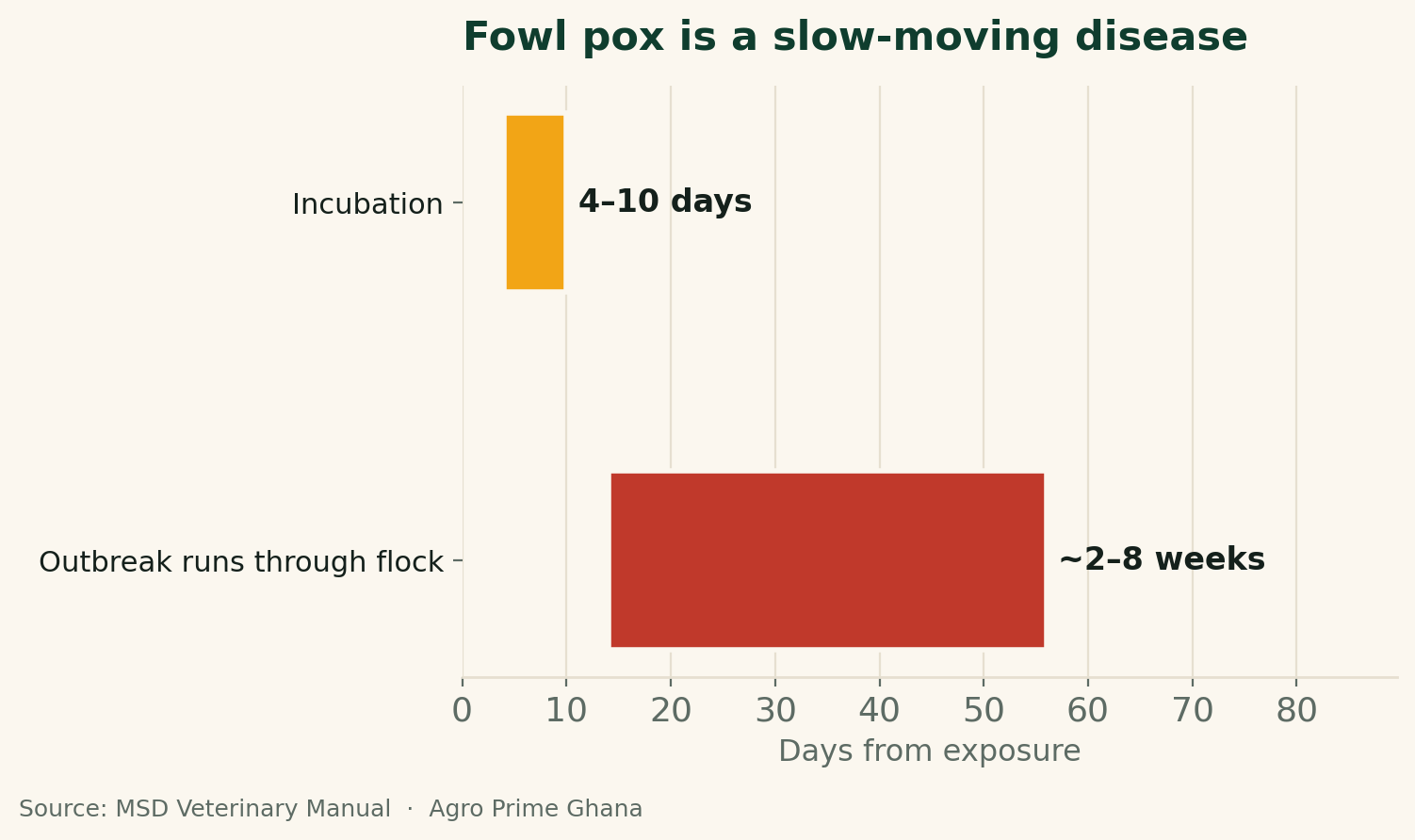
Fowl pox is caused by an avipoxvirus — a large DNA virus, quite unrelated to the human chickenpox virus despite the similar name. It is a bird disease and does not infect people. The virus produces disease in two very different ways depending on where it takes hold: on the skin (the cutaneous or "dry" form) or on the mucous membranes lining the mouth, throat and windpipe (the diphtheritic or "wet" form), and the same outbreak can produce both. According to the Merck (MSD) Veterinary Manual, the incubation period in chickens is typically 4–10 days, and the course in a flock is usually protracted — 2 to 8 weeks — because the virus moves relatively slowly from bird to bird rather than sweeping through in days. This slow tempo is a defining feature: it is why fowl pox is called a "slow-spreading" disease, and why a farmer who acts early can still blunt an outbreak already underway.
Why fowl pox is a standing threat in Ghana
The single biggest reason fowl pox is a year-round risk here is the mosquito. The Merck Veterinary Manual states plainly that mosquitoes and other biting insects may serve as mechanical vectors, and that transmission within a susceptible flock is rapid when mosquitoes are plentiful. A mosquito that bites an infected bird picks up virus on its mouthparts and can then infect other birds it feeds on for weeks. Ghana's warm, humid conditions — standing water in the rains, open and semi-open houses, bush and drainage around many farms — keep mosquito numbers high for much of the year, so the vector that drives fowl pox is almost always present. The virus is also tough: scabs shed from recovering birds are loaded with virus and dry into infectious dust, which the Merck manual notes can become a source of aerosol exposure. An open house full of birds, biting insects and dusty litter is close to an ideal setting for the disease, which is why fowl pox is so familiar to Ghanaian layer and cockerel keepers, especially in older flocks.
Dry pox versus wet pox: know the difference
The distinction between the two forms is not academic — it decides how worried you should be. The dry (cutaneous) form is by far the more common and the milder: raised, wart-like nodules on the unfeathered skin — comb, wattles, eyelids, the base of the beak and sometimes the legs — which progress to thick, dark scabs before healing over two to three weeks, with usually low mortality. The wet (diphtheritic) form is the one that kills: instead of skin scabs, the virus produces raised, yellowish, cheesy plaques on the mucous membranes of the mouth, tongue, pharynx, larynx and windpipe, which can grow large enough to block the airway so birds effectively suffocate. Hy-Line's technical guidance notes this wet form can cause mortality of up to 50–60% in unvaccinated flocks, a world away from the nuisance-level losses of dry pox. The table below lays the two side by side.
| Dry (cutaneous) pox | Wet (diphtheritic) pox | |
|---|---|---|
| Where lesions appear | Bare skin: comb, wattles, eyelids, beak, legs | Mouth, tongue, throat, larynx, windpipe |
| Appearance | Wart-like nodules turning to dark scabs | Raised yellow, cheesy plaques |
| Main danger | Eye lesions, reduced feed intake, egg drop | Airway blockage, suffocation, feeding stops |
| Typical mortality | Low if uncomplicated | Up to 50–60% in unvaccinated flocks |
| How common | The usual form seen on farms | Less common but far more deadly |
How to recognise fowl pox early
Because fowl pox moves slowly, you almost always have time to catch it — if you are looking. The earliest sign of dry pox is a few birds with small, pale, raised spots on the comb, wattles or around the eyes, easily mistaken for insect bites or scratches. Over days these enlarge into rough nodules and then the classic dark scabs, and the number of affected birds climbs steadily rather than all at once. Watch the eyes: eyelid lesions can swell them shut, and a bird that cannot see does not eat, so it falls behind fast. In laying flocks, a quiet dip in egg production often accompanies an outbreak — the Merck manual notes that extensive infection in a layer flock results in decreased egg production. The wet form is easier to miss until serious: suspect it when birds are gaping, shaking their heads, drooling, breathing with difficulty or going off feed, and confirm by opening the beak to look for the yellow cheesy plaques in the mouth and throat.
Field note: what we look for on the comb and around the eyes
On the farm, fowl pox usually announces itself as one or two birds with odd little bumps on the comb that we first take for peck wounds. The tell is that they do not heal — they grow, crust over dark, and within a week or two more birds show the same thing. We check eyelids closely, because a scab that swells an eye shut turns a mild case into a bird that stops eating and wastes away. If we see facial scabs, we quietly open a few beaks to check the mouth and throat, because catching the wet form early is what saves lives.
How fowl pox spreads through a flock
Understanding the spread is what makes prevention make sense. There are three main routes. First and most important in our climate is the biting insect: mosquitoes and other biting flies pick up virus when they feed on an infected bird and deposit it into the next birds they bite. Second is contact and abrasions: the virus enters through breaks in the skin, so scratches from fighting, pecking, rough perches or handling become entry points. Third is the environment: virus-rich scabs shed by recovering birds contaminate litter, dust, feeders and equipment, and can be inhaled or rubbed into abrasions — the Merck manual flags shed scabs as a source of aerosol exposure. This mix of routes explains the slow, grinding progress of an outbreak, exactly the 2–8 week course the manual describes.
Prevention: the vaccine is the whole strategy
There is no drug that cures fowl pox — the Merck manual is explicit that there is no specific effective treatment, so prevention is everything. Fortunately, prevention is cheap and reliable, because a good live vaccine exists.
- Vaccinate with a live fowl pox vaccine. The vaccine is made from live, attenuated fowlpox and/or pigeonpox virus of high immunogenicity and low pathogenicity. It is given not by injection or in water but by the wing-web (wing-stab) method: a special two-pronged applicator is dipped in the vaccine and pushed through the thin web of skin under the wing. A properly vaccinated flock develops small scabs ("takes") at the stab site within about 5–7 days — Hy-Line notes that with correct technique 99–100% of birds should show takes. Checking for takes a week later tells you the vaccination worked; no takes means the job must be redone.
- Time it right. The Merck manual recommends first vaccination within the first few weeks after hatching and revaccination at 12–16 weeks of age; other schedules give an early dose (day-old to a few weeks) and a booster before lay in high-challenge areas. For layers and cockerels that will live many months exposed to mosquitoes, vaccinating before they enter the risk period is essential.
- Control mosquitoes and biting insects. Because insects drive spread, cutting mosquito numbers cuts the disease: clear standing water and drainage around the house, remove bush and rubbish that harbours insects, screen open houses where feasible, and manage wet spots that breed mosquitoes.
- Practise sound biosecurity and hygiene. Reduce skin injuries, clean and disinfect between batches to lower the load of virus-laden scabs and dust, and keep new or sick birds separate — basics covered in our guide to poultry biosecurity.
Managing an active outbreak
If pox is already in the flock, the aim shifts to limiting spread and supporting affected birds while the disease runs its course. Vaccination is still worthwhile: the Merck manual notes it is often useful to limit spread if administered when fewer than 20% of the birds have lesions, so catching an outbreak early lets you ring-vaccinate the still-healthy birds. Beyond that, care is supportive: keep clean feed and water within easy reach of birds whose eyes or mouths are affected (a bird that cannot see or swallow will starve alongside the disease), protect open skin lesions against the secondary bacterial infection that often does the real killing, step up mosquito control, and isolate the worst-affected birds. Be patient — the outbreak takes weeks, not days, to pass, and most dry-pox birds recover.
Field note: check for "takes" a week after you vaccinate
The most common reason a vaccinated flock still gets pox is that the vaccine never actually "took" — a blocked applicator, vaccine that lost potency in the heat, or a rushed job in a big flock. That is why we always go back about 5–7 days after wing-web vaccination and lift a sample of wings to look for the small scab at the stab site. If the takes are there, we are confident the flock is protected; if they are missing or patchy, we revaccinate rather than assume we are covered. Keeping the vaccine cold right up to the moment of use, and mixing only what you can use quickly, matters a lot in our heat.
The economics: cheap to prevent, costly to ignore
Fowl pox sits in an unusual place economically. The dry form alone rarely kills many birds, so some keepers shrug it off — but even mild outbreaks cost real money through the egg drop in layers, birds set back by eye lesions, and weeks of lost performance. The wet form is another matter: with mortality reaching 50–60% in unvaccinated flocks, a single diphtheritic outbreak can wipe out birds you have already fed for months. Against that, the vaccine costs a few pesewas per bird, given once or twice in a lifetime. The maths is one-sided: for any flock kept beyond a few weeks in a mosquito-rich environment — almost every layer and cockerel operation in Ghana — vaccination is not optional but basic, high-return insurance.
The bottom line on fowl pox
Fowl pox is a slow-moving viral disease that is almost entirely under your control. It comes in a common, mild dry form of facial scabs and a less common but deadly wet form that suffocates birds with throat plaques, and in Ghana it is driven above all by mosquitoes over a 2–8 week outbreak. There is no cure once a bird is infected, so the strategy is prevention: give the cheap live vaccine by the wing-web method before birds enter their risk period, confirm it worked by checking for takes, knock down mosquito numbers, and keep skin injuries and dusty scabs to a minimum. Do that, and fowl pox goes from a recurring seasonal worry to a disease you simply do not see — which, for the price of the vaccine, is one of the best deals in poultry keeping.
Frequently asked questions
What are the first signs of fowl pox in chickens?
What is the difference between dry pox and wet pox?
How do mosquitoes spread fowl pox?
Is there a treatment for fowl pox?
How and when should I vaccinate against fowl pox?
What does it mean to check for "takes" after vaccination?
Does fowl pox affect egg production?
Can fowl pox spread to humans or other animals?
Sources & further reading
- Merck (MSD) Veterinary Manual — Fowlpox in Chickens and Turkeys (forms of disease, incubation, mosquito transmission, course, egg drop, vaccination timing, the <20%-lesion rule, no treatment).
- Hy-Line International — Technical Update: Fowl Pox in Layers (wet-pox mortality of up to 50–60% in unvaccinated flocks, wing-web method and 99–100% "takes").
- eXtension / poultry.extension.org — Fowl Pox in Poultry (slow-spreading nature, dry vs wet lesions, mosquito role).
- Agro Prime Ghana guides: poultry biosecurity, Newcastle disease in Ghana, and poultry house ventilation.
About Agro Prime Ghana
Agro Prime Ghana Limited runs a poultry hatchery and mixed agribusiness in Kasoa, supplying day-old chicks and working alongside poultry keepers across the country. These guides draw on that hands-on hatchery and farm experience, checked against current veterinary references. This article is general educational information, not a substitute for diagnosis and vaccination advice from a qualified veterinary or extension officer — if your flock is sick, get it seen. Need chicks, feed advice or farm support? Book a visit or message us on WhatsApp (+233 24 915 1503).