Ask a poultry keeper in Kasoa how the last batch went and you will often get an honest shrug: "I think we did well." Not we sold 480 birds at an average of 2.1 kg, spent this much on feed, lost 34 to a Newcastle scare in week three, and cleared a margin of about eight cedis a bird." The difference between those two answers is a notebook. Farms that write things down know exactly where their money goes and can prove which decisions paid off; farms that keep it all in their heads are, in effect, flying blind — and it usually costs them far more than the price of a pen. This guide explains what to record on a Ghanaian poultry farm, gives you templates you can start using today, and shows how a few minutes of writing each day turns guesswork into profit.
Written by the Agro Prime Ghana poultry team and reviewed against agricultural extension research (a Ghana study of small-scale poultry record-keeping by Tham-Agyekum and colleagues, and FAO smallholder poultry economics). Last updated September 2026.
Key takeaways
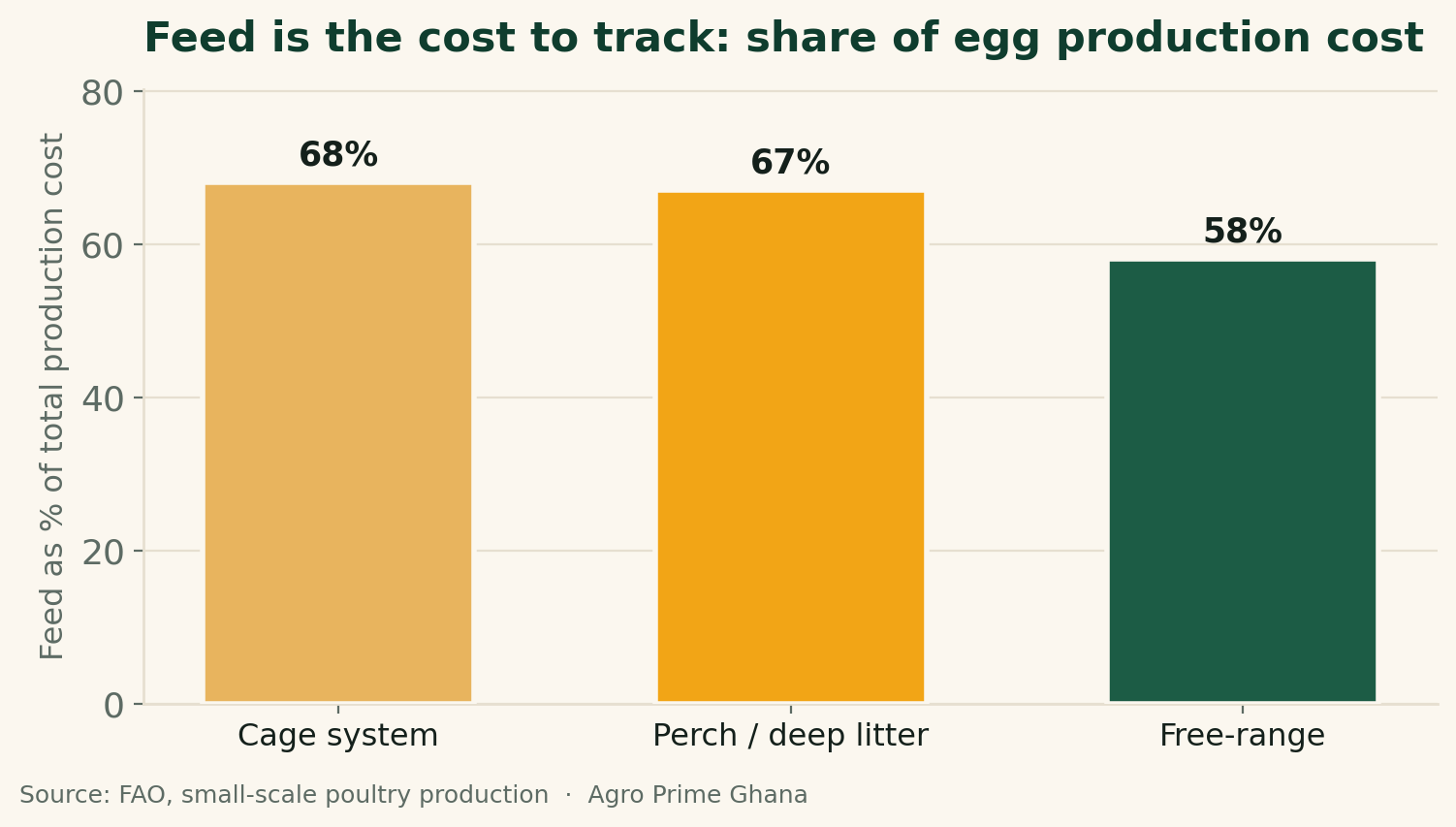
Records are not paperwork for its own sake — they are how you find hidden money. Feed alone is the biggest cost on any poultry farm, running at roughly 58–68% of the cost of producing eggs, so tracking feed and the birds it grows is where record-keeping pays first. A Ghana study of small-scale poultry farmers found that while most kept some production and financial notes, many believed the records were not useful to them — a habit that quietly caps profit. Keep six simple registers: production, mortality, feed, health/vaccination, finance and sales. Ghanaian layer producers have been measured at only about 54% profit efficiency, meaning the average farm leaves nearly half its potential profit on the table — much of it invisible without records. You do not need software: a ruled exercise book, filled in daily, is enough to change how a farm is run.
What "record-keeping" actually means on a poultry farm
Farm record-keeping is simply the habit of writing down what happens on the farm, day by day, in a way you can add up and compare later. It is not formal accounting, and it does not require a computer. At its core it is a set of small registers — a page for birds, a page for feed, a page for money — that between them answer three questions any serious farmer should be able to answer at any time: how are the birds performing, what is it costing me, and am I making money? The goal is not to write beautifully but to capture the handful of numbers that actually drive the business: birds in and out, deaths, feed used, eggs collected, money spent and money received. The discipline that matters is consistency — a number written down every day is worth far more than a perfect spreadsheet built once and abandoned. On our own farm the register lives on a nail by the feed store, not in a drawer, precisely because a record you have to go and find is a record that never gets filled in.
Why records matter so much in Ghana
The case for records is really a case about margins. Poultry in Ghana is a thin-margin business dominated by one enormous cost: feed. FAO figures for layer systems put feed at roughly 58 to 68% of the total cost of producing eggs, and broiler economics are similar. When a single input is two-thirds of your spending, small changes in how efficiently birds convert that feed into meat or eggs decide whether you profit or lose — and you cannot manage feed efficiency you are not measuring. The scale of what is being left behind is striking: a study of profit efficiency among Ghanaian layer producers found the average farm was only about 54% profit efficient, carrying a profit gap of roughly 46%. In plain terms, the typical farm could nearly double its profit with better management — and management starts with knowing your own numbers.
Yet the habit is weak. When researchers assessed record-keeping behaviour among small-scale poultry farmers in the Ga East Municipality, they found that although most farmers kept at least basic production and financial notes, a majority believed those records were not beneficial to them — and record-keeping did not depend on the farmer's age, education, experience, flock size or membership of any association. The lesson is uncomfortable but useful: keeping a few scraps is common, but using records as a management tool is rare, and that gap is exactly where the profit hides. A farm that writes down its feed use and its mortality, then actually reads those numbers back, is doing something most of its neighbours are not.
The six records every poultry farm should keep
You do not need dozens of forms. Six registers cover almost everything a small or medium Ghanaian farm needs, and each one answers a specific question. The table below is the backbone of a working record system — start here, and add detail only once these are running smoothly.
| Record | What to write down | What it tells you |
|---|---|---|
| Flock / production | Batch date, breed, number of chicks in, daily eggs collected or weekly body weights, age | Whether birds are growing or laying to target for their age and breed |
| Mortality & culls | Date, number dead or culled, suspected cause, house/pen | Early warning of disease; your true survival rate at sale |
| Feed | Date, feed type (starter/grower/layer), bags or kg used per day, price paid | Feed conversion and your single biggest cost, bird by bird |
| Health & vaccination | Date, vaccine or medicine, dose, age given, next due date, who administered | Proof of your programme; what to repeat, what to change |
| Finance (expenses) | Date, item, quantity, amount paid, supplier | Total cost per batch and per bird; where money leaks |
| Sales & income | Date, what sold (birds/eggs/manure), quantity, unit price, buyer | Revenue, best customers and your real profit per cycle |
Production records: are the birds doing their job?
The production register is where you catch problems while they are still cheap to fix. For broilers, that means weighing a sample of birds each week — twenty or so, the same day each week — and comparing the average against the breed's target weight for that age; a flock that drifts below target is telling you something is wrong with feed, health or heat long before it shows up in your sales figures. For layers, the key number is the daily egg count, ideally expressed as a laying percentage (eggs collected divided by hens present). A healthy commercial flock at peak should be laying well above 80%, and a sudden dip is one of the earliest, clearest signals a farmer can have — of disease, a feed problem, heat stress or simply hens ageing out. None of this is visible from memory; it only exists if someone writes the count on the pad every evening. Pair the production record with the breed's own performance targets — our guide to the best chicken breeds in Ghana covers what to expect from the common commercial strains, so you have a yardstick to measure against.
Field note: the daily egg count is your cheapest disease test
On the farm, the register we guard most jealously is the layer egg count, because it warns us before the birds look sick. A flock that quietly slips from, say, 88% to 80% over three or four days — with no dead birds and nothing obvious in the house — has almost always got a problem brewing: a water line issue, a bad feed batch, a draught, or the first stirrings of disease. Without the daily figure written down you feel that drop weeks later, as a vague sense that "the eggs are down." With it, you catch it on day two and go looking. The count takes thirty seconds and has paid for itself more times than any medicine.
Feed records: watching your biggest expense
If you only kept one record, it should be feed, because feed is where the money is. A proper feed register notes what type of feed went out each day and how much — in bags or, better, kilograms — so that at the end of a batch you can do the single most important calculation in poultry: feed conversion. For broilers that is kilograms of feed eaten divided by kilograms of live bird produced; for layers it is feed per dozen eggs or per kilogram of egg. These ratios are the honest scorecard of your farm's efficiency, and they let you compare one batch to the next, one feed supplier to another, or home-mixed feed against a commercial brand. Tie the feed record to price and you can see, in cedis, what a point of feed conversion is worth to you — which is exactly the number you need before deciding whether it is worth mixing your own ration. Our guides to broiler feeding and layer feeding set out the target intakes by age, so your feed record has something concrete to be measured against rather than just a running total of bags bought.
Mortality and health records: your disease early-warning system
A mortality register is not morbid bookkeeping — it is surveillance. Writing down every death with a date and a suspected cause turns a scatter of individual losses into a pattern you can read. Two or three deaths a week in a big flock is background noise; the same number jumping to fifteen over two days, all in one house, is an outbreak announcing itself — and the farmer recording daily sees the spike at once while the one relying on memory only notices when losses are severe. Paired with this, a health and vaccination record is essential: the date, product, dose and age for every vaccine and treatment, plus the next due date. In a country where Newcastle disease and other viral threats are ever-present, being able to prove exactly when a flock was last vaccinated, and against what, is the difference between a rational response to a scare and a panicked guess. These records also protect you commercially: a buyer or a bank that can see a clean, documented health history is dealing with a serious operation, not a gamble.
Financial records: knowing if you actually made money
This is the record most farmers skip and most regret skipping. A simple two-column habit — money out and money in — answers the question that matters: did this batch make a profit, and how much per bird? On the expense side, capture everything: chicks, each feed purchase, drugs and vaccines, litter, brooding fuel, electricity, water, labour, transport and repairs. On the income side, record every sale of birds, eggs, spent hens and even manure, with quantity, price and buyer. At the end of a cycle you subtract one from the other and, crucially, divide by the number of birds to get profit per bird — the figure that lets you compare batches honestly regardless of flock size. Do this for a few cycles and uncomfortable truths surface: perhaps the "cheap" feed actually cost more per kilo of bird, or a buyer who always negotiates hard is quietly your least profitable customer. Well-kept financial records are also what let a farm attack its own costs intelligently — for instance deciding whether to mix your own feed — because you can only cut what you can see.
Field note: separate the farm's money from your own
One habit does more for a small farm's finances than any spreadsheet: keep the farm's money apart from the household's. When feed money, sale money and family spending all flow through the same pocket, the farm looks profitable right up until there is nothing left to buy the next bag of feed, and no record can untangle it afterwards. On serious small farms we see, the owner runs the poultry as its own little business — its own cash box or mobile money line, its own record of what it takes in and pays out. It feels bureaucratic at first, but it is the difference between a farm that funds its own next cycle and one that constantly needs rescuing from the family purse.
Simple templates you can start using today
You do not need to buy anything special. A ruled exercise book, divided into sections, runs a farm perfectly well — and many of the best-run small farms in Ghana use exactly that. Set it up like this:
- Daily flock page: columns for date, age (days/weeks), birds alive at start, deaths today, culls, and — for layers — eggs collected and laying %. One line per day.
- Feed page: date, feed type, bags/kg issued, and a running total. Note the price each time you buy so cost is captured automatically.
- Health page: date, product, dose, age, next-due date, and who administered it. Leave a wide "notes" column for anything unusual.
- Money page: two facing columns — expenses on the left (date, item, amount, supplier), income on the right (date, item, quantity, price, buyer).
- Batch summary page: filled in once, at the end of each cycle — chicks in, birds sold, total mortality %, total feed used, feed conversion, total cost, total income, profit, and profit per bird.
If you are comfortable with a phone, a basic spreadsheet or even a free farm-record app adds up the columns for you and makes trends easy to see — but the paper book comes first, because the tool that gets used beats the tool that is clever. Whatever the format, the golden rule is the same: fill it in daily, at the same time, before you leave the house. Records written at the moment are accurate; records reconstructed from memory a week later are fiction.
Turning records into decisions
Writing numbers down is only half the job; the payoff comes from reading them back. Set aside a few minutes at the end of every batch to do the summary and compare it with the last one. Did feed conversion improve or slip? Did mortality creep up, and from what age? Was profit per bird higher or lower, and why? Over three or four cycles these comparisons reveal the levers that matter on your farm — the supplier whose chicks always start slow, the season when heat pushes feed conversion out, the age at which broilers stop converting efficiently enough to be worth holding. It is also how you make the big decisions rationally: whether to expand, or whether that new feed is really cheaper once you account for how the birds performed on it. Records turn each batch into a lesson instead of just an outcome, and a farm that learns from every cycle pulls steadily ahead of one that starts each batch from scratch.
The bottom line on record-keeping
Record-keeping is the least glamorous and most profitable habit in poultry farming. It costs a notebook and a few minutes a day, and it repays that with something no amount of hard work can otherwise buy: the ability to see your own farm clearly — to know your feed conversion, your true mortality, your cost and profit per bird, and which decisions actually worked. In a business where feed swallows two-thirds of every cedi and the average farm leaves nearly half its potential profit unclaimed, that clarity is not a luxury; it is the single cheapest route to a better margin. Start small: one exercise book, six pages, filled in every evening. Within a few batches you will wonder how you ever ran the farm without it — and you will have the numbers to prove it was worth it.
Frequently asked questions
What records should a small poultry farmer keep?
Do I need a computer or software to keep farm records?
Why is record-keeping important in poultry farming?
What is the most important single record to keep?
How often should I update my farm records?
How do records help me make more money?
What is feed conversion and how do I calculate it from records?
Should I keep the farm's money separate from household money?
Sources & further reading
- Tham-Agyekum, Appiah & Nimoh — Assessing Farm Record Keeping Behaviour among Small-Scale Poultry Farmers in the Ga East Municipality, Journal of Agricultural Science (record-keeping behaviour and attitudes in Ghana).
- FAO — Small-scale poultry production (feed as a share of production cost, layer output and economics).
- Ntim Adjei-Mensah et al. — Profit efficiency of layer production in Ghana (measured profit efficiency and the profit gap on Ghanaian farms).
- Agro Prime Ghana guides: broiler feeding, layer feeding, making poultry feed, and best chicken breeds in Ghana.
About Agro Prime Ghana
Agro Prime Ghana Limited runs a poultry hatchery and mixed agribusiness in Kasoa, supplying day-old chicks and working alongside poultry keepers across the country. These guides draw on that hands-on hatchery and farm experience, combined with current agricultural references. This article is general educational information, not a substitute for professional agronomic or business advice tailored to your farm. Need chicks, feed advice or farm support? Book a visit or message us on WhatsApp (+233 24 915 1503).