Most poultry farms in Ghana do not fail because the farmer cannot raise chickens. They fail because the money runs out before the birds start paying — the feed bill lands every week from the day the chicks arrive, while the first real income is months away, and somewhere in that gap the cash simply dries up. Financing a poultry farm is not just about finding a lump sum to start; it is about surviving the long, hungry weeks in between, when a growing flock eats money and returns none. Get the money side wrong and even a well-run farm stalls. This guide walks through the real options for financing a poultry venture in Ghana — savings, susu, loans, investors — and, just as important, the cash-flow reality that decides whether any of them works.
Written by the Agro Prime Ghana poultry team, drawing on Bank of Ghana interest-rate data and reporting on agricultural finance schemes including the Agricultural Development Bank's poultry programme and GIRSAL. Last updated September 2026.
Key takeaways
Poultry is a cash-flow business before it is a profit business: feed is the great majority of your running cost and it starts the day chicks arrive, while broilers take 6–8 weeks to return money and layers take five to six months before they lay a sellable egg. Borrowing is expensive — commercial farm loans have long run well above 20% a year, tracking a Bank of Ghana policy rate that hit 30% in 2023 and had eased to 18% by late 2025. Cheaper, targeted schemes exist: the Agricultural Development Bank's poultry programme offered funds at below 10%, backed by risk-sharing guarantees (GIRSAL) that absorb most of the lender's risk. The safe path for most keepers is to start small on savings and susu, prove you can run a batch profitably, reinvest, and take on debt or investors only once you have a track record — always with enough working capital to feed the flock through to the first sale.
The cash-flow reality: how long your money is tied up
The classic error is to treat the start-up cost as the whole cost — to count the pen, chicks and equipment, buy a bag or two of feed, and reckon the venture funded. Then the birds eat, and keep eating, and the feed bill recurs every week with no income to meet it. Feed is by far the largest cost in poultry, and it is a running cost: the money you need is not just the money to start but the money to keep going until the birds pay, which finance people call working capital.
Different poultry enterprises tie up cash for very different lengths of time, which should drive how you finance each. Broilers are the quickest turn: a batch reaches market weight in roughly six to eight weeks, so your money is locked up about two months before a sale — fast enough that a farmer with modest working capital can run batches and recycle the proceeds, which is why broilers suit self-financing. Layers are the long game: a pullet does not come into lay until around five to six months of age — that long a stretch of buying feed, vaccines and labour with no income at all, followed by a laying life of a year or more. That income-free rearing period is exactly where under-financed layer projects collapse, while cockerels and free-range birds sit in between, grown for months for the festive and traditional market.
The lesson is direct. A broiler batch can often run on savings, susu or short supplier credit, because the cash comes back quickly. A layer project needs far more patient money up front — enough to feed birds through five or six months of pure outflow before the first egg — so it is the enterprise most likely to need a loan or investor, structured so repayments begin only once the birds are laying. Match the money to the cycle: short cash for short cycles, patient capital for long ones.
The cost of money in Ghana right now
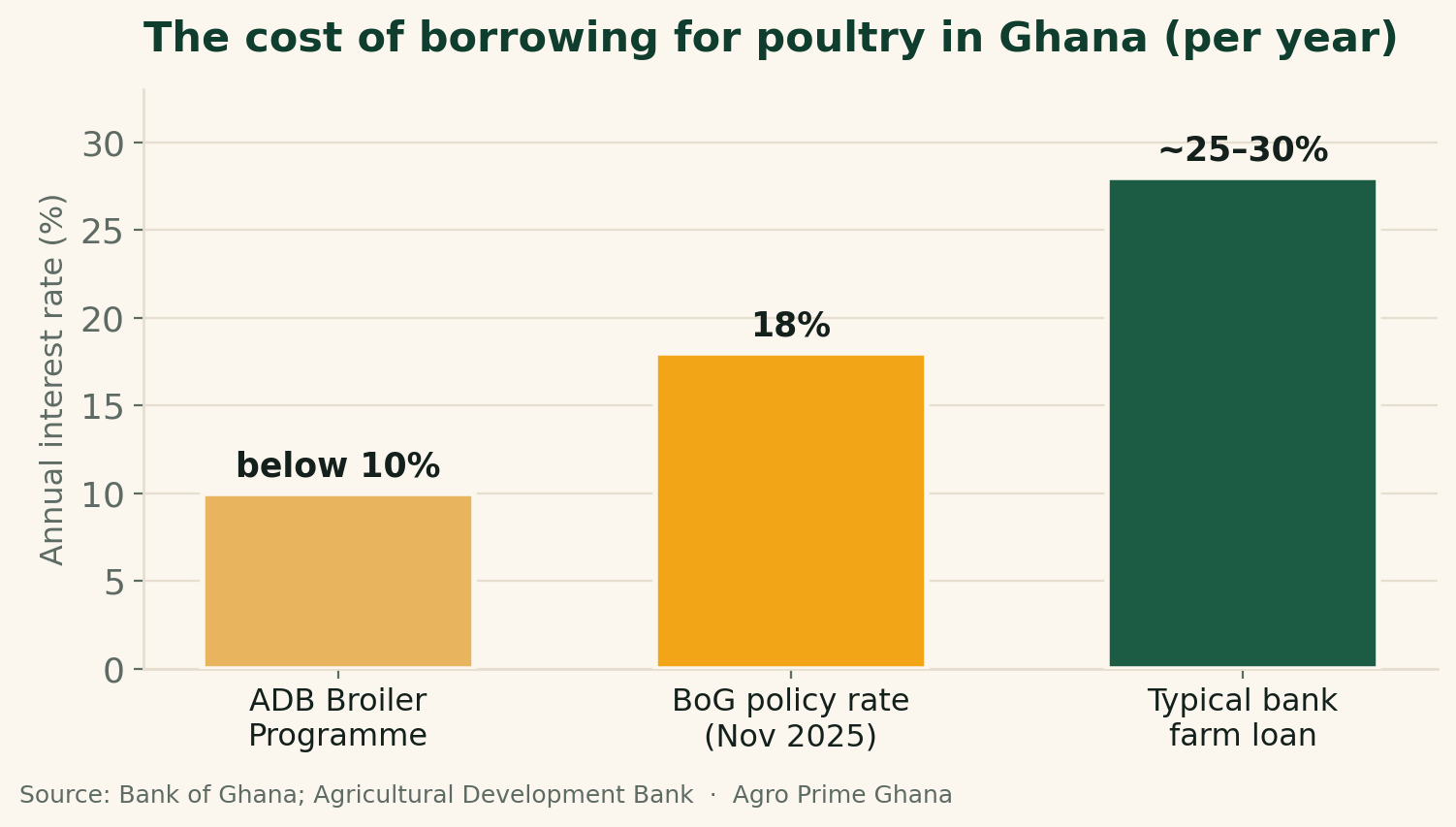
Borrowing in Ghana is not cheap. Commercial lending rates track the Bank of Ghana policy rate, which the central bank's published trends show peaked at 30% in 2023 and had eased to 18% by late 2025. Actual loan rates to a small farm sit well above that — the Agricultural Development Bank itself contrasts its cheaper poultry funding with "traditional loans exceeding 20 per cent." At those rates debt is a heavy load on poultry's thin margins — reason enough to lean first on your own money.
There is a hopeful side, though: rates have been falling from their crisis peak, and targeted, subsidised windows sit well below the commercial rate — the Agricultural Development Bank's poultry programme and MoFA's interest-rate subsidy for agribusinesses among them. Those windows are competitive and usually aimed at established operators, which brings us to who can actually get what.
Your financing options, compared
There is no single "right" way to finance a poultry farm — the sensible answer is usually a blend that fits your stage and appetite for risk. The table lays out the main sources with their real drawbacks.
| Source | Cost / catch | Best for |
|---|---|---|
| Own savings | No interest, no repayment pressure; limited by what you have | Starting small; broiler batches; the safest first step |
| Susu (daily/weekly collection) | Your own money saved with discipline; a collector fee, some default risk on the collector | Building a start-up lump sum; smoothing feed purchases |
| Family / partners | Flexible, often interest-free; risks personal relationships if it goes wrong | Top-up capital; sharing risk on a first venture |
| Rural / community bank or microfinance | More accessible than big banks, but interest is high; smaller sums | Small working-capital loans once you have a record |
| Commercial / agric bank loan | Larger sums, but rates well above 20% and collateral usually required | Established farms; layer projects; expansion |
| Targeted schemes (ADB, GIRSAL-backed, MoFA) | Below-market rates, but competitive and often for experienced operators | Scaling an existing, proven poultry business |
| Outside investor | No fixed repayment, but you share profit and control | Bigger builds where you bring skill and they bring capital |
| Supplier / input credit | Short-term feed or chick credit; convenient but can carry a hidden premium | Bridging one cycle — used carefully, not as a habit |
Start with your own money — and susu
For most people starting in poultry, the wisest capital is money they already control: savings, topped up through susu. Susu — the tradition of setting aside a fixed amount daily or weekly with a collector or group — is not a loan; it is forced savings discipline, and one of the most reliable ways ordinary farmers assemble a start-up lump sum without paying interest. It turns small, regular income into a usable block of capital and builds the saving habit a farm lives or dies by. Just use a trustworthy collector or a registered institution, since susu depends entirely on the honesty of whoever holds the money.
Starting on your own money does more than avoid interest — it forces you to start small and learn cheap. A first batch of a few hundred broilers run on savings teaches you your real feed conversion, mortality, market and margins for a fraction of the cost of learning those lessons on a large, borrowed flock. Get chick quality right from the start (our guide to choosing healthy day-old chicks matters, since weak chicks waste capital) and feed them well (see the broiler feeding guide), then reinvest the profit into a slightly bigger next batch. It is slower than borrowing, but it is how a large share of Ghana's durable poultry farms were built, and it never puts the whole venture at the mercy of a repayment schedule.
Field note: the batch that feeds the next batch
The healthiest small farms we see are not the ones that started biggest — they are the ones that started small, kept careful records of what each batch cost and earned, and let each successful batch fund a larger one. The farmer growing off retained profit owes nobody and knows their numbers cold by the time they scale — so when they finally take a loan, they borrow from strength, not hope.
Borrowing wisely: when a loan makes sense
Debt is a tool, not a sin — but in a 20–30% interest environment it is a sharp one. A loan makes most sense when you have a proven track record, a clear use for the money that will earn a return above the interest (expanding a working system, funding a layer flock's long rearing, buying feed in bulk), and a repayment plan matched to your cash flow — timed to when birds sell, not a rigid monthly schedule that falls due while the flock is still eating. Borrowing to start a farm you have never run, at commercial rates, is how farmers end up owing money on a venture that never found its feet.
Where you borrow matters as much as whether you borrow. Rural and community banks and microfinance are more accessible to a small farmer than the big banks, though their rates are high and sums modest; commercial and agricultural banks lend larger amounts but want collateral and a track record. The bright spots are the targeted, risk-shared schemes: the ADB poultry facility priced below 10%, and the guarantees from GIRSAL (the Ghana Incentive-Based Risk-Sharing System for Agricultural Lending), which the ADB reports absorb more than 75% of the lender's risk on poultry lending. Where you qualify, those guarantees can turn a "no" into a "yes" at a far better rate — but they usually target existing businesses with sector experience, one more reason to build a track record first.
Investors and partners: capital for a share
An alternative to debt is equity — bringing in someone who provides capital for a share of the profit rather than a fixed repayment. For a farmer with skill and land but not enough cash, a partner can fund a bigger build than savings allow, and because they share ownership rather than lend, there is no monthly repayment falling due while the flock is still growing — their return comes when the farm earns, which shares the risk. The trade-off is that you give up a slice of profit permanently, and often some control, so you must trust the person and pin the terms down in writing: who puts in what, how profit is split, and what happens if one side wants out. Vagueness is what turns a generous handshake into a bitter dispute when a batch dies — so keep it formal, and a good partner brings not just money but a second head and a shared incentive to make the farm work.
Field note: keep the working capital sacred
Whatever mix of money you use, the discipline that separates farms that last from farms that stall is protecting the working capital — the money reserved to feed the flock through to sale. When cash is tight it is tempting to dip into the feed money, telling yourself you will replace it from the coming sale. That is exactly how a flock ends up on short rations three weeks before market, losing the growth that was going to pay everyone back. We treat the feed-to-sale money as untouchable — not profit and not spending money until the birds are sold.
The bottom line on financing a poultry farm
Financing poultry in Ghana is about respecting time: the months your money is tied up in a flock that eats before it earns. Feed is the majority of the cost and starts on day one, broilers pay back in six to eight weeks and layers in five to six months, and borrowed money is expensive — commercial rates well above 20%, against a policy rate that only recently eased from 30% to 18%. The winning approach is to start on savings and susu, start small, learn your numbers, reinvest profit, and bring in debt or an investor only once you have a proven system and a repayment plan matched to when the birds actually pay. Do that, fund the whole cycle rather than just the start, and the money side stops quietly killing good farms.
Frequently asked questions
How much money do I need to start a poultry farm in Ghana?
Should I take a bank loan to start?
What is susu and can it fund a poultry farm?
Why does financing layers cost more than broilers?
Are there cheaper loans for poultry farmers in Ghana?
What is working capital and why does it matter so much?
Is bringing in an investor better than a loan?
How do I grow a poultry farm without heavy borrowing?
Sources & further reading
- Bank of Ghana — Policy Rate Trends (monetary policy rate history, including the 2023 peak and the easing to 18% in late 2025 that commercial lending rates track).
- Agricultural Development Bank — ADB Revives Poultry Industry with GH¢500m Loan Package (below-10% poultry funding, loan sizes, and GIRSAL/OVCF risk-sharing that absorbs most of the lender's risk).
- Agro Prime Ghana guides: broiler feeding guide and how to choose healthy day-old chicks.
About Agro Prime Ghana
Agro Prime Ghana Limited runs a poultry hatchery and mixed agribusiness in Kasoa, supplying day-old chicks and working alongside poultry keepers across the country. These guides draw on that hands-on hatchery and farm experience and on published financial data. This article is general educational and business information, not financial, investment or lending advice — interest rates and scheme terms change, so confirm current details with the relevant bank or institution before you commit. Planning a poultry venture and need chicks or practical advice? Book a visit or message us on WhatsApp (+233 24 915 1503).