Every year, plenty of Ghanaians pour their savings into poultry because they have heard it is profitable — and a painful number of them lose that money in the first flock. Not because poultry is a bad business, but because they started with birds instead of starting with a plan: no market lined up, housing built wrong, feed budget underestimated, chicks bought before anyone knew how to brood them. Poultry in Ghana is a genuinely good business — the country imports well over a hundred thousand tonnes of chicken a year that local farmers could be supplying — but it rewards preparation and punishes improvisation. This guide walks through how to actually start a poultry farm here: the decisions to make first, what capital you really need, and the order to do things in so your first flock teaches you rather than ruins you.
Written by the Agro Prime Ghana poultry team and reviewed against current references (Ghana's Ministry of Food and Agriculture and FAO poultry guidance). Last updated September 2026.
Key takeaways
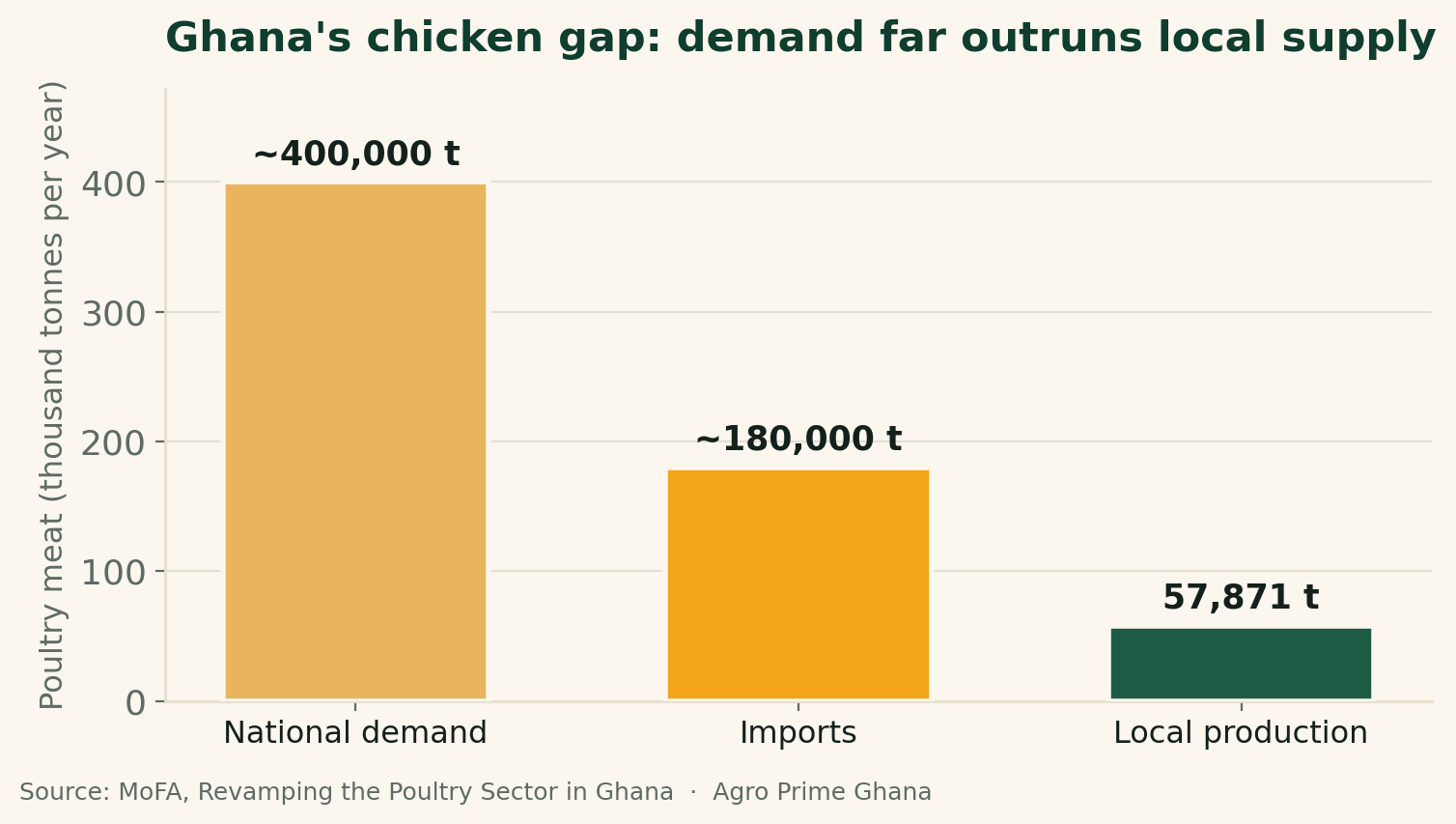
Ghana has a large, real market for local poultry: national poultry-meat demand runs around 400,000 tonnes a year against local production of only about 57,871 tonnes, with roughly 180,000 tonnes imported — so demand hugely outruns local supply. The business is winnable but unforgiving of poor planning. Start with the market and the money, not the birds: decide broilers (fast, ~6–8 weeks to sale) versus layers (slow to income, longer payback); start small (a few hundred birds) to learn; budget honestly, remembering that feed is roughly 60–70% of running cost; get housing, biosecurity and a brooding setup right before chicks arrive; and buy quality day-old chicks from a reliable hatchery. Do the boring preparation first and poultry pays. Skip it and the first flock usually eats the capital.
The opportunity — and why most beginners still fail
The market case is strong and easy to state. According to the Ministry of Food and Agriculture, national demand for poultry meat is on the order of 400,000 tonnes a year, while local production sits at just 57,871 tonnes and the country imports roughly 180,000 tonnes — with broiler meat making up over 80% of total meat imports and Ghana spending more than USD 375 million a year on meat imports overall. That gap between what Ghanaians eat and what Ghanaian farms produce is the opportunity: real, unmet demand for locally raised chicken and eggs. Livestock also accounts for about 14% of agricultural GDP. So why do so many beginners lose money? Almost never because they could not sell — almost always because of avoidable mistakes on the production side: underestimating feed costs over a full cycle, building housing that cooks or chills the birds, skipping biosecurity until disease arrives, brooding chicks badly in the first fragile weeks, or scaling to thousands of birds before mastering a few hundred. Poultry is not a get-rich-quick venture; it is a management business with thin margins and unforgiving biology, and the farmers who succeed treat it that way from day one.
Decision one: what are you actually producing?
Before anything else, decide what you are raising, because everything downstream — housing, feed, cash flow, market — flows from it. The two main paths for a beginner are almost opposite businesses. Broilers (meat birds) are fast: a broiler reaches market weight in roughly six to eight weeks, so money turns over quickly, several cycles a year — but margins per bird are tight and you must have a market ready every cycle, because a broiler held past its sell weight just eats into profit. Layers (egg birds) are the opposite — a slow, patient business. A pullet does not start laying until around 18–20 weeks, so you feed her for months before a single egg is sold, and the real payback comes over a long laying period of a year or more. Layers demand more capital and patience up front but give steadier daily income once producing. A common, sensible route is to start with a modest broiler batch to learn brooding, feeding and biosecurity on a short cycle, then move into layers once you have the skills and cash flow. Whichever you choose, our guides to broiler vs layer profit and the best chicken breeds for Ghana go deeper.
Decision two: start small, on purpose
The most valuable advice for a first-time poultry farmer is also the hardest to accept: start small. It is tempting to borrow big and put up two thousand birds because "that's where the money is," but a first flock is really a training course, and it is far cheaper to learn on a few hundred birds than a few thousand. With a small starter flock, a beginner's inevitable early mistakes cost hundreds of cedis, not a life's savings. You learn the rhythm of the work — feeding and watering, reading the flock's behaviour, spotting the first sign of illness, managing litter and ventilation, and actually selling the output and getting paid — and you discover your true costs and market before you scale. Farmers who begin small and grow from retained profit and hard-won experience tend to last; those who begin big on borrowed money often do not survive the first serious mistake. Scale is a reward you earn once the system works, not a starting condition.
Decision three: budget honestly — especially the feed
More poultry ventures die of underfunding than of anything else, usually because beginners budget for the chicks and the housing but badly underestimate the feed. Across a full cycle, feed is the largest single cost by far — commonly around 60–70% of the total cost of raising the birds. The money you spend after the chicks arrive dwarfs the money you spend buying them, and it must be available week after week until the birds are sold or laying. A budget that covers chicks and a shed but runs dry on feed in week four is a disaster in slow motion: half-grown broilers that stop gaining, or pullets that never come into proper lay. Build your budget around the whole cycle and the main cost buckets:
- Housing and equipment — the shed, feeders, drinkers, brooding heat source and basic biosecurity setup. A one-off cost where good design pays off for years.
- Day-old chicks — quality stock from a reliable hatchery; a modest share of total cost, but the foundation everything rests on.
- Feed — the dominant, recurring cost across the whole cycle. Budget generously and never let it run out.
- Health — vaccines, a basic medicine kit, and access to veterinary advice.
- Working capital and a buffer — for water, power, litter, labour and the unexpected, so a delay in sales does not sink you.
Because feed dominates, managing it well is the single biggest lever on profit — our guides to reducing poultry feed cost and making your own poultry feed are worth reading before you commit.
| Factor | Broilers (meat) | Layers (eggs) |
|---|---|---|
| Time to income | Fast — market in ~6–8 weeks | Slow — no eggs until ~18–20 weeks |
| Capital before first sale | Lower; short feed period per cycle | Higher; months of feed before eggs |
| Cash-flow pattern | Lump sums, several cycles a year | Steady daily income once laying |
| Main risk | No ready market at sell weight | Long wait; disease/loss before lay |
| Good for a beginner? | Yes — short cycle to learn on | Yes, but needs patience and more capital |
Getting the site and housing right
Housing is where beginners make expensive, permanent mistakes, because a badly designed shed handicaps every flock you ever raise in it. In Ghana's climate the enemy is usually heat, so the priority is a cool, well-ventilated, dry house — not a sealed box. Site the farm on well-drained ground, a little away from dense housing (to reduce disease pressure and keep the peace over smell and noise), with reliable access to clean water and a road you can get feed in and birds out on. Build for airflow and shade: an open-sided design with wire mesh and generous overhangs, the long axis positioned to catch breeze and dodge the worst afternoon sun, and a roof high enough to let heat rise away from the birds. Get ventilation right and you prevent a long list of problems at once — heat stress, damp litter, ammonia build-up and the respiratory disease that follows. Our guides to poultry house ventilation and heat stress in poultry are worth studying before you build, because retrofitting a bad house costs far more than designing a good one.
Field note: build the house for the hottest afternoon, not the average day
The most common building mistake we see from new farmers is housing designed for how it feels the day they put it up, not for a still, hot afternoon in the dry season when the birds are near market weight and generating their own heat. That is the moment a poorly ventilated house kills. When you plan a shed, picture the worst-case day: full stocking, no breeze, blazing sun — and design the airflow, shade and roof height so the birds stay comfortable then. Open sides, a high roof and good overhangs cost a little more up front and repay it in every flock that does not lose birds to heat. It is always cheaper to build cool than to cool a hot house later.
Biosecurity from day one, not after the first outbreak
Nothing wipes out a beginner's flock — and capital — faster than disease, and the farmers who avoid it build biosecurity in from the start rather than bolting it on after a Newcastle outbreak has already emptied the shed. Biosecurity is simply keeping disease out and, if it gets in, keeping it from spreading. The core habits are cheap and boring, which is exactly why beginners skip them and later regret it: control who and what enters the farm (visitors, vehicles, borrowed equipment and wild birds all carry disease); use a footbath and clean footwear; do not casually mix birds of different ages or sources; source chicks only from reputable hatcheries; quarantine new or returning birds; keep feed and water clean and rodent-proof; dispose of dead birds properly; and clean, disinfect and rest houses between batches. On top of hygiene sits vaccination: protecting against Newcastle disease in particular is essential in Ghana, and a proper vaccination schedule should be planned with veterinary or extension advice before the chicks arrive. Our full poultry biosecurity guide lays out the routine. Treat biosecurity as the cheapest insurance you will ever buy, because the alternative — a dead flock — is the most expensive lesson in the business.
Buying chicks and getting the first weeks right
Your flock can only be as good as the chicks you start with, so buy day-old chicks from a reliable hatchery rather than the cheapest source — weak, poorly hatched or disease-carrying chicks doom a flock before it begins. Know what a good chick looks like: alert, active, well-dried and fluffy, standing firmly, clean and healed at the navel, with no deformities (our guide to choosing healthy day-old chicks walks through the checks). Then be ready for the most fragile and important period of the whole cycle: brooding, the first few weeks when chicks cannot yet regulate their own body temperature and depend entirely on you for warmth. Have the brooder set up and warm before the chicks arrive — day-old chicks need a brooding temperature around 32–35°C in the first days, reduced gradually as they feather up. Get brooding wrong — too cold and they pile and chill, too hot and they pant and dehydrate — and you carry losses through to sale. Get it right, with clean water, correct starter feed and a calm environment, and you set the flock up to thrive. Our brooder temperature chart gives the week-by-week targets to have on the wall before the box of chicks is even opened.
Field note: everything ready before the chicks, not after
The habit that separates smooth first flocks from stressful ones is simple: nothing about the chicks' arrival should be improvised. Before the day-olds come, the house is cleaned, disinfected and rested, the brooder is running and at temperature, clean water is down, starter feed is on hand, and the vaccination plan is written and its first steps arranged. Chicks that step out of the box into a warm, clean, ready environment get off to the start that carries them all the way to sale; chicks that arrive to a farmer still rigging up a heat source start life behind and rarely fully catch up. Preparation is not fuss — with young poultry it is most of the job.
Records, market and the discipline that makes it pay
Two unglamorous habits quietly separate the poultry farms that make money from the ones that merely stay busy. The first is record-keeping. If you do not write down what you spend on chicks, feed, drugs and labour, and what you earn from sales, you are not running a business — you are guessing, and poultry's margins are too thin to guess with. Simple records of costs, feed used, mortality, weights or egg numbers, and sales tell you whether you are making money, which flock did best and why, and where costs are leaking — see our guide to record keeping. The second is lining up your market before you have birds to sell. Know who will buy your broilers or eggs — households, market traders, restaurants, hotels, cold stores — and roughly what they will pay, before the flock is ready, so you sell into demand rather than hunting buyers while birds eat their profit in the shed. Build relationships with a few reliable buyers and deliver consistent quality on time, and the market gap the national figures describe becomes your steady customers. Combine honest records, a ready market and disciplined daily management, and poultry becomes what it can genuinely be: a solid, repeatable business.
The bottom line on starting a poultry farm in Ghana
Ghana's poultry gap is real — hundreds of thousands of tonnes of chicken imported each year that local farms could supply — and the business genuinely pays for those who run it well. But it rewards preparation and punishes improvisation, so start in the right order. Decide first whether you are raising fast-turnover broilers or slow-but-steady layers, and start small enough that your first flock is an affordable education. Budget for the whole cycle, respecting that feed is the great majority of your running cost and must never run out. Build a cool, well-ventilated house designed for the hottest afternoon; put biosecurity and vaccination in place from day one; buy quality chicks and have a warm brooder ready before they arrive; and keep records and a market so you know your numbers and can sell what you produce. Do the groundwork first, learn on a small flock, grow from experience and retained profit, and poultry in Ghana becomes not a gamble on getting rich quick but a durable enterprise you can build on.
Frequently asked questions
Is poultry farming profitable in Ghana?
Should a beginner start with broilers or layers?
How much money do I need to start a poultry farm?
Why is it so important to start small?
What is the biggest cost in poultry farming?
What kind of housing do I need in Ghana's climate?
What should I do before the chicks arrive?
How do I keep my flock from dying of disease?
Sources & further reading
- Ministry of Food and Agriculture (Ghana) — Revamping the Poultry Sector in Ghana (demand vs local production and imports, meat-import spend, livestock share of agricultural GDP).
- FAO — Poultry production and products (poultry husbandry, housing and management fundamentals).
- Agro Prime Ghana guides: broiler vs layer profit, best chicken breeds for Ghana, poultry biosecurity, poultry house ventilation, brooder temperature chart, choosing healthy day-old chicks, reducing poultry feed cost and record keeping.
About Agro Prime Ghana
Agro Prime Ghana Limited runs a poultry hatchery and mixed agribusiness in Kasoa, supplying day-old chicks and supporting new and established poultry keepers across the country. These guides combine hands-on hatchery and farm experience with current references. This article is general educational information, not a substitute for professional veterinary, agronomic or business advice tailored to your situation. Ready to start, or want quality chicks and support for your first flock? Book a visit or message us on WhatsApp (+233 24 915 1503).


