To sell table eggs in Ghana, match your egg to the buyer: sell farmgate and to neighbourhood shops for the best price per crate but small volumes, and to wholesalers, cold stores, hotels and restaurants for large, steady volumes at a slightly lower price. The farmer who plans this before the first hen lays — and who supplies clean, consistent, correctly sized eggs on a reliable schedule — earns far more than the one who simply carries crates to the market and takes whatever price the day offers. This guide walks through every channel open to a Ghanaian layer keeper, how to price by the crate, how to build buyers who come back week after week, and how to survive the seasons when eggs pile up and prices sag.
Written by the Agro Prime Ghana poultry team and reviewed against current industry references (FAO Egg Marketing guide and USDA/Ghana sector reporting). Last updated September 2026.
Key takeaways
A hen in a well-run Ghanaian flock lays roughly 230–250 eggs a year — about eight crates of 30 eggs each — so even a small 500-bird flock produces around 14 crates every single day that must find a buyer. The main channels are farmgate (highest price, low volume), neighbourhood shops and provision stores, wholesalers and egg dealers (large volume, lower price), cold stores, and hotels, restaurants and institutions (steady contracts if you are reliable). The money is not in chasing the highest spot price — it is in repeat buyers who take a fixed quantity every week because your eggs are always clean, well graded and delivered on time. Price by the crate, keep eggs fresh (they hold about 3–5 weeks when cool), and plan for seasonal gluts. Most Ghanaian layer farms sell the bulk of their eggs off-farm, into nearby towns and the Accra–Tema corridor.
How many eggs will you actually have to sell?
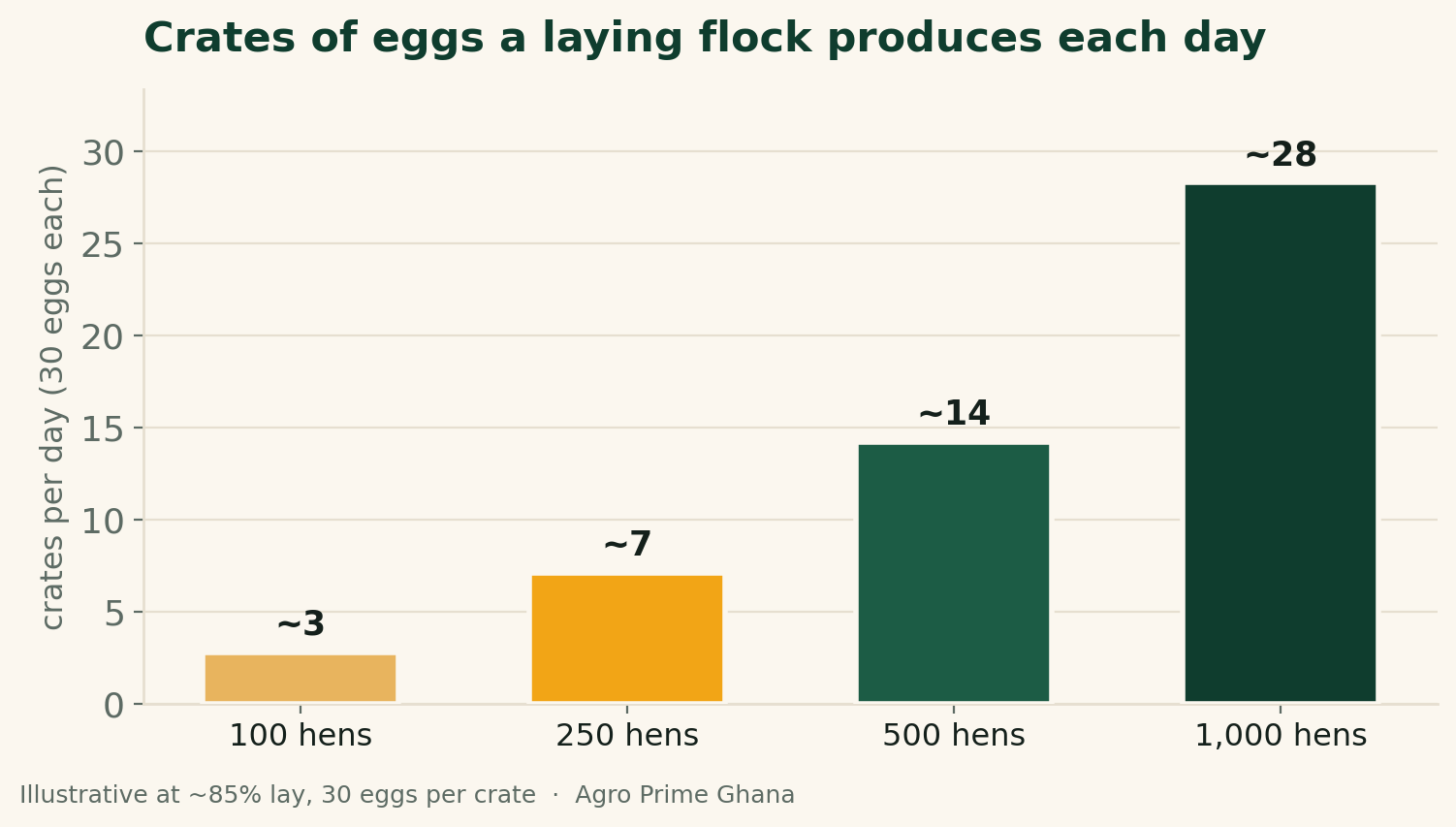
Before you think about buyers, understand the volume you are committing to move. A good commercial layer of the type reared in Ghana — Lohmann Brown, ISA Brown, Hy-Line and similar — comes into lay at around 18–20 weeks and, according to sector reporting summarised by The Poultry Site, produces on the order of 230 to 250 eggs per year. Divided by the 30 eggs in a standard Ghanaian crate, that is roughly eight crates per hen per year. It sounds modest until you multiply it across a flock. At peak lay a healthy flock is putting out something close to 85% of the birds' number in eggs every day — so 500 hens hand you about 14 crates daily, and 1,000 hens about 28 crates, day after day, whether or not you have a buyer lined up. Eggs are perishable and they do not wait. This is the single most important fact in table-egg marketing: production is relentless and daily, so your selling has to be organised and daily too. A farm that sells "when the crates pile up" is already losing money on freshness and on panic pricing.
What are the main channels for selling eggs in Ghana?
There is no single "egg market" — there is a chain of buyers, each wanting a different volume at a different price, and a smart farm sells into several at once. The FAO's egg marketing guide lays out the standard channels, and they map almost exactly onto how eggs move in Kasoa, Accra and the regional towns. Broadly, you can sell direct to the person who eats the egg, or through an intermediary who buys in bulk and resells. Direct sale earns more per crate but takes your time and reaches fewer buyers; bulk sale earns less per crate but clears large volumes in one transaction. Most successful farms do both — they hold back a portion for high-value direct customers and move the rest through dealers to keep the store empty and the eggs fresh.
| Channel | Typical volume | Price per crate | What it demands of you |
|---|---|---|---|
| Farmgate / on-farm | Small, irregular | Highest | Almost nothing — buyers come to you; eggs are freshest |
| Neighbourhood shops, provision stores, table-top sellers | Small–medium, steady | High | Regular small deliveries, clean well-graded eggs, some credit |
| Hotels, restaurants, chop bars, schools, hospitals | Medium, very steady | Medium–high | Reliability, consistent size, invoices, often a written agreement |
| Wholesalers / egg dealers / market queens | Large | Lowest | Bulk lots, one price, fast payment or agreed credit |
| Cold stores & supermarkets | Medium–large | Medium | Grading, packaging, food-safety standards, scheduled delivery |
Selling at the farmgate and door-to-door
The farmgate is the simplest and most profitable channel per crate, because the buyer comes to you and the eggs never travel or lose freshness. The FAO guide notes plainly that with farmgate sales "eggs will be fresh with little or no quality loss." In practice this means the neighbours, nearby chop bars, and small buyers who know your farm and come with their own money and containers. The limit is volume: a roadside farm in a busy area might clear several crates a day this way, but a farm down a back track will not. The related option is taking eggs to the buyer — door-to-door rounds, or a stall in a producers' or town market where, as FAO describes, eggs are "displayed in baskets and often differentiated by weight/size and colour." Both work best as a supplement, mopping up a portion of production at a good price, rather than as your whole plan. Treat every farmgate buyer as a potential repeat customer: a fair price, a clean crate and a friendly word turns a one-off caller into a weekly fixture.
Neighbourhood shops, provision stores and table-top sellers
The dense network of small shops, provision stores and table-top egg sellers is the backbone of Ghanaian egg retail, and supplying them directly cuts out a layer of middlemen. These buyers want small, frequent, reliable deliveries — a shop might take two or three crates twice a week — and they want them clean and consistent so their own customers keep coming back. This is a relationship business: the shopkeeper who can count on your Tuesday and Friday drop, always the same clean eggs, will not switch to a cheaper supplier who turns up late with dirty or cracked eggs half the time. Expect to extend some credit here, which is where discipline matters — keep written records of who owes what (our guide to record keeping on the poultry farm covers this), and do not let unpaid crates snowball. A ring of ten or fifteen loyal shops, each taking a few crates a week, is a more stable business than one big buyer who can drop you overnight.
Hotels, restaurants, institutions and the value of a contract
Hotels, restaurants, fast-food outlets, chop bars, schools, hospitals and canteens buy eggs in steady, predictable volumes — and they pay for reliability rather than the rock-bottom price. The FAO guide is explicit that selling to these institutions "need negotiation, written contracts, standard quality agreements, and consistent large-quantity supply." That sentence is the whole opportunity in a nutshell: an institution does not want to send someone to the market every morning, so if you can guarantee, say, ten crates every Monday and Thursday, correctly sized and clean, you become their supplier and the daily price stops mattering to both of you. This is the most attractive channel for a serious layer farm because it converts your relentless daily production into a predictable weekly order. Winning it takes professionalism: turn up on time, hold your quality steady, invoice properly, and never let them down at the last minute — the moment you fail a hotel twice, they replace you. Our companion guide on supplying eggs to shops and supermarkets goes deeper into grading, delivery schedules and contracts.
Field note: build a "spine" of steady buyers before you chase spot prices
The farms around us that sleep well at night are not the ones getting the very highest price on a good day — they are the ones who have locked in a spine of steady off-take. Before a flock even reaches peak lay, it is worth lining up two or three anchor buyers who will take a fixed number of crates every week: a wholesaler for bulk, a couple of institutions or a cold store for steady mid-volume, and a ring of shops for the retail margin. Once that spine takes 70–80% of your daily production off your hands automatically, the leftover crates are gravy — you can sell them farmgate at a premium and never feel forced to dump eggs cheap just to empty the store.
Wholesalers, egg dealers and market queens
Wholesalers and bulk egg dealers — including the market "queens" who control much of the retail egg trade — are how most large flocks move most of their eggs. As FAO describes, wholesalers "balance supply against retail demand" and typically have their own storage and transport; they buy large lots at one price and redistribute to retailers. The trade-off is straightforward: you get the lowest price per crate, but you clear huge volume in a single transaction and you do not have to chase a hundred small buyers. For a 1,000-bird flock producing 28 crates a day, a dependable wholesaler taking twenty crates every visit is what keeps the operation sane. The risk in this channel is price and payment: dealers buy at the market-clearing price, which sags when eggs are plentiful, and some will push for credit. Know your cost of production per crate so you never sell below it, agree payment terms in advance, and — as the research on the Kasoa poultry cluster found, where payment delays "after a week" on credit sales are common — do not let a big buyer turn into a big debtor.
Cold stores and supermarkets
Cold stores and supermarkets sit between retail and wholesale: they take medium-to-large, scheduled volumes and pay a fair mid-range price, but they demand more of you in return — proper grading, clean and sound packaging, consistent egg size, and delivery to a schedule. FAO lists supermarkets among the retail outlets that require eggs "of different sizes, colour and packaging" depending on the outlet. For a farm that has got its grading and hygiene right, this is a valuable, dignified channel that also builds your reputation. The main discipline it forces on you is consistency: a supermarket wants every crate to look like the last one, so you must sort your eggs by size and reject the dirty, cracked and misshapen ones rather than hiding them in the middle of the crate.
How do I price table eggs by the crate?
Egg pricing in Ghana revolves around the crate of 30 eggs, and the farmgate crate price is the anchor from which every other price is derived. Unlike frozen chicken, whose price swings wildly, egg prices tend to be comparatively stable — the Kasoa research noted that egg retail prices stay relatively steady even when meat prices lurch. Prices are driven overwhelmingly by feed cost, which is the largest single expense in egg production; when maize and soya jump, the crate price follows, and poultry farmer associations in Ghana periodically announce a revised recommended farmgate price for exactly this reason. Three rules keep your pricing sound:
- Know your cost per crate. Add up feed, pullet depreciation, labour, medication and overheads, and divide by the crates you produce. If you do not know this number you are flying blind — see reducing poultry feed cost and the layer profit picture.
- Price the channel, not just the egg. Charge the farmgate and shop buyer the top of the range for freshness and convenience; give the wholesaler a genuine bulk discount because they clear your volume. Both can be profitable.
- Size matters. Larger eggs command more, and pullet (small) eggs less, so grading by size lets you capture extra value instead of averaging everything into one price.
For a fuller treatment of margins along the chain and how the crate price is set, see our companion article on egg crate pricing and marketing.
How do I build buyers who come back every week?
Repeat buyers are the whole game, and they are won on three things: consistency, cleanliness and reliability. Consistency means every crate is graded and looks the same — a buyer who opens your crate and finds it uniform learns to trust you sight unseen. Cleanliness means eggs collected often, handled with clean hands, and kept out of the dirt; dirty and stained eggs cost you buyers and, if washed wrongly, can spoil faster. Reliability means you deliver the agreed quantity on the agreed day, every time, even when it is inconvenient — the supplier who never lets a chop bar down is the one who keeps the order for years. On top of these, small professional touches compound: keep the same collection and delivery rhythm, answer your phone, honour your prices, and quietly favour your loyal buyers when eggs are scarce. Good egg-handling practice — frequent collection, cool storage and careful transport — is covered in our guides to egg storage and handling and transporting eggs. Freshness is a selling point you can actually deliver: kept cool, table eggs hold their quality for roughly three to five weeks, so a farm that turns stock over quickly always has the freshest egg in the market.
Sell more with Agro Prime pullets — and a supply partner who knows the market
Reliable egg sales start with reliable eggs, and reliable eggs start with strong, healthy, well-reared birds. Agro Prime Ghana supplies point-of-lay (POL) pullets that are vaccinated and ready to start earning, plus day-old layer chicks and hands-on advice on feeding for steady lay and grading for the market. If you are a shop, cold store, hotel or institution that needs a dependable weekly supply of clean, well-graded table eggs, we can help with that too. Message us on WhatsApp at +233 24 915 1503 or book a visit to talk pullets, layer feed or an egg-supply partnership.
How do I handle seasonal gluts and slow markets?
Egg demand and supply both swing through the year, and the farmers who survive plan for it. Supply rises when many farms restock together and all their flocks peak at once, flooding the market and pushing the crate price down; demand shifts with school terms, festive seasons and household budgets. The Kasoa study captured how brutal seasonality can be for poultry generally — one farmer who sold "50 to 60 broilers a day" before Christmas could shift only "four birds per day" right after — and while eggs are steadier than meat, the same forces apply to your crate price. Your defences are practical: build a spine of contracted buyers so a chunk of your production is sold regardless of the market mood; keep eggs fresh and turn stock over fast so you are never dumping old crates cheap; time restocking so your flock does not peak at the same moment as everyone else's if you can manage it; and hold a little pricing discipline so you never sell below cost in a panic. Diversifying channels is itself a hedge — when the wholesale price sags, your shops, institutions and farmgate buyers hold up.
The bottom line on selling table eggs
Selling table eggs profitably in Ghana is not about finding one magic buyer or catching the highest price on a lucky day. It is about organising a relentless daily output — roughly eight crates per hen per year — into a portfolio of channels: farmgate and shops for the retail margin, institutions and cold stores for steady mid-volume, and wholesalers to clear the bulk. Above all it is about becoming the supplier people trust: clean eggs, graded consistently, delivered reliably, priced sensibly from a real knowledge of your costs. Get that right and you build a spine of repeat buyers who take your eggs week after week, so the seasonal gluts and price dips that sink disorganised farms become just a manageable wobble. In eggs, dependability is worth more than the odd extra cedi on a crate — the farm that never lets a buyer down is the farm that never runs short of buyers.
Frequently asked questions
How many eggs are in a crate in Ghana, and how many crates will my flock produce?
What is the best channel to sell table eggs in Ghana?
How do I price a crate of eggs?
How do I keep buyers coming back?
Should I sell to institutions like hotels and schools?
How long do table eggs stay fresh?
How do I deal with seasonal gluts when egg prices fall?
Do I need to grade eggs by size to sell them?
Sources & further reading
- FAO — Egg Marketing: A Guide for the Production and Sale of Eggs, Ch. 4 (marketing organization) and Ch. 6 (marketing services) — channels, institutional contracts, grading and pricing.
- The Poultry Site — Overview of Ghana's poultry sector — layer output (230–250 eggs/hen/year), feed costs, market structure.
- Open Journal of Business and Management (2024) — Bottlenecks and Prospects of Poultry Production in Kasoa, Ghana — local marketing, seasonality and credit findings.
- Agro Prime Ghana guides: egg crate pricing and marketing, supplying eggs to shops and supermarkets, egg storage and handling, transporting eggs, and record keeping.
About Agro Prime Ghana
Agro Prime Ghana Limited runs a poultry hatchery and mixed agribusiness in Kasoa, supplying healthy day-old chicks (broilers & layers), point-of-lay pullets, quality feed and hands-on farm support across Ghana — and producing and supplying quality table eggs. This article is general educational information, not a substitute for professional agronomic or business advice tailored to your farm. Ready to start or expand your layer business, or looking for a reliable egg supply partner? Book a visit or message us on WhatsApp (+233 24 915 1503) to order pullets, feed or advice.