The farmer with a good plan is often the one who cannot get the money. You know the land, you know the crop, you have the market lined up — but the inputs, the labour, the irrigation, the storage all need cash months before the harvest pays you back. So you turn to a bank, and the bank, eyeing the weather, the pests and the price of maize, decides farming is too risky and lends to a trader instead. That gap between what agriculture contributes and what it is lent is one of the biggest brakes on Ghanaian farming. This guide explains where farm finance in Ghana actually comes from, how newer tools like GIRSAL are opening the door, what lenders require, and how to prepare so you are the applicant a bank says yes to — while avoiding the debt traps that sink unprepared borrowers.
Written by the Agro Prime Ghana agribusiness team and reviewed against current references (Bank of Ghana, GIRSAL and agricultural finance research). Last updated September 2026.
Key takeaways
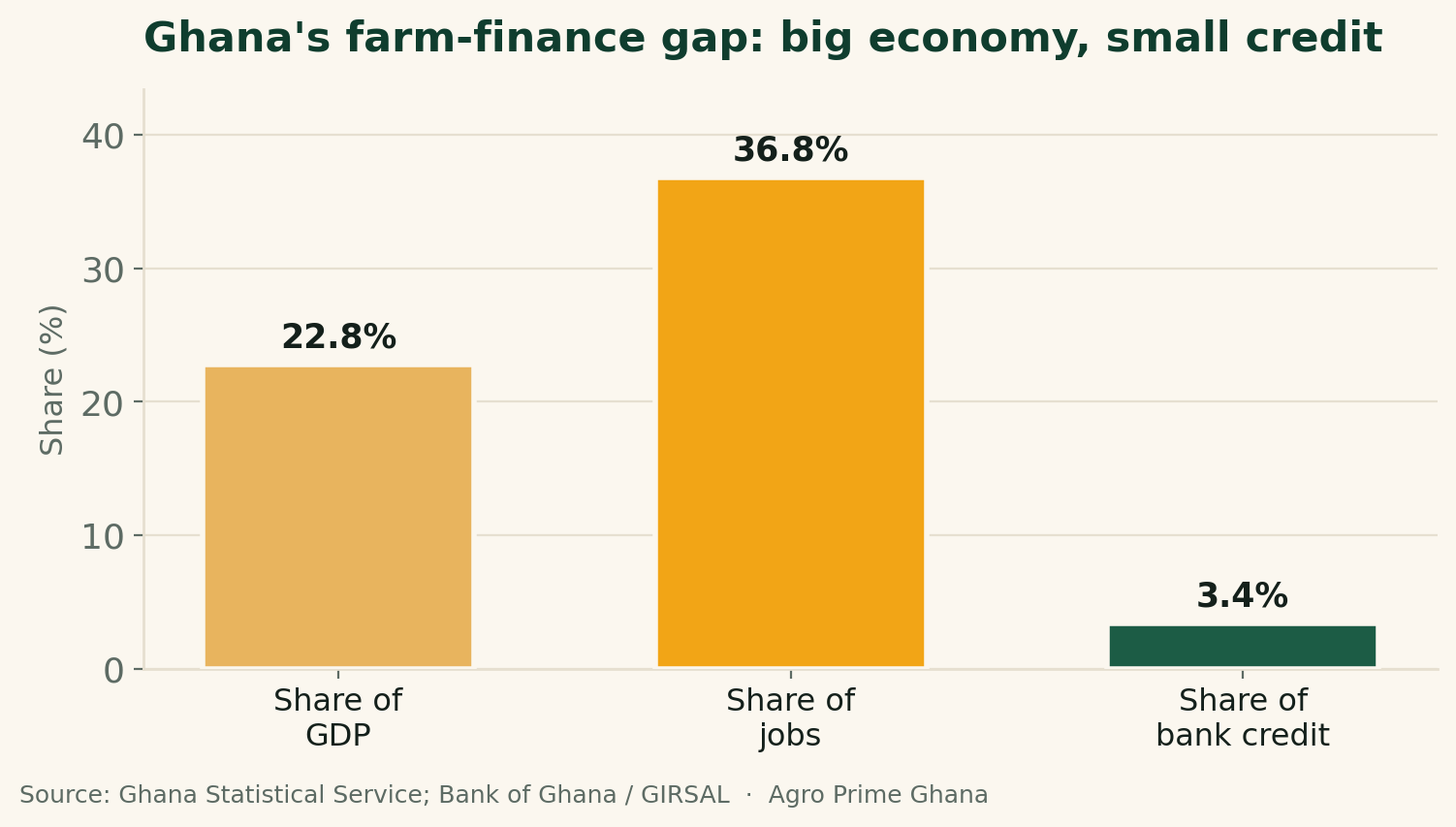
Agriculture is roughly a fifth of Ghana's economy — about 22.8% of GDP — and employs over a third of the workforce (around 36.8%), yet for years it received only about 3.4% of total bank credit. Banks treat farming as high-risk, so the key to getting a loan is reducing their perceived risk. That is exactly what GIRSAL does: a government-owned scheme that guarantees banks up to 70% of the loan principal (not the interest), which has helped mobilise around GHS 1.85 billion in loans to nearly 6,700 agribusinesses. Your realistic sources are commercial banks, the Agricultural Development Bank, rural and community banks, microfinance and savings-and-loans, farmer-group schemes and government programmes. To succeed, treat farming as a business: keep records, have a written plan and a named buyer, borrow the right amount for the right term, and never take a loan whose repayment does not match your harvest cycle.
The finance gap — and why it exists
Start with the mismatch, because it explains everything about how hard borrowing can be. Agriculture makes up around 22.8% of Ghana's GDP and employs roughly 36.8% of the labour force, according to national statistics — it is a huge part of the real economy and of most rural livelihoods. Yet the share of bank lending that reaches it has been strikingly small: figures cited by the Bank of Ghana and GIRSAL put agricultural lending at only about 3.4% of total bank credit, which is why GIRSAL set itself the goal of doubling that share. When nearly two out of every five working Ghanaians depend on a sector that receives one in thirty cedis of bank credit, the shortage of finance is not a detail — it is the constraint.
The reasons banks hold back are real, not irrational. Farming carries risks a bank cannot easily control: weather and drought, pests and disease, and prices that swing between planting and harvest. Loans must be repaid on a schedule, but farm income arrives in one or two lumps a year, not monthly. Many farmers lack the formal land title, audited accounts or collateral a bank normally asks for, and lending to thousands of scattered smallholders is costly to administer. Add historically high interest rates and a memory of loans gone bad, and you can see why a loan officer defaults to "no." Your job as a borrower is to systematically remove those worries — with records, a plan, a market and, increasingly, a guarantee.
Where farm finance actually comes from
There is no single "farmer's bank," and matching your need to the right source is half the battle. The main channels in Ghana are:
- Commercial (universal) banks. The big banks offer agribusiness loans, but tend to prefer larger, established operations, aggregators, processors and out-grower schemes over individual smallholders. They are more accessible when your loan is backed by a guarantee or a firm off-taker contract.
- The Agricultural Development Bank (ADB). Ghana's bank with a specific agricultural mandate, historically oriented towards farming and agribusiness lending across the value chain.
- Rural and community banks (RCBs). Locally owned banks embedded in farming districts. They understand local crops and seasons, are more approachable for smaller farmers, and are important players in reaching rural borrowers.
- Microfinance, savings-and-loans and susu-based lenders. For smaller amounts and shorter terms, these reach farmers the big banks overlook. Rates are usually higher and terms shorter, so they suit input finance and working capital more than long-term investment.
- Farmer groups, cooperatives and VSLAs. Borrowing as an organised group spreads risk, builds a track record, and unlocks group-guaranteed lending and input credit that individuals struggle to get alone.
- Value-chain and input credit. Aggregators, nucleus farmers, input dealers and off-takers often advance seed, fertiliser or cash against a commitment to buy your harvest — finance that comes with a market attached.
- Government and donor programmes. Public initiatives such as the Planting for Food and Jobs programme have channelled subsidised inputs and support to farmers; availability and terms change with policy, so check what is currently running with your district MoFA office.
GIRSAL: the tool changing the odds
The single most important development for farm finance in Ghana is the Ghana Incentive-Based Risk-Sharing System for Agricultural Lending (GIRSAL). It is a limited liability company wholly owned by the Government of Ghana, capitalised with seed funding from the Bank of Ghana and the African Development Bank, and its purpose is to attack the finance gap at its root: bank fear. GIRSAL does not lend to farmers directly. Instead it guarantees the bank — promising to cover up to 70% of the loan principal if an agricultural loan goes bad (the guarantee covers principal, not the interest). By absorbing most of the downside, it makes a bank far more willing to say yes to a farm loan it would otherwise refuse.
The results show the model works. According to GIRSAL's own reporting, the scheme has issued on the order of GHS 943 million in credit guarantees, helping to mobilise around GHS 1.85 billion in loans to roughly 6,700 agribusinesses across dozens of districts, with the great majority repaid on time. Its coverage spans the whole value chain — inputs, production, processing, aggregation, transport, storage, marketing and export — and every major subsector, from cereals, roots and tubers, legumes and horticulture to poultry, livestock and aquaculture. The Bank of Ghana has also moved to allow GIRSAL guarantees to count as acceptable collateral for agricultural loans, directly tackling the collateral problem that shuts so many farmers out. Practically, you access it by applying for a loan at one of GIRSAL's participating financial institutions — banks, specialised deposit-takers and rural and community banks — and asking whether your loan can be covered by a GIRSAL guarantee.
| Source | Best for | Watch out for |
|---|---|---|
| Commercial banks | Larger farms, aggregators, processors, off-taker-backed loans | Collateral and record demands; smallholders often turned away |
| Agric Development Bank | Value-chain agriculture across sizes | Still a formal bank with formal requirements |
| Rural & community banks | Smaller rural farmers; local crop knowledge | Smaller loan sizes; varies by bank |
| Microfinance / savings & loans | Small, short-term working capital and inputs | Higher interest, shorter terms |
| Farmer groups / cooperatives | Building a track record; group-guaranteed loans | Shared liability — one member's default hurts all |
| Value-chain / input credit | Inputs advanced against a harvest commitment | Locked to one buyer; check the price you must sell at |
What lenders will ask you for
Requirements vary by lender and loan size, but the pattern is consistent, and every item on the list is really the bank asking one question: "will I get my money back?" Expect to provide most of the following. A valid ID and, for a registered business, its registration documents. Evidence of your farming activity and experience — the land you use and your track record on it. A business or farm plan showing what you will grow, your costs, your expected yield and income, and how and when you will repay. Some form of security — traditional collateral such as land or equipment, a group guarantee, an off-taker contract, or increasingly a GIRSAL guarantee standing in for hard collateral. A bank account and transaction history, because a lender wants to see money moving through your hands. And crucially, a market — a named buyer or a credible plan to sell — because a bank is lending against your future sales, not your good intentions.
Field note: records are what turn a farmer into a borrower
The difference between the farmer a bank funds and the one it refuses is rarely the size of the farm — it is whether they can show their numbers. Keep a simple book: what you spent on seed, fertiliser, labour and transport; what you harvested; what you sold and for how much. Run your farm money through a bank or mobile-money account rather than only cash, so there is a record of income. Even a year of honest, basic records changes the conversation completely, because it lets a loan officer see a real business with real cash flow instead of a hopeful story. If you plan to borrow next season, start keeping records this season.
How to prepare a strong application
Getting a "yes" is mostly about doing the bank's risk assessment for it before you walk in. First, write a clear, realistic plan: the crop or enterprise, the acreage, a costed budget of inputs and labour, an honest yield estimate based on your own history, the price and buyer you expect, and a repayment schedule that lines up with when the money will actually come in. Whether it is maize, a dry-season vegetable enterprise like tomato, or a poultry venture built on the right breed choice, the plan is what proves you have thought it through. Second, bring your records — even a season or two of input, harvest and sales figures. Third, secure a market: a letter or agreement from an aggregator, processor or reliable buyer is one of the most persuasive things you can put in front of a lender. Fourth, borrow the right amount for the right purpose — enough to do the job properly but no more, and matched to the term (short-term for inputs, longer for equipment or an orchard). Finally, ask the right lender the right question: approach an RCB or a GIRSAL participating institution, and specifically ask whether your loan can be backed by a GIRSAL guarantee if collateral is your obstacle.
Understanding the cost — interest, fees and terms
A loan is a tool, and like any tool it can help or harm depending on how it is used. Before signing, understand the full cost, not just the headline. Ask for the interest rate and how it is calculated, and the fees — processing, insurance and, where a guarantee is involved, a guarantee fee (under GIRSAL, the guarantee fee is charged to the bank, not paid directly by you). Most importantly, understand the repayment schedule and make sure it matches your farming calendar: a farm loan should ideally allow you to repay after harvest, not demand equal monthly instalments during months when a crop produces no income. A "bullet" or harvest-aligned repayment structure fits farming; a rigid monthly one can strangle it. High rates make the timing and the amount matter even more — the shorter you need the money and the more surely your harvest will cover it, the safer the loan.
Field note: match the repayment to the harvest, not the calendar month
The most common way a sound farm ends up in trouble with a loan is a repayment schedule that ignores how farming earns. If the bank expects a fixed sum every month but your maize or tomato only pays you once or twice a year, you are forced to borrow again, sell early and cheap, or fall into arrears — none of which was caused by bad farming. Before you sign, walk the loan officer through your crop calendar and ask for a schedule that lets you pay the bulk after harvest. A lender who genuinely understands agriculture will work with that; if one insists on terms that fight your cash flow, that is a warning worth heeding.
The pitfalls that sink borrowers
Debt magnifies whatever you do with it, so the mistakes are worth naming plainly. Borrowing more than the farm can service is the classic error — a loan sized to ambition rather than realistic yield and price. Diverting the money to non-farm needs — a funeral, school fees, a phone — leaves the farm under-resourced and the debt still due. Ignoring the repayment timing turns a workable loan into a monthly crisis, and selling at a distress price to meet an instalment throws away the margin the loan was meant to build. Skipping insurance or a risk buffer means one bad season wipes out the ability to repay, and borrowing from the wrong source — a short, expensive loan for a long-term investment — creates a mismatch no harvest can fix. The through-line is discipline: use the loan only for its stated productive purpose, size it to reality, and protect your ability to repay as carefully as you protect the crop itself.
The bottom line on farm finance in Ghana
The credit gap in Ghanaian agriculture is real — a sector that is a fifth of the economy and over a third of the jobs, historically getting a thirtieth of the bank credit. But the door is opening. Risk-sharing tools like GIRSAL, the reach of rural and community banks, group and value-chain lending, and the growing acceptance of guarantees in place of hard collateral all mean that the well-prepared farmer has more genuine options than a decade ago. The finance will not come to you as a favour; it will come as a business decision by a lender you have convinced. So make the case irrefutable: run the farm as a business, keep records, write a costed plan, secure a buyer, choose the right lender and the right loan, and structure repayment around your harvest. Do that, and credit stops being the wall that blocks your farm and becomes the lever that grows it.
Frequently asked questions
Why is it so hard for Ghanaian farmers to get bank loans?
What is GIRSAL and how does it help me?
Which lenders should a smallholder farmer approach?
What documents and information will a lender ask for?
How can I improve my chances of approval?
What interest rate and repayment terms should I expect?
What are the biggest mistakes farmers make with loans?
Are there government schemes that help with farm finance?
Sources & further reading
- GIRSAL — Agricultural Credit Guarantee Scheme and About GIRSAL (70% guarantee coverage, ownership, guarantees issued, participating institutions, fees).
- Alliance for Financial Inclusion — Agricultural Finance Interventions in Ghana (agriculture's share of GDP and employment, 3.4% of bank credit, GIRSAL's doubling goal).
- Economy of Ghana (agriculture ~22.8% of GDP, ~36.8% of the labour force).
- Agro Prime Ghana guides: maize farming in Ghana, tomato farming in Ghana, and best chicken breeds in Ghana.
About Agro Prime Ghana
Agro Prime Ghana Limited runs a poultry hatchery and mixed agribusiness in Kasoa, and works with farmers building bankable enterprises around poultry and crops. These guides combine hands-on agribusiness experience with current finance-sector references. This article is general educational information, not financial advice — loan terms, schemes and rates change, so confirm current details with the specific lender, GIRSAL participating institution or your MoFA office before you borrow. Need farm support, quality chicks or feed guidance? Book a visit or message us on WhatsApp (+233 24 915 1503).