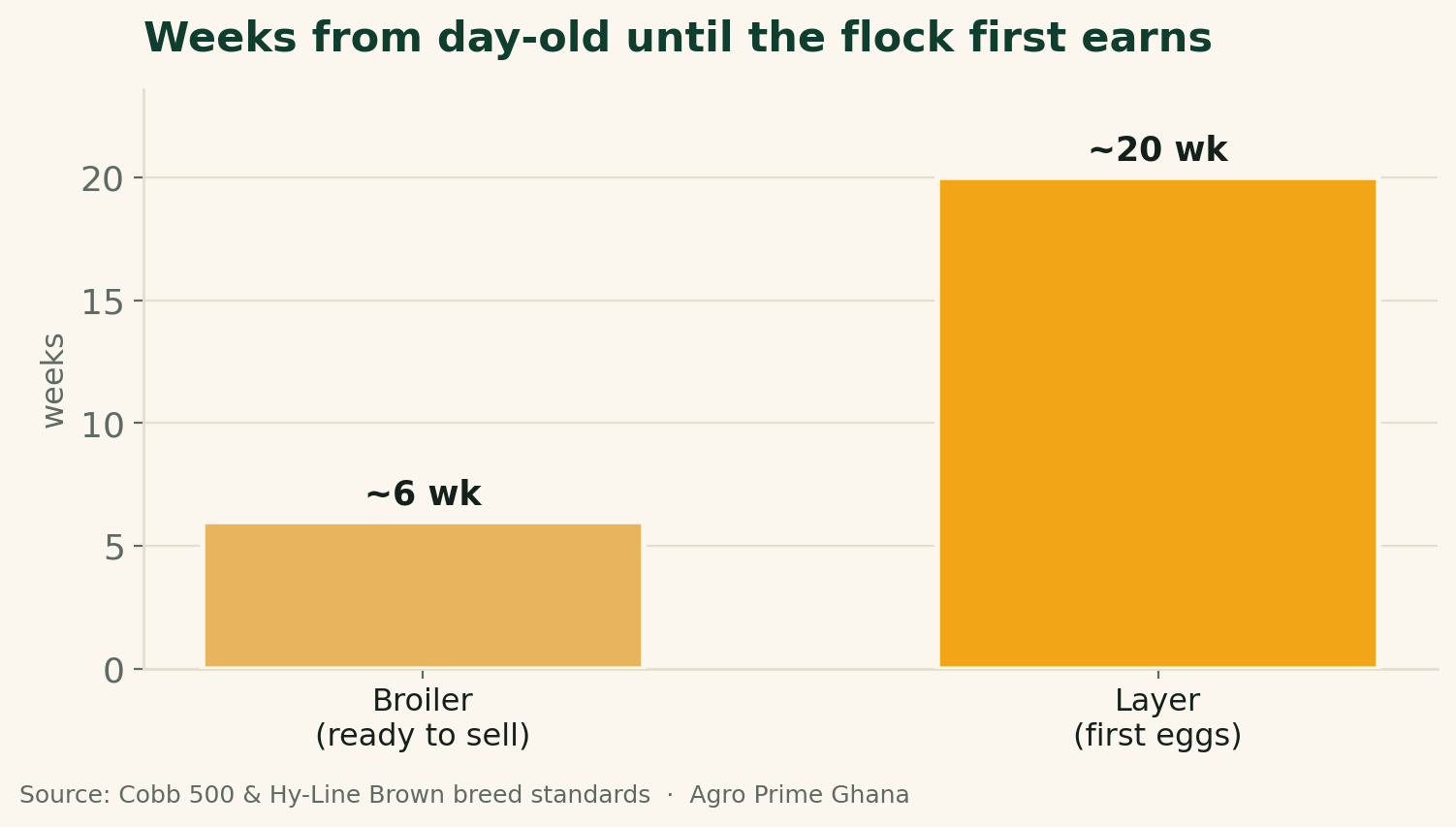
Buy broiler day-old chicks if you want meat and cash back quickly — a good broiler reaches roughly 2 kg in about six weeks and is sold as a whole flock. Buy layer chicks if you want a steadier, longer income from eggs — a pullet does not start laying until around 18–20 weeks of age, then lays for a year or more. That single difference in timing decides almost everything else: how much capital you need up front, how long your money is tied up, how you feed the birds, and how you sell. Every season we watch new farmers in Kasoa order the wrong type of chick for their pocket and their patience, then struggle. This guide lays out the real trade-offs so you choose the right day-old chick before you spend a cedi.
Written by the Agro Prime Ghana hatchery team and reviewed against current industry references (Cobb and Hy-Line management guides and USDA/FAO poultry data). Last updated September 2026.
Key takeaways
Broilers are fast meat birds: modern strains like Cobb 500 reach about 2.5 kg by 35 days and 3.2 kg by 42 days, converting feed at a ratio near 1.4–1.6, so a cycle is over in 6–8 weeks and you sell the whole batch at once. Layers are a long game: a modern brown hen reaches 50% lay around 20 weeks (about 139 days), peaks above 90%, and can lay 360–390 eggs by 80 weeks of age — but you feed her for roughly five months before the first egg pays you back. Broilers need less total capital per bird and return cash fast; layers need more patience and cash flow but earn daily once they lay. In Ghana, imported frozen chicken dominates the meat market while fresh local eggs face far less import competition — a real factor in the choice.
What is the real difference between a broiler and a layer chick?
A broiler and a layer start life looking almost identical — both are fluffy day-old chicks — but they are genetically different animals bred for opposite jobs. A broiler is a meat strain (Cobb 500, Ross 308, Arbor Acres, Hubbard and similar) selected over decades for explosive growth and efficient feed conversion. It is built to turn feed into breast and thigh meat as fast as possible, and it is grown, sold and gone within roughly two months. A layer is an egg strain (Lohmann Brown, ISA Brown, Hy-Line Brown, Bovans and similar) selected for a long, high-volume laying life on a modest, controlled body weight. You keep her for well over a year. The important point for a buyer is that you cannot swap the job: a broiler will not give you an economic run of eggs, and a layer will never grow the meat of a broiler. Choosing the chick is really choosing the business you are entering — a short, capital-cycling meat business or a long, income-generating egg business. If you are still weighing the money side, our companion guide on broiler vs layer profit in Ghana works through the economics in more depth.
How fast does each one make money?
Timing is the heart of the decision. A broiler flock is a sprint. Using Cobb 500 performance figures, birds are typically at target market weight between 35 and 42 days — about 2.5 kg at five weeks and over 3 kg at six weeks — with feed conversion around 1.44 to 1.55, meaning roughly 1.5 kg of feed per kilo of live bird (Cobb-Vantress management data, summarised by industry sources). You place chicks, feed intensively for six to eight weeks, sell the whole flock, clean out and — if you wish — start again. Your money is only tied up for two months per cycle, which is why broilers suit farmers with limited working capital who want to turn it over several times a year.
A layer flock is a marathon. According to the Hy-Line Brown performance standard, a modern brown pullet reaches 50% production at about 139 days — roughly 20 weeks — climbs to a peak of 93–98% hen-day lay, and accumulates on the order of 360–390 eggs per hen housed by 80 weeks of age, with livability to 60 weeks around 97%. But note what that means for cash: you buy the chick, then feed and house her for about five months with no income before the first egg. Once she lays, though, she pays you almost every day for a year or more. So broilers give fast, lumpy cash; layers give slow-starting but steady daily cash. Neither is "better" — they suit different pockets and temperaments.
Broiler vs layer chicks at a glance
The table below sets the two side by side on the factors that actually decide which is right for you. The performance numbers are from Cobb and Hy-Line breed standards; the market notes reflect Ghanaian conditions.
| Factor | Broiler (meat) chick | Layer (egg) pullet chick |
|---|---|---|
| Main product | Live/dressed meat birds | Table eggs (then spent hen for meat) |
| Time to first income | ~6–8 weeks (sell whole flock) | ~18–20 weeks (first eggs) |
| Productive life | One short cycle, then restart | ~12–15 months of laying |
| Output | ~2–3 kg live weight per bird | ~300–360+ eggs per hen over the cycle |
| Feed conversion | Very efficient (FCR ~1.4–1.6) | Steady daily intake ~110–120 g/hen/day |
| Cash flow shape | Fast, lumpy — one big sale per cycle | Slow to start, then daily once laying |
| Capital per bird held | Lower total (short cycle) | Higher total (long rearing before income) |
| Ghana market pressure | Heavy competition from imported frozen chicken | Fresh local eggs — much less import competition |
| Best for | Quick turnover, limited working capital, festive sales | Patient farmers wanting regular monthly income |
Which sells better in Ghana — meat or eggs?
This is where the choice becomes specifically Ghanaian, and it is a point too many new farmers ignore. Ghana's chicken-meat market is dominated by imports. USDA/FAS reporting puts imported chicken at roughly 270,000 tonnes against about 70,000 tonnes of domestic production in a recent year — imports are close to four-fifths of supply — and notes that locally raised broilers make up less than 5% of domestic chicken meat, with most local "chicken meat" actually coming from spent layer hens (USDA Foreign Agricultural Service, Ghana poultry report). In plain terms: as a broiler farmer you are competing against cheap, bulk-imported frozen chicken, so you win on freshness, live sales and festive demand (Christmas, Easter, Eid, Homowo and other occasions) rather than on price — see our guide to selling live birds for the festive market.
Eggs are a different story. Fresh table eggs are largely supplied by local layer farms because eggs do not import and store the way frozen meat does, so egg producers face far less foreign competition and enjoy steady year-round demand from homes, "tea" sellers, bakeries, chop bars and shops. That relative shelter is one of the strongest arguments for layers in Ghana — but it comes with the long wait and higher up-front feed bill before the first egg. Weigh the market reality against your own cash position honestly.
Field note: match the chick to your cash, not your ambition
The commonest, most expensive mistake we see on our hatchery floor is a first-timer with limited savings ordering a big batch of layer chicks because "eggs sell every day" — then running out of money somewhere around week 10 or 12, long before a single egg is laid, and being forced to sell starving point-of-lay pullets at a loss. Layers only reward you after roughly five months of feeding. If your working capital is thin, broilers — or a small first layer batch you can comfortably carry to lay — are the safer entry. Never buy more layer chicks than you can feed all the way to peak production. Count the whole rearing cost before you count the eggs.
How do feeding and housing differ?
The two birds are fed and managed on different programmes, and buying the wrong feed for your chick is a classic beginner error. Broilers are fed nutrient-dense, high-energy, high-protein rations in phases — starter, grower, finisher — to drive maximum growth in minimum time; our broiler feeding guide sets out the stages. Because they grow so fast, broilers are prone to heat stress and leg problems if overcrowded or overheated, which matters in Ghana's climate. Layers are reared more slowly and deliberately: chick and grower feeds that build a well-framed pullet without making her fat, then a switch to a calcium-rich layer ration as she comes into lay so she can build strong shells — our layer feeding guide and note on calcium for laying hens cover this. Layers also need nest boxes, a lighting programme to stimulate and sustain lay, and housing designed for a long occupancy, whereas a broiler house is a simpler space you clean out every couple of months. In short, broilers demand intensity for a short burst; layers demand consistency over a long haul.
Get the right day-old chick for your plan — talk to us first
Agro Prime Ghana supplies healthy, vaccinated day-old broilers, day-old layer chicks and sexed layer pullets, plus the matching starter feed and a brooding plan — so your chicks are built for the business you actually want to run. Not sure whether broilers or layers fit your budget, space and market? Tell us your working capital, your housing and how quickly you need income, and we will recommend the right bird and batch size honestly. Message us on WhatsApp +233 24 915 1503 or book a visit to the hatchery in Kasoa before you order.
Can I keep both, or a dual-purpose bird?
Yes — and for many small Ghanaian farms it is a sensible middle path. Some farmers run both enterprises to spread risk and even out cash flow: layers for steady monthly egg income, plus batches of broilers timed to festive peaks for lump-sum cash. If you do this, keep them as separate flocks with all-in/all-out management and good biosecurity, never mixed, because their ages, feeds and disease pressures differ. A third option is a dual-purpose or improved local bird — Kroiler/Kuroiler, Noiler, cockerels and similar — which grows more meat than a layer and lays more eggs than a broiler, tolerates local conditions and free-range better, but does neither job as efficiently as a specialist strain; our overview of Noiler and Kuroiler chickens explains where they fit. Dual-purpose birds suit lower-input, backyard and peri-urban systems more than intensive commercial ones. For a serious commercial start, most farmers still do best committing to one specialist enterprise, done well, before adding a second.
The bottom line: which day-old chick should you buy?
Choose broilers if you want meat, faster cash and a short cycle you can repeat, if your working capital is limited, and if you can sell fresh or live into a market that values it over imported frozen — festive seasons especially. Choose layers if you can afford to feed birds for about five months before they earn, if you want steady daily income for a year or more, and if you value the relative shelter local eggs enjoy from imports. The decision is less about which bird is "more profitable" in the abstract and more about which one fits your pocket, patience, space and market. Count the full cost to first income, be honest about your cash flow, and buy the chick that matches the business you can actually finance to the finish line.
Frequently asked questions
Should a beginner in Ghana start with broilers or layers?
How long before a layer chick starts laying eggs?
How fast do broilers reach market weight?
Which is more profitable in Ghana, broilers or layers?
Can I feed broiler feed to layer chicks or vice versa?
Do broilers and layers cost the same as day-old chicks?
What is a dual-purpose bird and is it a good compromise?
Can I keep both broilers and layers on the same farm?
Sources & further reading
- Cobb-Vantress — Cobb 500 broiler performance and management guides (target body weight and feed conversion at 35–42 days).
- Hy-Line International — Hy-Line Brown commercial layer variety and performance standards (age at 50% lay, peak production, eggs per hen housed, livability).
- USDA Foreign Agricultural Service — Ghana poultry reports (imported vs domestic chicken meat, share of broilers and spent layers, consumption).
- Agro Prime Ghana guides: broiler vs layer profit, broiler feeding, layer feeding, selling live birds at festive seasons, and Noiler & Kuroiler chickens.
About Agro Prime Ghana
Agro Prime Ghana Limited runs a poultry hatchery and mixed agribusiness in Kasoa, supplying day-old chicks and supporting poultry keepers across the country. We supply healthy day-old chicks (broilers & layers), point-of-lay pullets, quality feed and hands-on farm support nationwide. This article is general educational information, not a substitute for tailored business or veterinary advice — every farm's cash flow and market are different. Ready to start or expand? Book a visit or message us on WhatsApp (+233 24 915 1503) to order chicks, feed or advice.