
As a working rule for Ghana, plan on each good layer giving you roughly 250–300 eggs over her laying year — about 8 to 10 crates of thirty eggs per hen across the cycle — and size your flock backwards from the income you want. A well-managed flock of 100 layers can produce on the order of 18–20 crates a week at peak; 500 layers, around 90 crates a week; and 1,000 layers, close to 180 crates a week. But the number of birds is only half the answer — feed, space, mortality and your egg price decide whether those crates turn into profit. This guide walks through the real production figures, the crate-and-feed maths, and three worked examples so you can size a flock to a genuine income target instead of a guess.
Written by the Agro Prime Ghana poultry team and reviewed against current layer-breed performance data (Hy-Line Brown and Lohmann Brown management guides). Last updated September 2026.
Key takeaways
Modern brown layers like Hy-Line Brown and Lohmann Brown are bred to peak at 93–96% lay and to produce roughly 320+ eggs per hen housed to 72 weeks under good management — but plan conservatively for Ghanaian conditions at ~250–300 eggs per hen over the cycle. At the flock level, budget around 0.8 eggs per hen per day as a working average once birds are in full lay. Each layer eats about 110–120g of feed a day. A crate holds 30 eggs. To size a flock: decide your target monthly income, divide by your net profit per crate to get crates needed, convert to eggs, then to hens — and order about 5–10% extra birds to cover mortality. Start smaller than you think, master the management, then scale.
How many eggs does one layer actually produce?
A single well-bred, well-managed layer produces somewhere around 250 to 320 eggs in her main laying year, depending on the breed, the feed and how well she is looked after. The breed companies publish the top end of that range. The Hy-Line Brown performance standard targets a peak of about 94–98% lay and 368–391 eggs per hen housed by 80 weeks of age, while the Lohmann Brown guide lists a peak near 96% and about 324 eggs per hen housed to 72 weeks. Those are excellent birds. In real Ghanaian conditions — heat, variable feed quality, ordinary management — most farms land below the brochure, which is why we plan on the more conservative 250–300 eggs per hen for the cycle. The practical planning figure to burn into memory is this: a laying flock in full production averages roughly 0.8 eggs per hen per day (an 80% lay rate). Some weeks at peak it is higher; late in the cycle it is lower; 0.8 is a safe number to build a business plan on.
Why the flock's lay rate matters more than the breed
Two farms can buy the same Lohmann or Hy-Line pullets and get very different results, because egg numbers are decided far more by management than by the sticker on the box. What pulls a flock down from a 90% brochure peak to a real-world 70–80% average is usually one of a handful of fixable things: feed that is short on energy, protein or calcium; heat stress in the hottest part of the day; disease or a shaky vaccination programme; poor lighting; overcrowding; or simply birds that came into lay in poor body condition. The single biggest lever most farmers have is feed and water quality and consistency — see our layer feeding guide — followed by keeping the birds cool, healthy and unstressed. Before you scale up bird numbers, it usually pays far more to lift the lay rate of the birds you already have; our guide on increasing egg production covers the practical steps. A flock of 500 hens laying at 85% out-produces 600 hens laying at 65%, on less feed and less space.
The crate maths: turning hens into crates
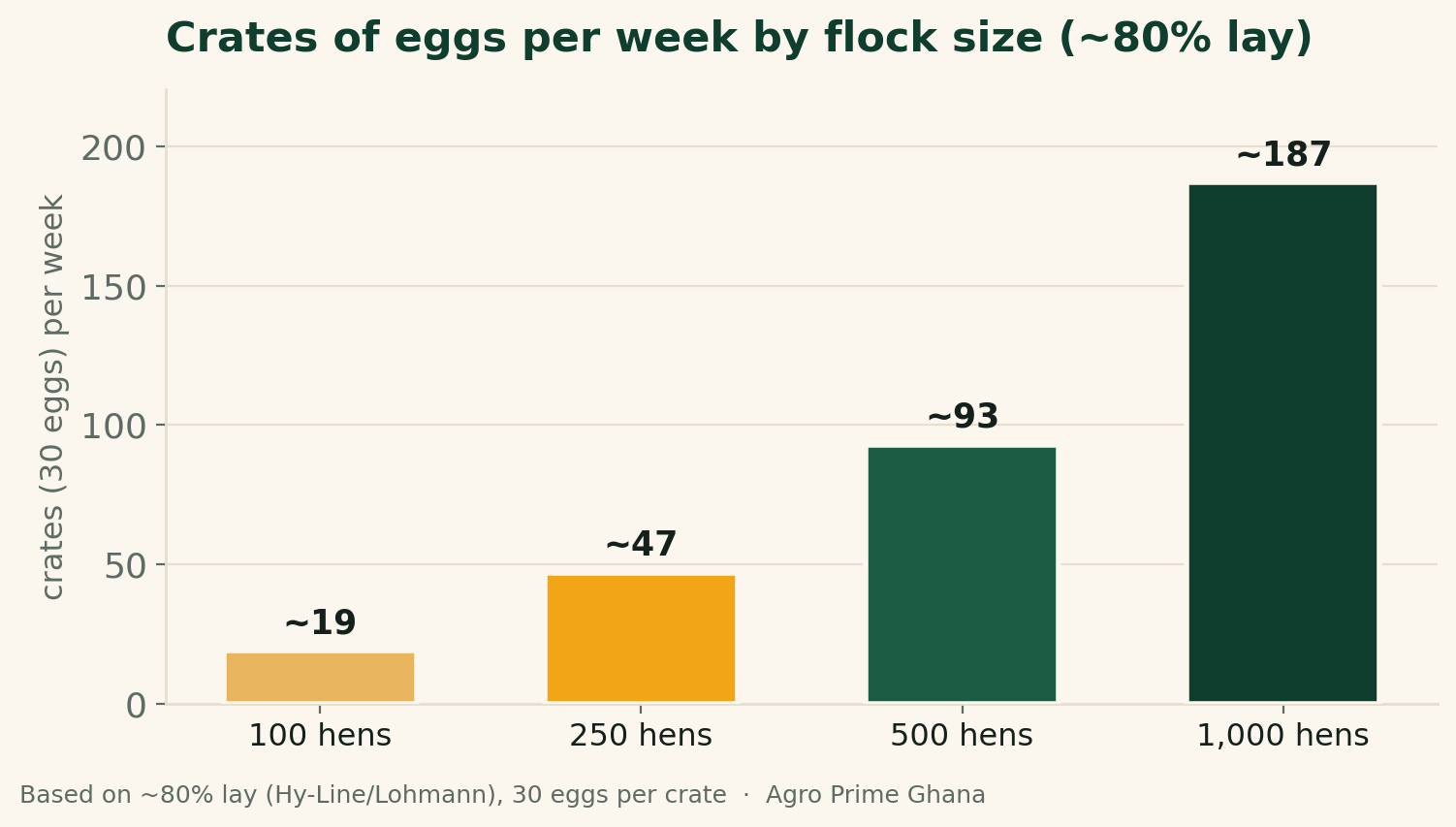
Everything in the egg business is counted in crates of 30 eggs, so learn to move between hens, eggs and crates quickly. The chain is simple: hens × lay rate = eggs per day; eggs per day ÷ 30 = crates per day; crates per day × 7 = crates per week. Using the working average of 0.8 eggs per hen per day, the table below shows what different flock sizes produce. These are planning figures for a flock in good lay — early on, before peak, and late in the cycle, numbers will be lower, so treat these as a strong flock's steady-state output rather than a guarantee.
| Flock size | Eggs/day (~80% lay) | Crates/day | Crates/week | Feed/day (~115g/bird) |
|---|---|---|---|---|
| 100 layers | ~80 eggs | ~2.7 crates | ~19 crates | ~11–12 kg |
| 250 layers | ~200 eggs | ~6.7 crates | ~47 crates | ~29 kg |
| 500 layers | ~400 eggs | ~13.3 crates | ~93 crates | ~57–58 kg |
| 1,000 layers | ~800 eggs | ~26.7 crates | ~187 crates | ~115 kg (~2.3 bags) |
Notice the feed column — it is the number that makes or breaks the business. At roughly 110–120 grams of feed per bird per day (a figure both Hy-Line and Lohmann confirm), a thousand layers eat well over a 100kg of feed every single day, more than two 50kg bags. Feed is typically 65–75% of the total cost of producing eggs, so your egg profit is really a bet on the gap between your feed cost and your egg price. This is why reducing and controlling feed cost — without starving the birds of nutrition — is the core skill of a layer farmer; our guide on reducing poultry feed cost goes into it.
How to size a flock to an income target
The right way to decide flock size is to start from the income you want and work backwards, using your own local egg price rather than a number from the internet. Egg prices in Ghana move with the season, the maize price and the festive calendar, so plug in the figure you can actually sell at. The method has five steps:
- Step 1 — set a target. Decide the monthly income you want the flock to generate (or the profit, if you know your costs well).
- Step 2 — find your net margin per crate. Work out what you truly clear on a crate after feed, chicks/pullets spread over the cycle, drugs, labour, transport and breakages. Feed dominates. Be honest and conservative.
- Step 3 — crates needed = target ÷ margin per crate. This tells you how many crates a month the business must sell to hit your goal.
- Step 4 — convert to hens. A flock averaging 0.8 eggs/hen/day lays about 0.8 crates per hen per month (30 days × 0.8 ÷ 30 eggs). So hens needed ≈ monthly crates ÷ 0.8. In round terms, plan on roughly one crate per hen per month at full lay being the very top end, and 0.8 crates being realistic.
- Step 5 — add a safety margin. Order about 5–10% more pullets than the sum to cover mortality and culls over the cycle, and remember birds take time to reach peak, so early months earn less.
Do this honestly and you get a flock size grounded in your real market, not wishful thinking. The most common mistake we see is skipping Step 2 — people size a flock to a revenue dream while ignoring that feed will eat most of that revenue.
Field note: don't start bigger than you can manage
The flocks that fail in Ghana usually fail from being too big too soon, not too small. A first-timer who buys 1,000 point-of-lay pullets is also taking on 115kg of feed a day, daily egg collection and marketing of nearly 27 crates a day, biosecurity, and the cash-flow strain of feeding birds for weeks before they hit peak — all while still learning. We far more often advise starting at 100–300 layers, getting the feeding, health and marketing genuinely right, building steady buyers, and then scaling in steps. The management you learn on 200 birds is exactly what makes 1,000 birds profitable later. Scale is only an advantage if the fundamentals are already working.
Worked example 1: a 100-layer household flock
A 100-bird flock is the classic starting point — big enough to earn real money, small enough to run alongside other work. In full lay at around 80%, it produces about 80 eggs a day, roughly 19 crates a week, or on the order of 80 crates a month. It eats about 11–12kg of feed a day. Over a laying cycle of roughly a year, at 250–300 eggs per hen, 100 birds yield in the region of 25,000–30,000 eggs, or about 850–1,000 crates. This size suits a family that wants steady egg income and a reliable home supply, and it is forgiving while you learn. The key discipline is treating it as a business from day one: feed a proper layer ration, collect eggs several times a day, keep simple records, and line up buyers before the eggs pile up.
Worked example 2: a 500-layer commercial flock
Five hundred layers is a serious small-commercial operation. At about 80% lay it produces roughly 400 eggs a day — about 13 crates daily, or 93 crates a week — and over a full cycle around 125,000–150,000 eggs (4,200–5,000 crates). It consumes close to 57–58kg of feed a day, so feed logistics and cash flow now matter a lot: you are buying feed by the bag, weekly, and a swing in the maize price hits your margin directly. At this scale you need dependable daily labour, proper housing with good ventilation for the heat, a solid vaccination programme, and more than one reliable buyer — a shop, a caterer, market traders — so nearly 100 crates a week actually move. This is the size at which good record keeping stops being optional and becomes the thing that tells you whether you are truly making money.
Worked example 3: a 1,000-layer flock
A thousand layers is a full commercial egg enterprise. At 80% lay it yields about 800 eggs a day — roughly 27 crates daily, close to 187 crates a week — and over a cycle around 250,000–300,000 eggs (8,300–10,000 crates). It also eats about 115kg of feed a day, more than two 50kg bags, every day, which is a substantial standing cost that must be met whether or not you have sold yesterday's eggs. At this scale the business is really a feed-and-marketing operation with birds attached: you need buffer capital to carry feed through the pre-peak weeks and through price dips, structured biosecurity to protect a large, valuable flock, dedicated labour, and a marketing network that can absorb nearly 200 crates a week consistently, including during gluts. The rewards are real, but so are the risks — which is exactly why we counsel farmers to arrive here by scaling up from a proven smaller flock, not by starting cold.
Ready to size and stock your layer flock?
Agro Prime Ghana supplies healthy point-of-lay (POL) pullets — birds reared and vaccinated and ready to come into lay — together with balanced layer feed and hands-on advice on housing, flock size and feeding for your target. Tell us the income you are aiming for and the space you have, and we will help you work out a realistic bird number, a feed plan and a starting budget rather than overselling you birds you cannot yet manage. Message us on WhatsApp (+233 24 915 1503) or book a visit to talk pullets, feed and setup — and see our guide to starting a poultry farm in Ghana to plan the wider build.
Space, housing and the other numbers you must plan
Bird numbers also dictate space and infrastructure, and under-planning these quietly caps your egg output. As a rough guide, layers on deep litter are commonly kept at around 4–6 birds per square metre for decent welfare and production, while cage systems fit more birds per unit of floor area but cost more to build; either way, overcrowding raises stress, cannibalism and disease and pulls the lay rate down. Beyond floor space you need enough feeder and drinker space for every bird to eat and drink without a scramble, adequate nest boxes (roughly one nest per four to five hens) to keep eggs clean and unbroken, and good ventilation and shade to fight Ghana's heat. Plan too for the boring essentials that scale with flock size: reliable water, secure feed storage, and a place to hold eggs cool before sale. Getting these right is what lets a flock actually deliver the crate numbers in the table above rather than falling short of them.
The bottom line on sizing an egg flock
How many layers you need depends entirely on the income you are chasing — but the maths is straightforward once you anchor it in real figures. Budget about 0.8 eggs per hen per day, roughly 0.8 crates per hen per month, and 250–300 eggs per hen over the cycle; remember each bird eats 110–120g of feed a day; and size the flock backwards from your target income and your honest margin per crate, adding 5–10% birds for mortality. A hundred layers is a strong, forgiving start at around 19 crates a week; five hundred is a real commercial step at about 93; a thousand is a full enterprise near 187 — but only if the feeding, health, housing and marketing are genuinely under control. Start at a size you can master, prove the management, then grow the bird numbers into a business you already know how to run.
Frequently asked questions
How many eggs does one layer produce per year in Ghana?
How many layers do I need to make a living from eggs?
How many crates a week will 500 layers produce?
How much feed does a laying hen eat per day?
Should I start with 100, 500 or 1,000 layers?
How much space do layers need?
What lay rate should I plan for?
How long does a layer stay productive?
Sources & further reading
- Hy-Line International — Hy-Line Brown Performance Standards (peak lay, eggs per hen housed, feed intake, livability).
- Lohmann Breeders — Lohmann Brown Management Guide (peak production, eggs per hen housed, feed intake, egg weight).
- Agro Prime Ghana guides: layer feeding guide, increasing egg production, reducing feed cost, starting a poultry farm, and record keeping.
About Agro Prime Ghana
Agro Prime Ghana Limited runs a poultry hatchery and mixed agribusiness in Kasoa, supplying day-old chicks (broilers & layers), point-of-lay pullets, quality feed and hands-on farm support to poultry keepers across the country. These guides combine practical hatchery and farm experience with current breed-performance references. This article is general educational and business information, not a guarantee of results — every farm's numbers depend on its own feed, management and market. Planning a layer flock? Book a visit or message us on WhatsApp (+233 24 915 1503) to order POL pullets, feed or advice sized to your goals.


