Plenty of Ghanaian poultry farmers are good at growing birds and poor at selling them — and it is the selling, not the growing, that decides whether the enterprise makes money. You can raise a beautiful flock and still lose, if your birds hit the market when everyone else's do, if you are trying to undercut frozen imported chicken you can never beat on price, or if you have no buyers lined up when the eggs start flowing and the feed bill keeps arriving. Marketing is not an afterthought you bolt on at the end; it is a decision you make before you buy a single chick — what will you sell, to whom, when, and why should they buy yours instead of the cheap imported alternative. This guide lays out how the Ghanaian poultry market actually works and the practical strategies for selling eggs and birds profitably in it.
Written by the Agro Prime Ghana poultry team and reviewed against current sector references (Ghana's Ministry of Food and Agriculture and industry trade reporting). Last updated September 2026.
Key takeaways
Ghana's poultry-meat market is dominated by imports — imported chicken makes up over 80% of the chicken eaten in the country, and it is roughly 30–40% cheaper than locally produced birds, so you cannot win the everyday frozen-chicken market on price. The egg market is the opposite: it faces almost no import competition, which is why it is the more reliable business for most farmers. Your winning strategies are differentiation and timing: sell fresh local eggs on a steady route, sell live and dressed birds into the premium festive market (Christmas and Easter, when Ghanaians want local live chicken), and sell direct — farmgate, contracts, WhatsApp — to keep the middleman's margin. Know your cost per bird and per crate, plan the buyer before the chick, and build repeat customers on freshness, reliability and quality.
Know the market you are selling into
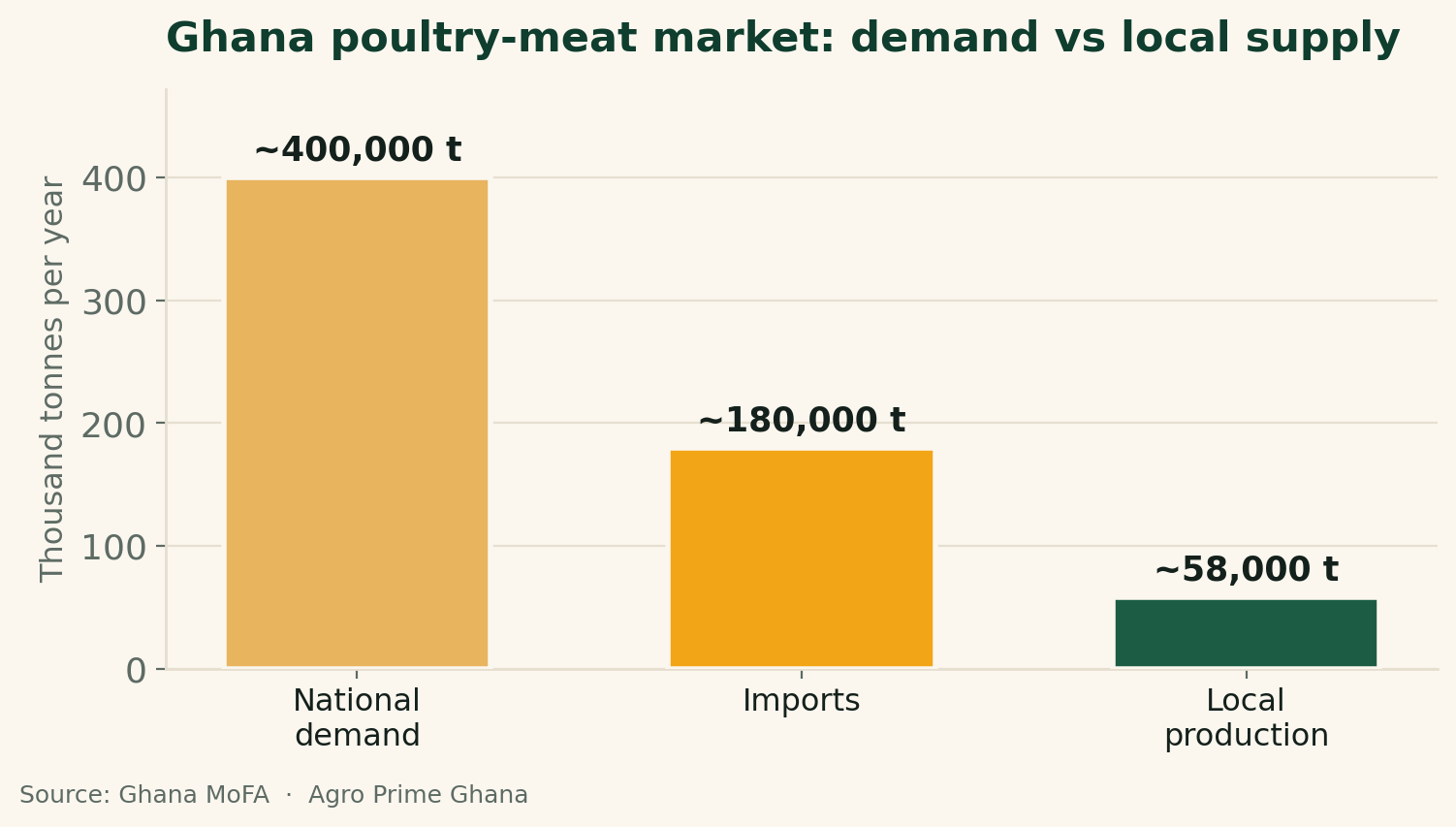
Good marketing starts with a clear-eyed view of the ground you stand on, and Ghana's poultry market has a very particular shape. On the meat side, local farmers are competing against a wall of imports. According to Ghana's Ministry of Food and Agriculture, national demand for poultry meat is around 400,000 tonnes a year, while local production sits at roughly 58,000 tonnes and imports fill about 180,000 tonnes of the gap — and broiler meat makes up over 80% of all meat imports. Trade reporting puts imported chicken at over 80% of the chicken consumed in Ghana, with local broiler production squeezed to under a fifth of the market, because imported frozen chicken is roughly 30–40% cheaper than the local bird. This is the single most important fact for anyone selling poultry here — in the everyday, price-driven frozen-chicken market, you are structurally at a disadvantage, and competing head-on on price is a losing game. The farmers who thrive do not fight that battle; they sell into the parts of the market where local birds and eggs genuinely win.
Why eggs are the steadier business
The flip side of that import story is the best news in Ghanaian poultry: the egg market is protected in a way the meat market is not. Fresh eggs do not ship and freeze the way chicken parts do, so eggs face virtually no competition from imports — which is exactly why many broiler producers, worn down by cheap frozen imports, have shifted into layers as a survival strategy, and why commercial feed millers have followed them from broiler feed into layer feed. For a farmer deciding what to sell, this matters enormously: eggs give you a continuous, home-turf market with a daily product, steady cash flow and no frozen foreign rival undercutting you. A well-run layer flock produces on the order of 230–250 eggs per bird per year once the pullets come into lay from around 16 weeks, which is a reliable, repeatable revenue stream rather than a single sale. If your goal is a dependable poultry income rather than a festive-season gamble, eggs are usually where to start — and getting the flock productive is the foundation, covered in our layer feeding guide.
The two markets, and where you can win
It helps to see the market split into the parts you cannot win and the parts you can, and to aim your production squarely at the latter. The table below sets out the main channels a Ghanaian poultry keeper sells into and how each one really behaves.
| Market channel | How it behaves | Where you stand |
|---|---|---|
| Everyday frozen chicken | Dominated by cheap imports (over 80% of chicken eaten); price-driven | Hard to win — do not compete head-on on price |
| Table eggs | Almost no import competition; steady daily demand | Strong — the most reliable local market |
| Festive live & local birds | Christmas, Easter and celebrations; Ghanaians prize local live chicken | Strong — premium prices if you time production right |
| Fresh local dressed birds | Buyers who value freshness, taste and local origin over price | Winnable through differentiation and direct sales |
| Spent layers & cockerels | Older hens and surplus males sold live; valued for local dishes | Useful extra income — plan it, don't waste it |
Sell the festive calendar, not just the bird
One of the oldest and most reliable features of the Ghanaian poultry market is the festive premium. Chicken has long been a celebration meal here, and around Christmas, Easter and other festive occasions Ghanaians still want locally produced live chicken — even households that buy imported frozen parts for everyday cooking will buy a local live bird for the celebration table. That preference is a gift to the local farmer, because it is a moment when buyers actively want what you have and will pay a premium for it. The catch is timing: everyone knows about December, so the reward goes to farmers who plan their production calendar backwards from the festive dates and have well-finished birds ready exactly when demand peaks — not a month late, and not scrambling for buyers in a glutted January. Work out the growing period for your birds and count back from Christmas and Easter so your flock reaches market weight into the rising demand. Matching bird type to this market matters too; our guide to the best chicken breeds for Ghana covers choosing stock buyers actually want.
Field note: line up the buyer before you buy the chick
The costliest marketing mistake we see is farmers who raise birds first and look for buyers afterwards — and then sell in a panic at whatever price they are offered because the feed is finished and the birds are eating into profit every extra day. On the farm we treat the market as the starting point, not the finish line: decide who the buyer is — a nearby restaurant, a cluster of egg customers, festive orders taken in advance — and size and time the flock to that demand before the chicks ever arrive. Taking orders and even deposits ahead of a festive batch turns an anxious sell-off into a planned delivery. A bird with a buyer waiting is worth far more than a slightly bigger bird you are desperate to move.
Cut out the middleman: sell direct
Where you sell shapes your margin as much as what you sell. Passing everything through wholesalers and market middlemen is easy, but every hand the product passes through takes a cut that could have been yours. The farmers who make real money work hard to shorten the chain and sell as directly as they can: farmgate sales to buyers who come to you; a fixed route of repeat egg customers — households, provision shops, chop bars, cold stores, hotels and restaurants — served reliably every week; standing contracts to supply eggs or birds to institutions, eateries and caterers; and increasingly WhatsApp and phone orders, which let a small farmer take orders, arrange delivery and build a loyal customer list without a shopfront. Direct selling does more than protect margin — it gives you steady, predictable demand instead of dumping birds onto an unpredictable open market, and it builds the personal relationships that make customers come back. Simple things help too: clean, professional presentation of your eggs and birds, and being the supplier who always keeps their word on quality and delivery. That reliability is itself a marketing asset most competitors lack.
Compete on what imports cannot offer
Since you cannot beat imported frozen chicken on price, you have to sell what it fundamentally cannot: freshness, taste, local origin and trust. Frozen chicken has been processed and in cold storage for a long time and often travelled from another continent; your bird can be fresh, local and traceable to a farm the customer can name. Many Ghanaian buyers genuinely prefer the taste and texture of local chicken and will choose it when they can, especially for special meals — that preference is your opening. Lean into it: emphasise fresh and locally raised, offer live or freshly dressed birds, and let customers associate your name with quality and food they can trust. The same applies to eggs — fresh, clean, well-handled local eggs from a known farm are an easy sell against tired stock, and good handling keeps them that way (see our note on broiler feeding for how finishing quality shows up in the final bird buyers judge you on). You are not selling the cheapest protein in the market; you are selling the fresher, better, local one, and that is a story imports cannot tell.
Field note: know your numbers before you name your price
Marketing falls apart if you do not know what a bird or a crate of eggs actually costs you to produce. We keep it simple but honest: add up chicks, feed (by far the biggest cost), medication and vaccines, labour, and a share of housing and overheads, then work out your cost per bird and cost per crate before setting any price. Feed prices move, so we revisit the sums regularly rather than pricing on last season's costs. Knowing your true cost tells you the floor you cannot sell below without losing money, stops you being talked down by a hard-bargaining buyer, and shows you honestly whether the festive premium or a direct contract is actually worth chasing. A farmer who does not know their cost per bird is not pricing — they are guessing.
Don't waste the by-products
A poultry enterprise has more to sell than its headline product, and the farmers who squeeze out a profit rarely let anything go to waste. Spent layers — hens at the end of their laying life — still have real value as live birds for the pot and for local dishes, and selling them well (again, often into the festive or live-bird market) recovers money that a farmer who simply culls and dumps them loses entirely. Surplus cockerels from a hatch, and any birds grown out for meat, feed straight into the live and festive markets. Even poultry manure is saleable to crop farmers and gardeners as organic fertiliser, turning a waste-disposal cost into a small income stream. None of these will make your business on their own, but together they are the difference between a thin margin and a workable one. Thinking of the whole enterprise as several products to be marketed, not one, is part of running poultry as a business rather than a hobby.
The bottom line on marketing poultry in Ghana
Selling is where Ghanaian poultry profits are won or lost, and the market rewards farmers who understand its shape rather than fight it. Accept that you cannot beat cheap imported frozen chicken on price — over 80% of chicken eaten here is imported and it is 30–40% cheaper — and aim instead at the parts of the market where local birds and eggs genuinely win. Build your base on eggs, which face almost no import competition and give steady daily income; capture the festive premium for live local birds by timing production to Christmas and Easter; sell direct to keep the middleman's margin and lock in repeat demand; and compete on the freshness, taste, local origin and reliability that imports can never match. Underpin all of it by knowing your true cost per bird and per crate, and by lining up the buyer before you buy the chick. Do that, and marketing stops being the weak link at the end of the chain and becomes the decision that makes your flock pay.
Frequently asked questions
Is poultry farming profitable in Ghana given all the imported chicken?
Should I farm eggs or meat birds for the Ghanaian market?
How do I sell my eggs for the best price?
When is the best time to sell chickens in Ghana?
How can I compete with cheap imported frozen chicken?
Should I sell directly or through middlemen?
How do I set the right price for my birds and eggs?
What can I do with spent layers and surplus cockerels?
Sources & further reading
- Ghana Ministry of Food and Agriculture (MoFA) — Revamping the Poultry Sector in Ghana (national poultry-meat demand, local production, import volumes, share of imports).
- The Poultry Site — Chickens for Christmas: Ghana's Unique Poultry Market (festive live-bird preference, share of imported chicken consumed).
- WATTPoultry — Ghana's broiler producers turn to eggs (imports 30–40% cheaper, local share under 20%, eggs facing little import competition, layer output).
- Agro Prime Ghana guides: layer feeding guide, best chicken breeds for Ghana, and broiler feeding guide.
About Agro Prime Ghana
Agro Prime Ghana Limited runs a poultry hatchery and mixed agribusiness in Kasoa, supplying day-old chicks and working alongside poultry keepers across the country — including on the business side of running a flock. These guides draw on that hands-on hatchery and farm experience together with current sector data. This article is general educational information, not financial or business advice tailored to your farm. Need chicks, feed advice or farm support? Book a visit or message us on WhatsApp (+233 24 915 1503).