The cost of producing eggs in Ghana is dominated by one line item — feed, at roughly 70–80% of the total — with the rest split between the point-of-lay pullet, labour, drugs and vaccines, depreciation on housing and equipment, and overheads like electricity, water and transport. Because a laying hen eats about 110–120 g of feed every single day for over a year, and because that feed is built on maize and soybean meal whose prices have swung violently with the cedi, your cost per crate is set mostly by two things you must watch obsessively: the feed price and your flock's lay percentage. This guide breaks the cost down line by line, shows how to work out your true cost per crate and per egg, explains why feed and the exchange rate dominate everything, and sets out a simple system for tracking it so you always know whether each crate is sold at a profit or a loss.
Written by the Agro Prime Ghana poultry team and reviewed against current sector references (Ghana feed and layer economics research, USDA FAS). Last updated September 2026.
Key takeaways
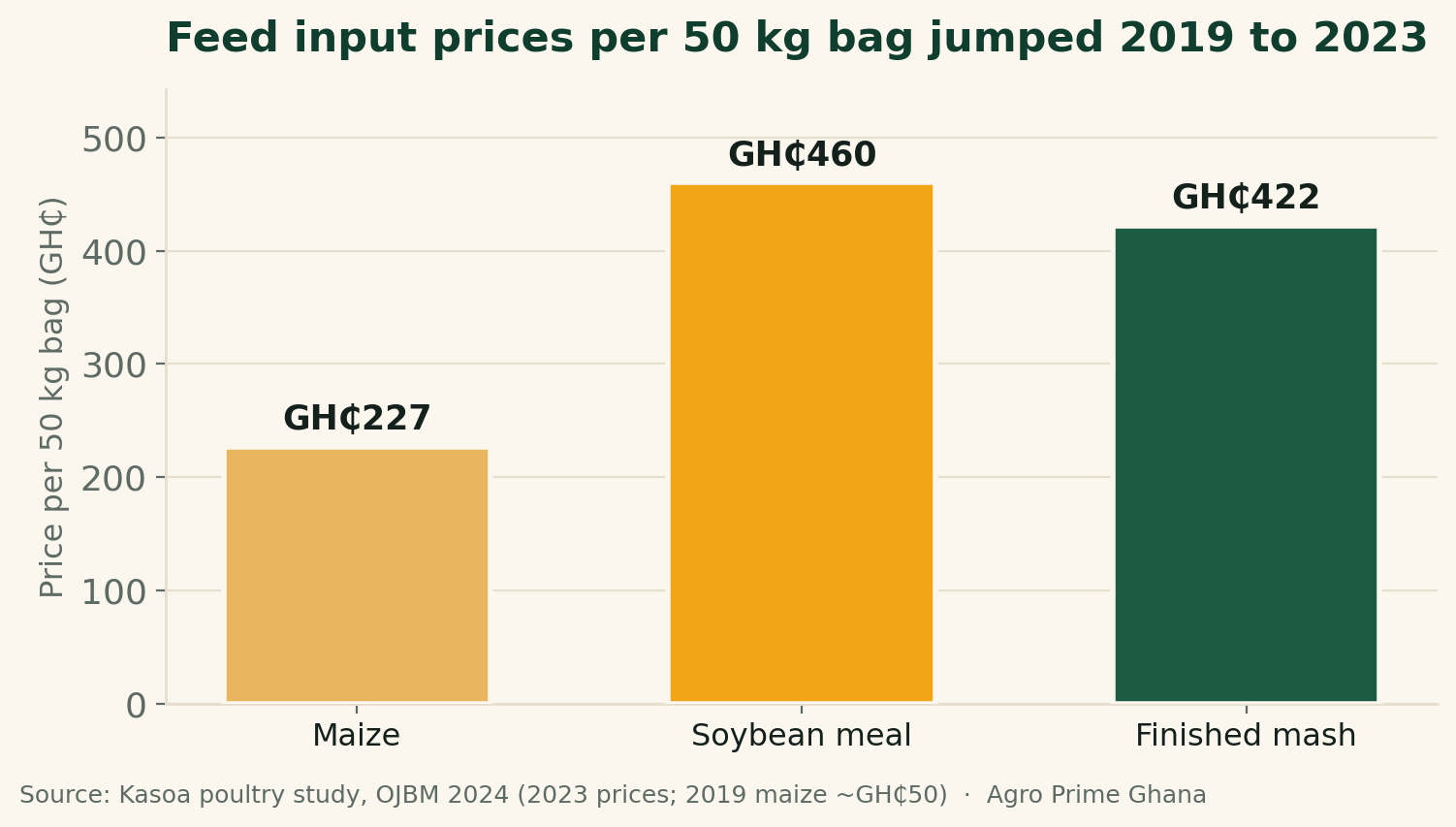
Feed is 70–80% of egg production cost in Ghana, so cost per crate rises and falls mainly with the maize and soybean price and with your lay percentage. A hen eats ~110–120 g/day and needs ~2.0–2.1 kg of feed per kg of egg. Feed prices have swung hard: in one Kasoa study, a 50 kg bag of maize rose from about GH¢50 (2019) to GH¢227 (2023) and soybean meal from about GH¢135 to GH¢460. To find your cost per crate, add all costs for a period and divide by crates produced (a crate = 30 eggs); the same feed bill spread over a 90% flock gives far cheaper eggs than over a 65% flock. Track feed cost per crate and lay percentage weekly, and you will see trouble before it drains you.
What goes into the cost of producing an egg?
The cost of an egg is the sum of everything spent to keep the hen that laid it, divided across all the eggs she and her flockmates produce. In practice that breaks into a handful of categories, and their sizes are wildly unequal. Feed is the giant, at around 70–80% of the total according to Ghanaian sector research and consistent with the FAO's description of feed as "the most important input for intensive poultry production." The point-of-lay pullet (or the day-old chick plus the feed to rear her) is the next real cost — a sunk investment spread across her laying life. Then come labour, drugs and vaccines, depreciation on the house, cages, feeders and drinkers, and overheads — electricity, water, transport, litter, packaging and miscellaneous. Understanding this hierarchy tells you where to aim your attention: shaving a few cedis off packaging changes almost nothing, while a small improvement in feed conversion or lay percentage moves the whole cost.
Why feed and the cedi dominate everything
Feed's share is so large that egg costs in Ghana essentially track feed prices, and feed prices in turn track the cost of maize and soybean meal — commodities whose prices are pushed around by harvests, demand and, crucially, the cedi's exchange rate, because a significant part of the feed chain (soybean meal, premixes, sometimes maize itself) is priced against imports. When the cedi weakens, feed gets more expensive in cedi terms almost immediately, and because feed is most of your cost, your cost per crate jumps even though nothing changed on the farm. The scale of these swings is not theoretical: a 2024 study of poultry farms in Kasoa documented a 50 kg bag of maize rising from roughly GH¢50 in 2019 to GH¢227 in 2023, soybean meal from about GH¢135 to GH¢460, and finished mash more than tripling over the same period — the same study named inadequate funding, disease and unreliable electricity as the leading bottlenecks farmers faced. For a layer farmer, this is the central risk of the whole business: your single biggest cost is the one you control least, so managing feed cost and locking in decent lay is survival, not optimisation.
Feed input prices have tripled and more
The chart above shows why so many Ghanaian egg farmers who were comfortable a few years ago found themselves squeezed: the raw materials of the layer ration have risen faster than egg prices could follow. When maize and soybean meal — between them the bulk of a layer feed — more than triple in a few years, the cost of every crate rises with them, and a farmer selling at last year's egg price is quietly losing money on each one. This is the mechanism behind the periodic reports of Ghanaian poultry farmers cutting flocks or leaving the business: not bad husbandry, but a cost structure in which the dominant input outran the selling price. It is also why cost control on a layer farm is really feed control — sourcing grain well, formulating efficiently, avoiding waste and spoilage, and never paying for feed that mould or aflatoxin has already ruined.
The cost breakdown, line by line
Here is the full picture in one place, with the practical point of each line for a Ghanaian layer farm.
| Cost item | Rough share | What drives it / how to manage it |
|---|---|---|
| Feed | ~70–80% | Maize & soybean prices, the cedi, feed conversion, waste, spoilage — the master lever |
| Pullet / day-old + rearing | Next largest | Sunk cost spread over laying life; spreads thinner the more eggs she lays |
| Labour | Modest | Wages; falls per crate as flock size and lay percentage rise |
| Drugs & vaccines | Small | Cheap insurance; skimping here can cost a whole flock |
| Depreciation | Small–modest | House, cages, feeders, drinkers written off over their life |
| Overheads | Small | Electricity, water, transport, litter, packaging — real but not where the money is |
The mortality rate quietly threads through all of this: every bird that dies took feed and rearing money with her and now lays no eggs to spread that cost, so good health management is also cost management. Notice too that most of the non-feed costs are broadly fixed — the house depreciates, the worker is paid, and the pullet cost is sunk — whether the flock lays at 90% or 60%. That is the deep reason lay percentage matters so much to cost, and it leads straight to the most important calculation on the farm.
How to calculate your cost per crate and per egg
Your cost per crate is not a number you can look up — it is a number you compute from your own farm, and it is the single most useful figure you can know. The method is simple: over a defined period (say a month), add up every cost — feed, labour, drugs, a fair share of the pullet cost and depreciation, and overheads — then divide by the number of crates produced in that period (a crate is 30 eggs). That gives cost per crate; divide by 30 for cost per egg. Compare it against the price you actually sell a crate for, and you know immediately whether you are making or losing money, and by how much. The eye-opener is always the effect of lay percentage. Because so much cost is fixed, the same total spend divided across the eggs of a 90%-lay flock gives a far lower cost per crate than across a 65%-lay flock — the hens in the high-laying flock are each spreading the farm's costs over more eggs. This is why a flock that slips off peak becomes unprofitable long before it looks sick: the crates simply cost too much to make. Our guides on reducing poultry feed cost and the layer feeding guide tackle both sides of that ratio — the feed bill and the lay.
Field note: two flocks, same feed bill, very different cost per egg
The clearest lesson we can offer on egg cost has nothing to do with buying cheaper feed. Picture two houses of the same size, fed the same, staffed the same — one laying at 90%, the other, through poor pullet quality, a lighting slip or heat stress, laying at 65%. They incur almost the same total cost, but the first produces far more crates from it, so its cost per crate is dramatically lower. The farmer chasing "cheap feed" to fix his margins is often looking in the wrong place: the bigger prize is usually getting the flock laying properly, so the feed you are already buying is spread over more eggs. Cheap feed that drops your lay is the most expensive feed there is.
Where you can actually cut cost — and where you cannot
Given the structure, sensible cost control follows a clear order. First, protect lay percentage: correct layer feed with adequate calcium, a steady lighting program, cool housing and full vaccination keep the flock producing, which is the cheapest way to lower cost per egg. Second, manage feed intelligently — not by buying the cheapest bag, but by sourcing good grain at fair prices, formulating or choosing a ration that converts efficiently, storing feed dry and pest-free so none is lost to mould or rats, and cutting physical wastage at the feeder (overfilled troughs spill feed that hens rake onto the floor). Reducing waste and spoilage is free money. Third, keep mortality low through biosecurity and health, since dead birds carry sunk cost and produce nothing. What you generally cannot cut without hurting yourself is the quality of the pullet, the calcium and protein in the ration, or the vaccination programme — the false economies that show up later as low peak, thin shells, disease and lost production. Our notes on making poultry feed and maize quality help on the feed-cost side.
Quality point-of-lay pullets and layer feed keep your cost per egg down
Because cost per egg is driven by lay percentage and feed efficiency, the cheapest eggs start with a good pullet and the right feed — the two things we supply. Agro Prime Ghana provides well-reared point-of-lay layer pullets that come into lay on target and peak well, plus quality layer feed formulated for efficient conversion, so the feed you buy is spread over more eggs rather than wasted on a poorly-laying flock. We are happy to talk through your feed and flock numbers and where your real costs sit. Message us on WhatsApp (+233 24 915 1503) or book a visit to our Kasoa farm.
Field note: wasted and spoiled feed is a cost you can simply delete
Because feed is most of the cost, the feed that never becomes an egg is pure loss — and there is usually more of it than farmers think. We watch three leaks in particular: overfilled troughs, where hens rake feed onto the floor (fill feeders no more than a third to half full and you can cut spillage sharply); storage losses to damp, mould and rodents, which not only waste feed but can bring aflatoxin into the flock; and out-of-spec feed that quietly fails to convert. None of these show up as a line on an invoice, so they are easy to ignore — but tightening them lowers your cost per crate without touching the feed price or the flock, which is about the cheapest win on the farm.
Tracking cost: the records that keep you profitable
You cannot manage a cost you do not measure, and on a layer farm the two figures that matter most — feed cost per crate and lay percentage — can only come from daily records. Keep a simple daily log of eggs collected (convert to lay percentage against the number of hens), feed used, mortality, and the prices of feed bought and eggs sold, plus periodic notes of labour, drugs and other spend. From those you can compute, each week, what a crate is actually costing you to produce and what you are selling it for — and act the moment the two lines converge. Farms that track this see a feed-price jump or a dip in lay in time to respond (renegotiate feed, fix the lighting, treat a health problem, adjust selling price); farms that fly blind discover the problem only when the cash runs short. This tracking is also the backbone of a realistic table egg business plan, which turns these same numbers into a forward budget. Our record-keeping guide sets out a simple system any farm can run.
The bottom line on the cost of producing eggs
Producing eggs in Ghana is a business where one input — feed — decides most of the cost, and where that input's price is tied to the cedi and to global grain markets you cannot control. That makes egg costing simple to describe and hard to master: watch the feed price like a hawk, keep the flock laying at a high, persistent percentage so the feed you buy is spread over the most eggs, cut every avoidable gram of waste and spoilage, keep mortality low, and never make the false economies — cheap feed, skipped vaccines, under-reared pullets — that lower cost on paper and wreck it in the laying house. Above all, compute your own cost per crate from real records and compare it to your selling price, week in and week out. The farmers who survive Ghana's feed-price swings are not the ones with the cheapest feed; they are the ones who know exactly what a crate costs them and keep their hens laying well enough to make it pay.
Frequently asked questions
What is the biggest cost in egg production?
How do I calculate my cost per crate of eggs?
Why does the cedi affect my egg costs?
How much have feed prices risen in Ghana?
Does lay percentage affect my cost per egg?
What is the cheapest way to reduce egg production cost?
Which costs should I not cut?
What records do I need to control egg costs?
Sources & further reading
- Open Journal of Business and Management — Bottlenecks and Prospects of Poultry Production in Kasoa, Ghana (2024) (feed input prices 2019–2023, bottlenecks).
- FAO — Nutrition and feeding (feed as the most important input in intensive poultry).
- Amrago et al., Profitability and choice of feed among poultry producers in Ghana (feed as ~70–80% of operating cost).
- USDA Foreign Agricultural Service — Ghana Poultry Voluntary Update 2024 (feed cost context, sector data).
- Agro Prime Ghana guides: reducing feed cost, layer feeding, record-keeping, and table egg business plan.
About Agro Prime Ghana
Agro Prime Ghana Limited runs a poultry hatchery and mixed agribusiness in Kasoa, supplying day-old chicks (broilers and layers), point-of-lay pullets, quality feed and hands-on farm support across Ghana. These guides combine day-to-day farm experience with current sector research. This article is general educational information, not financial advice — always cost your own farm against your verified local prices. Want help lowering your cost per egg? Book a visit or message us on WhatsApp (+233 24 915 1503) to order point-of-lay pullets, layer feed or advice.