A broiler production calendar is simply a plan built backwards from the day you want to sell. Because a modern broiler reaches market weight in about six weeks and a house needs one to two weeks of clean-out between batches, you count back roughly seven to eight weeks from your target sale date to know exactly when day-old chicks must arrive — and therefore when to book them. Get that arithmetic right and you can land birds into Christmas, Easter, a funeral season or a school-supply contract at full weight and full price, instead of selling underweight in a glutted market. This guide shows you how to build that calendar step by step under Ghanaian conditions, with a worked month-by-month plan you can copy.
Written by the Agro Prime Ghana poultry team and reviewed against current industry references (Cobb-Vantress broiler performance data and Poultry Hub Australia). Last updated September 2026.
Key takeaways
A broiler production calendar counts backwards from your sale date. Plan on roughly a 6-week grow-out (a Cobb 500 as-hatched bird reaches about 3.3 kg at 42 days at a feed conversion of around 1.55) plus a 1–2 week clean-out and rest before the next chicks arrive — so allow about 7–8 weeks per full cycle. That means up to six batches a year in one house run all-in/all-out. To hit a festive window, work back: sale date → chick-arrival date (about 6 weeks earlier) → order date (book chicks several weeks ahead). The highest prices come at Christmas, Easter and Muslim festivals, when Ghanaians buy live, home-slaughtered birds; the cheapest feed comes at maize harvest (July–October). A good calendar lines your birds up with the price peaks and your feed buying with the price troughs.
What is a broiler production calendar, and why plan backwards?
A broiler production calendar is a written schedule that fixes, in advance, the four dates that decide whether a batch makes money: when you order chicks, when they arrive, when you sell, and when the house is cleaned and rested before the cycle repeats. You plan backwards because the one date you do not fully control — market demand — is the one that pays you. A live broiler is worth far more in the three days before Christmas than in the second week of January, and the difference is not small. The bird does not know the calendar; you have to make it ready on the right day. The whole discipline is deciding the sale date first and letting every other date fall out of it.
The reason this works is that broiler growth is remarkably predictable. According to Poultry Hub Australia, meat chickens are typically grown "until 42 days of age," with heavier birds taken to 56 days, after which "the shed is cleaned and prepared for the next batch of day-old chicks, which generally arrives five days to two weeks after the previous harvest." Those two facts — a six-week grow-out and a one-to-two-week turnaround — are the skeleton of every broiler calendar in the world, Ghana included. Everything else is local detail.
How long is one broiler cycle in Ghana?
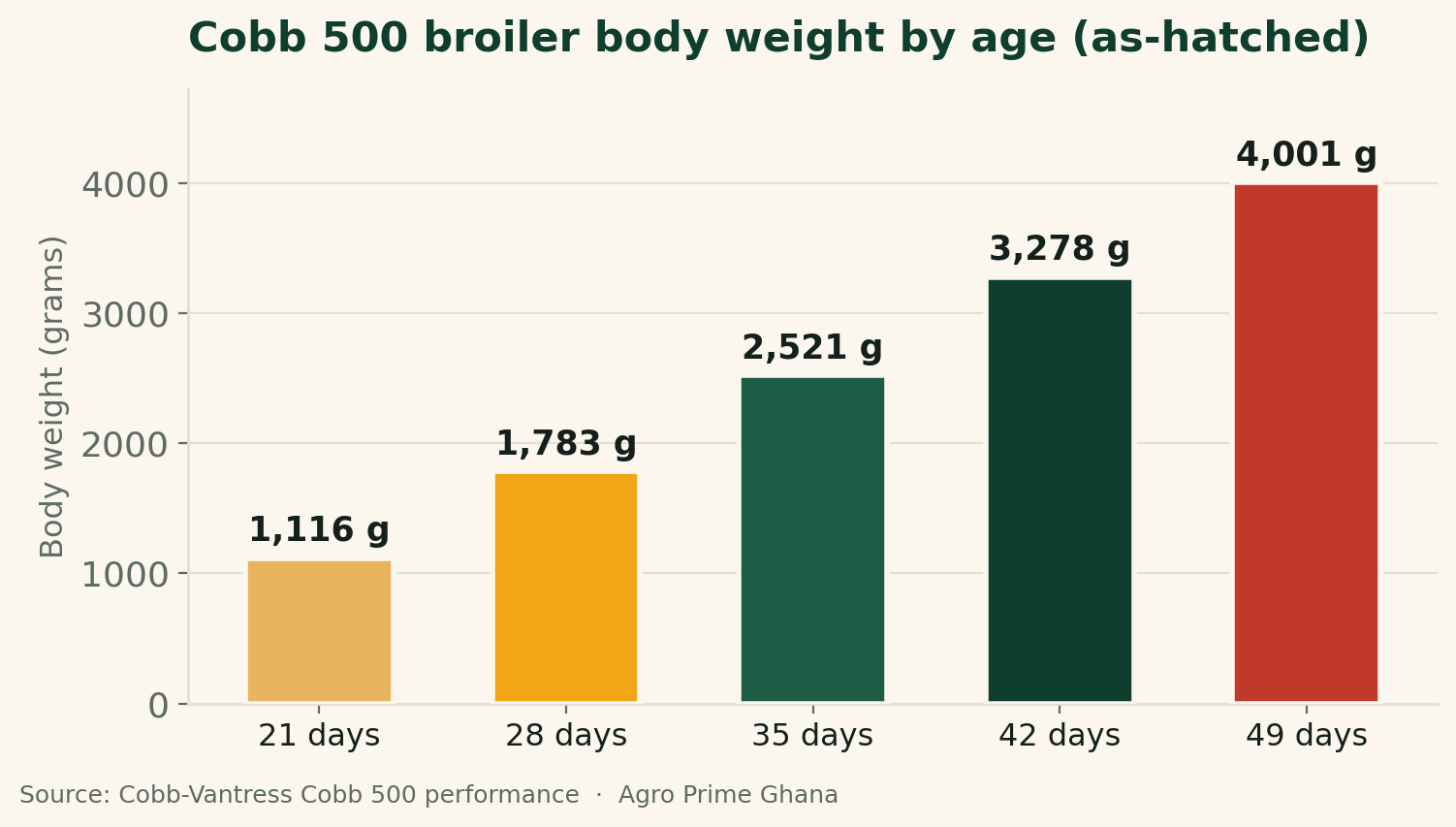
One full broiler cycle in Ghana is about seven to eight weeks: roughly six weeks of grow-out plus one to two weeks to clean, disinfect, dry and rest the house before the next chicks come in. The grow-out itself depends on the weight your market wants. Cobb-Vantress performance figures for the Cobb 500, one of the most common broiler strains sold here, give a clear picture of how fast the bird puts on weight — and of the point where growth starts to cost you more feed per kilo.
| Age | Body weight (as-hatched) | Cumulative FCR | What it means for your calendar |
|---|---|---|---|
| 21 days (3 wk) | ≈ 1,116 g | ≈ 1.18 | Very efficient, but too small for most markets |
| 28 days (4 wk) | ≈ 1,783 g | ≈ 1.32 | Small "soft" bird; some hotel/street demand |
| 35 days (5 wk) | ≈ 2,521 g | ≈ 1.44 | Popular live-market weight, feed still cheap per kg |
| 42 days (6 wk) | ≈ 3,278 g | ≈ 1.55 | Standard full-size festive bird — the usual target |
| 49 days (7 wk) | ≈ 4,001 g | ≈ 1.69 | Big bird, but each extra kg now costs more feed |
Read across the table and the trade-off is obvious: from 42 to 49 days the bird adds another 700 grams or so, but the cumulative feed conversion worsens from about 1.55 to about 1.69 — meaning every extra kilo of gain now takes more feed than the kilos before it. That is why most Ghanaian producers pull broilers at five to six weeks for the live market, and only push to seven weeks when a customer specifically wants and will pay for very large birds. We cover this decision in depth in our guide to the best age to sell broilers in Ghana, and the growth targets in our broiler weight chart.
Counting back from the sale date: the core arithmetic
To build the calendar, you only need to master one backward count. Start from the day you want cash in hand and step back:
- Sale date — the day (or two-to-three-day window) buyers are paying the most. For festive birds, this is the last few days before the holiday, not the holiday itself.
- Minus 6 weeks → chick-arrival date. For a standard ~3.3 kg bird at 42 days, chicks must be on the floor six weeks before the sale window. For a lighter 5-week bird, count back five weeks; for a heavy 7-week bird, seven.
- Minus another 1–2 weeks (before the previous batch) → clean-out window. The house that will hold these chicks needs to be emptied, washed, disinfected, dried and rested first.
- Minus your supplier's lead time → order date. Good hatcheries sell out their best hatch dates ahead of the festive rush, so the safe move is to book chicks several weeks — often a month or more — before you need them, especially for December and Easter.
A concrete example: to sell full-size birds on 22–23 December, chicks should hatch and arrive in the second week of November (about six weeks earlier). The house serving that batch should have finished its previous flock and gone through clean-out by late October / early November. And the order for those November chicks should ideally be placed by September or early October, before every serious producer in the country is chasing the same hatch dates. Miss the order window and you are not late by a day — you are late by a whole selling season.
Field note: build in a one-week safety buffer
On paper a bird hits weight at exactly 42 days. In the real Ghanaian house it does not always, because heat, a feed change, a mild disease knock or a cool harmattan spell can slow a batch by several days. We plan festive batches to be ready a few days early rather than bang on the deadline — aiming to have sale-weight birds by around day 40, with the market date a few days later. That buffer costs a little extra feed but protects the whole point of the exercise: being ready when the price is high. A batch that hits weight on the 27th of December has missed the entire year's best market by four days.
How many batches can one house run per year?
Run properly all-in/all-out, a single broiler house in Ghana can turn about six batches a year. The arithmetic is straightforward: roughly 52 weeks divided by a seven-to-eight-week cycle gives six to seven cycles, and you lose a little to the longer clean-outs you should take after any disease problem. Poultry Hub's figures point to the same range, and it is the standard planning number worldwide.
Resist the temptation to squeeze in a seventh batch by skimping on the down-time. The clean-out is not dead time — it is disease control. The whole logic of the all-in/all-out system is that emptying, washing, disinfecting and resting the house between flocks breaks the cycle of pathogens that would otherwise build up batch after batch. Cut that short and you save a week now but pay for it later in a slow, sick, unprofitable flock. Six clean, healthy batches beat seven struggling ones every time.
A worked month-by-month plan for a single house
Here is what six batches through one house looks like across a year, each timed either at a demand peak or at a moment when the house would otherwise sit empty. Treat it as a template and shift the dates to your own market and your supplier's hatch schedule.
| Batch | Chicks arrive | Sell (≈6 wk later) | Why this timing |
|---|---|---|---|
| 1 | Mid-January | Late February | Fills the post-festive gap; low chick demand means easy booking |
| 2 | Mid/late February | Easter window (Mar–Apr) | Lands live birds into the Easter demand peak |
| 3 | Late April | Early June | Steady mid-year trade; watch for rainy-season management |
| 4 | Late June / July | August | Grow-out runs into cheap maize at harvest — lower feed cost |
| 5 | Early September | Mid-October | Uses cheap post-harvest feed; sells before festive crush |
| 6 | Second week November | 22–24 December | The big one: full-weight birds for the Christmas live market |
Notice two things about this plan. First, the December batch is treated as the anchor and everything is arranged so the house is empty, cleaned and ready to receive its chicks in early November. Second, batches 4 and 5 are deliberately grown through the July–October maize harvest, when feed is cheapest — a point we return to below. The exact dates of Easter and the Muslim festivals move each year, so re-draw the middle of your calendar annually rather than copying last year's dates blindly. Our companion guide to year-round poultry planning in Ghana maps those moving peaks in detail.
Hitting the festive market windows
The reason a calendar pays is that Ghanaian demand for live chicken is strongly seasonal. As The Poultry Site describes, chicken consumption here has long been concentrated around celebrations — Christmas, Easter and other festive occasions — with farmers historically timing "their production schedules to coincide with the festive seasons' peak demand," and consumers favouring "live, home-slaughtered chicken" for those events. Even though imported frozen chicken now makes up the bulk of everyday consumption, the festive live-bird market remains the moment when a local broiler grower can command the best price. That is the window your calendar exists to hit.
The practical rules for hitting it are simple. Decide the sale date as the two-to-three days before the holiday, when buyers stock up. Count back six weeks for chick arrival. Book those chicks early, because you are competing with every other producer for the same hatch dates. And be ready a few days early rather than a day late. For the marketing side — pricing, finding buyers, and moving birds fast in a short window — see our guides to selling live birds in the festive season and poultry marketing in Ghana.
Order your chicks on a schedule — we hatch on a schedule
The single most common reason a farmer misses a festive market is not disease or feed — it is chicks that arrive a week or two late because they were booked too close to the rush. Agro Prime Ghana hatches day-old broiler and layer chicks on a reliable, planned schedule, so if you tell us the date you want to sell, we can work back with you to the exact hatch date your chicks should come from and reserve that slot. Bring us your target sale window — Christmas, Easter, a specific contract — and we will help you build the order dates around it. Message us on WhatsApp +233 24 915 1503 or book a visit to plan and reserve your chicks ahead of the season.
Timing feed buying to the maize harvest
A production calendar is not only about selling high — it is also about buying feed low, and in a broiler operation feed is by far the biggest cost. Maize, the energy base of every broiler ration, is strongly seasonal in Ghana. Analysis of Ghanaian maize markets by Amanor-Boadu (Kansas State University / AgManager) found that between July and October maize prices declined by roughly 15% to 34% across the crop years studied, before climbing steadily again through the lean season from about November to June. In other words, feed is cheapest right after the main harvest and dearest in the months before the next one.
The calendar lets you exploit this in two ways. First, where storage allows, buy and properly store maize during the July–October trough rather than at lean-season prices — keeping it dry to avoid the mould and aflatoxin problems that ruin badly stored grain. Second, schedule batches so that the feed-hungry finishing weeks fall during or just after harvest when possible. A batch grown through August–September on cheap maize can be markedly more profitable than the identical batch grown in April–May on expensive maize. For more on trimming this cost, see reducing poultry feed cost in Ghana and maize quality for poultry feed.
Recording and reviewing the calendar
A calendar is only as good as the records that feed it. For every batch, write down the order date, arrival date, number and cost of chicks, feed used, mortality, the age and weight at sale, the price you got, and the date the house was cleared and cleaned. Over a few batches this turns guesswork into knowledge: you learn how many days your birds in your house actually take to reach weight, how the season affects them, and which market dates paid best. That is what lets you tighten next year's calendar instead of repeating this year's mistakes. Our guide to record-keeping on a poultry farm gives simple templates, and if you are weighing the enterprise against eggs, see broiler vs layer profit in Ghana.
The bottom line on a broiler calendar
A broiler production calendar turns poultry from a gamble into a plan. Because the bird grows on a predictable six-week clock and the house needs one to two weeks to turn around, you can decide today exactly when to order, receive, sell and clean — and line all of it up so your birds are heaviest when prices are highest and your feed is cheapest when maize is at harvest. Anchor the year on the December market, work every date backwards from each sale window, book chicks early on a reliable hatch schedule, keep the house on strict all-in/all-out, and record every batch so next year's plan is sharper than this year's. Do that, and you stop selling whatever you happen to have whenever it happens to be ready — and start selling exactly what the market wants, exactly when it wants it.
Frequently asked questions
How do I build a broiler production calendar?
How long does it take to raise a broiler to market weight in Ghana?
How many broiler batches can I raise per year?
When should I order chicks to sell broilers at Christmas?
How much down-time do I need between broiler batches?
Should I sell broilers at 5, 6 or 7 weeks?
How does the maize harvest affect my broiler calendar?
Can I run several houses on staggered calendars?
Sources & further reading
- Cobb-Vantress — Cobb 500 broiler performance targets (body weight and cumulative FCR by age), as tabulated in the Cobb 500 Broiler Performance Metrics summary.
- Poultry Hub Australia — Meat chicken farm sequence (grow-out length, clean-out and down-time between batches).
- The Poultry Site — Chickens for Christmas: Ghana's unique poultry market (festive demand and timing production to peaks).
- V. Amanor-Boadu, Kansas State University / AgManager — Maize Price Trends in Ghana (2007–2011) (harvest vs lean-season maize prices).
- Agro Prime Ghana guides: best age to sell broilers, all-in/all-out poultry, selling live birds in the festive season, and year-round poultry planning.
About Agro Prime Ghana
Agro Prime Ghana Limited runs a poultry hatchery and mixed agribusiness in Kasoa, hatching day-old chicks on a planned, reliable schedule and working alongside poultry keepers across the country. We supply healthy day-old chicks (broilers & layers), point-of-lay pullets, quality feed and hands-on farm support nationwide. This article is general educational information, not a substitute for professional agronomic or veterinary advice. Ready to plan your next batch? Tell us your target sale date and we will help you work back to the right hatch date and reserve your chicks. Book a visit or message us on WhatsApp (+233 24 915 1503) to order chicks, feed or advice.