Walk onto a struggling poultry farm in Ghana and you will often find the same quiet mistake: birds of three or four different ages sharing one compound, a fresh batch of day-old chicks moving into a pen the previous flock only vacated last week, and a keeper who cannot understand why coccidiosis, Newcastle and chronic respiratory disease keep coming back no matter how much medicine is bought. The problem is rarely the medicine. It is that the farm never gives disease a chance to die out, because there is always a live bird somewhere keeping the germ alive. All-in/all-out is the discipline that fixes this — filling a house with one single-age group, raising them together, clearing them out together, then cleaning, disinfecting and resting the empty house before the next flock arrives. This guide explains how it works, why it breaks disease cycles, and how to run it on a real Ghanaian farm.
Written by the Agro Prime Ghana poultry team and reviewed against current industry references (PoultryMed and Cobb Genetics management guidance). Last updated September 2026.
Key takeaways
All-in/all-out (AIAO) means one house holds one single-age flock that arrives together and leaves together, so the building can be completely emptied between batches. That empty window is what breaks disease cycles: pathogens in litter, dust and cracks have no host to keep them alive and start to die off, and only then can a full clean and disinfect actually work. Industry guidance recommends a minimum of 14 days' downtime for commercial systems between flocks, with proper cleaning and drying inside that window. The opposite system — continuous flow, where new birds keep arriving beside older ones — never lets the building empty, so infection is handed straight from one batch to the next. AIAO cuts disease pressure, reduces medication, and lifts growth and survival, which is why almost every well-run commercial farm uses it.
What all-in/all-out actually means
All-in/all-out is a stocking pattern, not a product you buy. The rule is simple: a house (or, on a bigger farm, a whole site) is filled with birds of one age at one time, that group is managed as a single unit for its whole cycle, and every bird leaves within a short window — for broilers at sale weight, for a laying flock at the end of lay. No new birds are slipped in halfway to "top up" numbers, and no birds from an older batch are left behind. As the biosecurity guidance from Biosecurity Nova Scotia puts it, the animals "are often all the same age, and new animals are not added to the group," which allows the entire barn to be "empty at once" so it "can be cleaned and disinfected without risk of transferring contamination from flock to flock."
That last phrase is the whole point. The value of AIAO is not the way the birds go in — it is the empty house you are left with when they all go out. Only a completely empty building can be properly cleaned, disinfected, dried and rested. The moment even one live bird remains, you have a reservoir that keeps germs alive and re-seeds the fresh flock.
Why it breaks disease cycles
Most of the diseases that cost Ghanaian keepers real money are recycled, not re-introduced. The coccidiosis oocysts in the litter, the Newcastle or Gumboro virus in the dust, the E. coli and Salmonella in the cracks of a mud floor, the worm eggs in damp corners — these survive in the building itself. As PoultryMed notes, "pathogens like bacteria, viruses, and parasites can survive in litter, dust, or hidden corners of equipment — even after cleaning." What kills them is not just chemicals; it is time without a host. Many poultry pathogens are adapted to living inside or on a chicken. Take the chickens away, clean out the organic matter they leave behind, and the survivors are left exposed on dry, disinfected surfaces with nothing to infect — so their numbers fall.
Downtime, PoultryMed explains, gives pathogens "time to die off in the absence of a host." That is the biological engine behind AIAO. On a continuous-flow farm this engine never runs: there is always a bird in the building, so the germ always has somewhere to live, and each new batch of chicks walks into a challenge the previous batch built up. On an all-in/all-out farm the chain is snapped once per cycle — you clear the birds, clear the muck, let the empty house sit, and the next flock starts from a far lower load. This is exactly why so many recurring problems — the coccidiosis that "always" hits at three weeks, the mortality spike that "always" comes in the second month — quietly disappear once a farm switches to true single-age batches with a proper rest between them.
All-in/all-out versus continuous flow
The clearest way to see the difference is to put the two systems side by side. Continuous flow looks efficient because the house is never empty and therefore "never idle" — but that constant occupancy is precisely the weakness. AIAO accepts a short empty period as the price of breaking the disease chain, and almost always comes out ahead over the year.
| Factor | All-in/all-out | Continuous flow |
|---|---|---|
| Ages on the farm | One age per house/site at a time | Many ages together, always |
| Can the house be fully emptied? | Yes — every cycle | No — never truly empty |
| Cleaning & disinfection | Thorough, on an empty building | Partial, always working around live birds |
| Disease carry-over to next batch | Broken by the empty, rested window | Passed straight from old to young birds |
| Medication use | Usually lower | Usually higher and recurring |
| Management & records | Simple — one age, one programme | Complex — overlapping ages and schedules |
| House occupancy | Short idle window each cycle | Continuously stocked |
How much downtime you need between flocks
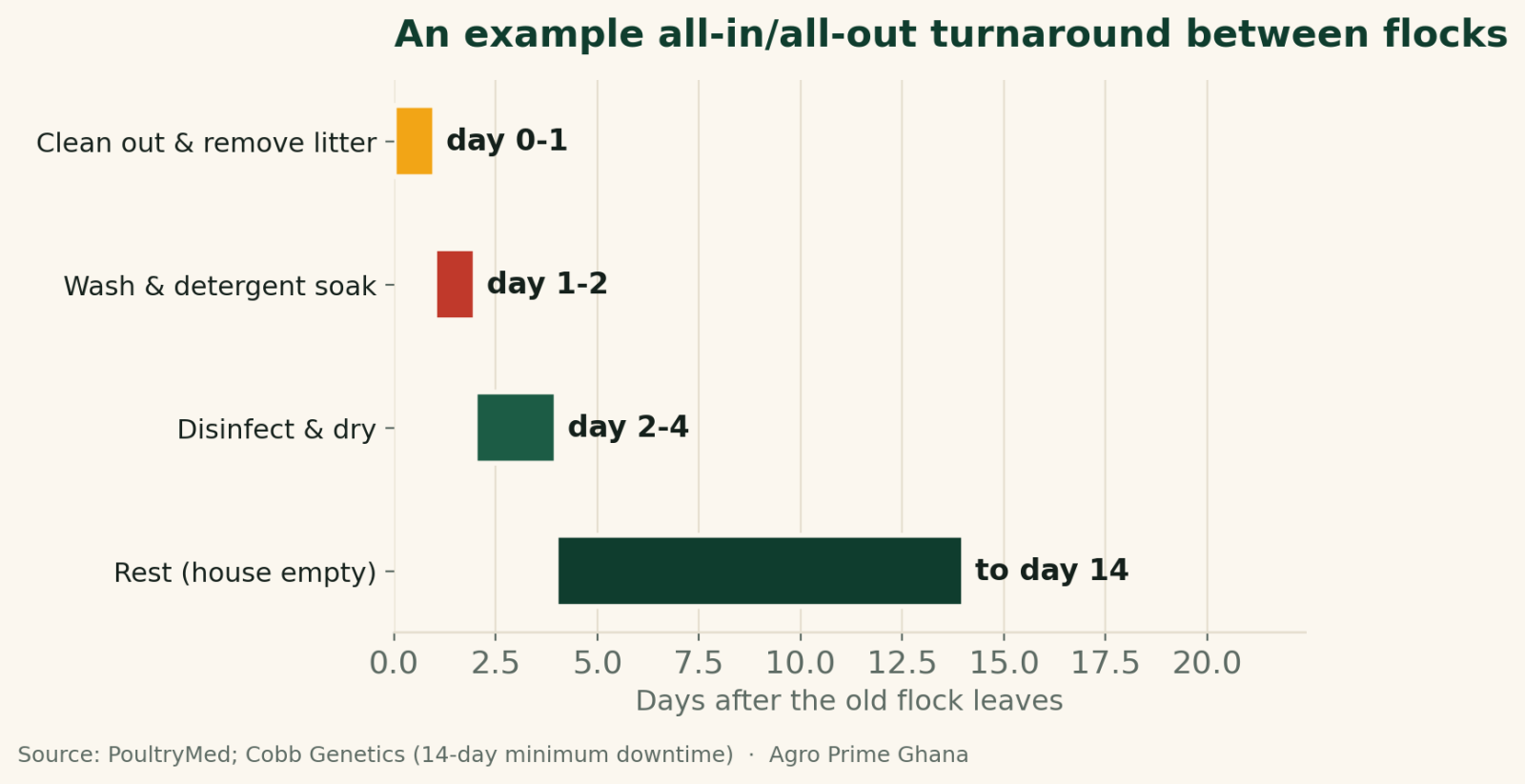
The empty period is not wasted time — it is the working part of the system, and it needs to be long enough to do three jobs: let pathogens start dying off, allow a proper clean and disinfect, and give surfaces time to dry completely. For commercial systems the widely quoted figure is a minimum of 14 days of downtime between flocks, as PoultryMed recommends, though it adds that even on smaller flocks "a few days of rest can make a noticeable difference." Cobb Genetics frames the same 14-day mark from the other direction, noting that flock biosecurity is maintained when the gap between finishing cleaning-and-disinfection and introducing the new flock is kept short and controlled.
Within that window the sequence matters. A workable turnaround is: clear the old flock and remove all litter and manure; wash the house down with detergent and water; disinfect; then let the building dry and rest until the new chicks arrive. Drying is not optional — PoultryMed stresses that proper downtime "allows for thorough drying after washing and disinfection," and a house brooded up while still damp simply hands the next flock a warm, moist surface that germs love. If you cannot manage a full 14 days on a small backyard scale, the principle still holds: every extra day of a properly cleaned, dry, empty house lowers the load the next flock meets.
Field note: the calendar is your cheapest disinfectant
On the farm, the temptation is always to rush the next batch in — a booked house earns money, an empty one does not, and a keen customer is waiting for chicks. But we treat the empty-house days as part of the growing cycle, planned into the schedule from the start, not as a gap to be squeezed. The practical trick is to book the new flock's arrival date after counting back the clean-out, wash, disinfect and dry days, rather than booking chicks first and cramming the cleaning into whatever is left. Time itself is doing real work in that window — pathogens dying with no bird to feed on — and it costs nothing but patience. A house rushed back into use while still damp and dirty will cost far more in the next flock's medicine bill than the few days you thought you were saving.
Single-age sites versus single-age houses
The ideal is one age on the entire farm at a time. In practice many Ghanaian keepers run more than one house and want birds coming through steadily, so they operate AIAO house-by-house instead of site-wide. That is a reasonable compromise, but only if the houses are managed as genuinely separate units. Biosecurity Nova Scotia is blunt about this: where different groups or production types share a farm, they "should be kept separate to achieve an all in/all out situation when possible," with different footwear and clothing between barns and, ideally, staff working from youngest birds to oldest rather than carrying germs backwards.
The failure mode to avoid is the one that looks like AIAO but is not: separate houses on paper, but the same person walking straight from a coughing older flock into the brooder house, the same feed scoop and boots moving between them, the same wet spot of shared ground in between. If germs can hitch a ride from house to house on people and equipment, you have quietly rebuilt a continuous-flow farm with extra walls. Keeping the youngest, most vulnerable birds physically and hygienically separate from older stock is the heart of making multi-house AIAO honest. Our guide to poultry biosecurity in Ghana covers the boots, dips and traffic rules that make this stick.
What happens in the empty window
AIAO is only as good as the work you do while the house stands empty, through a set sequence: remove every bird; strip out and dispose of all used litter and manure well away from the houses; dry-clean dust from surfaces, fans and equipment; wash down with detergent to lift the greasy film that shields germs; apply a proper disinfectant at the right dilution for its full contact time; then dry and rest. Skipping any step undoes the rest — a disinfectant sprayed onto caked manure is largely wasted, because organic matter soaks up and inactivates many disinfectants before they can work.
Litter handling deserves special attention in our climate, because old litter is a concentrated reservoir of coccidiosis oocysts, worm eggs and bacteria, and how you remove and store it decides whether you have really cleared the challenge or just moved it next door. Our guide to poultry litter management goes through safe clean-out and disposal. Get this window right and each new flock starts on a genuinely low disease load; get it wrong and AIAO becomes a tidy-looking ritual that changes nothing.
Why AIAO pays on a Ghanaian farm
The benefits of all-in/all-out show up on the balance sheet. PoultryMed lists the main gains from proper downtime as disease control through pathogen elimination, more effective cleaning, reduced medication, and better bird performance and resilience. In Ghanaian terms that means fewer of the recurring outbreaks that force emergency drug purchases, chicks that grow more evenly because they are not fighting an inherited infection from day one, and lower mortality — every bird that survives to sale is margin you keep. There is also a management dividend keepers underrate: with one age in the house, vaccination, feed changes, lighting and record-keeping all follow a single clean schedule instead of the tangle of overlapping programmes multi-age farms wrestle with. Diseases like Newcastle, which spread fast and punish mixed-age farms hardest, are far easier to keep out when there is no older carrier flock on site — see our guide to Newcastle disease in Ghana.
Field note: the "one sick house infects the next" trap
The most common way we see AIAO quietly fail is not in the paperwork but in the footpaths. A farm keeps its ages in separate houses — genuinely single-age batches — and still fights recurring disease, because staff, feed bowls, egg trays and boots move freely between an older house and the brooder. The germs do not need the birds to mix; they travel on us. Working strictly from the youngest house to the oldest, never the other way, and keeping dedicated boots or a foot dip at each door, is what turns "separate houses" into real all-in/all-out. It feels fussy on a small farm, but it is the difference between breaking the cycle and just relocating it.
Making the switch on an existing farm
If your farm currently runs continuous flow, you do not fix it overnight, but you can move towards AIAO deliberately. The cleanest reset is to let a house empty completely at the end of a batch and not refill it until it has been cleaned, disinfected, dried and rested — accepting one longer gap now to break the chain that has been costing you every cycle. From there, plan each new intake as a single-age batch with its own arrival and clear-out dates, and book chicks around the turnaround time rather than the other way round. Where you run several houses, stagger intakes so each building still gets its own empty window while the farm stays productive, and tighten the traffic rules between houses at the same time. It is a change of habit more than of infrastructure, and one of the highest-return decisions a Ghanaian keeper can make.
The bottom line on all-in/all-out
All-in/all-out is not a fancy commercial luxury — it is the single management idea that lets you actually get rid of disease instead of endlessly treating it. By filling a house with one age, clearing them together, and then cleaning, disinfecting and resting the empty building for a proper period (a minimum of about 14 days on commercial systems), you take away the live host that keeps pathogens alive and hand each new flock a genuinely clean start. Continuous flow does the opposite: it never lets the house empty, so it passes infection straight from old birds to young ones, cycle after cycle. Run true single-age batches, keep your ages and your footpaths separate, respect the downtime, and do the clean-out properly, and you will spend less on medicine, lose fewer birds, and finally break the disease cycles that make so many farms feel like they are running to stand still.
Frequently asked questions
What does all-in/all-out mean in poultry?
Why does all-in/all-out break disease cycles?
How long should a poultry house stay empty between flocks?
Can I run all-in/all-out with more than one house?
What is wrong with continuous flow (mixing ages)?
Do I still need to clean if I already use all-in/all-out?
Is all-in/all-out worth it for a small backyard flock?
How does all-in/all-out reduce my medicine costs?
Sources & further reading
- PoultryMed — Downtime Between Poultry Flocks: Why It Matters (14-day minimum downtime, pathogens dying off without a host, cleaning and drying, benefits).
- Biosecurity Nova Scotia — Tips for "All In/All Out" Production (single-age groups, emptying the barn, separating production types, traffic between barns).
- Cobb Genetics — Disinfection of Poultry Breeder Houses (controlled gap before new flock, cleaning and disinfection standards).
- Agro Prime Ghana guides: poultry biosecurity, poultry litter management, and Newcastle disease in Ghana.
About Agro Prime Ghana
Agro Prime Ghana Limited runs a poultry hatchery and mixed agribusiness in Kasoa, supplying day-old chicks and working alongside poultry keepers across the country. These guides draw on that hands-on hatchery and farm experience, checked against current industry and veterinary references. This article is general educational information, not a substitute for advice from a qualified veterinary or extension officer. Need chicks, feed advice or farm support? Book a visit or message us on WhatsApp (+233 24 915 1503).