It is the question almost every new poultry farmer in Ghana asks before they buy a single chick: broilers or layers — which one makes more money? The honest answer is that they are two very different businesses that happen to share a bird. Broilers are a fast, capital-hungry sprint measured in weeks; layers are a slow, patient marathon measured in more than a year. One can pay you back before the next rains; the other ties up your money for months before the first cedi comes in, then pays steadily for a long time. Choosing wrongly for your capital, your cash-flow and your market is one of the most expensive mistakes in poultry. This guide compares the two on the things that actually decide profit — cycle length, feed, risk, and how the money flows — so you can pick the enterprise that fits your situation rather than the one that sounds best.
Written by the Agro Prime Ghana poultry team and reviewed against agricultural economics references (FAO smallholder poultry data and a peer-reviewed Ghana study of layer profit efficiency). Last updated September 2026.
Key takeaways
Neither enterprise is simply "more profitable" — they profit differently. Broilers reach market weight of about 2 kg in roughly 5–7 weeks, converting feed efficiently (feed conversion around 1.7–1.9 on good management), so money turns over fast — but so does risk, and margins per bird are thin. Layers cost you for about 18–20 weeks before they lay a single egg, then produce roughly 250–290 eggs per hen a year for a laying period of a year or more, giving steady income and a spent-hen at the end. Feed is the dominant cost either way, at roughly 58–68% of total cost. Ghanaian layer farms have been measured at only about 54% profit efficiency, so management — not the choice of bird — often decides who profits. Match the enterprise to your capital, your patience and your market.
Two different businesses, not one choice
The first thing to understand is that comparing broilers and layers is less like choosing between two cars and more like choosing between a taxi and a rental property. A broiler flock is a short, intense production run: you buy day-old chicks, feed them hard for a few weeks, and sell them all at once as meat. A layer flock is a long-term asset: you raise pullets for months at a cost, and only then do they start earning, paying you back gradually through daily egg sales over a laying period that stretches well beyond a year. That single difference — how long your money is tied up before it comes back — drives almost everything else, from how much capital you need to start, to how you handle risk, to what kind of market you must line up. A farmer with modest savings who needs cash back quickly, and a farmer who can afford to wait months for a steady monthly income, are being pulled toward opposite ends of this spectrum, and both can be right for their own situation.
Cycle length and cash-flow: the decisive difference
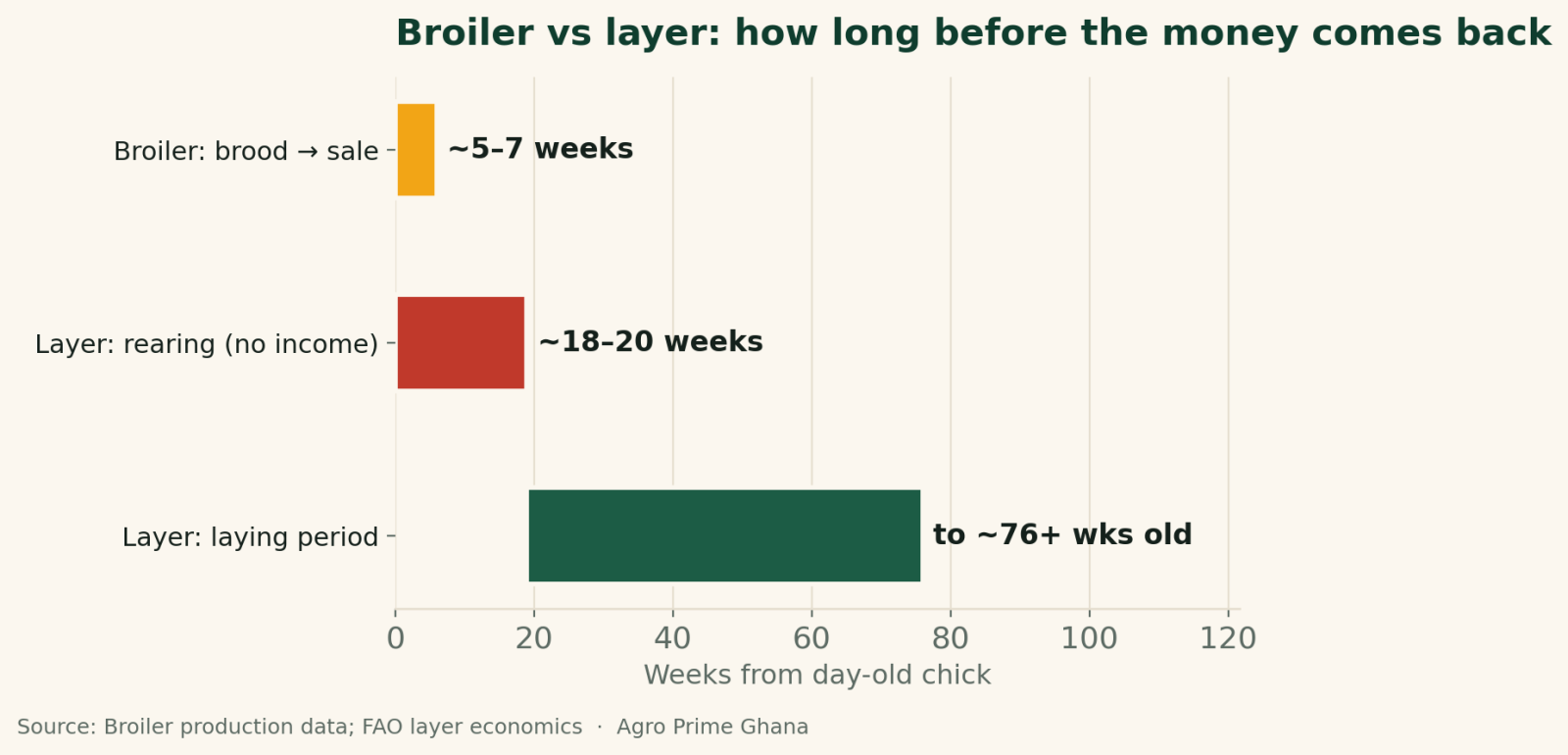
Broilers are bred for speed. Modern commercial strains reach a slaughter weight of about 2 kg in only 5 to 7 weeks, according to standard broiler production data — an astonishing rate of growth compared with the fourteen-plus weeks a slow-growing local-type bird needs. For the farmer that means several complete cycles in a single year: capital goes in and comes back out quickly, and profit compounds each time you turn it over. But the same speed cuts both ways. Everything is compressed, mistakes are punished fast, and because you sell everything at once you are entirely at the mercy of the market price on sale day.
Layers run on the opposite clock. A pullet must be reared for roughly 18 to 20 weeks before she comes into lay — nearly five months of feeding, housing and vaccinating with no income at all — and only then does she begin producing. Once laying, though, a good hen delivers on the order of 250 to 290 eggs a year across a laying period of a year or more, giving you daily cash rather than one big pay-day, and at the end of it a spent hen still worth selling for meat. The trade-off is stark and worth stating plainly: broilers give you fast turnover and high risk concentration; layers demand patience and working capital up front but then hand you a steadier, more diversified income. The chart below lays the two timelines side by side.
Broilers vs layers at a glance
The table below sets the two enterprises against each other on the factors that most affect profit. Treat the figures as realistic planning ranges under good Ghanaian management, not guarantees — your own records will give you the numbers that matter for your farm.
| Factor | Broilers | Layers |
|---|---|---|
| Time to first income | ~5–7 weeks (one sale) | ~18–20 weeks (then daily for a year+) |
| Main product | Meat, sold all at once | Eggs daily, plus spent hens at end |
| Capital tied up before payback | Low — weeks of feed | High — ~5 months of feed & care first |
| Feed conversion | ~1.7–1.9 kg feed per kg bird | Measured per dozen eggs, over long period |
| Feed share of total cost | High (~60–70%) | High (~58–68%) |
| Cycles per year | Several (fast turnover) | One long flock (~1.5 years in production) |
| Main risks | Price crash on sale day, disease, heat | Long exposure to disease & feed-price swings |
| Income pattern | Lumpy — big pay-days, gaps between | Steady — small daily cash-flow |
Where the money goes: feed dominates both
Whichever bird you keep, one cost towers over the rest: feed. FAO's smallholder poultry figures put feed at roughly 58 to 68% of the total cost of producing eggs, and broiler economics are much the same, with feed comfortably the largest line. This has a profound implication for the profitability question: the choice between broilers and layers matters far less than how efficiently you feed either one. A broiler flock with a feed conversion of 1.7 will out-earn one at 2.1 on identical bird and feed prices, and a layer flock that holds peak production on well-formulated feed will bury one that lays erratically on a cheap, poorly balanced ration. Because feed is where the money is, it is also where the discipline must be — which is why keeping honest feed and performance records is the real profit lever in both enterprises. Our guides to broiler feeding and layer feeding set out the intakes and ration changes by age that keep those conversion figures where they need to be.
Field note: the "cheap feed" trap catches both enterprises
The most common way we see farmers lose money is not choosing the wrong bird — it is buying the wrong feed to save a few cedis a bag. On broilers a poorly balanced or aflatoxin-tainted ration quietly pushes feed conversion from 1.8 toward 2.2, and because feed is two-thirds of your cost, that "cheap" bag ends up making each kilo of chicken more expensive to produce, not less. On layers the same false economy shows up as hens that never quite reach or hold peak lay. The only way to catch it is to judge feed by results — kilos of bird or dozens of eggs per bag — not by the price on the sack. The farm that measures conversion buys expensive feed with confidence because it can see it pays.
Risk: fast and sharp versus slow and long
Broilers and layers expose you to risk in opposite ways. With broilers the danger is concentrated and sudden: your entire return depends on the price you get on one sale day, so a market glut — the kind that hits when everyone floods the market at Christmas or Easter — can wipe out a cycle's profit no matter how well the birds grew. Disease or a heat wave in the final week, when the birds are big and eating most, can be financially devastating. But the exposure is short; a bad batch is over in weeks, and you can regroup. Layers carry the reverse profile: lower peaks but a much longer exposure. Your capital sits in the flock for the better part of two years, during which anything can happen — a disease outbreak that dents production, months of high feed prices, a fall in egg prices — and a single serious Newcastle or other viral event in a laying flock can cost you not just birds but the months of rearing investment behind them. This is why biosecurity and a solid vaccination programme matter even more for layers, where you are protecting a long-lived, expensive asset rather than a quick crop. Starting either enterprise with strong, healthy stock is the cheapest risk reduction available, which is why it pays to know how to choose healthy day-old chicks before you buy.
Market and seasonality: who buys, and when
Profit is made at the point of sale, so the market you can reach should shape your choice as much as your capital does. Broiler demand in Ghana is famously seasonal and lumpy: it spikes around festive periods — Christmas, Easter, Eid — when live and dressed birds command their best prices, and can be sluggish in between. A farmer who can time a flock to hit the market in December, and who has buyers lined up, can do very well; one who lands a batch into a flat, oversupplied market may struggle to clear it at a profit while the birds keep eating past their efficient age. Eggs, by contrast, sell steadily all year — to households, "waakye" and street-food sellers, provision shops, hotels and schools — which is part of what makes layers attractive to farmers who value predictable income over big seasonal wins. The flip side is that egg prices can be squeezed when the market is well-supplied, and eggs are perishable and awkward to hold, so a layer farmer needs reliable regular buyers rather than the occasional big order a broiler seller can chase. In short: broilers reward those who can play the calendar and line up bulk buyers; layers reward those who can build steady, repeat custom.
Field note: match the enterprise to your cash, not your ambition
When people ask us which to start with, the most useful question back is not "which is more profitable?" but "how long can your money wait?" A farmer with limited capital who needs the cash to recycle quickly is usually better suited to a modest broiler batch, where money comes back in weeks and can be reinvested — provided a market is lined up before the chicks arrive. A farmer who can afford to feed birds for five months with nothing coming in, and who wants steady income afterwards, is better matched to layers. We have watched enthusiastic starters put their last cedis into a big layer flock, then run out of feed money in month three — the birds were fine, the plan was not. Choose the enterprise your cash-flow can actually survive.
So which is more profitable in Ghana?
The research points to a conclusion that frustrates anyone hoping for a simple winner: profitability is decided more by management than by the choice of bird. The study of profit efficiency among Ghanaian layer producers found the average farm operating at only about 54% profit efficiency — leaving nearly half its potential profit unclaimed — with feed price and labour the biggest drags on returns. The clear message is that the gap between a well-run and a poorly-run farm of the same type dwarfs the average gap between the two enterprises. A disciplined broiler farmer hitting good feed conversion and timing festive sales can be very profitable; so can a disciplined layer farmer holding peak production and selling to steady buyers. An undisciplined version of either loses money regardless of which bird is in the house. Both enterprises are profitable in Ghana under good management, and both punish poor management. The right question is therefore not "which is more profitable in general?" but "which fits my capital, my patience, my market and my skill — and can I run it well enough to capture the profit that is there?"
The bottom line on broilers versus layers
Broilers and layers are two honest routes to a living from poultry, not a right answer and a wrong one. Broilers offer speed and fast turnover of capital, thin per-bird margins, sharp concentrated risk and lumpy, seasonal income — a good fit for farmers with limited capital, a festive-season market and the discipline to feed efficiently and sell on time. Layers demand patience and months of up-front feeding before the first egg, then repay it with steady year-round income and a spent-hen bonus — a good fit for farmers who can wait, who value predictable cash-flow, and who can protect a long-lived flock and build regular buyers. Feed dominates the cost of both, so feeding well and keeping records is the real profit engine either way. Decide by matching the enterprise to your own situation, run it tightly, and the bird you chose will earn its keep.
Frequently asked questions
Which is more profitable in Ghana, broilers or layers?
How long before broilers and layers start making money?
Which needs more capital to start?
How many eggs does a good layer produce?
What is feed conversion and why does it matter for profit?
Why is feed such a big part of poultry costs?
Are broilers riskier than layers?
Can I keep both broilers and layers on the same farm?
Sources & further reading
- Wikipedia (citing broiler production science) — Broiler (age and weight at slaughter, growth rate, feed conversion figures).
- FAO — Small-scale poultry production (feed as a share of cost, eggs per hen per year, system economics).
- Ntim Adjei-Mensah et al. — Profit efficiency of layer production in Ghana (measured profit efficiency, feed and labour as main cost drivers).
- Agro Prime Ghana guides: broiler feeding, layer feeding, and choosing healthy day-old chicks.
About Agro Prime Ghana
Agro Prime Ghana Limited runs a poultry hatchery and mixed agribusiness in Kasoa, supplying day-old chicks and working alongside poultry keepers across the country. These guides combine hands-on hatchery and farm experience with current agricultural references. This article is general educational information, not a substitute for professional advice tailored to your farm and market. Need chicks, feed advice or farm support? Book a visit or message us on WhatsApp (+233 24 915 1503).