A broiler weight chart is the week-by-week list of target body weights a healthy flock should hit at each age, and it is the yardstick every serious broiler farmer measures against. On breed standards, an as-hatched broiler grows from about 42–44 grams at day-old to roughly 200 g at one week, 1 kg at three weeks, 2.4–2.5 kg at five weeks and over 3 kg by six weeks — while its feed conversion ratio (FCR) climbs from well under 1.0 in the first week to around 1.5 by six weeks. Those two numbers, weight and FCR, read together, tell you almost everything about whether a flock is on track or quietly losing you money. In Ghana, where feed is the biggest cost and buyers pay by size and timing, weighing a sample every week and comparing it against the chart is one of the highest-value five-minute jobs on the farm. This guide gives the full Cobb 500 and Ross 308 target weights and FCR by age, and shows you how to weigh and benchmark your own flock honestly.
Written by the Agro Prime Ghana poultry team and reviewed against current industry references (Cobb-Vantress and Aviagen Ross performance objectives). Last updated September 2026.
Key takeaways
Day-old broilers weigh about 42 g (Cobb 500) to 44 g (Ross 308). As-hatched targets rise to roughly 200–215 g by day 7, 540–570 g by day 14, 1.0–1.1 kg by day 21, 1.66–1.78 kg by day 28, 2.36–2.52 kg by day 35 and 3.09–3.28 kg by day 42. Cumulative FCR worsens with age — from under 1.0 in week one to about 1.44–1.56 by day 42 — which is why selling on time protects your margin. Benchmark by weighing a representative sample weekly: catch birds from several spots, average them, and compare against the chart. Being behind at day 7 usually means a brooding or feed problem to fix now. Uniformity matters as much as the average — a wide spread signals disease or competition for feed and water.
What is a broiler weight chart?
A broiler weight chart is a table of expected body weights for each day or week of a broiler's life, published by the breeding companies from tightly controlled trials. Because nearly every commercial broiler in Ghana is a Cobb or Ross bird (or a close relative), these charts apply directly to the flocks people actually raise here. The genetics companies publish separate figures for males, females and "as-hatched" (a straight-run mix of both, which is what most farmers buy), and the as-hatched numbers are the ones to benchmark a typical mixed flock against. It is important to understand what the chart is and is not: it is a target under good conditions, not a guarantee. A Ghanaian flock in an open-sided house through the heat will often run a little behind these numbers — but the chart tells you how big that gap is, and a gap you can measure is a gap you can close. Used weekly, the chart turns "the birds look alright" into a precise question: are they on target, and if not, by how much and since when?
Cobb 500 and Ross 308 target weights by age
Here are the published as-hatched targets for the two dominant broiler breeds, taken directly from the 2022 Cobb 500 performance data and the 2022 Ross 308 objectives. Both climb from roughly 42–44 g at placement to over 3 kg by six weeks; the two breeds are very close, with Cobb slightly heavier in the middle weeks and Ross a touch leaner on feed early on. The FCR column is cumulative — total feed eaten divided by live weight to that point — and note that Ross's method includes the chick's placement weight, which is part of why its early FCR figures look lower.
| Age | Cobb 500 weight (g) | Cobb 500 FCR | Ross 308 weight (g) | Ross 308 FCR |
|---|---|---|---|---|
| Day-old (0) | 42 | — | 44 | — |
| Day 7 | 202 | 0.891 | 214 | 0.772 |
| Day 14 | 570 | 1.029 | 540 | 0.995 |
| Day 21 | 1,116 | 1.182 | 1,033 | 1.130 |
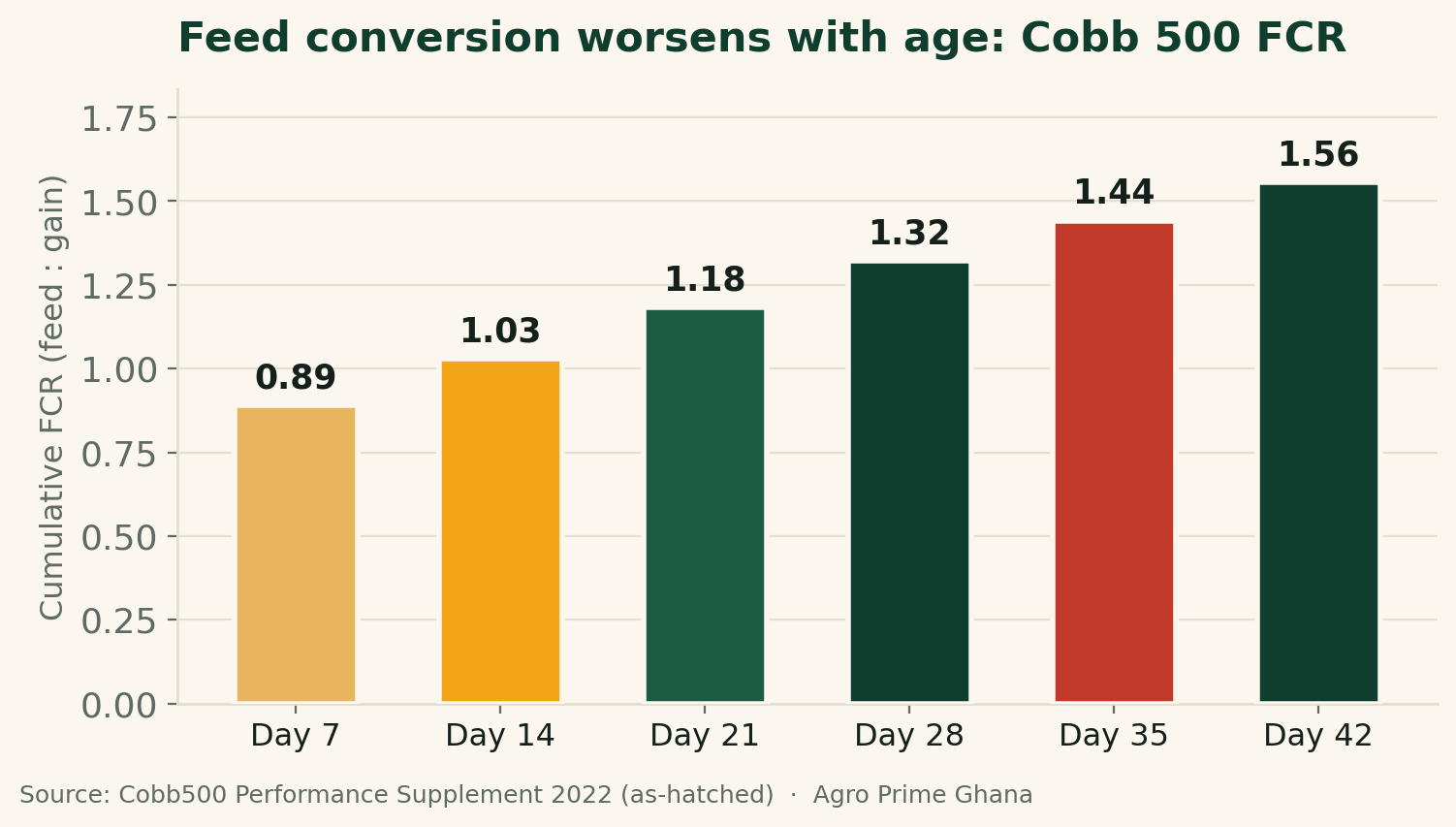
| Day 28 | 1,783 | 1.322 | 1,657 | 1.257 |
| Day 35 | 2,521 | 1.441 | 2,360 | 1.386 |
| Day 42 | 3,278 | 1.555 | 3,086 | 1.516 |
| Day 49 | 4,001 | 1.686 | — | — |
As-hatched (straight-run) figures. Sources: Cobb500 Broiler Performance & Nutrition Supplement 2022; Ross 308 Broiler Performance Objectives 2022. FCR is cumulative; Ross FCR includes placement weight.
Why FCR climbs as the bird grows
The single most important thing a weight chart teaches, beyond the weights themselves, is that feed conversion gets steadily worse with age — and that fact should drive your selling decisions. In the first week, a broiler converts feed extraordinarily efficiently; by six weeks, each additional kilogram of gain costs far more feed than it did earlier, because a bigger bird spends more feed just maintaining its body before any goes to growth. The chart below shows the Cobb 500 cumulative FCR climbing week by week. The practical lesson for a Ghanaian farmer is blunt: every day you hold a bird past its target market weight, you are buying weight at an increasingly poor rate, so unless a festive-season price premium justifies the heavier bird, the profitable move is to sell on time. Understanding this curve is the heart of our guide to broiler feed conversion ratio and the best age to sell broilers.
How to weigh a broiler flock
Weighing is only useful if the sample honestly represents the whole flock, so the method matters. The goal is a fair average, not the biggest or the easiest birds to catch. A simple, reliable routine:
- Weigh at the same time each week, ideally before feeding or at a consistent point in the day, so figures are comparable week to week.
- Catch birds from several spots in the house — corners, middle, near and away from feeders — not just the tame ones near the door. Use a catching frame or pen a small group so you sample whatever you grab, big and small alike.
- Weigh enough birds. For a small flock, weigh as many as is practical; for larger flocks, a sample of several dozen from multiple points gives a dependable average. The more birds and the more spots, the more trustworthy the number.
- Use a decent scale — a hanging or digital scale reading to the gram for young birds, something sturdier for finishing birds. Weigh individually where you can, so you also see the spread, not just the average.
- Write it down every week against the bird's age, and compare to the chart. A running record turns single numbers into a growth curve you can read at a glance.
Weighing individually rather than lumping birds together lets you calculate uniformity — how tightly the birds cluster around the average — which is often more revealing than the average itself. See our guide to weighing and flock uniformity for the sampling detail.
Field note: weigh at day 7 above all — it is your early-warning system
If you weigh only once in the whole cycle, weigh at day 7, because the seven-day weight is the most sensitive early signal of how the batch will end. A chick that has quadrupled its hatch weight to around 200 grams by day 7 was brooded and fed well and has the metabolism to grow on; a flock sitting well under target at day 7 is telling you something went wrong in brooding — chilled floors, poor crop fill, feed the chicks could not reach — and it is telling you while there is still time to fix it. We treat a disappointing day-7 weight as an alarm, not a disappointment: we go straight back to temperature, litter, feeder and drinker access. A shortfall you catch at day 7 can often be recovered; the same shortfall discovered at day 28 is money already gone.
Reading the gap: what a shortfall is telling you
The value of the chart is in the gap between it and your birds, and where that gap first appears points to the cause. If your flock is behind at day 7, the problem is almost always early: brooding temperature, crop fill, chick quality or starter feed. If birds start on target but fall behind from day 14–21 onward, look at the grow-out — feed quality and quantity, water flow, stocking density, ventilation and heat, or a disease challenge like coccidiosis eating growth quietly. If the flock's average is acceptable but the spread is wide — many small birds alongside the big ones — the issue is usually competition (not enough feeder or drinker space so timid birds lose out), uneven brooding, or subclinical disease. A high FCR with on-target weights means feed is being wasted or stolen (spillage, rodents, poor feeder adjustment) or diverted by illness. Reading these patterns is what separates farmers who react to a bad result at sale from those who correct course mid-cycle.
What affects whether a Ghana flock hits the chart
Breed charts are built in near-ideal, climate-controlled conditions, so a Ghanaian flock has to overcome real local headwinds to match them — and knowing those headwinds tells you where to push. Heat is the biggest: birds panting in a hot open-sided house eat less and grow slower, and finishing birds suffer most, so cooling and cool water directly protect weight (see broiler heat stress management). Feed quality is next — an under-specified or aflatoxin-tainted ration will hold birds below the chart no matter how well they are housed, which is why the starter phase and feed sourcing matter so much. Health challenges, especially coccidiosis and Newcastle, rob growth, sometimes without obvious signs. And brooding, as ever, sets the ceiling — a flock that was behind at day 7 rarely catches the chart later. The point of weighing against the chart is to find which of these is holding your particular flock back, batch by batch, so each batch beats the last.
Hit these weights: strong chicks and the right feed do most of the work
The flocks that track the breed chart most closely almost always start with two advantages — vigorous chicks and a correctly matched feeding programme. Agro Prime Ghana supplies robust broiler day-old chicks bred to perform, together with quality starter and finisher feed and a simple week-by-week weight target sheet so you always know whether your flock is on track. If your last batch finished under weight or unevenly, bring us your figures — we will help you read the gap and set up the next batch to close it. Message us on WhatsApp (+233 24 915 1503) or book a farm visit to order chicks, feed, or a benchmarking plan for your flock.
The bottom line on broiler weight charts
A broiler weight chart turns raising meat birds from guesswork into measurement. The breed targets are clear and close: from about 42–44 g at day-old to roughly 1 kg at three weeks and 2.4–2.5 kg at five, with FCR climbing from under 1.0 to around 1.5 as the bird ages. Weigh a fair sample of your flock every week, write it down, and compare it against the chart — the size and timing of any gap points straight to the cause, whether that is brooding, feed, heat or disease. Watch uniformity as closely as the average, and let the worsening FCR curve remind you that selling on time usually beats holding on. Do this and you stop finishing batches that "felt fine" and start finishing batches you can actually explain, improve and repeat. The chart is not there to make you feel bad about a shortfall — it is there to catch it while you can still fix it.
Frequently asked questions
How much should a broiler weigh at each week?
What is the weight of a broiler at 6 weeks?
What is a good FCR for broilers?
How do I weigh my broiler flock properly?
Why is my broiler flock below the weight chart?
What is the day-old weight of a broiler chick?
Should I benchmark against Cobb or Ross figures?
Does flock uniformity matter as much as average weight?
Sources & further reading
- Cobb-Vantress — Cobb500 Broiler Performance & Nutrition Supplement (2022) (as-hatched body weight and cumulative FCR by day, day-old chick weight).
- Aviagen — Ross 308 Broiler Performance Objectives 2022 (as-hatched) (body weight, daily gain and cumulative FCR by day).
- The Poultry Site — Evaluating Uniformity in Broilers (flock uniformity, the ±10% method, and its link to growth and FCR).
- Agro Prime Ghana guides: broiler management overview, broiler FCR, best age to sell broilers, Cobb 500 guide and Ross 308 guide.
About Agro Prime Ghana
Agro Prime Ghana Limited runs a poultry hatchery and mixed agribusiness in Kasoa, supplying day-old chicks and supporting poultry keepers across the country. These guides combine hands-on hatchery and farm experience with current industry references from Cobb-Vantress and Aviagen. This article is general educational information, not a substitute for professional veterinary or agronomic advice for your specific flock. We supply healthy broiler and layer day-old chicks, point-of-lay pullets, quality feed and hands-on farm support. Want your next batch to hit these weights? Book a visit or message us on WhatsApp (+233 24 915 1503) to order chicks, feed or a benchmarking plan.