Year-round poultry planning means mapping Ghana's demand peaks and feed-cost seasons onto a single 12-month production plan, so your birds are heaviest when buyers pay most and your feed is cheapest when maize is at harvest. The demand peaks are predictable — Christmas and New Year (the biggest), Easter, and the Muslim festivals of Eid al-Fitr and Eid al-Adha — with school-term and funeral demand filling the calendar in between. The cost season is just as predictable: maize is cheapest right after the main harvest in July–October and dearest in the lean months before it. Plan against both calendars at once and you stop reacting to the market and start meeting it on purpose. This guide shows you how to build that 12-month plan under Ghanaian conditions.
Written by the Agro Prime Ghana poultry team and reviewed against current industry and market references (The Poultry Site, AgManager maize data, and Cobb-Vantress performance figures). Last updated September 2026.
Key takeaways
A year-round plan lines up two calendars: demand and cost. Demand peaks at Christmas/New Year (the largest, when Ghanaians buy live, home-slaughtered birds), Easter (March–April), and the two Eid festivals — noting these Muslim dates shift about 11 days earlier each Gregorian year. Feed cost is lowest at the maize harvest (July–October), when Ghanaian maize prices fall roughly 15–34%, and highest in the lean season to June. Because a broiler needs about 6 weeks to reach ~3.3 kg, count back six weeks from each peak to set chick-arrival dates, and buy or store maize in the harvest trough. Fill quieter months with steady batches, egg production, or value-added sales so the farm earns all year, not just at the peaks.
Why plan the whole year at once?
Year-round planning matters because both the money coming in and the biggest cost going out move with the calendar in Ghana, and they do not move together. Demand for live chicken swings up sharply at a few festivals and sits quieter in between; the price of maize — the base of every ration — swings down at harvest and up in the lean season. A farmer who ignores these rhythms sells birds whenever they happen to be ready, often into a flat market, and buys feed whenever the store runs low, often at peak prices. A farmer who plans the year sells into the peaks and buys into the troughs. Same birds, same feed, very different profit.
The second reason is that the farm has costs every month, so it needs a plan for the quiet months too, not just the peaks. A business that only earns at Christmas and Easter starves the rest of the year. Good year-round planning fills the gaps — with steadily marketed broilers, with eggs, or with value-added products — so the farm carries itself continuously while still capturing the high-price windows. Think of it as designing income for all twelve months, then sharpening a few of them to a point.
Mapping Ghana's demand peaks
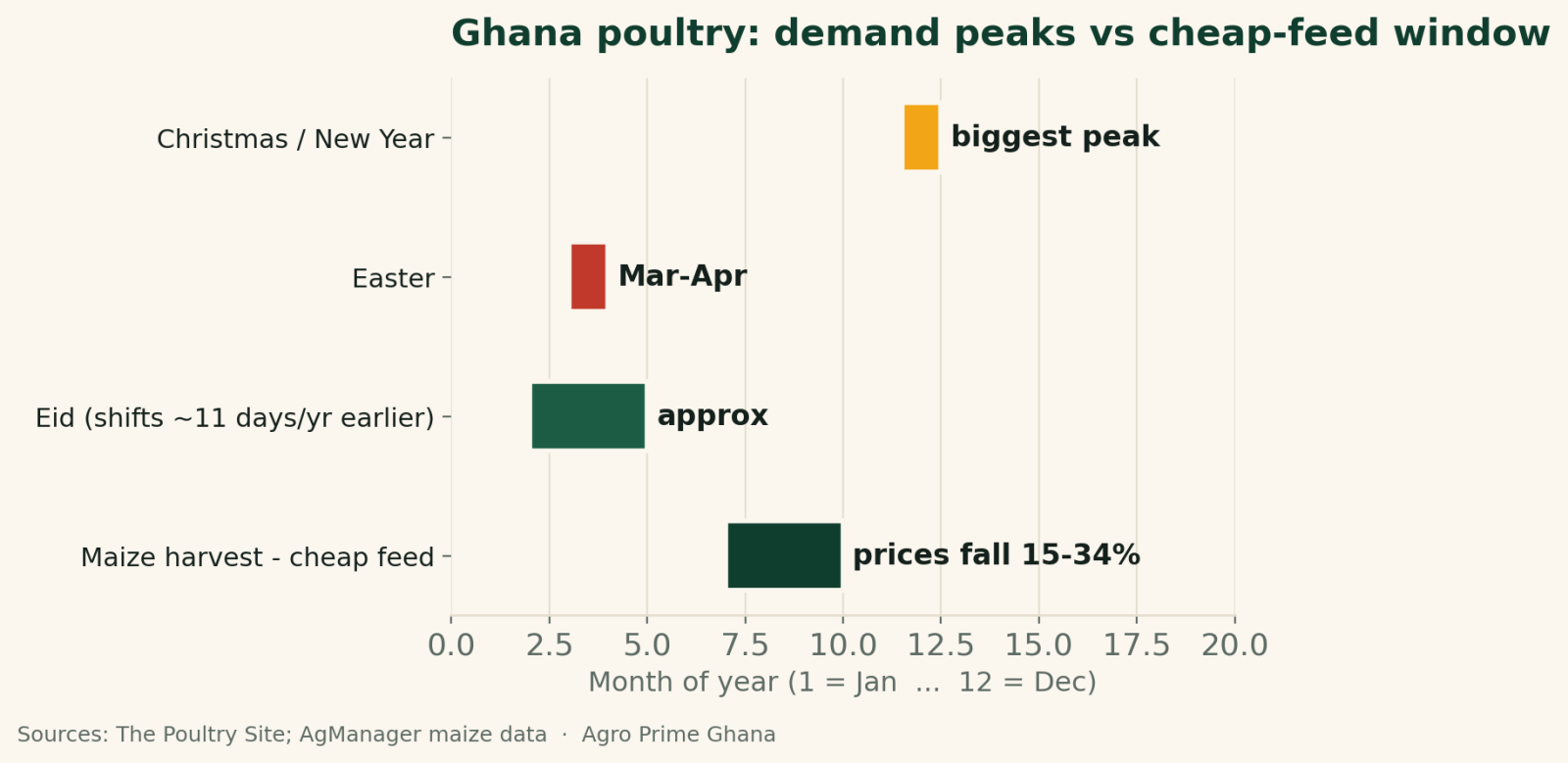
Ghana's live-chicken demand is strongly festive. As The Poultry Site describes, consumption here has historically clustered around celebrations — Christmas, Easter and other festive occasions — with farmers timing "their production schedules to coincide with the festive seasons' peak demand," and buyers preferring "live, home-slaughtered chicken" for those events. Even though imported frozen chicken now dominates everyday eating, these festive windows remain when a local grower gets the best price for a live bird. The peaks, in order of size and through the year, are:
- Christmas & New Year (December). The largest and most reliable peak by far. Demand builds through December and concentrates in the final days before Christmas, then again around New Year. This is the anchor of most farms' year.
- Easter (March or April). A strong secondary Christian peak. The date moves each year, so check it annually rather than assuming last year's timing.
- Eid al-Fitr and Eid al-Adha. Major Muslim festivals that lift demand, especially in Zongo communities and the north. Poultry demand around these festivals rises much as it does elsewhere in Muslim populations — reporting from other markets shows Ramadan-period poultry demand climbing well above baseline. Crucially, these dates follow the lunar calendar and move about 11 days earlier each Gregorian year, so they drift across the seasons over time — you must re-map them annually.
- Funerals, weddings and outdoorings — year-round. Traditional celebrations run all year and, especially at weekends and in the dry season, add a steady undercurrent of live-bird demand that never fully disappears.
- School terms. Boarding schools, canteens and the school-feeding trade create recurring institutional demand tied to the academic calendar (Ghanaian basic schools broadly run three terms across the year), quieter during long vacations.
Mapping the feed-cost season
The other calendar is cost, and it is dominated by maize. Because maize is the energy base of poultry feed and feed is the biggest expense on the farm, the maize price season largely sets your cost season. Analysis of Ghanaian maize markets by Amanor-Boadu (Kansas State University / AgManager) found that maize prices fell by roughly 15% to 34% between July and October — the main harvest period — before rising steadily through the lean season from about November to June. The pattern is driven by supply: grain is plentiful and cheap just after harvest, then tightens month by month until the next crop comes in.
This gives you a clear cost rule to plan around: feed is cheapest from roughly July to October and dearest from about February to June. Two batches grown in identical houses can differ noticeably in profit purely because one ate cheap harvest-time maize and the other ate expensive lean-season maize. Where you have storage, buying maize during the harvest trough and keeping it dry and pest-free — to avoid the mould and aflatoxin that ruin badly stored grain — lets you feed at low cost for months. For the how-to, see reducing poultry feed cost in Ghana and maize quality for poultry feed.
Putting the two calendars together
The art of year-round planning is overlaying the demand peaks and the cost troughs and finding where they align — and managing where they clash. The table below sketches a 12-month view for a broiler-focused farm; adjust the festival months each year and to your own market.
| Months | Demand | Feed cost | Planning move |
|---|---|---|---|
| Jan–Feb | Quiet after festive rush | Rising | Rest/clean houses; run lean batches; plan the year |
| Mar–Apr | Easter peak | High (lean season) | Target Easter; accept higher feed cost for peak price |
| May–Jun | Steady (funerals, weddings) | Highest | Watch margins; keep batches modest |
| Jul–Oct | Steady, school terms | Lowest (harvest) | Grow volume on cheap feed; buy & store maize |
| Nov | Building toward festive | Rising | Place the December batch; secure chicks & feed early |
| Dec | Biggest peak of the year | Rising | Sell full-weight festive birds; peak prices |
The happiest alignment is July–October, when feed is cheapest and school and everyday demand is steady — a good window to grow volume profitably. The trickiest is March–June, when the Easter peak and much traditional demand coincide with the dearest feed of the year; here you accept the higher feed cost specifically because the sale price justifies it, and you keep non-festive batches lean. December's peak comes as feed is climbing again, which is exactly why buying and storing cheap maize back in the harvest can protect your festive margin. To turn these alignments into exact placement dates, build a broiler production calendar by counting back six weeks from each sale window.
Field note: re-draw the moving peaks every single year
Christmas never moves, but almost everything else on the demand calendar does. Easter shifts by weeks between years, and the two Eid festivals march about eleven days earlier every Gregorian year, so a plan that was perfect two years ago will have the Muslim peaks in the wrong month today. The mistake we see most is a farmer copying last season's dates and placing chicks to hit a festival that has already drifted. Every January, before you commit chick orders, sit down and write in the actual dates of that year's Easter and Eid festivals, then count back six weeks from each to fix your placement dates. It takes fifteen minutes and it is the difference between hitting the peak and missing it.
Filling the quiet months
A farm that only chases festive peaks earns in bursts and struggles in between. Year-round planning deliberately fills the quiet months so the business carries itself continuously. There are three main ways to do it. The first is steady broiler production — running modest batches through the non-peak months, ideally on cheap harvest-season feed, sold to regular buyers rather than the festive crowd. Running several age groups at once for weekly income is exactly what staggered batch production is for, and it pairs naturally with year-round planning.
The second is layers and eggs. Eggs sell continuously all year, so a layer flock provides a baseline of steady income that does not depend on festivals at all — smoothing the farm's cash flow between the broiler peaks. Weigh the two enterprises in broiler vs layer profit in Ghana. The third is value addition and regular contracts: supplying hotels, restaurants, cold stores or institutions on standing orders gives dependable off-take through the calendar, and processing or branding can lift the price of birds you would otherwise sell live. For finding and keeping those buyers, see poultry marketing in Ghana.
Plan your chick orders around the whole year — we hatch to schedule
A year-round plan lives or dies on chicks arriving at the right times, and the festive placements are the ones most likely to sell out at the hatchery if left late. Agro Prime Ghana hatches day-old broiler and layer chicks on a reliable, planned schedule, so you can bring us your 12-month plan — Easter, the Eid dates, December, and the steady batches in between — and we will help you fix each placement date and reserve those chick slots ahead of demand. Booking your whole year at once, especially the November placements for Christmas, is the surest way not to be caught short. Message us on WhatsApp +233 24 915 1503 or book a visit to plan your year's chick orders with us.
Managing the seasons: rain and harmattan
Ghana's weather is part of the year-round plan too, because it changes how birds perform. The rainy season brings damp litter and higher humidity, which raise the risk of coccidiosis and respiratory problems and demand extra attention to ventilation and dry bedding. The harmattan, roughly late December to February, brings cool nights, dust and dryness — chilling young chicks at night, drying out and dusting the air, and stressing birds' airways. Neither has to derail a batch, but both should be anticipated in the plan: brood a little warmer and watch litter closely in the rains, and guard chicks against cold nights and dust in the harmattan. Building these realities into the calendar — rather than being surprised by them — is what separates a plan on paper from a plan that survives contact with a Ghanaian year.
Reviewing and improving the plan
A year-round plan should get better every year, and that only happens if you record what actually occurred against what you planned. For each batch and each month, note the dates, the feed price you paid, the age and weight at sale, the price you got, and how demand actually behaved. After a year you will know which peaks paid best on your farm, how much the harvest genuinely saved you on feed, and where the quiet-month gaps really fell — and you can redraw next year's plan from evidence rather than memory. Good record-keeping is the engine that turns a one-off plan into a sharpening annual routine.
The bottom line on year-round planning
Year-round poultry planning is the discipline of running your farm against two calendars at once: the demand calendar, which peaks at Christmas, Easter and the shifting Eid festivals, and the cost calendar, which bottoms out at the July–October maize harvest. Overlay them, count back six weeks from each demand peak to place chicks, buy and store maize in the harvest trough, and fill the quiet months with steady batches, eggs or contracts so the farm earns all twelve months. Re-draw the moving festival dates every January, plan for the rains and the harmattan, book your chicks — especially the festive placements — well ahead on a reliable schedule, and record every batch so next year's plan is built on evidence. Do that, and you turn the Ghanaian poultry year from a series of scrambles into a plan you control.
Frequently asked questions
What is year-round poultry planning?
When is poultry demand highest in Ghana?
When is poultry feed cheapest in Ghana?
How do I time chicks to hit a festive market?
Why do the Muslim festival dates move each year?
How do I keep earning in the quiet months?
How does the weather affect year-round planning?
Should I focus on peaks or on steady production?
Sources & further reading
- The Poultry Site — Chickens for Christmas: Ghana's unique poultry market (festive demand and timing production to peaks).
- V. Amanor-Boadu, Kansas State University / AgManager — Maize Price Trends in Ghana (2007–2011) (harvest vs lean-season maize prices).
- Cobb-Vantress — Cobb 500 broiler performance targets by age, as tabulated in the Cobb 500 Broiler Performance Metrics summary (six-week grow-out underpinning placement timing).
- Agro Prime Ghana guides: broiler production calendar, staggered batch production, selling live birds in the festive season, reducing poultry feed cost, and broiler vs layer profit.
About Agro Prime Ghana
Agro Prime Ghana Limited runs a poultry hatchery and mixed agribusiness in Kasoa, hatching day-old chicks on a planned, reliable schedule so farmers can order ahead against a whole year's plan. We supply healthy day-old chicks (broilers & layers), point-of-lay pullets, quality feed and hands-on farm support across Ghana. This article is general educational information, not a substitute for professional agronomic or veterinary advice. Building your 12-month plan? Bring it to us and we will help you fix your placement dates and reserve chicks for each. Book a visit or message us on WhatsApp (+233 24 915 1503) to plan and order your chicks.