Broiler management is the day-by-day job of turning a 42-gram chick into a market bird of 2 kg or more in about five to six weeks, and it comes down to getting six things right in the correct order: a warm, dry brood; the right feed at the right phase; clean water in front of every bird; sensible stocking density; a tight health and biosecurity routine; and honest weighing so you know where you stand. A modern Cobb 500 or Ross 308 broiler is bred to gain over 100 grams a day at peak and to reach roughly 2.5 kg by 35 days on around 1.5 kg of feed per kilogram of bird — but only if the house works with the bird instead of against it. In Ghana, where a hot, humid brooder can cook a chick as easily as a cold one can chill it, and where feed is the single biggest cost, small management slips compound fast. This guide walks the full 0-to-6-week cycle in order and links to the detailed pieces for each stage.
Written by the Agro Prime Ghana poultry team and reviewed against current industry references (Aviagen Ross and Cobb-Vantress broiler management guides). Last updated September 2026.
Key takeaways
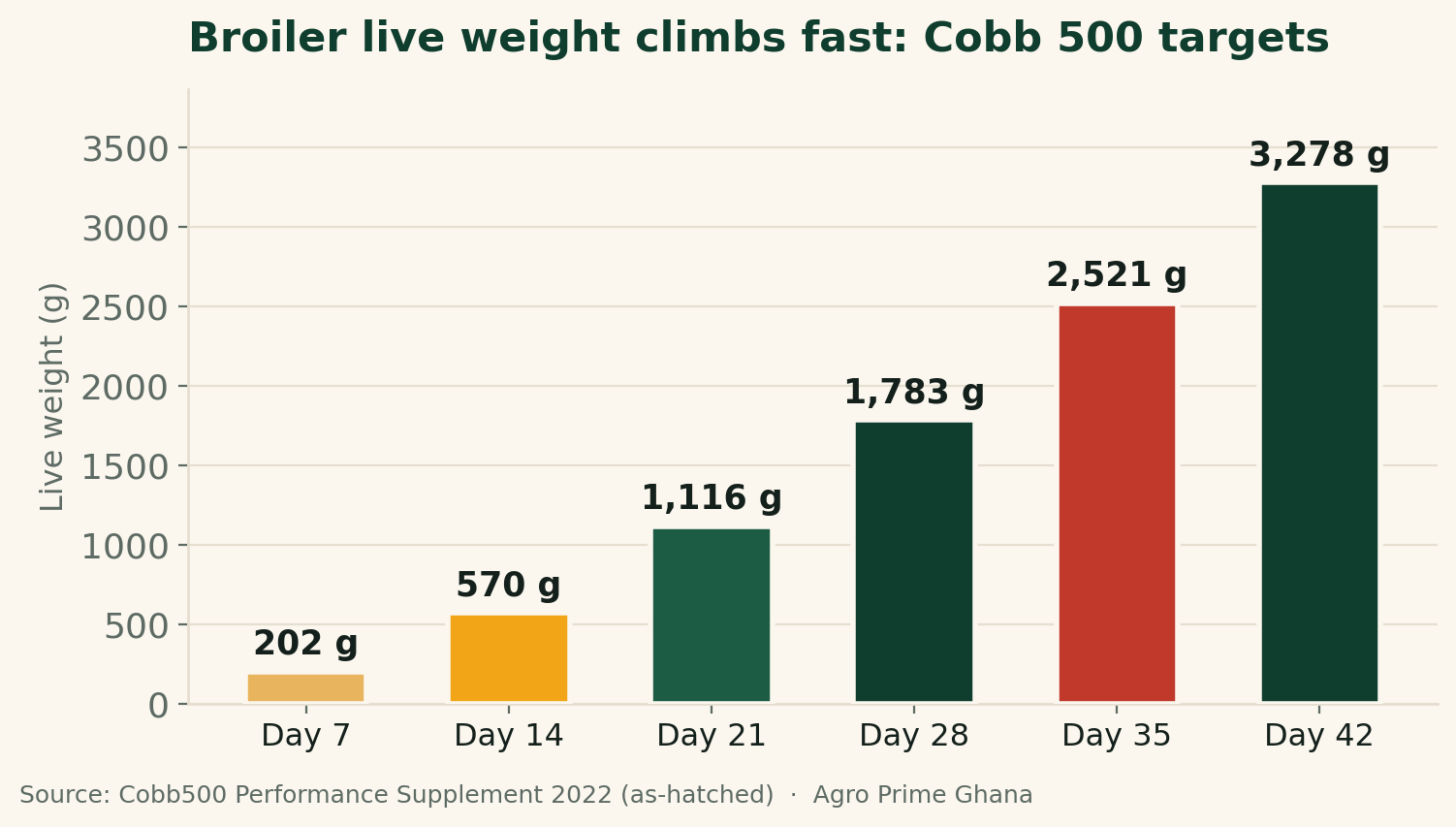
A broiler cycle runs about 0–42 days in four management stages: brooding (day 0–14), grow-out (feeding, water, density, health) and finishing and marketing (roughly day 28 onward). Feed the bird in phases — starter, grower, finisher — because its needs change weekly. Target weights climb from about 42–44 g at day-old to roughly 1 kg by 21 days and 2.4–2.5 kg by 35 days (Cobb 500 / Ross 308 as-hatched). Feed conversion (FCR) is best when birds are young and worsens with age, so selling on time protects your margin. Keep litter dry, water clean, density sensible, and weigh a sample weekly to benchmark against the breed target. Get brooding right first — it sets the ceiling on final weight.
What does broiler management actually involve?
Broiler management is everything you do to keep a fast-growing meat chicken healthy, comfortable and eating from placement to slaughter. Modern broilers are among the most efficient meat animals on earth: the Cobb 500 performance data shows an as-hatched bird reaching 2,521 g at 35 days on a cumulative feed conversion of 1.44, and the Ross 308 objectives put an as-hatched bird at 2,360 g on 1.39 FCR at the same age. Those are laboratory-clean targets. The gap between them and what a Kasoa farm actually achieves is management: temperature, feed, water, air, space, hygiene and timing. Think of the cycle as four overlapping jobs — brood the chick, feed it correctly, keep it healthy in a good house, and market it at the right weight and age — each of which we cover in its own guide. This piece is the map that ties them together.
The broiler cycle at a glance: what happens each week
The fastest way to hold the whole cycle in your head is to think in weeks, because the bird's needs change sharply from one week to the next. In week one the chick cannot regulate its own body temperature, so your heat, your feed access and your water access decide whether it thrives — this is the brooding phase, and it matters more than any other. By week two the bird is feathering, heat can start coming down, and appetite is climbing fast. Weeks three and four are pure growth: feed intake surges, litter gets tested, and heat and ammonia become the enemies in a Ghanaian house. Weeks five and six are finishing — the bird is laying down most of its final weight, feed conversion is at its least efficient, and your job is to keep birds cool, comfortable and eating right up to the day you sell. The chart below shows how quickly weight accumulates on a standard Cobb 500 curve.
| Age | Management focus | Feed phase | Approx. target weight (as-hatched) |
|---|---|---|---|
| Day 0–7 | Brooding: heat, crop fill, water & feed access | Starter | ~200–215 g by day 7 |
| Day 8–14 | Wean off heat, spread birds, watch litter | Starter | ~540–570 g by day 14 |
| Day 15–21 | Grow-out: density, ventilation, coccidiosis watch | Grower | ~1,030–1,120 g by day 21 |
| Day 22–28 | Heat & ammonia control, water flow, weighing | Grower | ~1,660–1,780 g by day 28 |
| Day 29–35 | Finishing: cooling, feed access, plan the sale | Finisher | ~2,360–2,520 g by day 35 |
| Day 36–42 | Market or push to size; withdraw as required | Finisher | ~3,090–3,280 g by day 42 |
Ranges show Ross 308 to Cobb 500 as-hatched objectives. Your flock's numbers depend on feed, heat and health.
Brooding: the first 14 days set the ceiling
If you only master one part of broiler management, make it brooding, because a chick that is chilled, overheated or slow to eat and drink in its first days never fully catches up. The newly hatched chick cannot control its body temperature and depends entirely on the house for warmth. Cobb advises pre-heating the house at least 48 hours before placement so that litter reaches 30–32°C and the floor beneath it is warm — a cold concrete floor pulls heat straight out of a chick's belly. Ross targets a placement air temperature of about 30–31°C at 60–70% humidity for whole-house brooding, with a warm spot around 32°C under spot brooders. The single best check that brooding is working is crop fill: 24 hours after placement, at least 95% of chicks should have full, soft crops, proof they have found both feed and water. Get the full temperature curve, chick-placement routine and crop-fill method in our dedicated broiler brooding guide, and start with strong chicks by using our healthy day-old chick checklist.
Feeding: match the ration to the bird's age
Feed is roughly two-thirds of the cost of producing a broiler, so feeding well is the difference between profit and loss. Broilers are fed in phases because a chick's requirement for protein and energy changes as it grows: a high-protein starter for roughly the first 10–14 days, a grower through the middle of the cycle, and a lower-protein, higher-energy finisher to put on cheap weight at the end. Feeding a cheaper, lower-spec ration in the starter phase to save money is a false economy — the early days are when protein builds the frame the bird will fill later. Always give feed and water free-choice (birds should never run out), keep feeders adjusted to bird height to cut waste, and match feeder and drinker numbers to the flock: Ross recommends about 12 birds per drinker nipple and 45–80 birds per feed pan. Our broiler feeding guide and starter-vs-finisher comparison break down the rations, and broiler FCR explains how to measure whether your feed is working.
Water: the nutrient people forget
Water is the cheapest and most important input in the house, and broilers drink roughly 1.6 to 2 times as much water as they eat feed — more in the heat. A bird that stops drinking stops eating within hours, so water problems show up as growth problems almost immediately. In Ghana's climate, cool, clean water also does double duty as a heat-stress tool: warm water sitting in a black tank all afternoon gets refused. Flush lines daily, keep drinkers clean and at the right height (roughly at the bird's back level as it stands), check flow rates, and never let a drinker run dry. Any medication or vaccine given in water must reach every bird, which means enough drinker space and good flow. We go deeper in our broiler water management guide.
Field note: walk the house at the same times every day
On our floor the most useful management tool is not a gadget — it is a routine walk, early morning and late afternoon, done the same way every day. We watch how birds are spread: evenly across the floor means the temperature is right; piled under the brooder means they are cold; pushed to the walls and panting means too hot; clustered away from a corner usually means a draught or a wet patch. We listen — a content flock has a soft, even chirp, while a sharp, distressed sound means something is wrong. And we put a hand into the litter and under the drinkers, because damp litter is where coccidiosis and footpad problems begin. Five honest minutes twice a day catches more problems than any amount of equipment.
Stocking density: give the birds room to grow
Stocking density is how many birds — and ultimately how many kilograms of live weight — you put on each square metre of floor, and it is one of the most common ways Ghanaian farmers quietly lose money. During brooding, chicks are deliberately concentrated in a part of the house near the heat (Cobb allows up to 55–60 birds/m² in the first days), then progressively spread out as they grow. By finishing, that same floor holds far fewer birds, because a crowded finishing house means heat build-up, wet litter, dirty birds, more disease and worse feed conversion — the birds compete for feeder and drinker space and the smaller ones fall behind. A good rule for a naturally ventilated open-sided Ghanaian house is to stock more conservatively than the closed, climate-controlled houses these breed guides assume, precisely because you cannot pull heat out mechanically. Plan your bird numbers around the finishing weight, not the day-old chick.
Health, biosecurity and litter: keeping the flock alive
A broiler flock that is growing fast is also a flock under pressure, and the diseases that hit hardest in Ghana — Newcastle, Gumboro (infectious bursal disease), coccidiosis and the heat-driven problems of the wet middle of the cycle — are largely preventable with routine. Follow a proper broiler vaccination schedule (typically Newcastle and Gumboro at the hatchery and on-farm), and treat biosecurity — controlling who and what enters the house — as free insurance. The everyday battleground is the litter: keep it dry and friable, fix leaking drinkers the moment you see a wet patch, and ventilate to carry moisture and ammonia out. Damp litter is the root of coccidiosis, footpad burns and ammonia damage all at once. Our guides to broiler litter management and heat stress management cover the two problems that cause the most avoidable losses in Ghanaian broiler houses.
Start your batch right: strong chicks, correct feed, a plan
Most broiler disappointments trace back to two things that are decided before the birds even settle — chick quality and the brooding setup. Agro Prime Ghana supplies robust broiler day-old chicks from managed parent stock, along with quality starter and finisher feed and a simple stocking, feeding and vaccination plan matched to your house and your target market weight. If you are placing a new batch, talk to us first about numbers, brooder setup and a feeding schedule that fits your budget. Message us on WhatsApp (+233 24 915 1503) or book a farm visit — it is far cheaper to plan a batch well than to rescue one.
Weighing: manage what you measure
You cannot manage a broiler flock properly without weighing it, because weight is the one number that tells you whether everything else is working. Weigh a representative sample of birds once a week (catch birds from several spots in the house, not just the easy ones near the door), record the average, and compare it against the breed's target for that age. If you are behind at day 7, you have a brooding or feed problem to fix now, while there is still time. If the flock is uneven — a wide spread between the biggest and smallest birds — that points to competition for feed and water, disease, or poor early brooding. Weekly weighing also tells you exactly when the flock will hit market size, so you can plan the sale rather than react to it. Our broiler weight chart gives the full week-by-week Cobb and Ross targets to benchmark against, and weighing for uniformity explains sampling and flock evenness.
Marketing: sell at the right weight and age
The last management decision — when to sell — quietly decides a large part of your profit, because feed conversion gets steadily worse as the bird ages. Early in the cycle a broiler converts feed at well under 1:1 relative to gain; by six weeks each extra kilogram of weight costs far more feed than it did in week three. That means every extra day you hold a bird past its target market weight, you are buying weight at an increasingly poor rate. Balance that against the Ghanaian market's appetite for a larger bird around festive periods, when prices lift enough to justify a heavier, later sale. Know your market first — live-weight buyers, dressed-bird customers, restaurants, festive sales — and grow the bird to suit it. Handle the sale itself carefully: catch birds calmly in the cool of the day and load gently, because rough catching and loading causes bruising and deaths that come straight off your price. Our guide to the best age to sell broilers works through the economics.
The bottom line on broiler management
Good broiler management is not complicated, but it is relentless: it is the same handful of things done well, in order, every single day. Brood the chick properly, because the first two weeks set the ceiling on final weight. Feed the right ration at the right phase, and never let feed or clean water run out. Give birds room, keep litter dry, keep the air moving and the house cool, and run a simple health and biosecurity routine. Weigh a sample every week so you always know where you stand against the breed target, and sell at the weight and age your market rewards before feed conversion eats your margin. Do these consistently and a Ghanaian broiler flock will come remarkably close to the Cobb and Ross numbers in the guides — and that gap you close is your profit.
Frequently asked questions
How long does it take to raise a broiler in Ghana?
What are the phases of broiler feeding?
What is a good broiler weight at 4 weeks?
Why is brooding so important for broilers?
How many broilers can I keep per square metre?
How much water do broilers drink compared to feed?
When should I sell my broilers?
What kills broiler profit fastest in Ghana?
Sources & further reading
- Cobb-Vantress — Cobb500 Broiler Performance & Nutrition Supplement (2022) (as-hatched body weight and FCR targets by age).
- Cobb-Vantress — Cobb Broiler Management Guide (brooding temperatures, pre-heating, crop fill, stocking, lighting).
- Aviagen — Ross 308 Broiler Performance Objectives 2022 (as-hatched weights, gain and FCR by day).
- Aviagen — Ross Broiler Pocket Guide 2020 (house temperatures, humidity, crop fill, drinker/feeder ratios).
- Agro Prime Ghana guides: broiler brooding, broiler weight chart, broiler feeding, Cobb 500 guide and Ross 308 guide.
About Agro Prime Ghana
Agro Prime Ghana Limited runs a poultry hatchery and mixed agribusiness in Kasoa, supplying day-old chicks and supporting poultry keepers across the country. These guides combine hands-on hatchery and farm experience with current industry references from Aviagen and Cobb-Vantress. This article is general educational information, not a substitute for professional veterinary or agronomic advice for your specific flock. We supply healthy broiler and layer day-old chicks, point-of-lay pullets, quality feed and hands-on farm support. Ready to start or expand a broiler batch? Book a visit or message us on WhatsApp (+233 24 915 1503) to order chicks, feed or advice.