A broiler in Ghana only lives about six weeks, so it needs a short, focused vaccination programme — not the long list a layer gets. In practice that means Marek's disease at the hatchery on day one, Newcastle disease and infectious bronchitis (usually as a spray at day-old, boosted around two to three weeks), and Gumboro (infectious bursal disease) in the drinking water at around two to three weeks. In Ghana, Newcastle disease is the one you cannot afford to skip. This guide sets out a real, workable broiler schedule, explains why broilers need far fewer vaccines than layers, and shows how to give them so they actually "take."
Written by the Agro Prime Ghana hatchery team and reviewed against current veterinary references (MSD Veterinary Manual broiler vaccination programme; FAO guidance on Newcastle disease control). Last updated September 2026.
Key takeaways
A broiler grows out in roughly six weeks, so it needs protection only against the diseases that strike in that window. The core programme is Marek's (given at the hatchery, day 0), Newcastle disease + infectious bronchitis (coarse spray at day-old, with a booster around day 14–21), and Gumboro/IBD (drinking water, about day 14–21). Broilers need fewer vaccines than layers because they are slaughtered before most late-life diseases matter and don't need protection for a long laying career. In Ghana, Newcastle disease is the top priority — in bad outbreaks it can kill the great majority of an unvaccinated flock. Vaccines fail from bad cold chain, wrong timing (maternal antibodies), or careless mixing far more often than from a "bad batch."
Why broilers need fewer vaccines than layers
Broilers need a much shorter vaccination programme than layers because they are only alive for about six weeks — a layer lives eighteen months or more. Every vaccine you give is protection against a disease the bird might meet during its life. A broiler's life is so short that it simply never reaches the age at which many poultry diseases become a problem, so protecting against them is wasted effort, wasted money and unnecessary stress. A commercial layer, by contrast, has to be defended through a long rearing period and then a whole laying cycle, which is why layer programmes stack up vaccines against fowl pox, avian encephalomyelitis, fowl typhoid, egg drop syndrome, coryza and more — often ten or more rounds. You can see the full picture in our layer vaccination schedule for Ghana. For a broiler you strip that right back to the handful of diseases that actually threaten a young, fast-growing meat bird: Marek's, Newcastle, infectious bronchitis and Gumboro. The MSD Veterinary Manual stresses that vaccination programmes are "highly variable and reflect local conditions, disease prevalence, severity of the challenge, and individual preferences" — so treat any schedule, including this one, as a sensible default to adapt with your vet, not a fixed law.
Why Newcastle disease is the priority in Ghana
If you only get one vaccination right in Ghana, make it Newcastle disease (ND). ND is the single most devastating poultry disease across West Africa: it spreads fast, has no treatment, and in a severe outbreak can wipe out most of a flock in days. Its impact varies sharply by area and season — a study of village poultry in northern Ghana recorded ND morbidity of about 3% in one region but, in the Upper East, morbidity of 49.3% and mortality of 40.5%, with case fatality showing that a large share of affected birds died (Frontiers in Veterinary Science, 2023). Outbreaks cluster in the drier months, roughly November to April. Even a well-managed commercial broiler house sits in this environment, exposed to backyard flocks, live-bird markets and wind-borne challenge. Because ND is uncontrollable once it takes hold, the FAO and every extension service in the region put ND vaccination at the centre of poultry health. For a broiler that means an ND vaccination at day-old and, in most Ghanaian conditions, a booster — this is not the vaccine to cut to save a few pesewas.
A real broiler vaccination schedule for Ghana
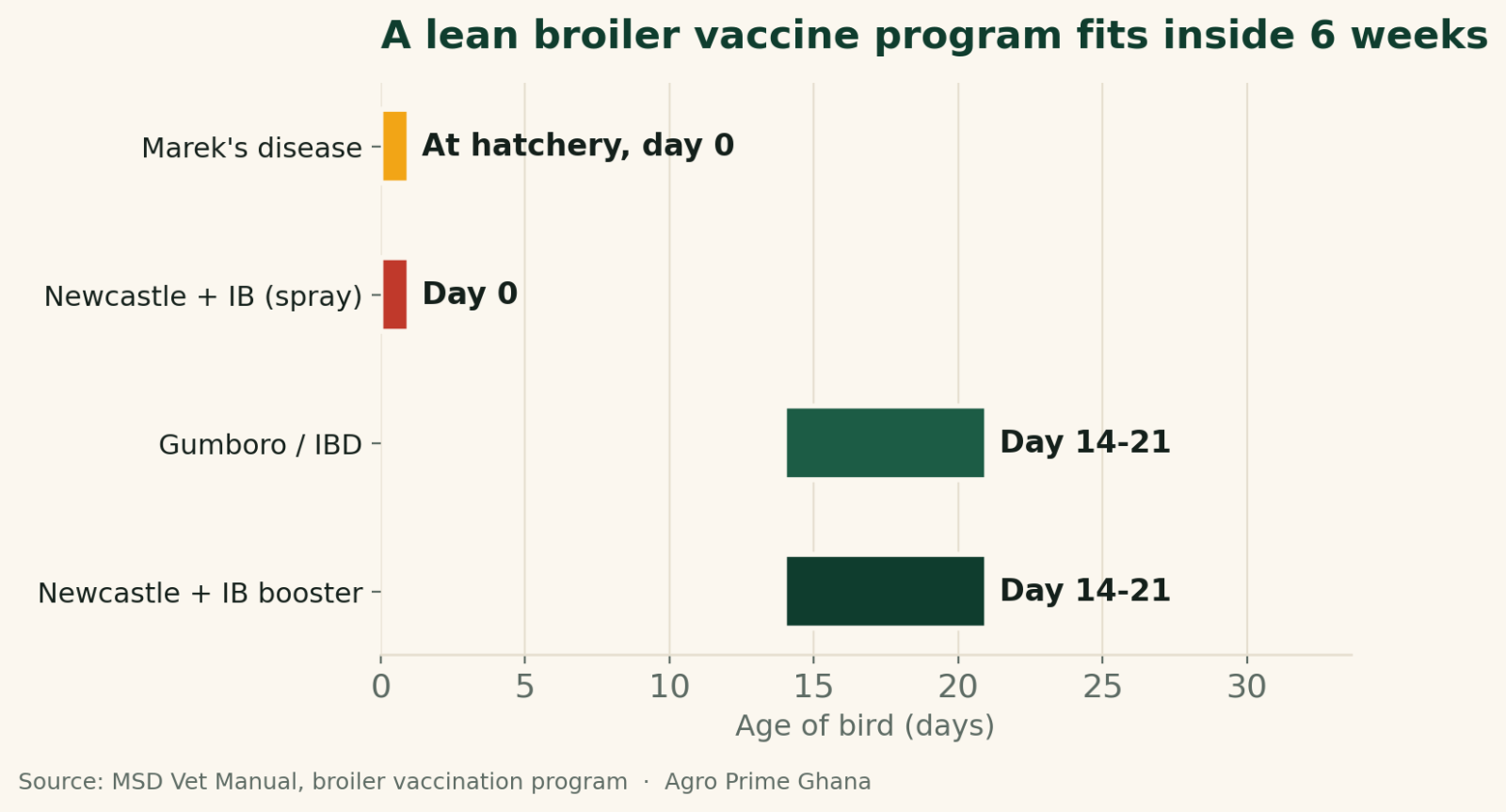
Here is a lean, defensible broiler programme built around the MSD Veterinary Manual's broiler vaccination table and adapted to Ghanaian ND pressure. Exact strains, brands and the decision on a second ND dose should be confirmed with your supplier or vet, because they depend on what challenge is circulating and what maternal antibody your chicks carry.
| Age | Vaccine | Protects against | Usual route |
|---|---|---|---|
| Day 0 (hatchery) | Marek's disease (HVT ± Rispens) | Marek's disease (tumours, paralysis) | Subcutaneous injection, or in-ovo at the hatchery |
| Day 0 (hatchery / arrival) | Newcastle + infectious bronchitis (live, e.g. ND B1/LaSota + IB Mass) | Newcastle disease, infectious bronchitis | Coarse spray (or eye drop) |
| ~Day 14–21 | Gumboro / IBD (intermediate strain) | Infectious bursal disease (Gumboro) | Drinking water |
| ~Day 14–21 | Newcastle + IB booster (live LaSota) | Newcastle disease, infectious bronchitis | Drinking water or coarse spray |
Four vaccination events, most of them done for you at a good hatchery, all finished well before the bird reaches the market at five to six weeks. That is the whole point of a broiler programme: protect the bird through its short, high-value life and no further. If you are buying chicks in, ask exactly what was given at the hatchery so you don't double-vaccinate or, worse, leave a gap.
What each vaccine is actually for
Marek's disease is a herpesvirus that causes tumours and paralysis. It can only be prevented by vaccinating day-old chicks — there is no cure and no "catching up" later — which is why it is given at the hatchery, by injection under the skin of the neck or increasingly in-ovo before the chick even hatches. If your chicks were properly hatchery-vaccinated, you never handle this one yourself; if you hatch your own, it is the single most important reason to get a proper Marek's vaccination setup or buy vaccinated chicks. Newcastle disease and infectious bronchitis are both respiratory viruses often given together in a combined live vaccine; the first dose primes the young chick and the booster lifts immunity through the grow-out. Gumboro (infectious bursal disease) attacks the bursa of Fabricius — the organ that trains a young bird's immune system — so an early Gumboro hit doesn't just cause its own losses, it leaves the flock unable to respond well to every other vaccine and infection. Timing the Gumboro vaccine is the trickiest part of the whole programme, for the reason below.
Field note: maternal antibodies decide your Gumboro timing
Day-old chicks from vaccinated breeder hens carry "maternal antibodies" — borrowed immunity passed through the egg. These antibodies protect the chick for the first couple of weeks, which is a blessing, but they also neutralise a live vaccine given too early, so a Gumboro or Newcastle dose given on the wrong day can be quietly cancelled out and do nothing. That is why the Gumboro vaccine usually lands around day 14–21, not day 3: you are waiting for maternal antibody to fade enough for the vaccine to "take," but not so long that field challenge gets in first. The ideal day depends on the chicks' breeder source, which is one more reason to know exactly where your chicks came from. When in doubt, follow the vaccine maker's timing for your strain and ask your supplier what the breeder flock's status was.
Vaccines fail from handling, not bad luck
Most "the vaccine didn't work" stories are really cold-chain or technique failures. Live poultry vaccines are fragile: they must be kept cold (roughly 2–8°C) from the depot to the bird, protected from sunlight and heat, and used within minutes of mixing. In Ghana's heat, a vaccine vial left on a dashboard or a cool-box that ran out of ice can be dead before it reaches the flock — and you would never know until the disease broke. The rules that keep vaccines alive are simple but unforgiving: keep them in a working fridge or a proper cold box with ice packs (never touching the ice directly to freeze them); mix only what you will use within about an hour; for drinking-water vaccines, withdraw water for one to two hours beforehand so thirsty birds drink the dose quickly, use cool clean water free of chlorine and disinfectant, and add skim milk powder or a stabiliser to protect the virus; and for spray vaccines use clean equipment and the right droplet size. Our guides to vaccine handling and the cold chain and vaccination technique walk through this step by step. Get the handling right and an ordinary vaccine works well; get it wrong and the best vaccine in the world fails.
Start with strong, correctly vaccinated chicks
The cheapest, most reliable half of a broiler vaccination programme is done before the chick ever reaches your brooder — if you buy from a hatchery that vaccinates properly. At Agro Prime Ghana we supply healthy broiler day-old chicks that come Marek's-vaccinated and started on the right day-old vaccines, and we send you off with a simple written schedule for the Gumboro and Newcastle boosters you give on-farm, plus brooding and feeding advice to keep the flock strong enough to respond to them. If you'd like vaccinated chicks and a schedule matched to your area's Newcastle pressure, message us on WhatsApp at +233 24 915 1503 or book a visit — we'll set you up so vaccination is one less thing that can go wrong.
Getting the drinking-water method right
Most on-farm broiler vaccination in Ghana is done through the drinking water, because it is fast and needs no catching of birds — but it is also the method most often botched. The goal is for every bird to drink a full dose in a short window, so the whole flock is covered evenly. Withdraw water for one to two hours first (longer in cool weather, shorter in the heat) so birds are genuinely thirsty; use enough clean, cool water that the flock can finish it in about one to two hours; make sure there are enough drinkers that even the timid birds at the back get to the water; and never use water containing chlorine, disinfectant residues or sanitiser, all of which kill live vaccine. Adding skim milk powder (roughly two grams per litre) mops up any residual chlorine and stabilises the virus. Do it in the cool of early morning, not the midday heat. A vaccine that half the flock never drinks leaves a pocket of susceptible birds — exactly where the next outbreak starts.
Field note: keep a simple vaccination record
The cheapest insurance in a broiler house is a scrap of paper on the wall recording what was given, when, and how. Time and again a problem flock turns out to have missed a dose, been given one twice, or had a booster skipped because "someone thought it was done." Write down the hatchery vaccinations your chicks arrived with, the date and vaccine for each on-farm dose, the batch or expiry, and a note if anything went wrong (water finished late, a lamp failed, birds looked off). When an outbreak or a poor result happens, that record is the first thing that tells you whether it was a vaccine gap or something else — and it turns each flock into a lesson for the next.
Fitting vaccination around brooding and biosecurity
Vaccination is one layer of protection, not the whole wall. It works best on top of good brooding and solid biosecurity, because a stressed, cold or overcrowded chick mounts a poor immune response and may not develop proper protection even from a perfectly given vaccine. Keep the brooder at the right temperature, don't crowd birds, provide clean water and good feed, and control who and what comes onto the farm. Vaccinate only healthy flocks — never vaccinate birds that are already sick, because you will simply add stress without building immunity, and a live vaccine can tip a struggling flock over. Think of the schedule as one instrument in a section: the chicks, the brooder, the feed, the hygiene and the vaccines all have to play together for the flock to stay healthy through to sale.
The bottom line on broiler vaccination in Ghana
A broiler vaccination programme should be short and sharp, because the bird's life is short: Marek's at the hatchery, Newcastle plus infectious bronchitis at day-old with a booster around two to three weeks, and Gumboro in the water at about the same age. Newcastle is the disease that most deserves your attention in Ghana, so never cut that dose. Fewer vaccines than a layer is not a weakness — it is exactly right for a six-week bird. What decides whether the programme works is rarely the vaccine itself but the boring details around it: a cold chain that never breaks, timing that respects maternal antibodies, careful water or spray technique, and a healthy, well-brooded flock able to respond. Start with strong, correctly vaccinated chicks, follow a simple written schedule, and you protect your broilers through their whole life for the price of a few well-handled doses.
Frequently asked questions
What vaccines do broiler chickens need in Ghana?
Why do broilers need fewer vaccines than layers?
When should I give the Gumboro (IBD) vaccine to broilers?
Is Newcastle disease vaccine really necessary for broilers?
Why do poultry vaccines sometimes fail even when given?
Can I vaccinate broilers through the drinking water myself?
Do I need to vaccinate broilers against Marek's disease?
Should I vaccinate broilers against coccidiosis?
Sources & further reading
- MSD Veterinary Manual — Vaccination Programs for Poultry and the broiler vaccination program table (vaccines, ages, routes for Marek's, ND, IB and IBD).
- Frontiers in Veterinary Science (2023) — Poultry health constraints in smallholder village poultry systems in Northern Ghana and Central Tanzania (regional Newcastle disease morbidity and mortality).
- FAO — Controlling Newcastle Disease in Village Chickens (why ND is the priority disease and how vaccination is organised).
- Agro Prime Ghana guides: layer vaccination schedule, vaccine handling and cold chain, vaccination technique and poultry biosecurity.
About Agro Prime Ghana
Agro Prime Ghana Limited runs a poultry hatchery and mixed agribusiness in Kasoa, supplying day-old chicks and supporting poultry keepers across the country. We supply healthy day-old chicks (broilers & layers) that leave the hatchery correctly vaccinated, point-of-lay pullets, quality feed and hands-on farm support, including simple written vaccination schedules matched to your area. This article is general educational information, not a substitute for professional veterinary advice — for a programme tailored to your flock and local disease pressure, consult your veterinary or extension officer. Ready to start or expand? Book a visit or message us on WhatsApp (+233 24 915 1503) to order vaccinated chicks, feed or advice.