Broilers should be caught calmly in dim light, held by both legs (never by one leg, a wing or the neck) with no more than about three birds per hand, and loaded into clean crates in a single, comfortable layer — after feed has been withdrawn for a total of roughly 8 to 12 hours counting catching, loading and transport. Getting this last morning right protects both the birds' welfare and your money: research finds that 90–95% of the bruises seen at processing happen in the final 12 hours, and dead-on-arrival losses climb sharply with heat, crowding and long delays. In Ghana's midday heat, the difference between a careful catch-and-load and a rough one shows up directly as downgraded, bruised and dead birds. This guide sets out how to do it properly.
Written by the Agro Prime Ghana poultry team and reviewed against current welfare and industry references (Humane Slaughter Association, Virginia Tech Extension and peer-reviewed preslaughter research). Last updated September 2026.
Key takeaways
Withdraw feed (not water) about 8–12 hours before slaughter in total — including catching, loading and transport — to empty the gut and cut carcass contamination, but no longer, or you lose weight and risk gut rupture. Catch in dim or blue light, move calmly, and hold birds by both legs with shanks side by side, a maximum of about three per hand; never lift by a single leg, wing, neck or tail. Load crates in a single layer with room to sit, and fill module drawers top-to-bottom. Heat is the biggest killer: DOA rises above about 28°C, so catch and move birds in the cool of early morning or evening, keep air moving, and never leave loaded crates standing in the sun. Roughly 40% of processing bruises trace to catching — careful hands pay for themselves.
When and how long to withdraw feed before catching
Feed should be removed so that birds have gone without it for a total of about 8 to 12 hours by the time they are slaughtered — and, crucially, that window is meant to include the time spent catching, loading, travelling and waiting, not to be counted only up to the moment of catching. The purpose is practical and hygienic: an empty crop and gut mean far less faecal contamination of the carcass during processing, which protects food safety and cuts the labour of re-cleaning fouled birds. But the window has two edges. Withdraw feed for too short a time and birds arrive with full guts that rupture and contaminate the meat. Withdraw for too long — well beyond 12 hours — and the birds lose saleable weight, become distressed, and the gut lining actually weakens and tears more easily, so contamination rises again. Research on Ghanaian-relevant commercial conditions found that roughly every extra eight minutes of excessive feed-withdrawal time was associated with about 1% more dead-on-arrival birds, a reminder that "a bit longer to be safe" is the wrong instinct. One rule matters above all: water stays available right up until catching begins. Birds must never be deprived of water during withdrawal, especially in our heat.
Why the last morning decides carcass quality and losses
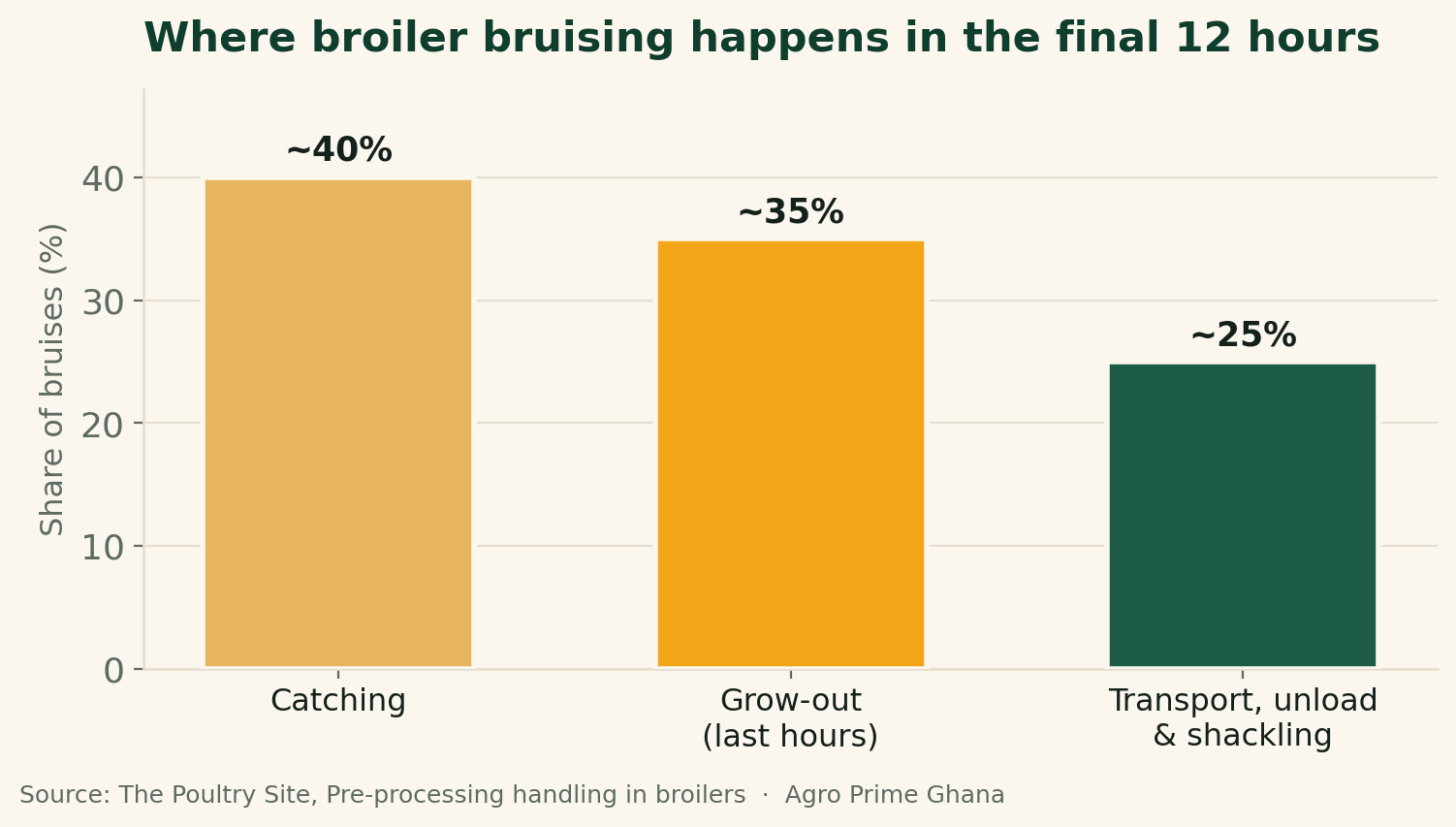
The final few hours before slaughter carry an outsized share of the damage a broiler suffers in its whole life. According to industry handling guidance summarised by The Poultry Site, an estimated 90–95% of the bruises found on birds at processing occur during the final 12 hours — and of those, roughly 40% happen during catching, about 35% in the last hours in the house, and the remainder during transport, unloading and shackling. A bruise is not just a welfare failure; it is a visible defect that downgrades or condemns the carcass, so it is money lost. The economics are stark: the same guidance illustrates that a mere 0.3% live-weight loss per bird — about 8 grams — across a million birds can be worth around US$10,000 a week. For a Ghanaian farm the scale is smaller but the principle is identical: rough, rushed, hot handling in the last morning quietly eats the margin you spent six weeks of feed building. This is the cheapest place on the whole farm to protect profit, because good technique costs nothing but discipline.
How to catch broilers humanely
The single most important welfare improvement in catching is how you hold the bird. The Humane Slaughter Association is clear that good practice is to catch and carry a chicken by both legs — or, better still where practical, with body support (a hand each side over the wings) — and that catching by a single leg should be phased out, because it twists the hip and causes dislocations, bruising and pain. The practical rules that follow from the welfare evidence:
- Both legs, shanks side by side. Grip both shanks together in the hand so the legs cannot cross and dig in. Never lift or carry a bird by one leg, a wing, the neck, the head or the tail — each of these causes dislocations, fractures or bruising.
- No more than about three birds per hand. The HSA sets a maximum of three chickens per hand (two for heavy breeders). Overloading the hand means birds are dropped, banged and bruised. Fewer, well-held birds beat a fistful of flapping ones.
- Carry gently and keep birds calm. If a bird flaps hard, rest its breast briefly against your thigh to settle it rather than fighting it. Avoid banging birds against crate edges, posts or your own legs.
- Lower birds into the crate, breast first. Place them down gently; do not throw or drop them in.
There is genuine welfare interest in upright catching (supporting the body rather than inverting the bird), which causes fewer injuries, though a worker can carry fewer birds at a time this way. Whichever method you use, the enemy is speed at the cost of care: a catching team that is paid or pushed purely on birds-per-minute will bruise and kill more birds than a slightly slower, calmer team.
Field note: catch in the dark, or as close to it as you can
The easiest way to make catching calmer, safer and faster is to dim the lights. Birds are far quieter and less prone to piling and panic in low or blue light, which means fewer scratches, fewer smothered birds and far less flapping-related bruising — the HSA specifically recommends reducing house lighting to the lowest safe level or using blue light for catching. On an open-sided Ghanaian house that often means catching in the early morning before full daylight, or at dusk. The bonus is that these are also the coolest hours, so the same timing that calms the birds also protects them from heat. Move quietly, avoid sudden noise, and never rush a spooked flock into a corner where they will pile and suffocate.
Crate density: single layer, room to sit
Birds should be crated in a single layer, at a density that lets each bird sit comfortably and, ideally, turn around, with that density adjusted for the size of the bird and — critically in Ghana — the weather. Crating is a genuine balancing act that the research makes explicit. On one hand, packing crates too tightly raises dead-on-arrival losses: one commercial study found DOA rose by around 5% for each extra kilogram of birds per crate, mainly because crowding traps body heat. On the other hand, oddly, very loose crating can allow more movement and slightly more bruising. The resolution is not to crowd birds to stop them moving, but to crate them at a sensible, single-layer density and control the real problem — heat — directly. When you load into module-drawer systems, fill from the top drawer down so you are never dropping birds onto those already loaded below, and check that every drawer is properly seated so birds have full headroom. Crates and drawers must be clean, dry and undamaged, with no sharp edges to bruise or cut birds.
| Handling factor | What the evidence shows | Practical rule for Ghana |
|---|---|---|
| Feed withdrawal | ~8–12 h total (incl. transport) empties gut; too long loses weight, raises DOA and gut rupture | Stop feed ~8–12 h before slaughter counting travel; keep water till catching |
| Holding method | Single-leg / wing / neck carrying causes dislocations & bruising; both legs or body support is far better | Both legs, shanks together; never a wing, neck or single leg |
| Birds per hand | Overloading causes dropping and bruising | Max ~3 birds per hand (2 for heavy birds) |
| Crate density | Too tight traps heat (~5% more DOA per extra kg/crate); single layer recommended | Single layer, room to sit; loosen and cool in heat |
| Temperature | DOA rises above ~28°C; birds lose more weight transported at 34°C vs 25–30°C | Catch & move in early morning / evening; never park in sun |
| Lighting | Dim / blue light calms birds, cuts flapping injuries | Catch before dawn or at dusk, or dim the lights |
Sources: Humane Slaughter Association poultry handling note; Virginia Tech Extension preslaughter welfare; peer-reviewed preslaughter handling studies.
Heat is the biggest killer — plan around it
Of every factor that decides how many birds arrive dead or damaged, heat is the most dangerous in Ghana, and it is also the most controllable through simple timing. The evidence is consistent: dead-on-arrival rates climb once temperatures rise above roughly 28°C compared with below about 24°C, birds transported at 34°C lose more weight than those moved at 30°C or 25°C, and DOA is markedly lower when birds are caught and hauled at night or in the early morning rather than in the daytime, simply because the ambient temperature is lower. A crate full of feathered, packed broilers generates and traps a lot of heat; leave that crate standing in still air or direct sun for even a short while and birds start to die. The defences are cheap and effective:
- Catch and load in the cool hours — early morning before the sun is high, or in the evening. This single decision does more than any other to cut DOA and weight loss in our climate.
- Keep air moving. Loaded crates must never sit in dead, still air. Position a passively-ventilated vehicle where fans or a breeze reach the birds, and keep it moving on the road.
- Never park loaded birds in the sun — not at the farm, not at the market, not at the processor. Waiting (lairage) time is dangerous: research links each extra minute of holding in crates to measurably higher DOA, because heat keeps building.
- Minimise the whole journey. Keep transport well under four hours where you can; DOA and stress climb steeply on long hauls.
Sell live birds and broilers the right way — with support from Agro Prime
Careful catching and loading protect the value of birds you have spent weeks feeding — and they matter just as much when you buy in live birds to fatten and resell, or when you sell into the festive market. Agro Prime Ghana supplies healthy broiler day-old chicks in several strains and works with farmers on the whole cycle, from brooding through to getting birds to market in good condition. If you are planning a batch, timing a festive sale, or want a second opinion on your catching, loading and transport routine, we are happy to help. Message us on WhatsApp (+233 24 915 1503) or book a visit. For more on marketing, see our guides to selling live birds for the festive market and poultry marketing.
A simple, humane catch-and-load routine
Put together, a good routine on the day looks like this. The evening or night before, plan the feed-withdrawal timing backwards from the slaughter or market time so total withdrawal lands around 8–12 hours, and leave water running. Catch in the cool, dim hours — before dawn or at dusk — with a calm, unhurried team briefed to hold birds by both legs, no more than three per hand, and to lower them gently, breast first, into clean, single-layer crates. Load module drawers top to bottom, check every drawer is seated, and get the birds into moving air immediately. Keep the journey short, never let loaded crates stand in the sun, and minimise waiting at the other end. Finally, watch and count: if you see rising bruising, panting, piling or DOA, the fix is almost always in this routine — slow the team down, lighten the hands, loosen the crates, and move earlier in the day. None of it costs money; all of it protects the birds and the batch you worked six weeks to grow. Good pre-slaughter handling is the last, and one of the cheapest, ways to defend your broiler profit.
Frequently asked questions
How long before slaughter should I stop feeding broilers?
Should broilers be caught by one leg or both legs?
What causes dead-on-arrival (DOA) losses in broilers?
How densely should I pack broilers in transport crates?
Why do so many birds get bruised, and where does it happen?
What time of day is best to catch and load broilers in Ghana?
Does feed withdrawal make birds lose weight?
Should I dim the lights when catching broilers?
Sources & further reading
- Humane Slaughter Association — Poultry catching and handling (Technical Note 15) (both-legs catching, birds per hand, dim/blue light, crate loading).
- Virginia Tech Extension — Preslaughter Welfare of Broiler Chickens (feed withdrawal window, catching methods, DOA and thermal stress).
- The Poultry Site — Pre-processing handling in broilers (feed withdrawal timing, bruise origins, economic loss).
- Peer-reviewed preslaughter research — Preslaughter handling factors affecting DOA, condemnations and bruising in broilers (crate density, lairage, temperature and season effects).
- Agro Prime Ghana guides: selling live birds for the festive market, poultry marketing, broiler vs layer profit and heat stress in poultry.
About Agro Prime Ghana
Agro Prime Ghana Limited runs a poultry hatchery and mixed agribusiness in Kasoa, supplying day-old chicks and working alongside poultry keepers across the country. We supply healthy broiler day-old chicks in several proven strains, plus point-of-lay pullets, quality feed and hands-on farm support nationwide. This article is general educational information, not a substitute for professional veterinary or welfare advice for your specific operation. Planning a batch or a sale? Book a visit or message us on WhatsApp (+233 24 915 1503) to order chicks, feed or advice.