Broilers suffer heat stress when they cannot shed body heat fast enough — a problem that starts as the house climbs past their comfort zone (roughly 18–24°C) and turns dangerous above about 30°C, when birds pant, stop eating and, in the worst cases, die suddenly. Because a chicken has no sweat glands and a fast-growing broiler generates enormous internal heat, the heavy birds in the last two weeks before sale are the most vulnerable — exactly when they are worth the most. In Ghana's climate this is not an occasional emergency but a routine management challenge, and the farms that grow broilers well are the ones that plan for heat rather than react to it. This guide explains how heat stress harms broilers and exactly how to manage ventilation, water, feeding and stocking to protect growth and prevent losses.
Written by the Agro Prime Ghana poultry team and reviewed against current references (University of Florida IFAS Extension, University of Minnesota Extension and The Poultry Site). Last updated September 2026.
Key takeaways
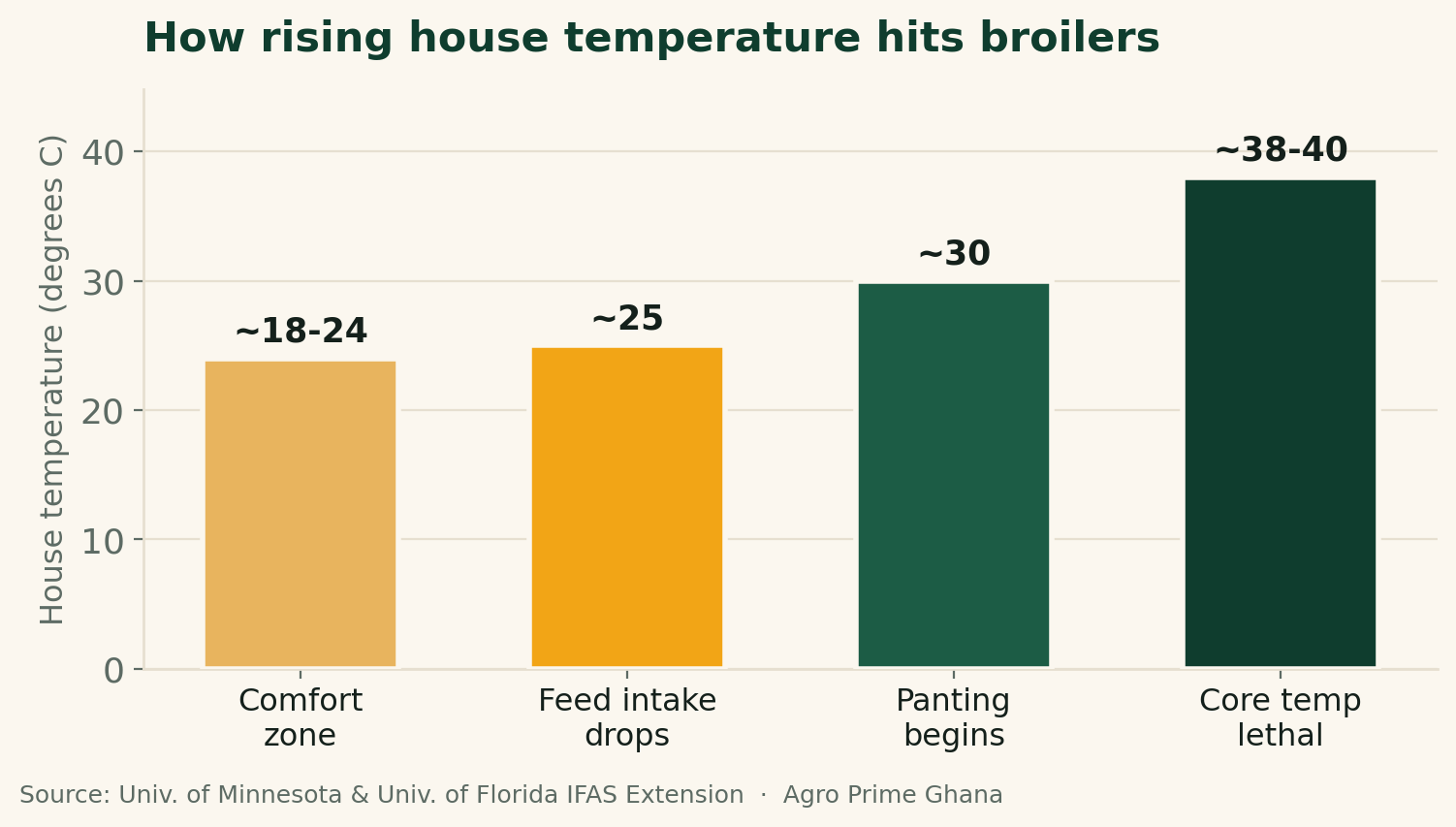
A broiler's comfortable temperature falls as it grows, and adult birds do best around 18–24°C; a chicken's body temperature is about 41°C (105°F), so it can only lose heat when the air is cooler than that. Feed intake starts dropping above roughly 25°C, panting begins around 30°C, and core temperature can reach lethal levels as the house nears 38–40°C. Heavy, near-market broilers are hit hardest. The defences that work: air movement (tunnel ventilation aims for around 350 ft/min / ~1.8–3 m/s over the birds), unlimited cool clean water (intake rises 2–4× in heat), feeding in the cool hours and withdrawing feed before the afternoon peak, electrolytes (e.g. potassium chloride) and vitamins, and lower stocking density. Plan for heat before the hot season, not during a crisis.
What heat stress is and why broilers are so vulnerable
Heat stress is the state a bird enters when the heat it produces plus the heat it absorbs from its surroundings exceeds the heat it can lose — so its core temperature starts to rise. A chicken maintains a body temperature of about 41°C (around 105°F), and crucially it has no sweat glands. It sheds heat in two main ways: "sensible" loss (radiating and conducting heat to cooler air through its skin, legs and comb) and, once the air gets too warm for that to work, "evaporative" loss through panting — rapid open-mouth breathing that evaporates water from the airways and lungs. The problem is that sensible loss only works while the surrounding air is cooler than the bird; as the house approaches body temperature, that route shuts down and the bird is left relying almost entirely on panting. Broilers are especially exposed because modern fast-growing strains produce a lot of metabolic heat, carry heavy muscle and dense feathering, and — unlike a light layer — have a large body mass relative to their surface area, making heat hard to dump. The University of Minnesota Extension puts the comfortable ("thermoneutral") zone where heat production is lowest at roughly 60–75°F (about 16–24°C), and warns that as temperatures climb the bird must spend more and more energy just staying cool instead of growing.
How heat stress hurts growth and kills birds
The damage from heat runs on a scale from quietly expensive to suddenly catastrophic. The first and most universal effect is a drop in feed intake: a bird that is too hot eats less, because digesting feed itself generates heat. The University of Minnesota Extension notes a slight reduction in feed consumption begins as the house rises above the comfort zone (around 25°C) and falls further as it reaches 29–32°C (85–90°F). Less feed eaten means slower growth, poorer flock uniformity and a longer time to market weight — a hidden tax paid across the whole flock. As heat builds, birds pant heavily, hold their wings away from the body, spread out, and stop moving; feed conversion worsens because energy is diverted to cooling. Prolonged panting also disturbs the bird's blood chemistry (it blows off carbon dioxide, causing "respiratory alkalosis"), which among other things harms eggshell quality in layers and weakens birds generally. At the top of the scale, when a heavy flock cannot cope — often on a hot, still, humid afternoon, or worse during a power cut that stops the fans — core temperature climbs to lethal levels and birds die, sometimes in large numbers within an hour or two. The University of Minnesota Extension notes core body temperatures can reach lethal levels as the environment nears 100°F (about 38°C). These sudden mass mortalities almost always strike the biggest birds in the last week or two before sale, which is what makes heat stress so financially painful.
| House temperature | What happens to the broiler | What you should be doing |
|---|---|---|
| ~18–24°C | Comfort zone — normal feeding and growth | Nothing extra; this is the target |
| ~25–28°C | Feed intake begins to dip; birds seek cooler spots | Increase air movement, check water is cool and plentiful |
| ~30–33°C | Panting starts; wings held out; growth slows | Full ventilation, feed in cool hours, add electrolytes |
| ~34–37°C | Heavy panting, birds prostrate, real mortality risk | Emergency cooling — air speed, wetting roof/birds, cold water |
| ~38–40°C+ | Core temperature lethal; sudden deaths, especially heavy birds | Crisis — every cooling measure at once; prevent power failure |
Ventilation: moving air is your first defence
The most powerful thing you can do for hot broilers is move air across them, because air movement strips heat from the birds and speeds evaporation from their airways — a moving 33°C breeze cools a bird far better than still 33°C air. This "wind-chill" effect is the whole basis of hot-climate poultry housing. In fully enclosed tunnel-ventilated houses, the University of Florida IFAS Extension notes that most of the benefit comes at an air velocity of about 350 feet per minute (roughly 1.8 metres per second), which it treats as a minimum target over the birds; well-run hot-climate houses often push higher air speeds over heavy flocks. Most Ghanaian broilers, though, are raised in open-sided houses, where the tools are different but the goal is identical: get air moving over the birds. That means orienting and siting the house to catch prevailing breezes, keeping side netting clear and curtains fully open in the heat, removing anything upwind that blocks airflow, and adding circulation fans to keep air moving on still afternoons — the dead, humid calm of a hot afternoon with no wind is when birds die. A reflective or well-insulated roof, generous eave height and roof overhangs to keep sun off the walls all reduce the heat load before ventilation even has to deal with it. Our guides to poultry house ventilation and managing house temperature and humidity go deeper on getting this right.
Field note: the still, humid afternoon is the killer — and the power cut behind it
The dangerous days on our floor are rarely the hottest by the thermometer — they are the still, humid ones, when there is no breeze to carry heat away and the air is already so damp that panting barely works. That is when a heavy flock can crash. Two habits save birds: first, never rely on a single source of air movement, so a stalled breeze does not mean stalled cooling; second, treat a power cut on a hot afternoon as a genuine emergency, because when fans stop, a packed house can reach lethal temperatures within an hour. Anyone running fan-dependent housing in Ghana needs a plan for ECG outages — a backup generator, or the ability to open up fast and get birds cool by other means.
Water: the most important thing in the house
In hot weather, water matters more than feed — a broiler can survive missing feed far longer than it can survive without cool water, and panting itself loses water fast. Birds drastically increase drinking to cool themselves: the University of Minnesota Extension notes water consumption can rise to two to four times the normal amount during heat stress. Three things follow. First, water must be unlimited and easy to reach — enough drinker space that even the birds pushed to the edges of a panting flock can drink without a fight, and lines flushed often so no bird gives up on a distant or empty drinker. Second, the water must be cool: warm water sitting in black pipes under the sun does little to cool a bird, so shade tanks and pipes, flush the hot standing water out of the lines in the afternoon, and where you can, offer cooler water at the peak. Third, water quality has to be sound, because birds drinking heavily will multiply any contamination problem — see our note on broiler water management. Getting water right is the single cheapest, highest-return heat-stress measure there is.
Feeding strategy: eat in the cool, rest in the heat
Because digesting feed produces body heat, the smart approach is to shift feeding into the cooler parts of the day and take feed away during the hottest hours. The Poultry Site's guidance is direct: birds should be fed during the cool part of the day and not fed during the afternoon in hot weather. In practice that means concentrating feed in the early morning and the evening/night, when the air is coolest and eating adds least heat load, and running empty or restricted feeders through the hot midday-to-afternoon window. The University of Minnesota Extension similarly advises withdrawing feed roughly six hours before the expected afternoon peak so that birds are not in the middle of digestion at the worst moment, and using night lighting to encourage feeding when it is cool. Beyond timing, the ration itself can help: because birds eat less in heat, every gram should count, so many hot-climate feeds are made slightly more nutrient-dense, and fat as an energy source generates less body heat than an equivalent amount of carbohydrate or excess protein. Pair these feeding tactics with your normal phase-feeding plan from our broiler feeding guide.
Electrolytes, vitamins and supportive care
When birds pant heavily they lose not just water but salts, so electrolytes in the drinking water are a proven support during hot spells. The University of Minnesota Extension describes using potassium chloride (around 0.6% in the drinking water for up to about three days) to replace losses, and notes that heat stress increases the loss of potassium, sodium, phosphorus, magnesium and zinc. Commercial poultry electrolyte or "anti-stress" sachets provide a convenient balanced mix; a home solution of a little salt and sugar can help in a pinch but is cruder and easy to get wrong, so a proper product is better. Vitamins matter too: supplementing vitamins A, D, E and the B-complex supports broilers under heat, and vitamin C in particular is widely used to help birds cope with heat stress. Give electrolytes and vitamins around the hottest part of the day and during known stress events, not constantly — they are a support for peaks, not a permanent additive. Above all, keep handling to a minimum in the heat: catching, weighing or moving heavy birds on a hot afternoon can tip a coping flock into mortality, so do necessary handling in the cool of early morning.
Grow heat-ready broilers from strong Kasoa chicks — and a hot-season plan that fits your house
A broiler flock copes with heat far better when it starts strong and is grown to a sensible density in a house set up for airflow. Agro Prime Ghana supplies vigorous day-old broiler chicks from our Kasoa hatchery and helps you plan stocking, ventilation and feeding for the season you'll actually be growing in — including simple, affordable fixes for open-sided houses and a realistic plan for power cuts. If you are gearing up for the hot months or losing heavy birds to heat, talk to us before you place your next batch. Message us on WhatsApp (+233 24 915 1503) or book a visit to order chicks and get a heat-management plan for your farm.
Stocking density and house design
Every bird in the house is a small heater, so how densely you stock directly sets how hot the house runs — and reducing density is one of the most reliable ways to cut heat-stress losses. Packing birds tightly raises the heat load, blocks air from reaching every bird, and leaves no room for a panting flock to spread out and find cooler floor. For hot-season broilers, deliberately stocking lighter than you would in cool weather gives each bird more air, more drinker and feeder access, and a better chance of losing heat — and the improved growth and lower mortality of a less-crowded flock often more than pay for the "missing" birds. Design choices compound this: a well-oriented, high-roofed, well-shaded open house with a light-coloured or insulated roof stays far cooler than a low, dark, sun-baked shed. If you are building or upgrading, plan for heat from the start — it is much cheaper than fighting a badly sited house every hot season. Timing the flock also helps where possible: avoiding taking very heavy birds through the peak of the hot, humid months reduces your exposure to the worst mortality risk.
The bottom line on broiler heat stress
Heat stress is the defining broiler-management challenge of Ghana's climate, and it is largely preventable. A broiler runs at about 41°C with no way to sweat, so once the house pushes past its comfort zone the bird pants, eats less and grows more slowly — and once the house nears body temperature, heavy birds can die fast, especially on still, humid afternoons and during power cuts. The winning strategy is layered and mostly cheap: keep air moving over the birds, give unlimited cool clean water, feed in the cool hours and pull feed before the afternoon peak, support with electrolytes and vitamins during hot spells, stock lighter in the heat, and design or site the house to shed heat before it ever reaches the flock. None of this is exotic — it is disciplined, planned management. Do it consistently and heat stops being the reason your heaviest, most valuable birds die in the last week before sale, and becomes just another factor you have under control.
Frequently asked questions
At what temperature do broilers start suffering heat stress?
Why are big broilers more vulnerable to heat than small ones?
How do I cool broilers during a heat wave?
Should I feed broilers in hot weather?
Do electrolytes help with heat stress in broilers?
How much water do broilers need in the heat?
Does stocking density affect heat stress?
Why do broilers die suddenly on hot afternoons?
Sources & further reading
- University of Minnesota Extension — Preventing heat stress in poultry (comfort zone, feed and water changes, electrolyte and vitamin support, lethal temperatures).
- University of Florida IFAS Extension — Heat Stress Management in Broilers (VM019) (panting physiology, tunnel-ventilation air velocity).
- The Poultry Site — Hot Weather Management of Poultry (body temperature, comfort range, cool-hour feeding, air velocity).
- Agro Prime Ghana guides: poultry house ventilation, broiler water management, broiler feeding guide, heat stress in poultry and house temperature and humidity.
About Agro Prime Ghana
Agro Prime Ghana Limited runs a poultry hatchery and mixed agribusiness in Kasoa, supplying day-old chicks and supporting poultry keepers nationwide. These guides combine hands-on hatchery and farm experience with current extension and industry references. This article is general educational information, not a substitute for professional veterinary or engineering advice on your specific house. Building a broiler flock for the hot season? Book a visit or message us on WhatsApp (+233 24 915 1503) to order strong chicks and get a heat-management plan for your farm.