Walk into a poultry house on a humid Kasoa morning and you can often diagnose the flock before you see a single bird. If your boots stick, if the bedding under the drinkers has gone dark and greasy and packed into a crust, and if the sharp, throat-catching smell of ammonia hits you at the door, you have a wet litter problem — and it is already costing you. Wet, caked litter is not just an untidy floor. It is the single biggest driver of footpad burns, hock lesions, dirty downgraded carcasses, ammonia, flies and a quietly rising disease bill — and, in most houses, it is entirely fixable once you understand what is putting the water there. This guide explains what wet litter really is, why it happens so readily here, what it does to your birds and your margins, and how to get the floor dry and keep it that way.
Written by the Agro Prime Ghana poultry team and reviewed against current references (University of Florida IFAS Extension and the University of Georgia poultry science programme). Last updated September 2026.
Key takeaways
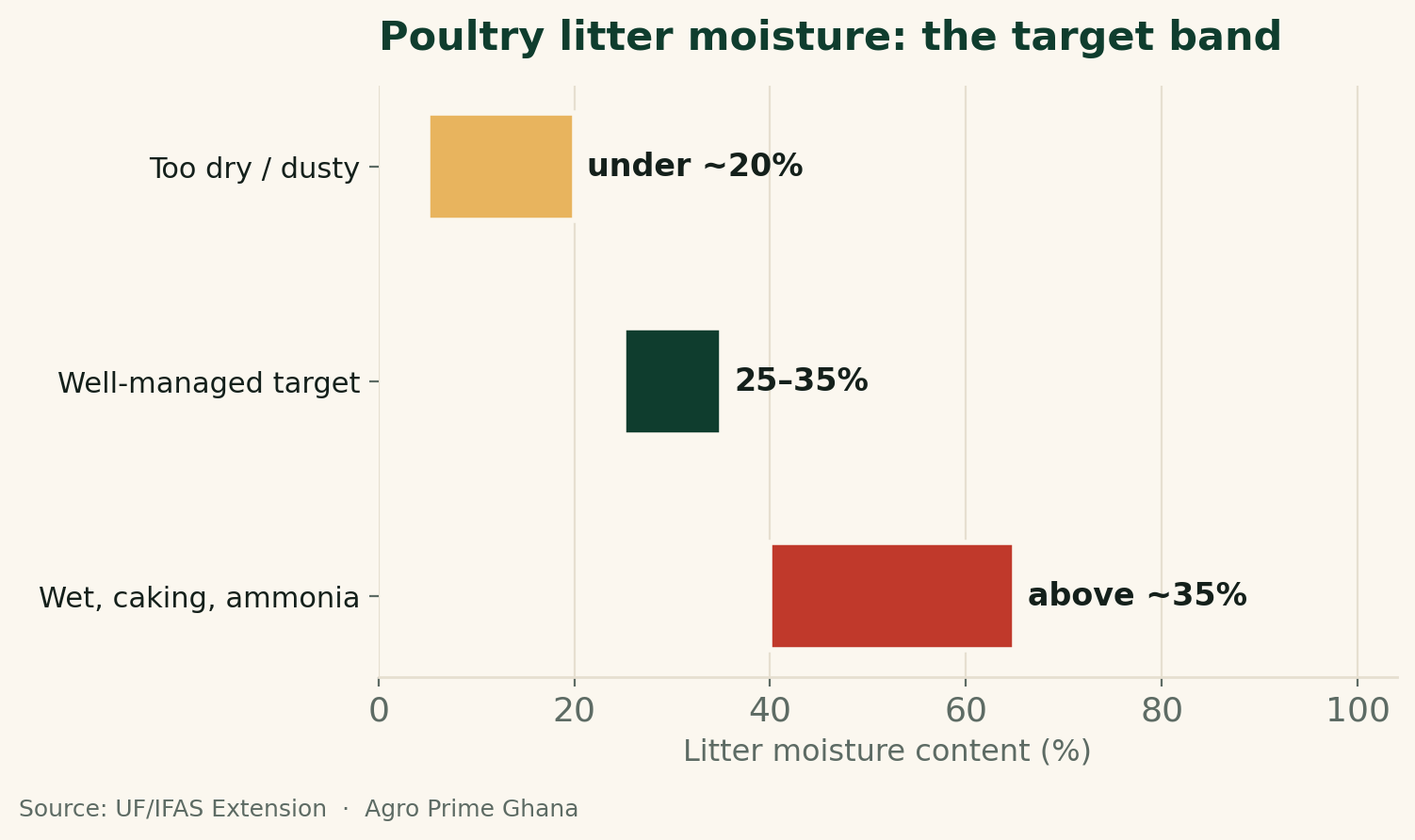
In a well-managed house, litter moisture normally sits between 25 and 35 percent — above that, it starts to cake, smell and burn feet. Wet litter is caused by water going in (leaking or badly pressured drinkers, roof leaks, condensation) or water not coming out (too little ventilation to carry moisture away), plus wet droppings from diet imbalances, mouldy feed or gut disease such as coccidiosis. The damage shows up as footpad dermatitis, hock burn and breast blisters, dirty feathers, more flies, and — because wet litter is where ammonia is made — poor air and slower growth. The fix is a routine, not a product: sound drinkers, enough air movement, dry absorbent bedding, and prompt removal of wet patches. Get the floor right and half your other problems shrink with it.
What "wet litter" actually means
Litter is the bedding — wood shavings, sawdust, chopped straw or rice hulls — you spread on the floor to soak up droppings and spilled water and give birds a soft, insulating surface. Its whole job is to hold moisture and then release it into the air, keeping the surface dry and friable (loose and crumbly). Good litter passes the squeeze test: close a handful in your fist and it should form a loose ball that falls apart when you open your hand; if it stays in a hard damp lump it is too wet, and if it only puffs into dust it is too dry. According to University of Florida IFAS Extension, litter in a well-managed broiler house averages between 25 and 35 percent moisture. Push much past that and the bedding can no longer absorb what the birds add: it caps over, packs into a slick crust, turns anaerobic underneath, and becomes the wet, ammonia-generating layer every keeper dreads. Wet litter, then, is simply litter that has taken on more water than it can give back to the air.
Why Ghana's houses go wet so easily
Three local realities gang up on the litter floor. The first is humidity: litter dries by evaporating moisture into the air and ventilating it out, but during the rains and in the coastal humidity around Kasoa the incoming air is already close to saturated, so it can pick up little more — evaporation slows and water that would normally leave the litter stays in it. The second is heat: hot birds drink far more, and more water in means more water out, both as wetter droppings and spillage at the drinkers, as our guide to heat stress in poultry explains. The third is ventilation habits — to keep chicks warm or driving rain out, keepers close houses down, and a closed house traps the very moisture the litter is trying to shed. Add the common use of whatever bedding is cheap, sometimes material that absorbs poorly, and it is easy to see why so many houses run damp. None of these are excuses; each points to a control you have.
The two ways water gets into your litter
It helps to stop thinking of "wet litter" as one problem and treat it as a simple balance sheet: water coming in versus water going out. On the water-in side sit leaking drinkers and lines, water pressure set too high so birds splash, roof and gutter leaks, condensation dripping off a cold roof on a humid night, and damp rising through a poorly drained earth floor. On the water-out side sits ventilation — the air exchange that carries evaporated moisture out. When intake exceeds removal, the litter is where the surplus lands. This framing matters because keepers often reach for more bedding or a litter treatment when the real fault is a dribbling nipple line or a shut-up house. Fix the source first; manage the symptom second.
| Cause of wet litter | What is really happening | First thing to check / do |
|---|---|---|
| Leaking / high-pressure drinkers | Water spilled straight onto litter, worst in lines and under bells | Walk the line daily; adjust pressure and height so birds reach up slightly; fix drips at once |
| Too little ventilation | Moisture evaporates but cannot leave the house; humidity builds and litter can't dry | Increase minimum air exchange, especially overnight; don't seal the house tight |
| Heat & high humidity | Birds drink more, droppings wetter, and damp incoming air won't absorb moisture | Cool and ventilate; expect to work harder on litter in the rains and hot season |
| Diet imbalance | Excess sodium, potassium, magnesium or poor fats drive up water intake and wet droppings | Use well-formulated feed and clean water; review salt and fat quality |
| Mouldy feed (mycotoxins) | Toxins irritate the gut and damage kidneys, causing watery droppings | Reject mouldy feed; store grain dry (see feed-storage guidance) |
| Gut disease | Coccidiosis and enteric bacteria/viruses cause diarrhoea straight into the litter | Watch young flocks; treat promptly; keep litter dry to break the cycle |
| Roof leaks / condensation | Rain or dripping condensation wets patches directly | Repair roof; improve insulation/airflow to stop condensation dripping |
| Poor bedding material | Straw, rice hulls or cardboard absorb and release moisture poorly | Prefer good soft wood shavings; use enough depth |
The birds' side: wet droppings from feed and disease
Not all the water comes from a pipe; a surprising amount arrives as unusually wet droppings, and you cannot mop your way out of those. IFAS Extension notes several dietary triggers: rations too high in certain minerals — sodium, potassium, magnesium, sulphate and chloride — push birds to drink more and pass wetter droppings, while poor-quality or rancid fats and certain grains upset digestion the same way. Mouldy feed is especially nasty: mycotoxins such as ochratoxin irritate the gut and damage the kidneys, so birds pass more water — one more reason to take grain storage seriously, as we cover in our companion guide on aflatoxin and mould in feed. Then there is disease: coccidiosis damages the gut lining and causes profuse, sometimes bloody diarrhoea, and its oocysts sporulate fastest in warm, damp litter — so wet litter breeds the very disease that makes litter wetter. Breaking that loop is one of the strongest arguments for keeping the floor dry.
Field note: the drinker line tells the story first
On the farm, the first place we look when litter starts going off is not the whole floor — it is the strip directly under the drinker line, where leaks, splash and over-pressure show up earliest as a darker, packed band while the rest is still fine. Walking that line every day, feeling the bedding by hand, and fixing a weeping nipple the moment you notice it prevents more wet-litter trouble than any powder you can buy. If the wet band is only under the line, it's a water problem; if the whole floor is damp, think ventilation, weather or the birds' droppings.
What wet litter does to your birds
The damage is real money, not just discomfort. IFAS Extension lists the direct consequences of poor litter as odours including ammonia, insect problems (especially flies), soiled feathers, footpad lesions and breast bruises or blisters, plus carcass downgrading at processing. Footpad dermatitis — ulcerated, blackened pads — comes from birds standing on wet, caustic, ammonia-rich caking; it is painful, slows growth, and ruins the feet, which are a saleable product in many markets. Hock burns and breast blisters follow the same logic and downgrade the carcass, and dirty, matted feathers mean dressed birds that fetch less. Wet litter is also a fly factory. Above all, it is where ammonia is produced: microbes in damp, packed bedding break the nitrogen in droppings down into ammonia gas, which burns eyes and airways, suppresses growth and opens birds up to respiratory disease. We treat that gas in depth in our guide to ammonia in poultry houses — the key point here is that you control ammonia mainly by controlling litter moisture. Dry the litter and the gas problem largely goes with it.
Getting the floor dry: ventilation first
The most powerful tool against wet litter is moving air — ventilation is the whole "water-out" side of the balance, and even a modest, steady exchange carries evaporated moisture out and lets the litter breathe. The instinct to seal a house up — to hold warmth for chicks or keep rain out — is exactly what tips litter into the wet zone, because trapped moist air settles back into the bedding overnight. The skill is to keep a minimum ventilation running even during brooding and on cool nights: enough fresh air to remove moisture and ammonia without chilling the birds. This matters most, and is hardest, in the rains, when incoming air is already damp. Our detailed guide to poultry house ventilation in Ghana covers practical ways to get air moving in open-sided houses without expensive kit. If you fix only one thing, fix the airflow.
Water discipline and good bedding
The second lever is the drinkers, and it is cheap. Set water pressure and drinker height so birds reach slightly upward to drink — this cuts spillage dramatically — and walk the lines daily, fixing any leak at once, because a single weeping nipple puts an astonishing amount of water into one spot over a grow-out. On bedding, the material matters: IFAS Extension recommends good soft wood shavings for their ability to both absorb and release moisture, and cautions that straw, rice hulls and cardboard hold and shed water poorly. Spread enough depth to give the floor real absorbing capacity from day one, and manage it actively: stir or top up damp areas, and physically remove wet caked patches — especially under drinkers and in poorly ventilated corners — before they spread. None of this is expensive; it is attention. The full routine, including reusing and resting litter between batches, is in our guide to poultry litter management.
Field note: attack the wet patch while it's still a patch
Wet litter almost never appears all at once — it starts as a hand-sized dark spot under a leak or in a dead-air corner and spreads day by day. The cheapest habit we keep is to deal with those spots the moment they show: fork out the caked, sour material, top up with fresh dry shavings, and fix whatever caused it. Ten minutes on a small patch today saves a whole ammonia-reeking floor next week. Waiting until clean-out means the birds live on it — and pay for it — the entire time.
Diet, health and the water balance
Because wet droppings are part of the picture, feed and flock health belong in any serious litter plan. Use properly formulated feed with sensible salt levels and sound, fresh fats; badly balanced home mixes high in salt or made with rancid oil are a common hidden cause of wet floors. Keep drinking water clean, since gut upsets end up in the litter too, and store feed dry so mould and its toxins never reach the birds. Stay on top of gut disease: watch young flocks for coccidiosis and remember that dry litter is itself one of your best coccidiosis controls, because it stops the parasite maturing. When the floor is dry the birds are healthier, and healthy birds keep the floor drier — which is why the farms with the driest houses tend to have the fewest disease problems too.
The bottom line on wet litter
Wet litter is the hinge on which much of poultry welfare and profit turns. Keep the bedding in its comfortable 25–35 percent band and you get sound feet, clean carcasses, low ammonia, fewer flies and healthier birds almost for free; let it slide and you inherit footpad burns, downgrades, bad air and disease all at once. The causes are never mysterious — water going in through leaking drinkers, rain or damp droppings, and water failing to leave because the house is shut up against Ghana's humidity. The cure is a daily routine, not a purchase: run enough ventilation to carry moisture out, keep the drinkers tight and correctly set, use good absorbent bedding at proper depth, feed and water clean, and lift out wet patches the day they appear. Do that consistently and the sticky, sour floor that greets you on a humid morning simply stops happening.
Frequently asked questions
What is the ideal litter moisture for a poultry house?
What causes wet litter in chickens?
How does wet litter harm my birds?
How do I dry out wet litter quickly?
Which bedding material is best against wet litter?
Can feed cause wet droppings and wet litter?
Is wet litter linked to ammonia?
Why is wet litter worse in the rainy season?
Sources & further reading
- University of Florida IFAS Extension — Managing Litter Moisture and Wet Litter in Poultry Houses (ideal 25–35% moisture, dietary, equipment and disease causes, consequences).
- University of Georgia Precision Poultry Farming — Controlling Ammonia Generation in Poultry Houses (litter moisture, pH and ventilation as drivers of ammonia).
- Agro Prime Ghana guides: poultry litter management, poultry house ventilation, and ammonia in poultry houses.
About Agro Prime Ghana
Agro Prime Ghana Limited runs a poultry hatchery and mixed agribusiness in Kasoa, supplying day-old chicks and supporting poultry keepers across the country. These guides draw on hands-on hatchery and farm experience, checked against current veterinary and extension references. This article is general educational information, not a substitute for professional veterinary or extension advice — if your flock is unwell or your house conditions are hard to control, get expert help. Need chicks, feed advice or farm support? Book a visit or message us on WhatsApp (+233 24 915 1503).