You usually smell it before you can name it — that sharp, stinging catch at the back of the throat when you open a closed poultry house first thing in the morning, the one that makes your eyes water and the birds cough. That smell is ammonia, and by the time a human nose picks it up, the gas is already at a level that is quietly hurting your flock. Ammonia is invisible, it comes free with every damp poultry house, and it does its damage in exactly the places you cannot see — the birds' eyes, windpipe and air sacs — long before you notice sick birds. It burns growth, wrecks feed conversion, blinds airway defences so respiratory disease walks in, and it is unpleasant and unhealthy for you and your workers too. This guide explains where ammonia comes from, the levels that matter, what it does, and how to keep it down under Ghanaian conditions.
Written by the Agro Prime Ghana poultry team and reviewed against current references (University of Georgia poultry science programme and peer-reviewed poultry health literature). Last updated September 2026.
Key takeaways
Ammonia (NH3) is made when microbes in damp litter break down the nitrogen in droppings — the uric acid and undigested protein birds excrete. The gas should be kept below 25 parts per million (ppm); that is the widely used maximum for both bird welfare and worker safety. Trouble is, you can smell it at about 10 ppm and birds are already suffering by 20–25 ppm — reduced feed efficiency, damaged airways, weaker immunity and more disease — while 300 ppm is an immediate threat to human life. Because ammonia is made in the litter, you control it by controlling litter moisture and ventilation: dry, friable bedding and steady air exchange are worth more than any additive. The rule of thumb is simple — if you can smell ammonia at the birds' level, it is already too high.
What ammonia is and where it comes from
Ammonia is a colourless, pungent gas, lighter than air, produced right there on your litter floor. Birds do not pass urine the way mammals do; they excrete nitrogen mainly as uric acid along with some undigested protein in their droppings. According to work summarised by the University of Georgia's precision poultry programme, undigested protein and uric acid supply roughly 70 percent and 30 percent of the total nitrogen in poultry manure respectively. Microbes and enzymes in the litter break those compounds down, and one end product is ammonia gas, which rises into the air the birds breathe. The crucial thing to grasp is that this breakdown needs moisture — the microbes thrive in warm, damp, packed bedding and stall in dry, loose litter. So ammonia is not really an air problem you fix with fans alone; it is a wet-litter problem that shows up in the air. Control the moisture and you cut off the gas at its source.
Why it matters so much in Ghana
Every condition that favours ammonia is common in a Ghanaian poultry house. The gas is made by microbes, and microbes love warmth and moisture — both of which our climate supplies in abundance, especially in the humid coastal belt around Kasoa and through the rainy season. Litter here goes damp easily, and damp litter is an ammonia factory. On top of that, the same instinct that traps moisture — sealing a house to keep chicks warm or rain out — traps the ammonia too, so the gas concentrates instead of blowing away. The UGA review lists the factors that govern how much ammonia you get: temperature, relative humidity, litter pH, air velocity, ventilation rate, bedding type and stocking density — and almost every item on that list is something you influence with management. Ghana's climate loads the dice toward high ammonia, but it does not force the outcome; the houses that stay sweet are simply the ones managing litter and air deliberately. Our companion guide on wet litter tackles the moisture side in detail.
The numbers that matter: how much is too much
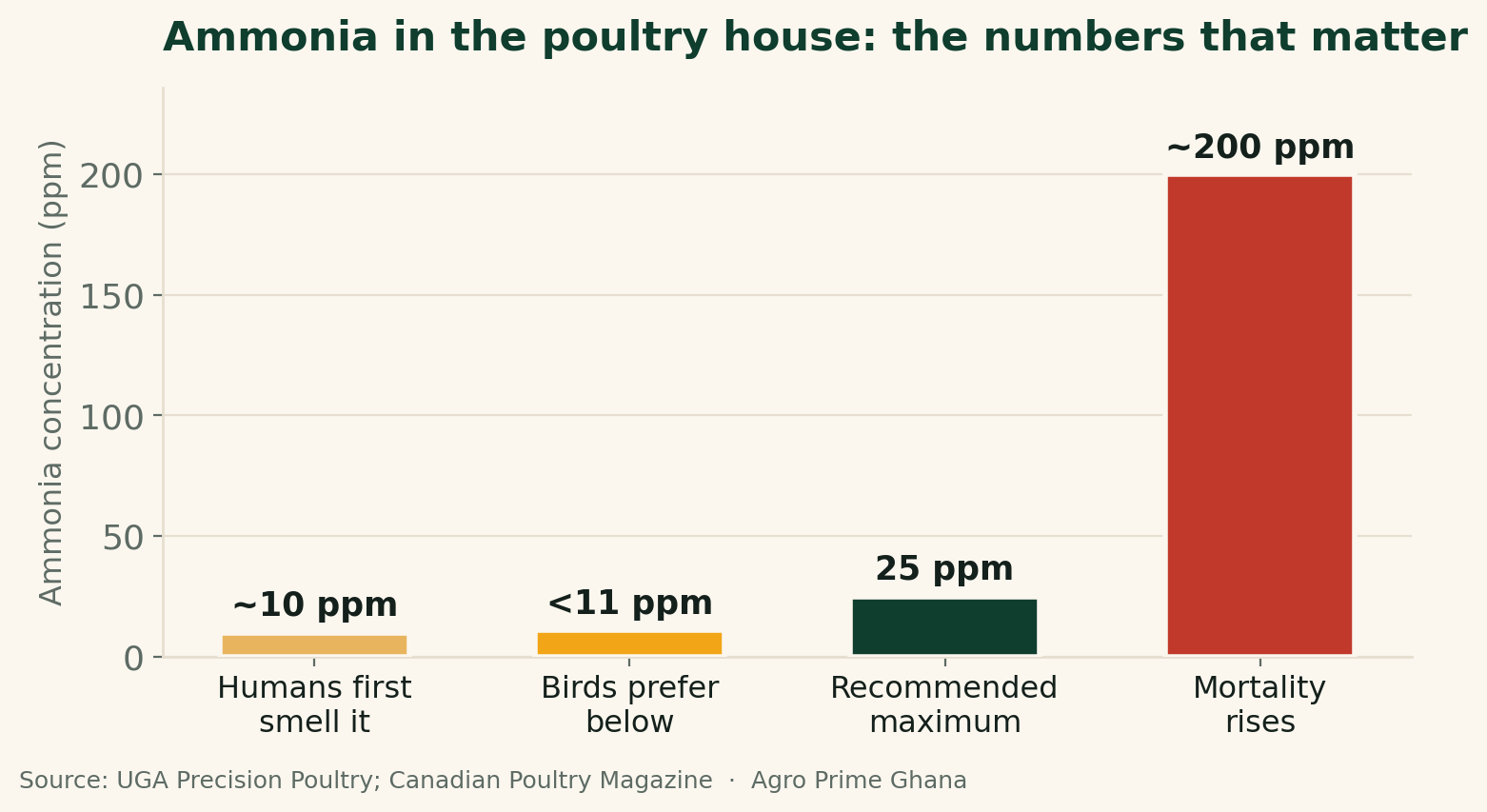
Ammonia is measured in parts per million (ppm), and the numbers are lower than most keepers expect. The single figure to remember is 25 ppm: UGA states that ammonia in the house "should be controlled below 25 ppm," and that is also the highest concentration accepted in many welfare and workplace standards. But do not read 25 as "safe" — it is the ceiling, not the target. Reporting reviewed by Canadian Poultry Magazine notes that an unexposed human nose can perceive ammonia at around 10 ppm, that as little as 12 ppm can begin to affect human lung function, and that at 20–25 ppm birds already show increased susceptibility to viral and bacterial challenge, poorer feed efficiency and tissue damage. Birds given a choice prefer air below about 11 ppm. At the far end, 300 ppm is considered an immediate threat to human life, and the UGA material notes bird mortality rises steeply once levels reach the low hundreds. The practical takeaway is blunt: aim to keep the house well under 25 ppm, treat any smell at bird level as a warning that you are already too high, and never let a shut-up house climb toward the danger zone.
| Ammonia level (ppm) | What it means |
|---|---|
| Below ~11 ppm | What birds prefer when given a choice; a good target for a well-run house |
| ~10 ppm | Level at which an unexposed human nose starts to smell it — your early warning |
| ~12 ppm | Can begin to affect human lung function |
| 20–25 ppm | Birds suffer: weaker immunity, more disease, poorer feed efficiency, airway damage |
| 25 ppm | The recommended maximum — a ceiling to stay below, not a target |
| ~200 ppm and above | Bird mortality rises steeply |
| 300 ppm | Immediate threat to human life and health |
What ammonia does to your birds
Ammonia is a corrosive, irritant gas that attacks wet surfaces — in a bird, the eyes, the lining of the windpipe and the air sacs. Directly, it inflames the eyes (watery, swollen or, at high exposure, painfully damaged), irritates the trachea, causes air-sac inflammation, and makes birds "snick" and struggle to breathe. Indirectly — where most of the money is lost — it strips the respiratory tract of its natural defences: the airway is lined with tiny hair-like cilia and a mucus layer that sweep out dust and germs, and ammonia paralyses and damages that system, so inhaled bacteria and viruses that would normally be cleared take hold instead. This is why respiratory disease so often flares in ammonia-heavy houses, and why UGA links exposure above the threshold to increased disease susceptibility alongside reduced production efficiency, lower feed intake, slower growth and poorer egg production. Much of the cost is invisible: not dead birds, but a whole flock growing a little slower, converting feed a little worse, and responding a little less well to its vaccines than it should.
Field note: your nose is a cheap, honest ammonia meter — used correctly
Most small farms will never buy an ammonia meter, and you don't strictly need one — but you must test at the right height. Ammonia is generated at the litter and the birds live down there, so the air by your standing head is not the air they breathe. The habit we keep is to crouch right down to bird level, especially first thing in the morning before the house has been opened, and take a good breath. If it stings your eyes or catches your throat down there, you are already past the point where the birds are being harmed — because you smell it around 10 ppm and they suffer by 20–25. A house that smells clean at chick level, morning after morning, is a house with its litter and ventilation right.
Control starts in the litter
Because ammonia is made by microbes working on nitrogen in damp litter, the most powerful control is keeping that litter dry and friable — everything that dries litter cuts ammonia. Fix leaking and over-pressured drinkers so water is not spilled onto the floor. Avoid overcrowding, since higher stocking density means more manure and moisture in the same space, which UGA lists as a direct driver. Use good absorbent bedding at proper depth so the floor holds and releases moisture rather than caking into a sour, airless crust where the ammonia-making microbes thrive, and remove wet caked patches promptly, especially under drinkers and in dead-air corners. Between flocks, clean out and manage built-up litter so each new batch does not start on a nitrogen-loaded floor. In practice, the farms with the lowest ammonia are simply the farms with the driest litter. The full moisture routine is in our guides to poultry litter management and wet litter.
Ventilation: moving the gas out
If dry litter stops ammonia being made, ventilation removes what is made anyway — and in Ghana's open-sided houses it is often the difference between a sweet house and a stinging one. The principle is simple: incoming fresh air dilutes the ammonia, and outgoing air carries it away while removing the moisture that feeds ammonia production, so ventilation works twice for you. The mistake to avoid is shutting the house up: it is tempting to close everything down to keep chicks warm or keep out driving rain, but a sealed house lets both moisture and ammonia build overnight to exactly the levels that harm birds. The skill is to keep a minimum air exchange running at all times, even during brooding and on cool nights — enough to carry moisture and gas away without chilling the birds, the balance our guide to poultry house ventilation is built around. When you next smell ammonia at bird level, ask two questions: is the litter wet, and is enough air moving?
Other tools — and where they fit
Beyond dry litter and good air, there are extra measures, but they are supports, not substitutes. Litter amendments — acidifying treatments spread on the bedding — lower litter pH and can sharply reduce ammonia release; the UGA material reports litter additives cutting emissions on the order of 50 percent in broiler houses, and more in some systems at higher rates. These are genuinely useful, particularly early in a brooding cycle, but they buy time rather than fix a wet floor, and their effect fades. Diet matters too: feeding well-balanced protein so birds excrete less surplus nitrogen means less raw material for ammonia in the first place. For most Ghanaian keepers the honest hierarchy is: get the litter dry, get the air moving, feed sensibly, and use amendments as a helpful extra when you need them. Reaching for a powder while the drinkers leak and the house stays shut is spending money to treat a symptom while feeding the cause.
Field note: the brooding trap
The hardest moment for ammonia is the brooding phase, and it catches many keepers out. Young chicks need warmth, so the natural move is to close the house tight and hold the heat — but that same closure traps moisture and lets ammonia climb, and chicks' delicate airways are especially easily damaged. We treat the first weeks as a deliberate balancing act: hold the temperature the chicks need, but never at the price of stagnant air. A little steady ventilation that costs a small amount of heat is far cheaper than a brooding house full of ammonia-scorched airways. If you must choose between a house that is a touch cool and one that stings at chick level, err toward the fresh air.
The bottom line on ammonia
Ammonia is the invisible tax on a damp, badly aired poultry house: a corrosive gas made by microbes feeding on the nitrogen in droppings, harming birds at 20–25 ppm — levels you can barely smell, long before any bird looks sick. It scorches eyes and airways, disarms the respiratory defences so disease takes hold, and quietly drags down growth, feed conversion and egg output across the whole flock. The good news is that you do not fight it in the air so much as at its source. Keep litter dry and friable, fix the drinkers, avoid overcrowding, and above all keep real air moving through the house even when instinct says to close it up — and the gas has neither the moisture to form nor the still air to accumulate. Use your own nose, at bird level, first thing in the morning, as the honest daily check it is. A house that smells clean down where the birds live is a house that is quietly making you money.
Frequently asked questions
What level of ammonia is safe in a poultry house?
How does ammonia form in poultry litter?
What does ammonia do to chickens?
Can I smell dangerous ammonia levels?
How do I reduce ammonia in my poultry house?
Why is ammonia worse during brooding?
Is ammonia dangerous to me and my workers?
Do litter treatments and additives work against ammonia?
Sources & further reading
- University of Georgia Precision Poultry Farming — Controlling Ammonia Generation in Poultry Houses (25 ppm ceiling, nitrogen sources, driving factors, mitigation efficiencies).
- Canadian Poultry Magazine — Be Air-Aware: The Impact of Ammonia (human smell ~10 ppm, effects at 20–25 ppm, 300 ppm human danger, bird preference below 11 ppm).
- Agro Prime Ghana guides: wet litter in poultry houses, poultry litter management, and poultry house ventilation.
About Agro Prime Ghana
Agro Prime Ghana Limited runs a poultry hatchery and mixed agribusiness in Kasoa, supplying day-old chicks and supporting poultry keepers nationwide. These guides combine hands-on hatchery and farm experience with current veterinary and extension references. This article is general educational information, not a substitute for professional veterinary or extension advice — if your birds show respiratory disease or your house air is hard to control, seek expert help. Need chicks, feed advice or farm support? Book a visit or message us on WhatsApp (+233 24 915 1503).


