A broiler lighting program is a deliberate daily schedule of light and darkness that you run from day one to slaughter, and getting it right is one of the cheapest ways to improve leg health, feed conversion and survival in a Ghanaian broiler house. The short version: give chicks a bright, near-continuous start so they find feed and water, then step the light down to a program that includes a real block of darkness — commonly four to six hours a day — because birds that never experience proper darkness grow too fast on weak legs, sleep badly and die more often from sudden death and heart failure. Yet on most small farms around Kasoa the "lighting program" is whatever the security bulb happens to do: full light all night, every night. That single habit quietly costs you birds and money, and fixing it costs nothing but a timer and a decision.
Written by the Agro Prime Ghana poultry team and reviewed against current industry references (Aviagen/Ross broiler management guides and peer-reviewed lighting research). Last updated September 2026.
Key takeaways
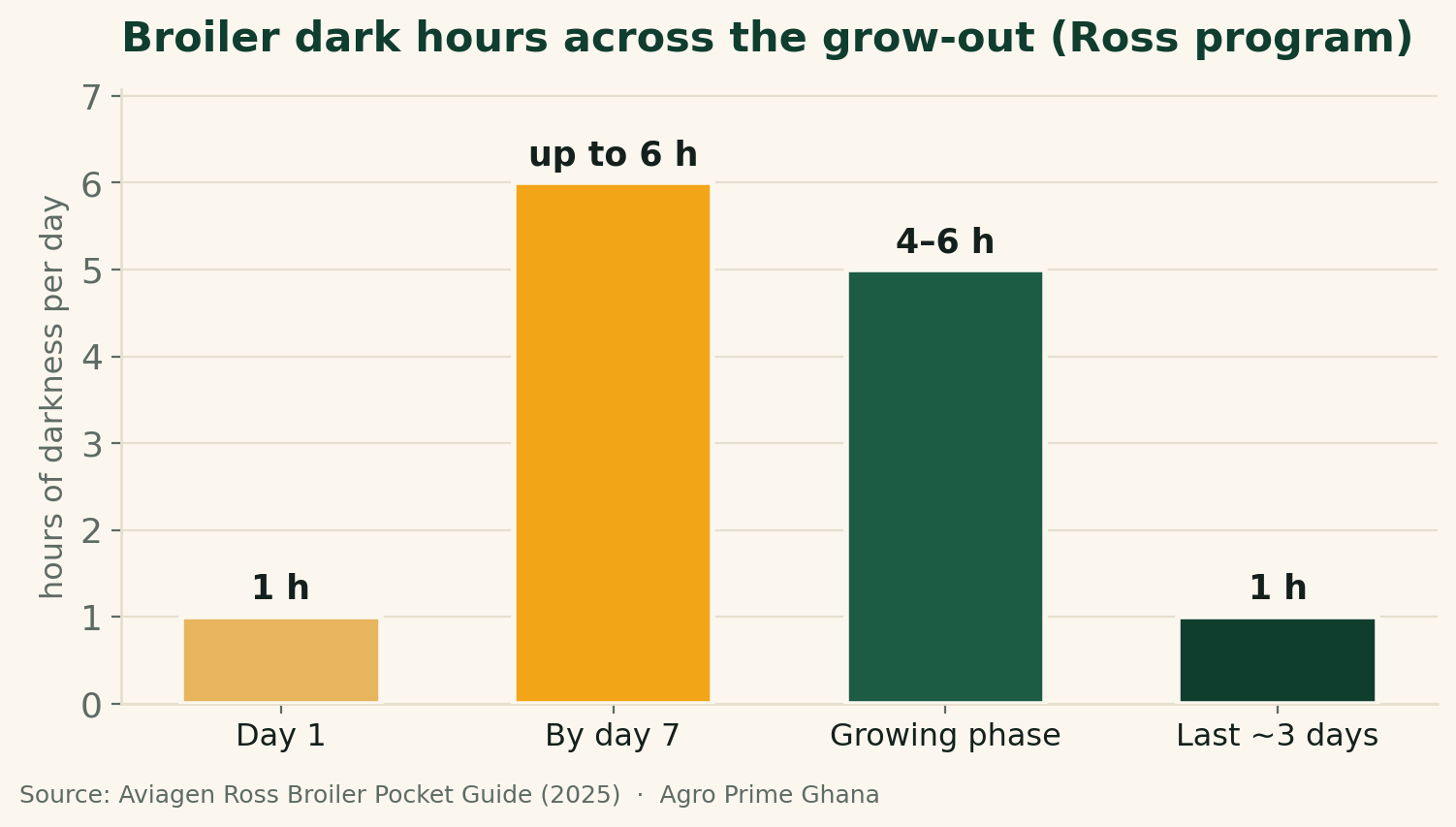
Give day-old chicks a bright start — Ross guidance recommends about 23 hours of light at 30–40 lux on day 1 — then step down to introduce darkness, reaching 4–6 hours of dark by around day 7 and holding a real dark period through the grow-out. After the first week, drop intensity to roughly 5–10 lux. A minimum of 4 hours continuous darkness is needed for normal eye and skeletal development and for the bird's melatonin rhythm. Broilers perform best on 17–20 hours of light, not 23; continuous light does not improve performance and worsens leg problems, sudden death syndrome and mortality. Return to near-continuous light for the last few days before catching. A good program improves feed conversion, leg strength and welfare at essentially no cost.
What a broiler lighting program is — and why it matters
A lighting program controls three things: how many hours of light the birds get (photoperiod), how bright that light is (intensity, measured in lux), and how the schedule changes with age. It matters because light is not just about the birds being able to see — it drives their behaviour, their appetite, their hormone rhythms and, through all of that, how their bones and hearts develop. Modern broilers are bred to grow extremely fast, and if you let them eat around the clock under permanent light, their frame and internal organs struggle to keep up with the muscle. According to Aviagen's Ross lighting technical guide, "broiler performance is not optimized by providing 23 hours of light," and that continuous-light program is explicitly not recommended. Instead, the research points to 17 to 20 hours of light per day as the sweet spot, with the balance given as darkness. That block of darkness is the working part of the program: it forces a rest period, spreads growth more evenly, and lets the skeleton and cardiovascular system mature in step with the muscle.
Why darkness protects legs, hearts and survival in Ghana
Darkness matters most for the problems that hurt Ghanaian broiler farmers the hardest: leg weakness, lameness, and sudden unexplained deaths of your biggest birds. When broilers get a proper dark period, mortality and leg problems fall — Aviagen reports that the benefit improves in a roughly straight line as you add darkness, with the gains levelling off around a 17-hour photoperiod (about 7 hours dark). The mechanism is straightforward: darkness makes birds rest instead of eating continuously, which slows the runaway early growth that overloads immature leg bones and strains the heart. A review of broiler lighting programs notes that many programs exist specifically to slow early growth rate and so reduce metabolic disorders such as sudden death syndrome, ascites (waterbelly) and skeletal problems. Darkness also lets birds produce melatonin — the hormone the body only makes in the dark — which supports bone development and immune function. In our climate, where heat already pushes birds toward panting and stress, a night-time dark-and-cool period is doubly useful: the birds rest, the house cools, and the flock enters each hot day less exhausted. If leg problems are a recurring frustration in your flocks, the lighting program is one of the first things to examine alongside our notes on leg problems in broilers and general poultry lameness.
A practical Ghana broiler lighting schedule
Here is a workable program built on Ross/Aviagen guidance, adapted for a typical open-sided or lightly-controlled Ghanaian broiler house. The principle is the same whichever guide you follow: bright and long at the start, dimmer with a real dark block through the middle, bright again at the end. The table gives target hours of light and darkness and the intensity to aim for. Treat lux as a guide — as a rough check, at roughly 20 lux you can read newsprint comfortably; at 5–10 lux the house is dim but birds can still see feed and each other clearly.
| Age | Light : dark (hours) | Light intensity | Why |
|---|---|---|---|
| Day 1 | ~23L : 1D | 30–40 lux (bright) | Chicks must find feed and water fast; stimulate early intake |
| Days 2–7 | Step darkness up to 4–6 hours dark by day 7 | Reduce gradually toward 5–10 lux | Introduce a rest period as chicks settle onto feed |
| Day 8 to ~3 days before sale | ~18–20L : 4–6D | 5–10 lux (dim, even) | Rest period protects legs and heart; steady, even growth |
| Last ~3 days before catching | Back toward 23L : 1D | 5–10 lux | Maximise final feed intake and prepare birds for catching |
Two practical points. First, the dark period should be continuous — one solid block, not several short off-and-on switches — so the birds get genuine rest and a proper hormonal night. Second, keep at least 1 hour of low-level darkness even on day 1; Aviagen's day-1 recommendation is 23 hours light and 1 hour dark, not 24 hours light, so that chicks experience some darkness from the very start and so that a power cut is never their first experience of a dark house.
Intermittent versus continuous versus step-down: which to run
Broiler keepers meet three broad approaches, and it helps to know what each is. Continuous (or near-continuous) lighting — 23 or 24 hours of light — is the default that happens by accident on many farms; it maximises the time birds can eat but delivers the worst leg health and the highest rates of sudden death, and it does not actually improve final performance, which is why the breeder companies advise against it. Intermittent lighting repeats short cycles of light and dark through the 24 hours (for example, blocks of light alternating with blocks of dark). It can improve feed efficiency and give birds rest, and research on intermittent programs has shown benefits for growth efficiency and bone measurements — but it is fiddly to run well and can disturb feeding if poorly designed. Step-down (single dark-period) programs — the schedule in the table above — are the most practical for most Ghanaian farms: one long light period and one consolidated dark period each day, with the light hours highest at the start and end. For a smallholder with a timer switch and no fancy controller, the single dark-block step-down program captures most of the welfare and leg-health benefit with the least complication. Whichever you choose, the non-negotiable is a real, consolidated dark period of at least four hours once the chicks are past the first few days.
Field note: the security-bulb trap
The most common lighting mistake we see on small farms has nothing to do with the birds and everything to do with the night watchman. A bright security light left on all night, shining into an open-sided pen, quietly converts a sensible daytime program into 24-hour lighting — the birds never get their dark period, and the farmer wonders why the big cockerels keep dropping dead. If you need light for security, keep it outside the birds' field of view, or use a dim red or low bulb that does not flood the pen, or shield the pen side. The birds need their night even if the compound does not.
Getting light intensity right — bright start, dim middle
Intensity is as important as duration, and it changes with age. In the first week, bright light (around 30–40 lux) helps chicks locate feed and water and get off to a strong start — this is when you want them active and eating. After about day 7, dropping the intensity to roughly 5–10 lux calms the flock, reduces activity that can lead to scratches and pecking, and supports the rest that protects legs. Do not go pitch-dark during the "light" hours — birds still need to see to eat — but dim is good once they are established. If you raise coloured or slower broilers such as managed broilers alongside cockerels, the same principle holds. Avoid harsh flickering from failing fluorescent tubes, which can stress birds; steady LED or incandescent light is calmer. And keep intensity even across the house — bright patches under a bulb and dark corners elsewhere make birds crowd the lit areas, worsening litter and footpad problems in the shaded zones.
Order broiler chicks with a ready-made brooding and lighting plan
Agro Prime Ghana supplies strong, well-started broiler day-old chicks (Cobb, Ross and other lines) and can set you up with a simple day-by-day lighting and brooding schedule matched to your house and your timer switch — the same programs we run ourselves. If you are not sure how to translate "23L on day 1, step down to 4–6 hours dark" into a routine your farm hand can follow, we will write it out for you. Message us on WhatsApp (+233 24 915 1503) or book a visit to order chicks and get a brooding, lighting and vaccination plan together. Pair this with our Ross 308 and Cobb 500 breed guides.
How lighting affects growth and feed conversion
There is a real trade-off between raw growth and efficiency, and understanding it helps you tune the program to your market. More light hours mean more time eating, which can push slightly faster growth to a given age — Aviagen's data shows body-weight gain peaking around 20 hours of light at younger market ages. But feed conversion (FCR) actually improves with shorter day-lengths: the same guidance reports the best FCR at around 14 hours of light, because rested birds convert feed more efficiently and waste less energy on constant activity. For birds taken to older, heavier weights (48–49 days), 17 and 20 hours of light give equal, superior growth. In plain terms: if you are chasing the fastest possible weight for a fixed early sale date, lean toward the longer (18–20 hour) end; if feed cost is your biggest worry and you can accept marginally slower growth, a slightly shorter photoperiod saves feed. Either way, staying in the 17–20 hour band keeps you in the zone that protects legs and survival — pushing to 23 hours buys you almost nothing in growth and costs you birds. Because feed is the largest cost in any broiler enterprise, even a small FCR gain from a sensible dark period adds up over a flock; see our note on broiler feed conversion.
Lighting, heat and power realities in Ghana
A lighting program has to survive Ghanaian conditions: hot days, unreliable power, and open houses that follow natural daylight. Use these realities to your advantage. Schedule the dark period to overlap with the coolest part of the night so birds rest when it is most comfortable, and keep the hottest afternoon hours as light, active feeding time only if the house is bearable — during a heatwave, birds will stop eating in the heat regardless, so shifting feeding toward cooler morning and evening light hours is smart. In open-sided houses that rely on natural light, you are really adding artificial light at the ends of the day and controlling the night; a simple timer switch on the house bulbs is the single most useful piece of equipment for running any program consistently. Plan for power cuts: an unexpected blackout during the "light" period is a stress, and a generator or even a few battery lamps to cover feeding times helps. Do not let ECG outages accidentally set your program — decide the schedule and make the equipment follow it. Heat management and lighting work together, so read this alongside broiler heat stress management.
Building the program into your daily routine
The farms that get consistent results are the ones where the lighting program is written down and automated, not left to memory. Set the timer once for the current age band, check it does what you think each morning, and adjust the bands as the birds grow. Walk the house during the dark period occasionally (with a torch, briefly) to confirm it really is dark and the birds are resting — no leaking security light, no bright neighbour's bulb flooding in. Keep the bulbs clean; dust and cobwebs can cut a house's light level dramatically over a flock, so a 30-lux start can drift to a dim, uneven mess by week three without anyone touching a switch. And record what you ran: noting the program against your final weights, mortality and FCR turns each flock into information you can use to fine-tune the next one, which ties into good farm record keeping. None of this is expensive. A timer, clean bulbs, a shielded security light and the discipline to give birds their night will do more for your leg health and survival than most of the supplements sold for the purpose.
The bottom line on broiler lighting
Light is a management tool, not just illumination. Start bright and long so chicks find feed, then step down to a dimmer program with a real, consolidated dark period of four to six hours — keeping the birds in the 17–20 hour light band that the breeder guides recommend — and return to near-continuous light only for the last few days before catching. Done consistently, this protects legs, reduces sudden death and ascites, improves feed conversion and gives birds the rest that welfare and performance both depend on. It is one of the rare improvements that costs almost nothing: a timer, clean bulbs, and the discipline to let your broilers have their night. Avoid the accidental 24-hour lighting that a stray security bulb creates, and you remove a hidden, expensive drain on your flock.
Frequently asked questions
How many hours of light do broilers need per day?
Why do broilers need a dark period?
What light intensity (lux) should a broiler house have?
Is continuous (24-hour) lighting bad for broilers?
What is the difference between intermittent and step-down lighting?
Does the lighting program affect feed conversion?
Should I change the lighting before selling broilers?
How do I run a lighting program in an open-sided house in Ghana?
Sources & further reading
- Aviagen / Ross — Lighting for Broilers (Ross Tech): recommended photoperiods (17–20L), intensity, and dark-period effects on mortality, leg problems and FCR.
- Aviagen — Ross Broiler Pocket Guide: day-1 lighting (23L, 30–40 lux), step-down to 4–6 hours dark, 5–10 lux, and pre-catch lighting.
- Olanrewaju et al. — A Review of Lighting Programs for Broiler Production (International Journal of Poultry Science): lighting to slow early growth and reduce metabolic disorders.
- Agro Prime Ghana guides: leg problems in broilers, broiler heat stress management, and broiler litter management.
About Agro Prime Ghana
Agro Prime Ghana Limited runs a poultry hatchery and mixed agribusiness in Kasoa, supplying day-old chicks and working alongside broiler farmers across the country. These guides combine hands-on hatchery and farm experience with current industry references. This article is general educational information, not a substitute for professional veterinary or technical advice tailored to your farm. We supply healthy day-old broiler chicks, brooding equipment and hands-on setup support. Ready to start or expand? Book a visit or message us on WhatsApp (+233 24 915 1503) to order chicks, equipment or advice.