A lame bird tells you something is wrong long before your records do. It sits when the others feed, walks on its hocks, splays a leg, or simply hangs back at the far end of the pen and gets out-competed. On a broiler farm a cluster of lame birds is money walking away — slow growth, downgrades at slaughter, cull losses. On a layer farm it can be the first visible sign of a mineral problem quietly cracking the whole flock's shells and bones. The frustrating part is that "lameness" is not one disease: it is a symptom with a dozen very different causes, from infections to feed mistakes to plain mechanical strain. This guide sorts those causes into the groups that matter — infectious, nutritional and mechanical — and shows you how to tell them apart under Ghanaian conditions.
Written by the Agro Prime Ghana poultry team and reviewed against current veterinary references (Merck/MSD Veterinary Manual and Poultry Extension). Last updated September 2026.
Key takeaways
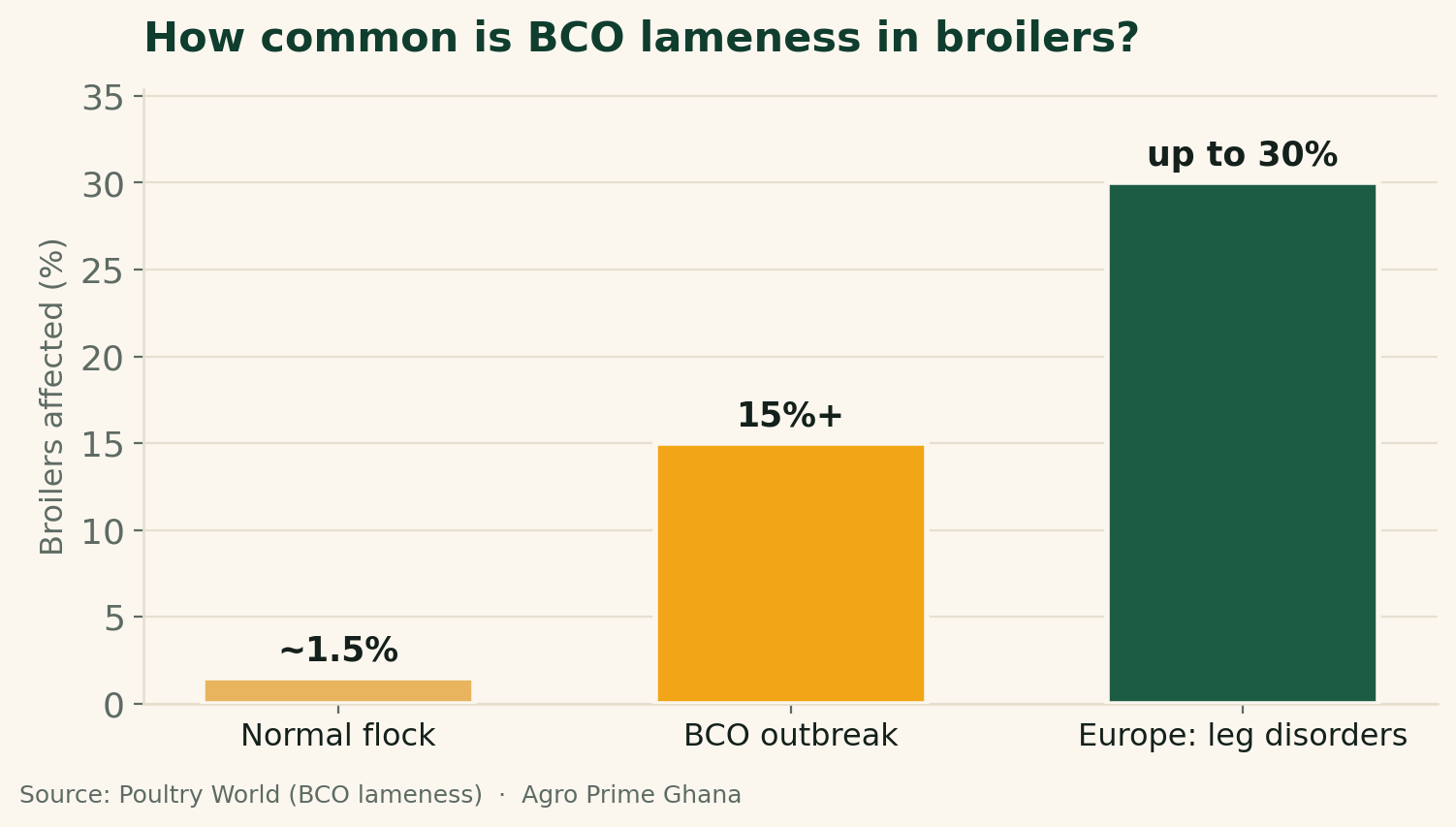
Lameness in poultry has three broad families of cause. Infectious: viral arthritis (swollen hocks), Mycoplasma synoviae and staphylococcal infection (swollen joints, bumblefoot), Marek's disease (one-sided leg or wing paralysis), and bacterial chondronecrosis with osteomyelitis (BCO) — a gut-origin bone infection that is now recognised as a leading cause of broiler lameness, affecting over 15% of a flock in outbreaks and reportedly up to 30% of broilers in parts of Europe. Nutritional: rickets (vitamin D, calcium, phosphorus imbalance — soft bones), perosis/slipped tendon (manganese and choline shortage), riboflavin deficiency (curled-toe paralysis) and cage layer fatigue (calcium-depleted, paralysed but alert hens). Mechanical/developmental: fast growth outrunning the skeleton, tibial dyschondroplasia, angular (valgus-varus) leg deformities, and injury. Diagnosis is about pattern — age, one leg or both, joint swelling, bone softness — and a post-mortem is often the fastest way to be sure.
Why lameness deserves your attention
Modern poultry are bred to grow or lay at a pace that puts real strain on the skeleton. As the Merck Veterinary Manual puts it, "production characteristics of modern poultry lines — body weight in broiler chickens, egg production in laying hens — place high demands on the skeletal system, and inadequacies in nutrition or husbandry often result in skeletal diseases." The bird's frame runs close to its limit, so any weakness in feed, hygiene or management shows up in the legs first. A lame bird eats less, gets bullied off the feeder and is prone to breast blisters and hock burn from sitting in litter — which means lost growth, more culls, downgraded carcasses and, in layers, a drop in output. That is why leg health is treated as a core performance measure on well-run farms.
The three families of cause — a working map
The single most useful thing you can do with a lame bird is decide which family it belongs to, because the fix is completely different for each. Infectious causes need hygiene, biosecurity and sometimes treatment; nutritional causes need the feed corrected; mechanical and developmental causes need management of growth rate, housing and handling. The table below is the map we use to start narrowing it down.
| Family | Typical causes | What you tend to see |
|---|---|---|
| Infectious | Viral arthritis, Mycoplasma synoviae, staphylococcus/bumblefoot, Marek's, BCO | Swollen hot joints or hocks, pus, one-sided paralysis, birds going down from a certain age |
| Nutritional | Rickets, perosis (Mn/choline), riboflavin deficiency, cage layer fatigue | Soft/bendy bones, twisted hocks, curled toes, paralysed but alert layers |
| Mechanical / developmental | Fast growth, tibial dyschondroplasia, valgus-varus deformity, injury | Bowed or twisted legs, heavy birds sitting, sudden single-bird lameness after handling |
Infectious causes: when a bug is behind the limp
Several infections settle in joints, tendons and bones. Viral arthritis (reovirus-associated tenosynovitis) classically shows as lameness with swollen hocks and can rupture the gastrocnemius tendon in heavier birds. Mycoplasma synoviae causes infectious synovitis — swollen, painful joints and lameness — and spreads within and between flocks. Staphylococcus infection produces swollen joints and footpad infections, including bumblefoot, where a penetrating injury to the pad lets bacteria in and the foot swells hard. Marek's disease, a herpesvirus, is a common cause of the striking one-sided picture — a bird dragging one leg forward and one back, or a drooped wing on one side; Pasteurella (fowl cholera) can cause lameness and paralysis too. The Poultry Extension guide to lameness ties each of these to the joint and paralysis signs listed above.
The infection now getting the most attention in broilers is bacterial chondronecrosis with osteomyelitis (BCO), also called femoral and tibial head necrosis — a bone infection, not a simple joint problem. Bacteria that originate in the gut — Enterococcus, E. coli and Staphylococcus — cross a stressed or leaky gut wall, travel in the bloodstream, and lodge in the growth plates of bones under the most mechanical load: the top of the femur and tibia and the thoracic spine, where the bone dies and the head can collapse. According to reporting in Poultry World, BCO affects roughly 1 in 67 broilers over 30 days of age under normal conditions, but over 15% of a flock during outbreaks, and up to 30% of broilers in Europe are estimated to suffer painful leg disorders linked to BCO. Because the root is gut health and mechanical stress, prevention leans on a stable gut microbiome from day one, good litter, and not pushing early growth so hard that immature legs are overwhelmed — one report noted vitamin D₃ supplementation cutting lameness by over half.
Field note: read the pattern before you reach for anything
Before we treat a lame bird for anything, we ask three quick questions. One leg or both? A one-sided leg-and-wing picture in a grower points hard toward Marek's; both legs weak points more to nutrition or general skeletal strain. Is a joint hot and swollen, or is the bone itself soft and bending? Hot swollen joints say infection; soft, rubbery bones say a feed problem. And at what age did it start? These three answers usually put us in the right family before any drug or feed change — and they stop the classic mistake of dosing antibiotics into what is really a feed-formulation problem.
Nutritional causes: the feed is in the legs
A great deal of poultry lameness is written in the ration, and this is often where Ghanaian home-mixed and lower-cost feeds fall down. The main players:
- Rickets — a failure of bone mineralisation from too little vitamin D₃, or the wrong calcium-to-phosphorus balance. The Merck manual and extension sources describe soft, bendy bones and a rubbery beak, birds reluctant to stand, and a springy keel. It hits growing birds and is a feed-formulation and vitamin problem, not an infection.
- Perosis (slipped tendon / "hock disease") — caused mainly by a shortage of manganese and choline (with other B-vitamins involved). The hock joint enlarges and the gastrocnemius tendon slips off its groove, twisting the lower leg outward; badly affected birds cannot walk.
- Riboflavin (vitamin B₂) deficiency — the classic sign is curled-toe paralysis, where chicks walk on hocks with toes curled inward. Caught early and corrected in the feed it can improve; left too long the nerve damage becomes permanent.
- Cage layer fatigue — high-producing hens drained of calcium for shell after shell become paralysed but remain alert, often found down in the cage. It reflects a calcium, phosphorus and vitamin D shortfall against a heavy laying demand.
The common thread is that these are fixed by getting the ration right, not by medicine — the correct vitamin-mineral premix, the right calcium and phosphorus levels for the class of bird, and enough vitamin D₃. Our guides to layer feeding and broiler feeding set out the mineral and vitamin targets that keep legs sound. Home-mixers especially should never skimp on the premix to shave costs — the saving comes straight back out of the flock's legs.
Mechanical and developmental causes: growth outrunning the frame
The third family is about the skeleton itself failing to keep up. Fast-growing broilers put enormous load on legs that are still cartilage in places, and several conditions follow. Tibial dyschondroplasia is an abnormal, un-mineralised plug of cartilage in the top of the tibia that weakens the bone and, in bad cases, causes bowing and lameness; it is strongly linked to rapid early growth. Angular bone deformities — legs bowing outward (valgus) or inward (varus), the classic "twisted leg" — likewise track with fast growth and imbalanced nutrition. On top of these sits plain mechanical injury: a bird caught in slats or wire, a rough catch, or damage from overcrowding and poor footing. Mechanical causes typically show as a single bird suddenly lame, often after handling or a housing fault, rather than a whole cohort going down together — a useful distinction when working out what you are dealing with.
Field note: heavy birds sitting is a warning, not a habit
With fast-growing broilers it is easy to accept birds sitting a lot as "just how big birds are." We treat it as a warning instead. When a batch starts spending most of the day on its keel, we check growth rate against target, litter (wet, capped litter makes every skeletal problem worse and adds hock and footpad burns), feeder and drinker access so weaker birds are not pushed out, and whether lighting and stocking let birds move enough to build sound legs. Managing growth and litter is far cheaper than culling the lame tail at the end — and wet litter is a leg-health issue as much as a hygiene one, covered in our litter management guide.
How to diagnose lameness on the farm
You will rarely have a laboratory on hand, so practical diagnosis is about systematic observation and a willingness to open a bird. Work through it in order:
- Watch the gait. Vets score walking ability on a 0–5 scale, from normal (0) to unable to walk (5). You do not need the formal scale — grade birds roughly from "walks fine" to "won't stand," and track whether the flock is drifting worse over days.
- One leg or both? One-sided leg-and-wing paralysis strongly suggests Marek's; symmetrical weakness points toward nutrition or general skeletal disease.
- Feel the joints and bones. Hot, swollen joints or footpads mean infection (arthritis, synovitis, staph/bumblefoot). Soft, bendable bones or a rubbery beak mean a mineral/vitamin problem such as rickets.
- Note the age and number affected. A cohort going down together over a set age window suggests infection or a feed fault; a lone bird suddenly lame suggests injury.
- Post-mortem a fresh case. Looking at the hock, the top of the femur and tibia (for the collapsed, discoloured heads of BCO), the tendon groove (perosis) and bone hardness tells you more in five minutes than days of guessing. If Marek's is suspected, involve a veterinary or extension officer.
Because several causes overlap — and a flock can have more than one at once — do not stop at the first answer. A bird can be nutritionally weak and then infected in the damaged bone, which is exactly the BCO story.
Prevention: sound legs are built, not bought
Most lameness is preventable, and the levers are the ordinary ones done well. Feed a properly balanced ration for the class and age of bird, with the right calcium-to-phosphorus ratio, adequate vitamin D₃, and a full vitamin-mineral premix including manganese, choline and riboflavin — this alone removes the whole nutritional family. Keep litter dry and friable and stocking sensible, so birds move freely and footpads stay healthy. Run tight hygiene and biosecurity to keep infectious causes out, and source chicks from clean, well-vaccinated parent stock (Marek's is controlled by day-old vaccination at the hatchery). For fast-growing broilers, manage early growth and protect gut health, the front line against BCO, and handle birds gently to avoid injury. None of this is exotic — it is the same husbandry that protects the rest of the flock, aimed at the legs.
The bottom line on lameness
Lameness is a symptom, not a diagnosis, and the keepers who deal with it well are the ones who slow down and sort it into the right family before acting. Ask whether it is one leg or both, whether the joint is hot and swollen or the bone soft and bending, and at what age it began — those three questions steer you between infection, nutrition and mechanical strain, which need three different responses. Get the ration and its minerals right, keep litter dry and biosecurity tight, protect gut health in fast-growing broilers, and handle birds with care, and the great majority of leg problems never start. When they do, a five-minute post-mortem usually beats a week of guessing. Legs are where poultry husbandry is honestly graded — look after them, and the rest of the flock's performance tends to follow.
Frequently asked questions
What are the main causes of lameness in chickens?
How can I tell if lameness is from infection or nutrition?
What is BCO lameness?
Why are my broilers sitting down and not walking?
Can lameness be caused by feed?
Is lameness in one leg different from both legs?
How do I prevent leg problems in my flock?
Should I cull a lame bird or treat it?
Sources & further reading
- Merck Veterinary Manual — Overview of Skeletal System Disorders in Poultry (demands of modern production on the skeleton, diagnostic approach).
- Poultry Extension (eXtension) — Causes of Lameness in Poultry (infectious, nutritional and other causes and their signs).
- Poultry World — Easy guide to BCO lameness in chickens (prevalence figures, gut-origin bacteria, prevention).
- Agro Prime Ghana guides: layer feeding, broiler feeding, and poultry litter management.
About Agro Prime Ghana
Agro Prime Ghana Limited runs a poultry hatchery and mixed agribusiness in Kasoa, supplying day-old chicks and supporting poultry keepers nationwide. These guides combine hands-on hatchery and farm experience with current veterinary references. This article is general educational information, not a substitute for diagnosis by a qualified veterinary or extension officer — if birds are going lame in numbers, get the cause identified before treating. Need chicks, feed advice or farm support? Book a visit or message us on WhatsApp (+233 24 915 1503).