Leg problems in broilers are common, costly and mostly preventable: they arise when a bird's skeleton cannot keep pace with the speed and weight of modern meat-bird growth, and they show up as lameness, twisted legs, swollen hocks or birds that sit rather than walk. The main culprits are fast growth on a young skeleton, mineral and vitamin imbalances (calcium, phosphorus and vitamin D3), and damp, dirty litter — with infection and injury adding to the toll. In one large survey, more than a quarter of broilers had a walking impairment by around six weeks of age. This guide explains the main types of leg problems, why they happen in Ghanaian conditions, and how to prevent them through growth control, nutrition, litter and honest culling.
Written by the Agro Prime Ghana poultry team and reviewed against current veterinary references (MSD Veterinary Manual, noninfectious skeletal disorders; University of Maryland Extension). Last updated September 2026.
Key takeaways
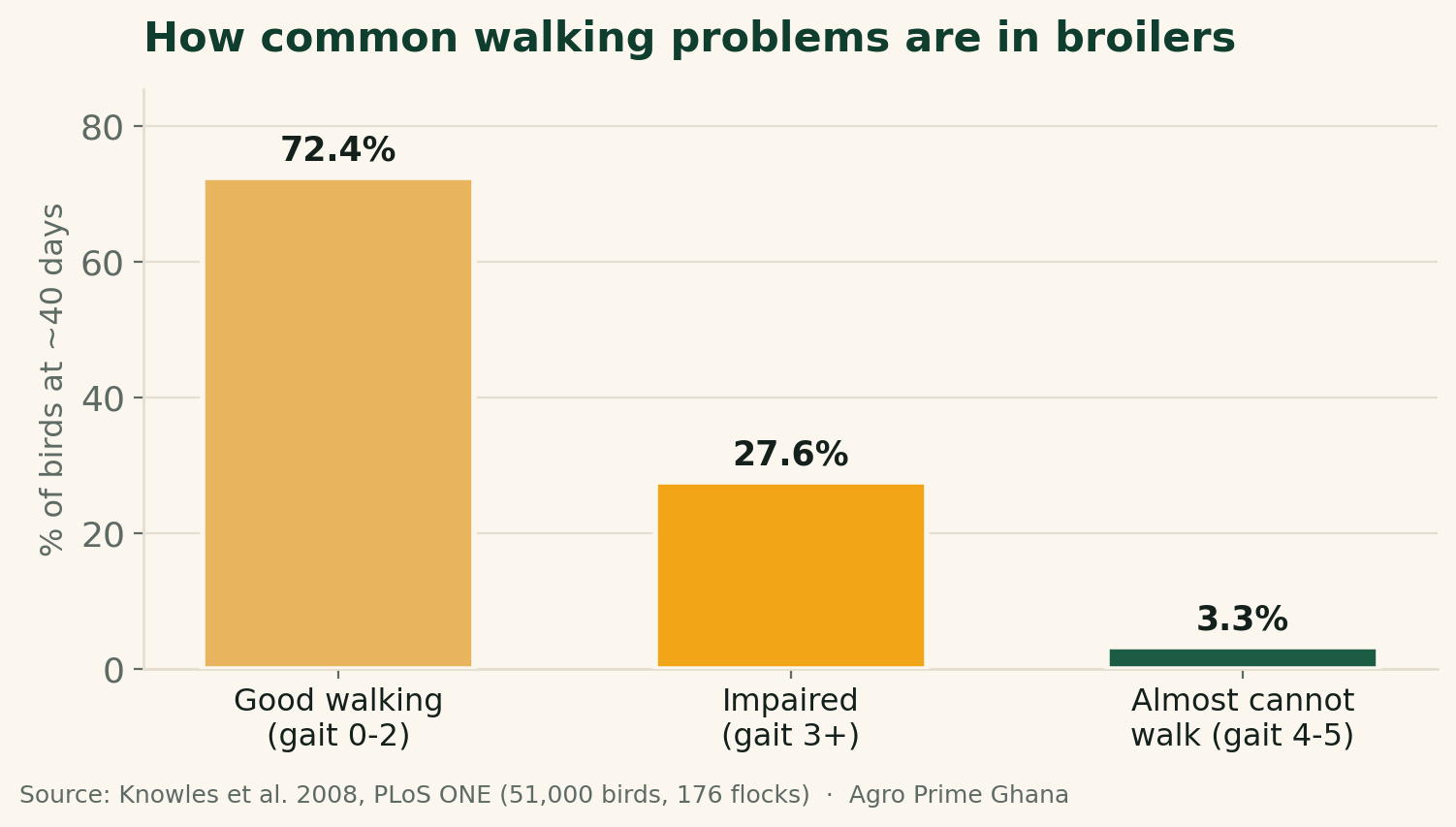
Broiler leg problems are mostly the result of a fast-growing body outpacing a young skeleton, made worse by nutrition and litter faults. The big named conditions are tibial dyschondroplasia (TD) — a cartilage plug in the shin bone linked to rapid growth and calcium-phosphorus imbalance; valgus-varus (angular) leg deformity — bent or splayed legs, commoner in males; rickets — soft, bending bones from too little vitamin D3, calcium or phosphorus; and spraddle leg in day-old chicks from slippery brooder floors. A large UK survey found 27.6% of broilers had impaired walking (gait score 3+) and 3.3% could barely walk, at about 40 days old. Prevention: slow early growth (lighting, feed), get calcium, phosphorus and vitamin D3 right, keep litter dry, provide firm footing for chicks, and cull cripples early and humanely.
How common are leg problems in broilers?
Leg problems are one of the most widespread welfare and production issues in broiler production worldwide, not a rare accident. The clearest measure comes from a large study that assessed the walking ability of over 51,000 birds across 176 flocks (representing 4.8 million birds) at a mean age of about 40 days, scoring each bird's gait from 0 (normal) to 5 (unable to walk). It found that 27.6% of birds had a gait score of 3 or above — a clear, visible walking impairment — and 3.3% were almost unable to walk (gait score 4 or 5), and this was despite culling policies meant to remove the worst cases (Knowles et al., 2008, PLoS ONE). In other words, in a typical fast-grown broiler flock, roughly one bird in four is not walking well by market age. For a Ghanaian farmer this is not an abstract statistic: lame birds eat and drink less, grow unevenly, get trampled or picked on, downgrade at sale, and die or need culling — every one of them a direct loss. The good news is that most of these problems trace back to a few controllable causes.
Why growth rate is the underlying driver
The deepest reason broilers get leg problems is the same reason they get ascites: they have been bred to grow extraordinarily fast, and the skeleton — bones, growth plates, joints, tendons — struggles to keep up with the muscle piling on above it. A modern broiler reaches market weight in around six weeks, and for much of that time it is a heavy body balanced on an immature frame. The MSD Veterinary Manual repeatedly names genetic selection and rapid growth rates as central factors in skeletal disorders such as tibial dyschondroplasia and angular bone deformity, and lists feed restriction or modified lighting programmes — both of which moderate growth — as prevention. This is why so many leg problems cluster in the fastest, heaviest birds and in males, which grow quickest. It also explains why simply slowing early growth a little, rather than pushing every bird to maximum speed from day one, prevents a surprising share of leg trouble. You are giving the skeleton time to mineralise and strengthen before it has to carry a finisher-weight body.
The main leg problems and how to tell them apart
"Leg problems" is a family of distinct conditions, and telling them apart helps you find the cause. The table below summarises the ones you are most likely to meet in a Ghanaian broiler house.
| Condition | What you see | Main causes |
|---|---|---|
| Tibial dyschondroplasia (TD) | Lameness, reluctance to move in growing birds; a plug of cartilage in the top of the shin (tibia) — often found only at post-mortem | Rapid growth, genetics, calcium-phosphorus imbalance, excess dietary chloride, copper deficiency, some mycotoxins |
| Valgus-varus (angular) deformity | One or both legs bent outward (valgus, "knock-knee") or inward (varus, "bow-leg") at the hock; splayed stance | Fast growth, poor bone mineralisation (rickets), genetics; commoner in males |
| Rickets | Soft, bendy bones, unsteadiness, birds unable to stand, fractures, rubbery beak and ribs | Deficiency or imbalance of vitamin D3, calcium or phosphorus |
| Spraddle (splay) leg | Day-old chick doing the "splits", legs sliding out sideways, cannot stand | Slippery brooder floor in the first days; sometimes incubation faults |
| Spondylolisthesis ("kinky back") | Bird sits on hocks/tail with legs forward, or lies on its side; seen ~2–8 weeks | Vertebral deformity pinching the spinal cord; low incidence but untreatable |
| Bacterial infection (BCO / arthritis) | Swollen, hot hock or foot joints, lameness after ~2 weeks of age | Bacteria (often via gut or footpad) settling in bone/joint, especially in fast-growing birds |
| Footpad dermatitis / bumblefoot | Dark scabs, swelling or ulcers on the footpad; painful walking | Wet, caked, ammonia-rich litter; footpad injury and infection |
Tibial dyschondroplasia and angular deformities
The two most important growth-related leg problems are tibial dyschondroplasia and valgus-varus deformity. TD is, in the MSD Veterinary Manual's terms, a failure of the normal process by which cartilage in the growth plate turns into bone: cartilage cells fail to mature properly, blood vessels do not penetrate the growth plate, and a mass of unconverted cartilage is left in the top of the tibia. Many affected birds show no outward sign and are only found at post-mortem, but severe cases are lame and reluctant to move. TD is pushed along by rapid growth and genetics, and worsened by a poor calcium-to-phosphorus balance, excess dietary chloride causing metabolic acidosis, copper deficiency and certain mould toxins in feed — several of which are avoidable through good feed. Valgus-varus deformity is the visible one: the leg bends outward (valgus) or inward (varus) at the hock, giving a knock-kneed or bow-legged bird that walks badly and, when both legs splay, may end up sitting. MSD notes valgus is commoner than varus, that males are more often affected, and that poor bone mineralisation from rickets makes the deformity worse — so getting minerals and vitamin D right (below) is part of preventing it, alongside slowing growth with feed or lighting programmes.
Field note: a 30-second walk-the-flock check
You do not need a laboratory to gauge your flock's legs — you need a daily walk and honest eyes. Move slowly through the birds and watch how they get up and move: a sound broiler stands and walks away smoothly, while a bird with leg trouble is slow to rise, waddles, rocks side to side, takes a few steps and squats, or sits on its hocks. Note whether the strugglers are your biggest birds (points to growth-rate problems) and check their feet for dark footpad scabs (points to wet litter). Doing this every day, rather than only when losses spike, catches a leg problem while you can still fix its cause — and tells you which cause to chase.
Nutrition: getting calcium, phosphorus and vitamin D right
After growth rate, nutrition is the biggest lever you control, and it centres on three linked nutrients: calcium, phosphorus and vitamin D3. These three build and mineralise bone together, and it is not just how much of each you provide but the balance between them. Too little vitamin D3, too little available phosphorus, too little or too much calcium, or a wrong calcium-to-phosphorus ratio all lead to rickets — soft, bending bones, weak legs, birds that cannot stand, and, as MSD notes, "pliable long bones," soft beaks and a rachitic "rosary" of swellings along the ribs. Because rickets weakens the whole skeleton, it also makes TD and angular deformities worse. The practical protection is to feed a properly formulated broiler ration with the correct mineral and vitamin premix for each growth phase, and not to tamper with the mineral balance if you mix your own feed — this is exactly where home-mixers get into trouble. MSD lists adequate vitamin D supplementation among the measures that decrease TD incidence. Our guides to a broiler feeding programme and the vitamin-mineral premix explain how to get this right in Ghanaian conditions, where variable ingredient quality makes a good premix especially important.
Field note: most "sudden lameness" starts in the feed bag or the litter
When a broiler farmer calls us about legs, the two questions we ask first are what the birds are eating and how wet the litter is. A ration mixed without a proper premix, or one where the calcium and phosphorus were guessed rather than formulated, quietly produces soft-boned, wobbly birds a few weeks later — long after the mixing mistake is forgotten. And a house with damp, caked litter under the drinkers breeds footpad sores and joint infections that show up as limping birds. Neither problem looks like a feed or litter fault at first glance; they look like "bad legs." Fixing the feed formulation and drying out the litter usually does more for a flock's legs than any treatment.
Litter, footpads and infection
Not every leg problem is about bones — many are about the floor the bird stands on. Wet, caked, ammonia-heavy litter is directly responsible for footpad dermatitis (bumblefoot) and hock burns: the constant moisture and ammonia scald and ulcerate the skin of the foot and hock, which is painful, makes birds reluctant to walk, and opens a door for bacteria. Those bacteria can travel and settle in the leg bones and joints, causing bacterial chondronecrosis with osteomyelitis (BCO) and infectious arthritis — swollen, hot joints and lameness that typically appears after about two weeks of age and again hits the fast-growing birds hardest. The University of Maryland Extension's guidance on leg health in chickens puts clean, dry litter and housing near the top of its prevention list, alongside balanced nutrition and good biosecurity. So litter management is leg-health management: keep litter dry and friable, fix leaking drinkers immediately, ventilate to carry moisture away, and top up or turn damp patches. Our guide to broiler litter management covers the practical routine for Ghanaian houses, where humidity and heavy stocking make wet litter a constant battle.
Spraddle leg in the brooder — a preventable early loss
One leg problem hits right at the start and is almost entirely preventable: spraddle (or splay) leg, where a day-old chick's legs slide out sideways so it does the "splits" and cannot stand or reach feed and water. It is usually caused by slippery brooder flooring in the first days of life — smooth paper, plastic or bare board on which tiny legs cannot grip — and sometimes by incubation problems. The fix is simple and cheap: give newly hatched chicks firm, non-slip footing, such as rough paper, cloth or litter with a bit of grip, from the moment they go under the brooder. Chicks caught very early can often be corrected with a soft "hobble" that holds the legs at the right width for a few days, but prevention beats treatment every time. Because spraddle-leg chicks cannot compete for feed and water, they fade fast if left, so this is also a culling decision — see below. Our dedicated guide to spraddle leg in chicks walks through both prevention and correction.
Strong legs start with strong chicks and a good plan
Leg health is built in the first weeks, from the quality of the chick to how it is brooded, fed and housed — so it starts before the birds even arrive. At Agro Prime Ghana we supply healthy, vigorous broiler day-old chicks and pair them with practical advice that protects legs: non-slip brooding to prevent spraddle, a feeding plan with the right calcium, phosphorus and vitamin D3 for each phase, a lighting and growth approach that stops birds outrunning their skeletons, and litter management to keep footpads sound. If you have been battling lame birds, splayed chicks or uneven flocks, message us on WhatsApp at +233 24 915 1503 or book a visit — we'll help you build a programme that keeps your birds on their feet all the way to market.
Culling: the honest, humane part of leg management
Good leg management includes knowing when a bird cannot be saved and dealing with it promptly and humanely. A broiler that genuinely cannot walk — kinky-back birds sitting on their hocks, chicks with severe uncorrectable spraddle, birds with advanced deformities — cannot reach feed and water, will not recover, suffers, and will die slowly or be trampled if left in the flock. MSD is clear that nonambulatory birds which cannot access food and water should be culled. Walk the flock daily, identify birds that are down and not improving, and cull them by an approved humane method rather than hoping they will come right. This is not defeat; it is welfare and economics together — you spare the bird suffering, you stop it wasting feed and spreading contamination, and you get a truer picture of the flock's real leg-health status. A farm that culls cripples early and then asks why they appeared — feed? litter? growth rate? — steadily gets fewer of them.
The bottom line on broiler leg problems
Broiler leg problems are common — roughly one bird in four walks poorly by market age — but they are not mysterious, and they are largely in your hands. They come from a fast-growing body outpacing a young skeleton (TD, angular deformities), from nutrition that gets calcium, phosphorus or vitamin D3 wrong (rickets, and worsened deformities), from wet dirty litter (footpad sores, joint infections), and from slippery brooder floors (spraddle leg). Prevention lines up against each cause: moderate early growth with sensible feeding and a lighting programme; feed a properly formulated ration with the right mineral-vitamin premix; keep litter dry and drinkers sound; give chicks firm footing from day one; and cull the birds that cannot be saved, humanely and early. Get those right and you keep far more of your flock walking, feeding and growing evenly — which is exactly what turns into weight, uniformity and profit at the point of sale.
Frequently asked questions
What causes leg problems in broiler chickens?
What is tibial dyschondroplasia (TD) in broilers?
How do I prevent leg problems in my broiler flock?
Can calcium and vitamin D fix leg problems?
What is spraddle leg in chicks and how do I prevent it?
How common is lameness in broilers?
Does wet litter cause leg problems?
Should I cull broilers that cannot walk?
Sources & further reading
- MSD Veterinary Manual — Noninfectious Skeletal Disorders in Poultry (tibial dyschondroplasia, valgus-varus deformity, rickets, kinky back, causes and prevention).
- Knowles T.G. et al. (2008), PLoS ONE — Leg Disorders in Broiler Chickens: Prevalence, Risk Factors and Prevention (27.6% gait score 3+, 3.3% almost unable to walk, ~40 days).
- University of Maryland Extension — Leg Health in Chickens (FS-1179) (TD, angular deformities, bacterial leg infection, litter and nutrition prevention).
- Agro Prime Ghana guides: broiler feeding guide, vitamin-mineral premix, broiler litter management and spraddle leg in chicks.
About Agro Prime Ghana
Agro Prime Ghana Limited runs a poultry hatchery and mixed agribusiness in Kasoa, supplying day-old chicks and supporting poultry keepers across the country. We supply healthy day-old chicks (broilers & layers), point-of-lay pullets, quality feed and hands-on brooding and nutrition support that helps prevent leg problems before they start. This article is general educational information, not a substitute for professional veterinary advice — if your flock is going lame, have birds examined by a qualified veterinary or extension officer. Ready to start or expand? Book a visit or message us on WhatsApp (+233 24 915 1503) to order chicks, feed or advice.