Wet droppings in layers — watery faeces, damp litter and dirty, stained eggs — almost always mean the birds are passing more water than the litter can handle, and in Ghana the usual causes are, in rough order, heat, too much salt or minerals in feed or water, poor water quality, gut disease, and mycotoxins. It is a symptom, not a disease in itself: something is either pushing water intake up or stopping the gut and kidneys from conserving water. Fix the cause and the droppings firm up, the litter dries out and the eggs come clean again. This guide walks through each cause, how to tell them apart, and exactly what to do about wet droppings and the dirty eggs that come with them.
Written by the Agro Prime Ghana poultry team and reviewed against current veterinary references (MSD Veterinary Manual and Hy-Line technical guidance). Last updated September 2026.
Key takeaways
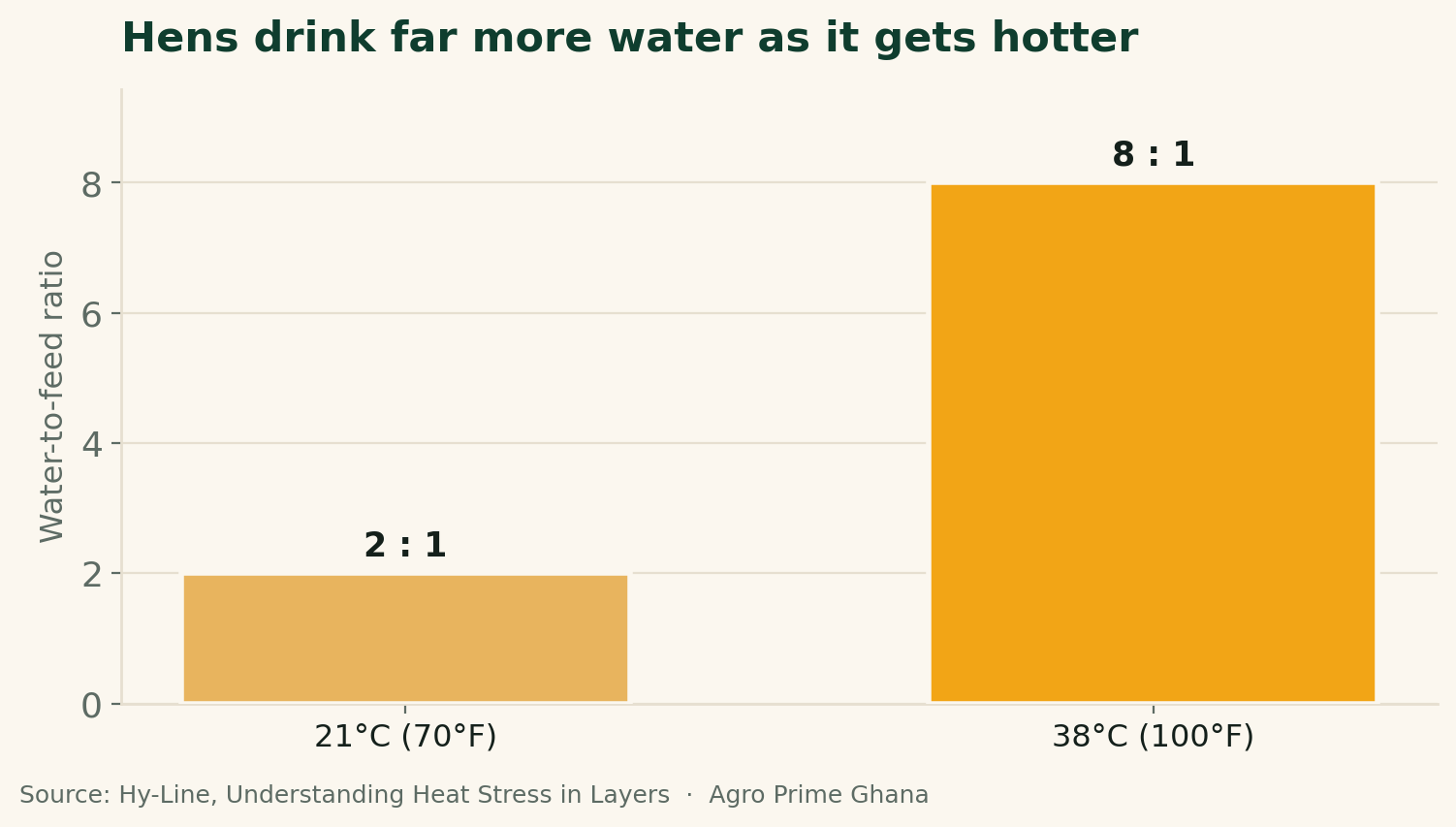
Wet droppings mean birds are voiding excess water, soaking the litter and dirtying eggs. Well-managed litter runs at about 25–35% moisture; above that it turns wet and caked. The common Ghanaian causes are heat (as temperature rises the water-to-feed ratio climbs from about 2:1 at 21°C to 8:1 at 38°C, so far more water passes through the bird), excess salt/sodium (feed salt above about 2%, or water above roughly 4,000 ppm dissolved solids, causes watery droppings and wet litter), high levels of other minerals (potassium, magnesium, chloride, sulphate), poor water quality, gut disease (coccidiosis, enteritis, Newcastle, worms), and mycotoxins that damage the kidneys. Wet litter causes dirty, downgraded eggs, footpad sores, ammonia and coccidiosis. The fix is to find and correct the specific cause — cool the birds, check salt and water, treat disease, bind mycotoxins — not just to add more litter.
What "wet droppings" actually is — and what's normal
To troubleshoot wet droppings you first have to know what normal looks like. A healthy chicken passes two kinds: firm, well-formed faecal droppings capped with white urates, and, a few times a day, softer, wetter caecal droppings that are normal and should not be mistaken for disease. Birds have no separate bladder — urine (as urates) and faeces leave together through the vent — so a hen's droppings are naturally moister than a mammal's, and water balance shows up directly in the litter. Well-managed layer litter sits at roughly 25–35% moisture; when droppings carry too much water it climbs above that, turns dark and caked, and eggs come out stained. So "wet droppings" is really a water-balance problem — the bird taking in or passing more water than the system can cope with, and almost every cause below is a reason that balance has tipped.
Why wet droppings matter — it's not just mess
Wet droppings and the wet litter they create cause real, countable losses. The most immediate cost for a layer farm is dirty eggs: eggs laid or walked through wet, sticky litter pick up faecal staining, which downgrades them, cuts their price and — because a dirty shell is a food-safety risk — threatens the quality of what you sell; clean eggs start with dry litter (see producing clean eggs). Beyond the eggs, wet litter drives footpad dermatitis from birds standing on caking litter, rising ammonia as wet manure breaks down, a perfect breeding ground for coccidiosis (whose oocysts sporulate fastest in warm, damp litter), and heavier fly loads. In short, wet droppings are an early warning that, left alone, quietly costs you eggs, bird health and hygiene at once.
| Cause | What you notice | How to fix it |
|---|---|---|
| Heat stress | Panting, wings out; wettest droppings in hot afternoons; birds crowding drinkers | Cool the house & water, ventilate, feed in cool hours |
| Excess salt / sodium | Heavy thirst, uniformly watery droppings, soggy litter soon after a feed change | Check feed salt (<~0.4–0.5% Na) and water; correct the ration |
| Poor water quality | Salty/brackish borehole; high dissolved solids; drop tracks a new water source | Test water; treat or switch source; keep lines clean |
| Other minerals (K, Mg, Cl, SO₄) | Watery droppings tied to specific ingredients or supplements | Review ration balance and supplements |
| Gut disease (cocci, enteritis, ND, worms) | Sick birds, blood/mucus or foul droppings, off feed, drop in lay | Diagnose & treat specifically; call a vet |
| Mycotoxins (kidney damage) | Wet droppings, high water intake, poor performance despite "clean" feed | Check grain/storage; use a toxin binder; replace bad feed |
| Feed factors (high protein, NSP grains, poor fat) | Sticky droppings after wheat/rice bran or a ration change | Balance protein; consider enzymes; check fat quality |
Cause 1: Heat — the biggest Ghanaian driver
In our climate, heat is the single most common reason for wet droppings, and the mechanism is simple: hot birds drink far more water, and most of it passes straight through into the litter. A hen is comfortable at about 18–25°C; above that she cools herself partly by drinking and panting. According to Hy-Line's heat-stress guidance, the water-to-feed ratio rises from about 2:1 at 21°C to roughly 8:1 at 38°C — four times as much water per unit of feed in serious heat — and all that extra water ends up as watery droppings and soggy litter, worst in hot afternoons. This is not disease; it is thermoregulation. The fix is to attack the heat: improve ventilation and shade, insulate hot roofs, keep drinking water cool (birds drink less when water is above about 30°C) and plentiful, and feed in the cooler hours. See our heat stress in poultry guide; managing heat usually firms up the droppings on its own.
Cause 2: Too much salt or sodium
Excess salt is a classic, often overlooked cause of watery droppings and wet litter. Salt (sodium chloride) makes birds thirsty; they drink more, and the extra water flushes straight through — the MSD Veterinary Manual notes that with salt excess "watery droppings and wet litter are also observed," because water follows the sodium. The manual flags feed salt above about 2% as dangerous, and drinking water above roughly 4,000 ppm dissolved solids as enough to depress performance, and warns that other sodium sources such as sodium bicarbonate can do the same if over-added. On Ghanaian farms this shows up with over-salted home-mixes, heavy fishmeal, a premix or additive that pushes sodium up, or brackish water — the tell-tale being heavy thirst and uniformly watery droppings across the flock, often soon after a feed or water change. Check and correct the salt (layers need only modest sodium — roughly 0.15–0.20% of the diet), review salty ingredients, and test the water. Excess potassium, magnesium, chloride and sulphate cause the same flushing effect, so review a badly balanced ration as a whole.
Field note: taste the water, read the feed tag, before you medicate
When a whole flock develops watery droppings but the birds are eating well and otherwise bright, we resist the urge to reach for medicine and check two things first: the water and the salt. It costs nothing to taste the drinking water for a brackish, salty edge — a common borehole problem — to read the feed's salt and sodium level, and to think about whether a new ingredient, a heavy hand with fishmeal, or an extra additive recently went in. Many "diarrhoea" cases farmers try to treat with antibiotics are simply salt or water problems that no drug will fix. Rule out salt and water before you assume disease.
Cause 3: Poor water quality
Because layers drink so much, water quality matters as much as feed — and poor water is a direct route to wet droppings. Water that is saline or high in dissolved solids (common with some coastal and borehole sources in Ghana) acts like dietary salt, driving thirst and flushing water through the birds; keep well below the roughly 4,000 ppm dissolved-solids benchmark noted by the MSD Veterinary Manual. Water can also be contaminated — dirty tanks, biofilm in the lines, or bacteria that upset the gut. If wet droppings appear after a change of water source, or the water tastes salty or comes from a suspect borehole, have it tested for total dissolved solids and, where possible, bacteriology, then treat the water, sanitise storage and lines, or switch source. See water quality for layers for what to test and the limits.
Cause 4: Gut disease
When wet droppings come with sick birds — off their feed, dull, dropping in lay, or passing blood, mucus or foul faeces — think disease rather than diet. Coccidiosis, driven by the same warm, damp litter that wet droppings create, damages the gut lining and causes loose or bloody droppings, especially in growing pullets — see coccidiosis in poultry. Bacterial enteritis (E. coli, clostridia), worms and viral diseases such as Newcastle disease can all cause watery or abnormal droppings, usually alongside respiratory distress, mortality or a fall in lay. The difference from diet-driven wetness is that disease makes birds ill, not just wet, and often affects the flock unevenly. When birds are clearly sick, do not guess: isolate them, tighten biosecurity, and get a veterinary or extension officer to diagnose the specific problem — targeted treatment works, while shotgun medication wastes money and time.
Field note: sick-and-wet is a different animal from bright-and-wet
The distinction we lean on hardest is whether the flock is ill or merely wet. A flock with diet- or heat-driven wet droppings is otherwise bright, eating well and laying, with droppings fairly uniform across every bird. A flock with gut disease looks different: individual birds are dull and hunched, off their feed, lay has dropped, and you may see blood, mucus or a foul smell — often unevenly. That single read — bright-and-uniform versus sick-and-patchy — steers you toward feed, water and heat on one hand or a vet diagnosis on the other, and stops you wasting antibiotics on a salt or heat problem.
Cause 5: Mycotoxins
Mould toxins are a sneaky cause because they can act on the kidneys without any visible mould in the feed. Certain mycotoxins — notably ochratoxin and citrinin, which ride in on poorly stored maize and other grains — damage the kidneys and disturb water balance, driving up water intake and producing wet droppings, alongside poorer performance and (with aflatoxin) suppressed immunity. The frustrating part is that these toxins are invisible and tasteless to the bird and are often present even when grain looks acceptable. Suspect them when a flock develops wet droppings and drinks heavily on grain of doubtful storage or a new feed batch, especially if performance is quietly slipping. The response is to secure feed quality — buy well-dried grain, store it dry and cool, reject musty material — and use a mycotoxin binder where grain quality is hard to guarantee.
Dry litter and clean eggs start with the right flock and feed
Many wet-litter problems trace back to two things Agro Prime Ghana can help you get right from the start: healthy, well-reared birds and a properly balanced ration. We supply strong point-of-lay pullets and layer feed formulated with correct sodium and mineral levels, and we can advise on feed storage, water testing and litter management. Battling persistent wet litter, dirty eggs or watery droppings? Message us on WhatsApp (+233 24 915 1503) or book a visit and we will look at your feed, water and management together to pin down the cause.
Cause 6: Feed factors — protein, grains and fat
Beyond salt and mycotoxins, the ration itself can loosen droppings. Diets too high in protein leave excess nitrogen the bird excretes as extra urates and water. Grains rich in non-starch polysaccharides — wheat and rice bran, sometimes used to cheapen local rations — increase gut viscosity and produce sticky droppings, though the right feed enzymes can counter this, and poor-quality fat or any abrupt feed change can also loosen droppings. If wet droppings appear after a ration change or a bran-heavy mix, look at the feed first: balance protein to need, use enzymes with high-NSP grains, use good fat, and change feed gradually. See our layer feeding guide.
The bottom line: diagnose before you treat
Wet droppings and the dirty eggs and soggy litter that follow are a symptom of a water-balance problem, not a disease to be blindly medicated. The winning approach is to read the flock first. If the birds are sick — dull, off feed, dropping in lay, passing blood, mucus or foul faeces — treat it as possible disease and get a proper diagnosis. If they are bright and eating well but wet, work the diet-and-environment causes in order: cool the house and water if it is hot; check the salt in the feed and taste-test the water; review the ration for excess protein or bran-heavy grains; and secure feed quality against mycotoxins with good storage and a binder. Alongside the cause, manage the litter itself — ventilate, fix leaking drinkers, remove the wettest caked material — to break the cycle of wet litter, dirty eggs and coccidiosis; see managing wet litter in poultry. Keep water cool, clean and low in salt, balance the ration's sodium and minerals, and store grain well, and your droppings firm up, your litter stays dry, and your eggs come out clean and saleable.
Frequently asked questions
What causes wet droppings in layers?
Is salt a common cause of wet droppings?
Can heat cause wet droppings and wet litter?
How do I tell wet droppings from real diarrhoea/disease?
Do mycotoxins cause wet droppings?
Why does wet litter cause dirty eggs?
Can feed changes or high-protein diets cause wet droppings?
How do I fix wet droppings in my flock?
Sources & further reading
- MSD / Merck Veterinary Manual — Poisonings in Poultry (salt/sodium toxicity, dangerous feed salt >2%, ~4,000 ppm water, watery droppings and wet litter).
- Hy-Line International — Understanding Heat Stress in Layers (water-to-feed ratio 2:1 at 21°C to 8:1 at 38°C, comfort zone).
- Poultry Producer / University extension — Causes and Prevention of Wet Litter (normal litter moisture 25–35%, mineral and mycotoxin causes).
- Agro Prime Ghana guides: water quality for layers, producing clean eggs, and coccidiosis in poultry.
About Agro Prime Ghana
Agro Prime Ghana Limited runs a poultry hatchery and mixed agribusiness in Kasoa, supplying day-old chicks and supporting poultry keepers across the country. These guides combine hands-on hatchery and farm experience with current veterinary references. This article is general educational information, not a substitute for diagnosis by a qualified veterinary or extension officer — if your birds are sick, get them seen. We supply healthy day-old chicks (broilers & layers), point-of-lay pullets, quality feed and hands-on farm support across Ghana. Fighting wet litter or dirty eggs? Book a visit or message us on WhatsApp (+233 24 915 1503).