The way to produce clean eggs is to stop them getting dirty in the first place — by giving hens enough clean, attractive nests, keeping nest and floor litter dry and fresh, and collecting eggs often (at least once a day, twice is better) so they spend as little time as possible where droppings and mud can reach them. A clean egg is not just a better-looking egg: its natural surface coating and shell keep bacteria out, while a dirty shell carries a far heavier bacterial load and a real Salmonella risk that washing does not fully remove. For a Ghanaian layer farmer, clean eggs mean a better price, fewer rejections and safer food — and they are won mainly through nest and collection management, not through washing after the fact. This guide shows exactly how to keep eggs clean, why dirty eggs lose value and carry risk, and how to wash the few that need it without doing harm.
Written by the Agro Prime Ghana poultry team and reviewed against current references (University of Minnesota Extension and eXtension small-flock food-safety guidance). Last updated September 2026.
Key takeaways
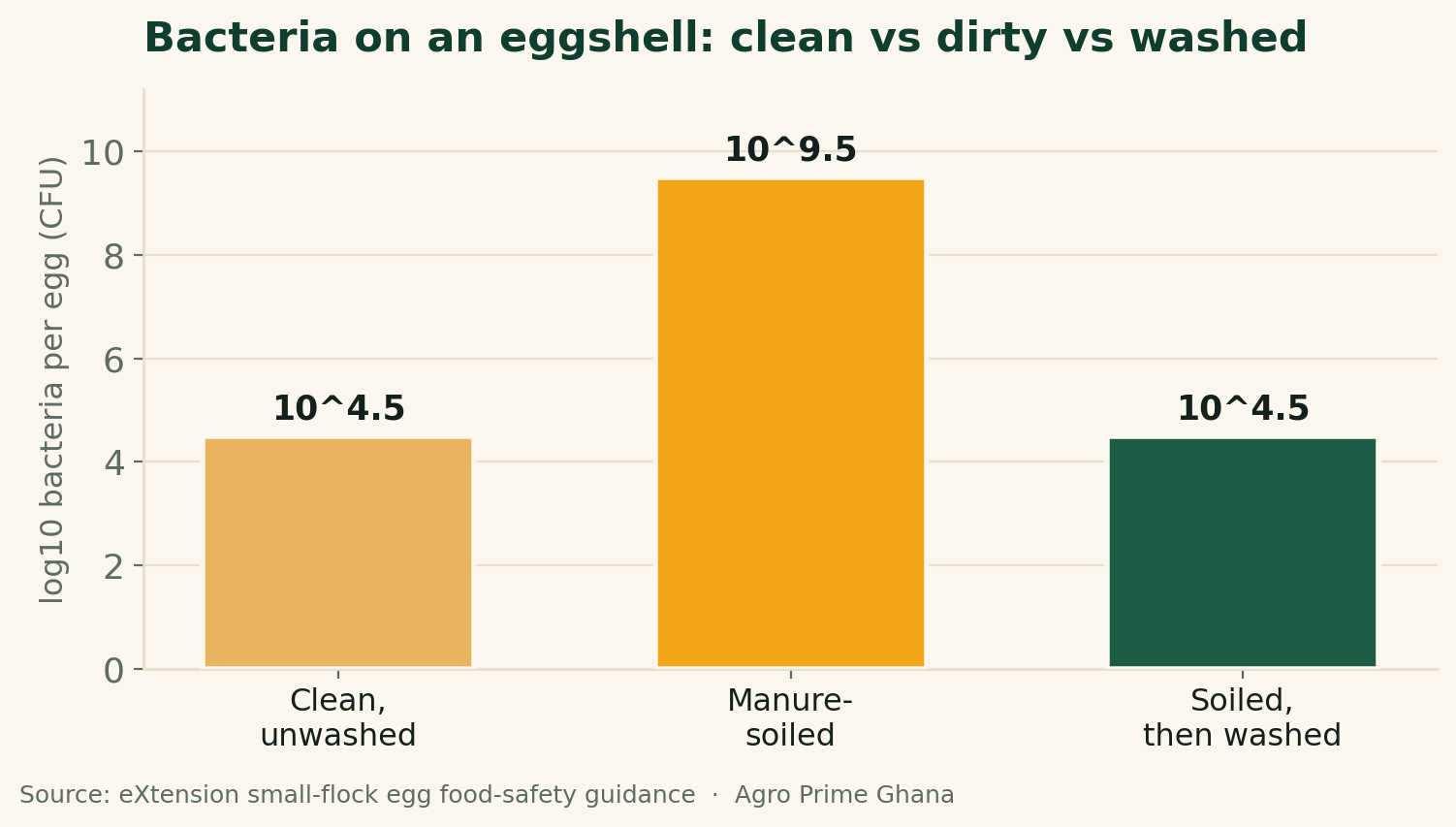
Clean eggs are produced by prevention, not washing. Give roughly one nest box per five hens, keep nests dark, inviting and filled with clean, dry bedding, and encourage hens off the floor so they lay in nests rather than in litter or mud. Collect at least once a day — twice or more is better — so eggs leave the nest before they get soiled or cracked. A clean, unwashed egg carries a bacterial load of roughly 104.5 bacteria, while a manure-soiled egg can carry around 109.5 — many thousands of times more — and Salmonella can sit on the shell and even inside. Dirty eggs are downgraded, rejected by better buyers, and unsafe. If you must wash, use running water warmer than the egg (at least 20°F / ~11°C warmer), never a cold soak, dry the egg, and keep eggs cool. The winning formula is clean nests + frequent collection + gentle handling.
Why do clean eggs matter so much?
Clean eggs matter because the shell is a food-safety barrier, and a dirty shell both damages that barrier and advertises risk to your buyer. A freshly laid egg comes coated in a thin protective layer — the cuticle or "bloom" — that seals the roughly 8,000 microscopic pores in the shell and helps keep bacteria out of the contents. When an egg is smeared with droppings or mud, three things go wrong at once: the surface now carries a heavy load of bacteria pressed against those pores; moisture and rubbing can break down the protective bloom; and the egg simply looks unsafe, so buyers discount or reject it. The bacterial difference is stark. According to eXtension's small-flock food-safety guidance, a clean, unwashed egg carries on the order of 104.5 colony-forming units of bacteria, whereas an egg soiled with faecal material can carry around 109.5 — a difference of many thousands of times. And washing a dirty egg only brings it back down to roughly the level of a clean unwashed egg, which is still contaminated. In other words, you cannot wash your way to a clean egg; you have to keep it clean from the start.
The Salmonella risk hiding on a dirty shell
Dirty eggshells are the main way Salmonella and other gut bacteria get onto and into eggs, which makes clean-egg production a food-safety duty, not just a cosmetic one. University of Minnesota Extension notes that warm eggs sitting in the danger zone of roughly 80–90°F (27–32°C) — exactly the temperature of a Ghanaian layer house through much of the day — allow bacteria to multiply and raise Salmonella risk, which is why prompt collection and cooling matter so much. Salmonella enteritidis is especially troublesome because it can contaminate both the shell surface and, in infected hens, the egg contents. Faecal contamination on the shell provides both the bacteria and, if the shell is cracked or the bloom is damaged, a route inside. For anyone selling eggs to schools, hotels, restaurants, "waakye" and egg-sandwich vendors or the general public, this is reputational and public-health exposure you carry with every dirty egg. Clean eggs, kept cool and handled well, are simply safer food — and safer food is what keeps buyers loyal.
Where dirty eggs come from
Almost every dirty egg traces back to one of a short list of causes, and knowing them tells you exactly where to intervene:
- Floor and litter eggs. Eggs laid on the floor or in litter instead of in nests pick up droppings and dampness immediately. This is the single biggest source of dirty eggs on most farms.
- Dirty nests. Nests with soiled, caked or wet bedding transfer that filth to every egg laid in them; a hen with muddy or manure-covered feet dirties clean eggs as she settles.
- Infrequent collection. The longer an egg sits in the nest, the more likely another hen tramples it, drops manure on it, or cracks it — and a cracked egg leaks and soils its neighbours.
- Wet or muddy conditions. Leaking drinkers, poor drainage, and hens tracking mud in the rainy season all raise the dirty-egg rate.
- Loose droppings and gut upsets. Sick birds or wet droppings mean dirtier vents and dirtier eggs, so flock health feeds directly into egg cleanliness.
The good news is that all of these are management problems with management fixes — nests, litter, collection routine and drainage — rather than anything you need to buy your way out of.
Nest management: the foundation of clean eggs
Good nests are the first and most powerful clean-egg tool, because an egg laid in a clean nest starts clean and an egg laid on the floor starts dirty. The principles that work:
- Provide enough nests. A widely used rule is about one nest for every four to five hens. Too few nests means crowding, floor-laying and cracked eggs.
- Make nests attractive. Hens prefer nests that are darker than the rest of the house, tucked out of the way, and quiet. A nest that is bright, exposed or high-traffic gets ignored in favour of a dark corner on the floor.
- Keep clean, dry bedding in every nest. Soft, dry nest material — clean wood shavings, chopped straw or nest pads — cushions eggs against cracking and keeps them clean. Top up or change nest litter as it gets soiled, and clean out any nest that a hen has fouled or slept in.
- Discourage sleeping and dunging in nests. Hens that roost and sleep in nests foul them overnight. Providing proper perches and well-designed nest boxes, and closing nests at night where practical, keeps them cleaner.
- Train against floor-laying early. When a new flock comes into lay, walk the house often, gather any floor eggs promptly, and gently move floor-laying hens toward the nests so the habit sets in the nest, not on the floor.
Field note: chase the floor eggs hard in the first two weeks of lay
The habit a flock forms in its first fortnight of laying tends to stick for the whole cycle, so that is where we put the effort. When pullets start to lay we walk the house several times a day, lift every floor egg the moment we see it, and quietly place hens that are trying to lay on the floor into the nests. It is tedious for two weeks and then it largely takes care of itself — a flock that learns to lay in clean nests early gives clean eggs for months, while a flock allowed to floor-lay from the start fights you with dirty, cracked eggs to the end of the cycle.
Collect often — and why timing matters
Frequent collection is the second pillar of clean-egg production: the sooner an egg leaves the nest, the less can happen to it. The eXtension guidance is plain — collect eggs at least once a day, and twice a day is better; larger or hotter operations do well to collect more often still. Every extra hour an egg spends in the nest is an hour in which another hen can trample it, drop manure on it, crack it, or simply warm it in that 80–90°F danger zone where bacteria multiply. Frequent collection also means fewer eggs piled in a nest at once, which cuts cracking (a cracked egg leaks and soils its neighbours) and gets eggs into cool, clean storage faster. In Ghana's heat this cooling step matters as much as the cleanliness — a clean egg that sits warm all day still ages and loses quality. Pair frequent collection with prompt cooling and sensible storage, as we cover in egg storage and handling, and you protect both cleanliness and freshness at once.
Litter, drainage and flock health
Clean eggs also depend on a clean, dry house, because the litter and the birds' own cleanliness feed straight into the nests. Keep floor litter dry and friable — fix leaking drinkers immediately, ventilate to carry moisture away, and avoid the damp patches where mud and caked droppings form; our guide to poultry litter management covers this in detail. Good drainage around the house keeps rainy-season mud out. And because loose droppings mean dirty vents and dirty eggs, ordinary flock health matters: a gut upset or a mild disease that loosens droppings will show up as a spike in dirty eggs, so a sudden rise in soiling is worth investigating as a health signal, not just a cleaning problem. Hens with clean feet, on dry litter, laying in clean nests, produce clean eggs almost automatically.
Clean eggs start with healthy, well-housed hens — let us help
Clean, saleable eggs come from healthy pullets in a well-set-up laying house. Agro Prime Ghana supplies point-of-lay (POL) pullets ready to lay, quality layer feed, and practical advice on nest layout, collection routines and handling that keep your eggs clean and premium-grade. If dirty or downgraded eggs are eating into your price, message us on WhatsApp (+233 24 915 1503) or book a visit and we will help you fix the nest, litter and collection set-up that is causing it — and set you up with birds and feed that make clean eggs the norm.
Washing eggs: the last resort, done correctly
Washing should be the exception for the few eggs that come in lightly soiled, not a routine to rescue a dirty-egg problem — and if you do wash, doing it wrong is worse than not washing at all. The danger is that cold or standing water drives bacteria inward through the shell pores. A cold egg dropped into cool water contracts and can actually suck contaminated water in through those 8,000 pores. So the rules, drawn from USDA and extension guidance, are strict:
- Use running water, not a soak. Never immerse eggs in a bowl of standing water — that just spreads contamination from egg to egg.
- Wash with water warmer than the egg — at least 20°F (about 11°C) warmer. Warm water makes the egg's contents expand and push outward, resisting inward movement of bacteria. Commercial in-line washing uses potable water at a minimum of about 90°F (32°C).
- Wash quickly, then dry fully. Do not let eggs sit wet. Dry them completely before storage.
- Cool and store promptly. Washed eggs should be cooled and kept cool (commercially, at or below 45°F / 7°C). Washing removes the protective bloom, so washed eggs actually need more care in storage, not less.
Remember the core fact: washing a manure-soiled egg only brings its bacterial load back down to roughly that of a clean unwashed egg — still contaminated. Washing cannot make a dirty egg as safe as an egg that was never soiled. That is the whole argument for prevention: it is easier, cheaper and safer to keep an egg clean than to clean a dirty one.
The bottom line on producing clean eggs
Clean eggs are produced at the nest and the collection bucket, not at the wash basin. Give your hens enough dark, inviting nests — around one for every four or five birds — filled with clean, dry bedding; train a new flock hard against floor-laying in its first two weeks; collect at least once and preferably several times a day so eggs leave the nest before they get soiled, trampled or cracked; keep litter dry and drainage good; and treat a rise in dirty eggs as a signal to check nests, litter and flock health. Wash only the few lightly soiled eggs that slip through, and only with warm running water, drying and cooling them properly. Do this and the great majority of your eggs will reach the buyer clean, sound and safe — earning a better price, avoiding rejections, and protecting both your customers and your name. A dirty egg is a preventable loss; a clean egg is a management habit.
Frequently asked questions
How often should I collect eggs?
Should I wash my eggs?
Why are dirty eggs a health risk?
How many nest boxes do I need?
How do I stop hens laying eggs on the floor?
Does washing remove Salmonella from eggs?
What causes a sudden increase in dirty eggs?
How should I store eggs after collecting them?
Sources & further reading
- eXtension / Poultry Extension — Safe Handling of Eggs from Small and Backyard Flocks (collection frequency, nest ratio, bacterial loads, washing temperatures, storage).
- University of Minnesota Extension — Reducing Salmonella Risk in Table Egg Production (temperature danger zone, washing and cooling, storage temperature).
- Agro Prime Ghana guides: egg storage and handling, poultry litter management, and perches and nest boxes.
About Agro Prime Ghana
Agro Prime Ghana Limited runs a poultry hatchery and mixed agribusiness in Kasoa, supplying point-of-lay pullets, day-old chicks, quality feed and hands-on support to poultry keepers across the country. These guides combine practical farm experience with current food-safety and extension references. This article is general educational information, not a substitute for professional veterinary or food-safety advice. Want cleaner, better-priced eggs? Book a visit or message us on WhatsApp (+233 24 915 1503) to order POL pullets, layer feed or advice.


