It often starts with one or two hens with a watery eye and a thin nasal discharge, easy to dismiss. Within days more birds have swollen faces, one or both sides puffed up around the eye, wattles thickened, and — the sign that gives it away — a distinctive foul, offensive smell hanging over the pen. Then the egg basket tells the real story: production slides, sometimes by a third or more, almost overnight. This is infectious coryza, a fast-spreading bacterial disease of the upper airways that thrives wherever birds of different ages are mixed and biosecurity is loose. It rarely kills large numbers by itself, but it can gut a layer flock's income and, because recovered birds carry it for life, it can haunt a farm for years. This guide explains how to recognise it, how it spreads, how to treat it, and above all how to keep it out.
Written by the Agro Prime Ghana poultry team and reviewed against current veterinary references (MSD Veterinary Manual and university extension sources). Last updated September 2026.
Key takeaways
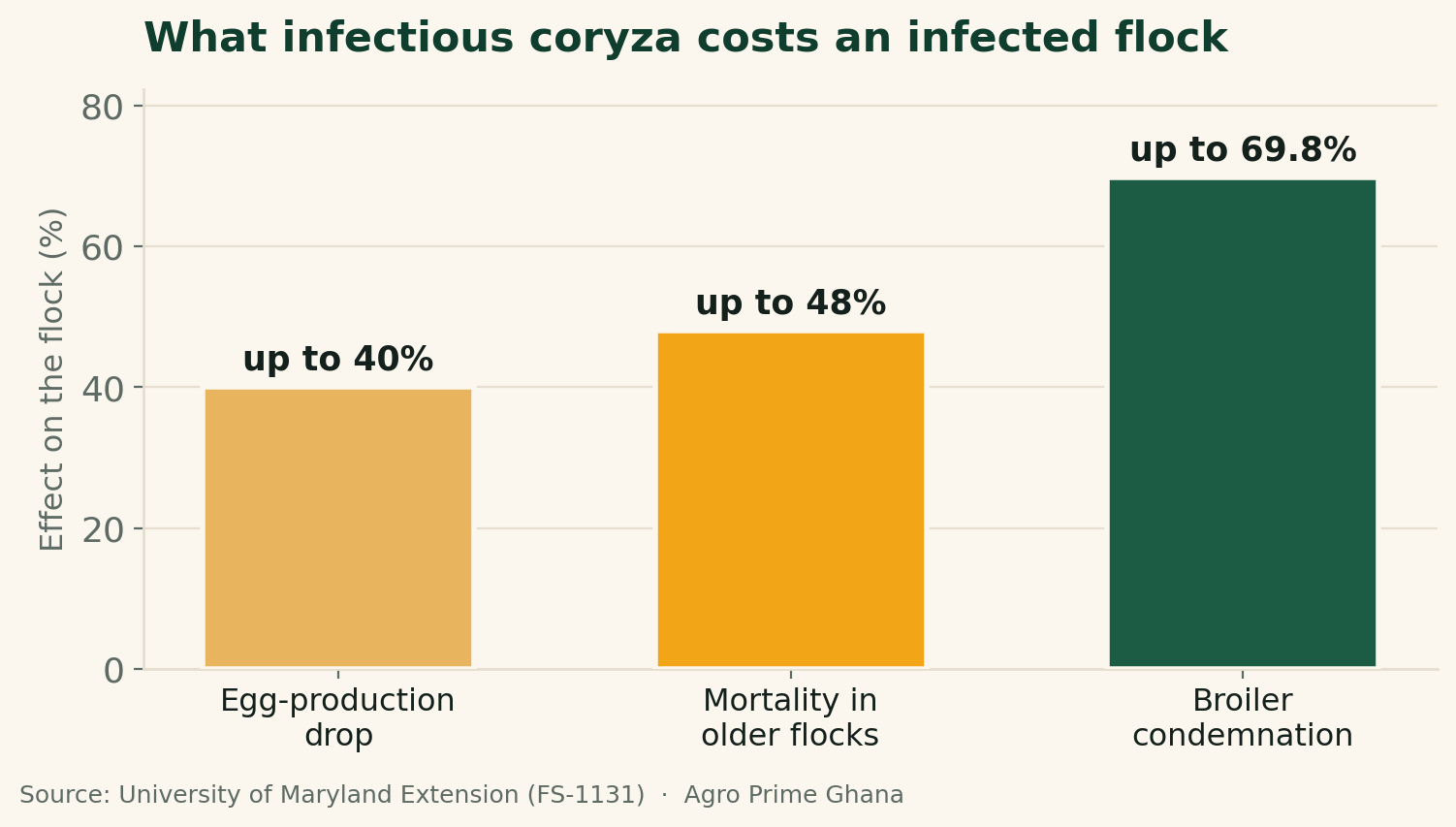
Infectious coryza is caused by the bacterium Avibacterium paragallinarum and shows as swollen faces and wattles, nasal discharge, watery eyes and a foul smell, with a drop in egg production of 10–40%. The incubation is short — 1–3 days — and disease runs about 2–3 weeks. It spreads from chronically infected and healthy carrier birds through direct contact, airborne droplets and contaminated drinking water, and recovered birds remain carriers for life — the single most important fact for control. Mortality is usually low but can reach up to 48% in older flocks with complicating infections. Antibiotics (erythromycin, tetracyclines, sulfonamides) ease signs but do not clear the carrier state. The disease is beaten by biosecurity and all-in, all-out management, with vaccination in high-risk areas.
What infectious coryza is
Infectious coryza is an acute bacterial disease of the upper respiratory tract of chickens. According to the MSD Veterinary Manual, it is caused by Avibacterium paragallinarum — "a gram-negative, pleomorphic, nonmotile" bacterium (formerly called Haemophilus paragallinarum). Unlike a virus such as Newcastle disease, this is a bacterium, which matters because it means antibiotics can help — but also because, as with many bacterial diseases, treating the signs is not the same as clearing the organism from the flock. The disease targets the sinuses and nasal passages, producing the inflammation and discharge that give it its name (coryza simply means inflammation of the nasal mucous membranes). It is primarily a disease of chickens, and it is found in poultry-keeping regions worldwide, including across Africa. Its reputation is as a disease that "won't kill your flock but will ruin your egg cheque" — although in the wrong circumstances, with other diseases piled on top, it does far worse.
Why it matters so much for Ghanaian layer farms
Coryza earns its place on any Ghanaian layer keeper's watch-list for three reasons. First, it hits egg production directly and hard: University of Maryland Extension puts the drop in egg production at 10% to 40% in infected flocks, and in a bird kept specifically to lay, that is the whole business model taking a hit. Second, it spreads on exactly the practices that are common where farms grow piecemeal: keeping multiple ages on one site, buying in point-of-lay pullets or "replacement" birds of unknown status, and sharing equipment, crates and workers between houses. Third — and this is what makes it so persistent — recovered birds become carriers for life, so once coryza is on a farm it tends to stay, flaring in each new batch that meets the carriers. Extension guidance is explicit that "recovered birds mostly serve as carriers for life." The combination of a heavy production hit, easy spread on ordinary bad habits, and lifelong carriers is what turns coryza from a passing illness into a chronic drain. It is also frequently made worse by other diseases — a coryza-weakened flock hit by mycoplasma or Newcastle suffers far more than coryza alone would cause.
The signs: how to recognise coryza
Coryza has a fairly distinctive picture once you know it, and the swollen face plus the smell are the classic combination. The MSD Veterinary Manual describes the progression: early "listlessness, a serous [watery] nasal discharge, and occasionally, slight facial swelling," developing into "extreme swelling of one or both infraorbital sinuses" — the area just below and in front of the eye — with oedema of the surrounding face. In adult males the swelling can extend down into the intermandibular space and the wattles. Alongside the swelling you typically see:
- Nasal and eye discharge — at first watery, later thick and sticky, sometimes crusting the nostrils shut so birds breathe through the mouth.
- A distinctive foul, offensive odour around affected birds — one of the most reliable field clues to coryza specifically.
- Swollen, puffy faces and wattles, often more on one side, with eyes partly or fully closed by the swelling.
- A sharp fall in egg production in layers, and delayed onset of lay in young pullets coming into production.
- Reduced feed and water intake, listlessness and general depression as birds struggle to breathe and smell their feed.
The facial swelling usually starts to subside within 10–14 days in uncomplicated cases, and the disease as a whole typically runs 2–3 weeks. But do not read early recovery as the end of the story — the birds that recover are the carriers that will seed the next outbreak.
Field note: trust the smell, then rule out the look-alikes
The offensive smell over a pen of birds with swollen, one-sided faces is the combination that points most strongly to coryza rather than the other respiratory problems, and it is worth training your nose as well as your eyes. That said, swollen faces and respiratory signs also show up in chronic respiratory disease (mycoplasma), fowl coryza's frequent travelling companion, and in the respiratory form of other diseases, and coryza is often mixed with them. When a flock shows these signs — especially with a production drop — the right move is not to guess but to get a proper diagnosis from a vet or a laboratory, because the treatment and the prognosis differ, and coryza plus a second disease is a far more dangerous situation than coryza alone.
How coryza spreads
Understanding the spread is the whole key to keeping coryza off a farm, because the routes are entirely manageable. The MSD Veterinary Manual is clear that "birds chronically ill with infectious coryza or healthy carrier birds are the reservoirs" — in other words, the disease almost always arrives on a farm inside a bird, whether a visibly sick one or an apparently healthy carrier. From there it moves by direct or indirect contact, airborne droplets, and contamination of drinking water. In practice that means the classic entry points are: buying in birds (especially point-of-lay pullets or "started" birds) from unknown sources; mixing new or recovered birds into an existing flock; keeping several ages on one site so a carrier older flock infects each young flock; and moving the bacterium around on shared drinkers, equipment, crates, egg trays, footwear and hands. One piece of good news sits inside the bad: the organism is fragile outside the bird. Extension sources note it "can only live outside a bird host for a few days" and is "sensitive to many disinfectants," so the environment is not a long-term reservoir the way it is for some diseases — clean-out and downtime work well. The problem is almost never the building; it is the birds and the traffic between them.
Treatment: what antibiotics can and cannot do
Because coryza is bacterial, antibiotics genuinely help — but with an important limit. The MSD Veterinary Manual lists erythromycin and oxytetracycline as commonly used, along with "various sulfonamides, including trimethoprim–sulfamethoxazole." Given early and correctly, these ease the clinical signs, shorten the sickness and help the flock hold more of its production. What they do not do is eliminate the carrier state: treated birds recover but remain infected and continue to shed, so antibiotics manage an outbreak — they do not cure the farm. Practical treatment points:
- Get a diagnosis and, ideally, veterinary guidance on the antibiotic and dose, because coryza is often mixed with other infections and because sensible antibiotic use matters for resistance and residues.
- Treat early and treat the whole flock, usually via the drinking water since sick birds still drink; ensure weak, swollen-faced birds can actually reach the water.
- Support the flock: reduce stress, keep the house well ventilated (see our guide to poultry house ventilation), maintain feed and water access, and consider vitamin support during recovery.
- Observe egg and meat withdrawal periods for whichever antibiotic is used, and complete the course rather than stopping when birds look better.
- Decide honestly what to do with the flock afterwards. Because recovered birds are lifelong carriers, the cleanest long-term solution on a badly affected farm is often to finish that flock, depopulate, clean, disinfect and rest the house before restocking — rather than keeping carriers that will infect every future batch.
Field note: the recovered bird is the problem, not the solution
The hardest lesson with coryza is that a bird which looks fully recovered is exactly the bird that keeps the disease alive on your farm. It is tempting to nurse survivors back to lay and mix them into the next batch — and that is precisely how farms end up with coryza flaring in flock after flock. On a site that has had coryza, the disciplined approach is to run each batch all-in, all-out, avoid holding "recovered" birds as breeders or replacements, and clean and rest the house between flocks. Extension guidance recommends allowing two to three weeks of downtime after cleaning and disinfection before restocking. The organism dies quickly in a clean, empty house — the carriers are what you have to break.
Prevention and biosecurity: where the disease is really won
Coryza is a biosecurity disease above all, and the measures that stop it are the same disciplines that protect against most poultry diseases — done consistently. The foundations:
- Practise all-in, all-out. MSD notes that "all-in all-out management has essentially eradicated infectious coryza from many commercial broiler operations." Filling and emptying a house as a single batch, with cleaning and downtime between, denies coryza the multi-age setup it depends on.
- Buy birds from clean, known sources — day-old chicks from a reputable hatchery are far safer than bought-in older birds of unknown status, which are the classic way coryza enters a farm. If you must bring in birds, quarantine and observe them well away from the flock.
- Avoid mixing ages on one site where you possibly can; an older carrier flock is a standing threat to every younger one.
- Control traffic: dedicated footwear and footbaths, clean hands, and no sharing of drinkers, crates, egg trays or equipment between houses without disinfection. These are the everyday details our biosecurity guide sets out in full.
- Clean and disinfect thoroughly between batches and allow 2–3 weeks of downtime — easy and effective, because the organism is short-lived and disinfectant-sensitive outside the bird.
- Consider vaccination in high-risk areas. Killed bacterin vaccines are available and, MSD notes, are typically given "between 10 and 20 weeks of age." Vaccination reduces disease severity but works best on top of good biosecurity, not instead of it, and should match the local bacterial serovars — worth discussing with a vet if coryza is common in your area.
None of this is exotic or expensive; it is the same discipline that keeps Newcastle, mycoplasma and other diseases at bay, which is why a farm that runs tight biosecurity rarely has a single-disease problem.
The economics: a disease worth preventing
Coryza's cost is mostly in lost eggs and lingering underperformance rather than in dramatic deaths. A production drop of 10–40% across a laying flock, for weeks, is a large and immediate loss of income for a business whose entire purpose is eggs; delayed onset of lay in pullets pushes back the day the flock starts earning; and the lifelong carrier state means the losses can repeat with each batch on an affected farm. Mortality is usually modest on its own, but Extension data note it can reach up to 48% in older flocks where other infections complicate the picture. Set against all that, the cost of prevention is small: sourcing clean chicks, running all-in/all-out, keeping traffic and equipment clean, and vaccinating where risk is high. This is a disease where the arithmetic strongly favours keeping it out over treating it once it is in.
The bottom line on infectious coryza
Infectious coryza is a fast, foul-smelling bacterial disease of the upper airways that swells faces and wattles and, most painfully, knocks 10–40% off egg production in a flock kept to lay. It arrives inside birds — sick ones or healthy carriers — and spreads on contact, droplets, water and shared equipment, and because recovered birds carry it for life, it can settle into a farm and flare batch after batch. Antibiotics such as erythromycin, tetracyclines and sulfonamides ease an outbreak but never clear the carriers, so the real answer is prevention: source clean chicks, run all-in/all-out, avoid mixing ages, keep traffic and equipment clean, clean and rest houses between batches, and vaccinate where risk is high. Treat it as the biosecurity test it is, and coryza becomes a disease you keep off the farm rather than one you keep fighting.
Frequently asked questions
What are the main signs of infectious coryza in chickens?
What causes infectious coryza?
How is infectious coryza treated?
Do chickens that recover from coryza stay infected?
How does infectious coryza spread between flocks?
Is there a vaccine for infectious coryza?
Can I eat eggs and meat from birds with coryza?
How do I keep infectious coryza off my farm?
Sources & further reading
- MSD Veterinary Manual — Infectious Coryza in Poultry (causative bacterium, incubation and duration, signs, transmission, treatment, vaccination and all-in/all-out control).
- University of Maryland Extension — Infectious Coryza (IC): Frequently Asked Questions (FS-1131) (egg-production drop, mortality, lifelong carriers, downtime and biosecurity).
- Agro Prime Ghana guides: poultry biosecurity, poultry house ventilation, and Newcastle disease in poultry.
About Agro Prime Ghana
Agro Prime Ghana Limited runs a poultry hatchery and mixed agribusiness in Kasoa, supplying day-old chicks and supporting poultry keepers nationwide. These guides combine hands-on hatchery and farm experience with current veterinary references. This article is general educational information, not a substitute for diagnosis by a qualified veterinary or extension officer — if your flock shows respiratory signs or a production drop, get it seen, as coryza is easily confused with and complicated by other diseases. Need chicks, feed advice or farm support? Book a visit or message us on WhatsApp (+233 24 915 1503).