Pick up a hen at dusk and part the feathers around her vent. If tiny specks scurry away from the light, or you find crusty grey deposits and clusters of pale eggs glued to the feather bases, your flock is feeding parasites as well as you. External parasites — the poultry red mite, the northern fowl mite, the scaly leg mite and several lice — are among the most overlooked causes of lost egg production, restless birds and slow decline in Ghanaian poultry. They work mostly at night and out of sight, and a keeper can lose weeks of lay and dozens of birds before realising the problem was never a disease at all. This guide explains how to find them, what damage they do, and how to treat and control each one under Ghanaian conditions.
Written by the Agro Prime Ghana poultry team and reviewed against current veterinary references (MSD Veterinary Manual and peer-reviewed studies, including Ghanaian survey data). Last updated September 2026.
Key takeaways
The parasites that matter most are the poultry red mite (Dermanyssus gallinae), which hides in cracks by day and sucks blood at night; the northern fowl mite, which lives permanently on the bird; the scaly leg mite, which burrows under leg scales; and several lice that chew feathers and skin. The red mite is the hardest to beat — an empty house can stay infested for up to 9 months, and across Europe over 80% (up to 94%) of laying farms are affected. Heavy infestations cause anaemia, restlessness, feather damage, drops in lay and even death, and mites can carry disease organisms such as Salmonella. In one Ghanaian survey every mature hen carried lice. Control means treating the birds, treating the house, and repeating after about 7–10 days to catch newly hatched parasites.
The four parasites you are actually fighting
"Mites and lice" get lumped together, but they live and feed in different ways, and treating them well means telling them apart. The MSD Veterinary Manual and its companion page on lice describe four that matter for most keepers. The poultry red mite (Dermanyssus gallinae, also called the chicken mite) is a blood feeder that spends the day hidden in cracks, perches and nest boxes and comes out at night to feed — which is exactly why day-time inspections so often miss it. The northern fowl mite (Ornithonyssus sylviarum) is different: it lives its whole life on the bird, clustered around the vent, and MSD calls it "the most important parasite of layers and breeding chickens in the US." The scaly leg mite (Knemidocoptes mutans) burrows under the scales of the legs and feet, lifting them into thickened, crusty deformities. And the lice — chiefly the chicken body louse (Menacanthus stramineus, about 3–3.5 mm) and the shaft louse — are not blood feeders in the true sense; MSD notes they "normally feed on feathers or bits of dead skin," though the body louse also chews at the skin and pin feathers. Each has a weak point, but you have to know which one you are looking at.
Why external parasites hit Ghanaian flocks hard
Warm temperatures shorten every parasite's life cycle, and Ghana's climate lets these pests turn over generations fast. The poultry red mite, MSD notes, "can complete its life cycle in only one week," so a handful of mites in a warm house becomes a plague within a month or two. The parasites are also genuinely present here: a study in the Sunyani West district found that all mature hens (72–82 weeks) harboured lice, with growers on the three farms carrying lice at 62–73% and mite co-infections reaching 36–44% on two of the farms. The parasites concentrated on the ventral body, wings, cloacal and tail regions — the warm, sheltered spots — which is precisely where you should look first. Add the reality that many houses are wooden or have plenty of cracks and crevices for red mites to hide in, that birds are often kept for long laying cycles, and that infested equipment moves between houses, and you have ideal conditions for external parasites to establish and persist. This is a problem of Ghanaian poultry keeping, not a textbook curiosity.
How long they survive — and why the red mite is the worst
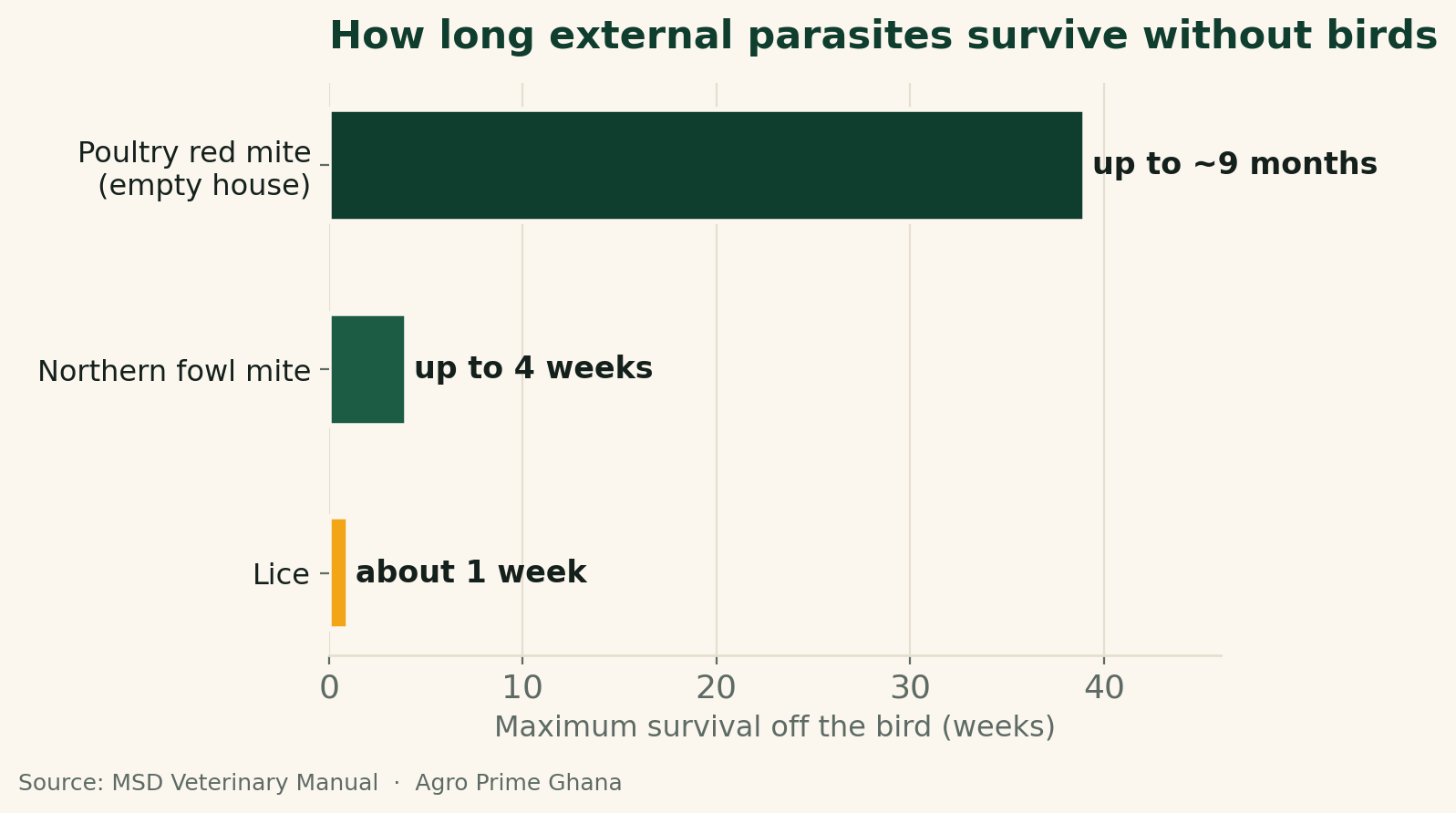
The single most important fact for control is how long each parasite can survive away from birds, because that determines whether treating the birds alone is enough. Here the red mite is in a league of its own. Because it only visits the bird to feed and otherwise lives in the structure of the house, MSD reports that "a poultry house can remain infested for up to 9 months after affected birds are removed." That is why you cannot beat red mite by dosing birds alone — the reservoir is in the building. The northern fowl mite, living on the bird, survives only up to about 4 weeks off-host, and lice — which spend their whole lives on the bird — die in roughly a week away from a host. This hierarchy explains the whole control strategy: for red mite you must treat the house aggressively and repeatedly; for the on-bird parasites, treating the birds thoroughly (and their immediate environment) does most of the work.
| Parasite | Where it lives | Life cycle | Survives off the bird | Main damage |
|---|---|---|---|---|
| Poultry red mite | Cracks & perches by day; on bird at night | ~1 week | Up to 9 months (in house) | Anaemia, restlessness, deaths, disease spread |
| Northern fowl mite | On the bird, around the vent | 5–12 days | Up to ~4 weeks | Drop in lay above ~100 mites/bird, anaemia |
| Scaly leg mite | Under leg & foot scales | On host | Short | Thick, crusty, deformed legs; lameness |
| Lice (body, shaft) | On the bird, on skin & feathers | ~3 weeks | ~1 week | Irritation, feather damage, lost condition & lay |
What the parasites do to your birds — and your income
External parasites cost money in several ways at once. The most direct is blood loss and anaemia from the red mite and, in heavy loads, the northern fowl mite — pale combs, weakness, and in severe cases death, especially in young or already-stressed birds. MSD states that heavy red mite infestations "decrease reproductive potential in males, egg production in females, weight gain in young birds, and feed conversion efficiency" and "can also cause anemia and death." For the northern fowl mite, even moderate loads above about 100 mites per bird are enough to cut egg production. Beyond the blood loss, constant night-time biting causes restlessness and stress: birds that cannot sleep eat and lay less, and heavy irritation drives feather pecking. The scaly leg mite lames birds and leaves legs "thickened, encrusted, and unsightly." And there is a food-safety dimension: research on Dermanyssus gallinae in European laying systems (Frontiers in Veterinary Science) reports the mite can act as a reservoir and possible vector of pathogens including Salmonella. That same review puts the mite's economic damage at around €31 million a year, with well over 80% of premises infested and up to 94% in some countries — no minor nuisance.
Field note: inspect at night, and check the vent first
The red mite's night shift is why so many keepers miss it — walk the house at midday and you may see nothing, while the perches are crawling after dark. On the farm we make a habit of two checks: a torch inspection at night or in the very early morning along the undersides of perches, in nest boxes and in cracks near where birds roost, where red mites cluster and where you may see grey ash-like deposits and dark specks that leave a red smear when crushed; and a hands-on daytime check of individual birds, parting the feathers around the vent and under the wings where northern fowl mites and lice concentrate. Ten birds checked properly tells you more than a hundred glanced at.
Finding them: a proper inspection
Detection is half the battle, and it takes a torch and a few minutes with the birds in hand. For red mite, inspect at night or early morning: run a finger or a piece of white paper along the undersides of perches and into cracks and nest-box joints, and look for moving specks, grey deposits and the tell-tale red smear when you crush a fed mite. A classic trick is to lay strips of corrugated cardboard near the perches overnight and check the folds in the morning — red mites hide in them. For the northern fowl mite and lice, catch several birds and part the feathers around the vent, under the wings and on the back; you will see mites moving on the skin, and lice as pale, fast-moving insects with clusters of eggs (nits) cemented to the feather bases. For scaly leg mite, look at the legs: healthy scales lie flat and smooth, whereas infested legs are rough, raised, thickened and crusty. Check a proper sample of birds, not one or two — parasites are never spread evenly.
Treatment: birds, house, and a second round
Effective treatment follows the biology. Two principles run through all of it: treat the environment as well as the birds where the parasite lives off-host, and always repeat the treatment after about 7–10 days, because insecticides and acaricides kill moving parasites but not the eggs, which then hatch. MSD specifically advises repeating louse spraying "after 10 days" to catch newly hatched lice, and the same logic applies to mites.
- Poultry red mite. This is the hard one, because the mites live in the house. Treat the structure — spray or paint acaricide into every crack, joint, perch end and nest box, not just surfaces; remove and burn or deep-clean infested litter and any harbourage; and repeat. A thorough clean-out with the house empty, followed by treatment of the cracks, is the strongest move you can make, since an empty untreated house stays infested for months. Some keepers use silica- or diatomaceous-earth-based products in cracks and dust areas as part of an integrated approach.
- Northern fowl mite and lice. Because these live on the bird, treat the birds thoroughly with an approved acaricide/insecticide dust or spray, making sure it penetrates the feathers down to the skin (a light surface mist does nothing). MSD notes the spray force must penetrate the feathers. Provide a dust bath of dry sand mixed with food-grade diatomaceous earth, which birds use to control parasites themselves. Repeat after 7–10 days.
- Scaly leg mite. Because the mite is sealed under the leg scales, the classic approach is to smother it: coat the affected legs with a suitable oil or petroleum jelly (some use surgical spirit first), repeated every few days over a few weeks until new, smooth scales grow in. Systemic products are also used under veterinary advice.
Whatever product you use, follow the label, mind any egg withdrawal, and be cautious with off-label medicines — MSD notes, for example, that the toxic dose of ivermectin in poultry is around 5.4 mg/kg, so unmeasured "home" dosing is risky. Where you can, get advice from a vet or agro-vet shop on which registered products are appropriate for your birds.
Field note: the empty house is your best weapon
The turnaround point between batches is the moment to break a red mite problem for good, and it is wasted more often than any other. When a house is empty, we clean it out completely, scrub and treat the cracks, perch ends and nest boxes where mites hide, and let it stand — because those are exactly the harbourages that keep an infestation alive for months after the birds have gone. Treating birds while ignoring the building is how keepers end up spraying month after month and never winning. Beat the house while it is empty and the next flock starts clean.
Prevention: keeping parasites out and numbers down
Once you have a clean flock and house, keeping them that way is far cheaper than fighting outbreaks. The core measures overlap heavily with good general management. Practise all-in, all-out with a thorough clean-out and treatment of cracks and crevices between batches, so red mites cannot bridge from one flock to the next. Provide permanent dust-bathing areas of dry sand and diatomaceous earth, which let birds keep on-body parasites in check naturally. Keep the house and equipment in good repair — fewer cracks mean fewer red-mite hiding places — and keep litter dry and managed, as covered in our litter management guide. Quarantine and inspect new birds before they join the flock, since introduced birds are a common way lice and mites arrive, and do not move equipment, crates or egg trays between houses without cleaning them. Control wild birds and rodents, which can carry parasites in. And fold parasite checks into routine flock monitoring — the same walk-throughs and record-keeping that underpin good biosecurity. Prevention here is mostly attention, not expense.
The bottom line on mites and lice
External parasites are the hidden thieves of the poultry house: they feed at night or under the feathers, they are easy to overlook, and they drain condition, eggs and sometimes lives before most keepers suspect them. The four to know are the blood-feeding red mite — the toughest, because it lives in the building and can hold an empty house for up to nine months — the on-bird northern fowl mite, the leg-deforming scaly leg mite, and the feather-chewing lice that a Ghanaian survey found on every mature hen it examined. Beat them by knowing which one you have, inspecting properly (at night for red mite, in the hand around the vent for the rest), treating both the birds and the places the parasite lives off-host, and always repeating after 7–10 days to catch the next hatch. Do that, and you stop paying to feed parasites and start keeping the eggs and growth for yourself.
Frequently asked questions
How do I know if my chickens have mites or lice?
What is the difference between the red mite and the northern fowl mite?
Why is red mite so hard to get rid of?
How do I treat scaly leg mite?
Do external parasites reduce egg production?
Can mites and lice from chickens affect humans?
How often should I treat and inspect for parasites?
Does diatomaceous earth work against mites and lice?
Sources & further reading
- MSD Veterinary Manual — Mites of Poultry and Lice of Poultry (species, life cycles, off-host survival, production effects, treatment).
- Ghanaian ectoparasite survey — Assessment of ectoparasitic infestation in chickens in the Sunyani West district, Ghana, Journal of Science and Technology (Ghana).
- Sparagano and colleagues, IPM strategies for the poultry red mite (Dermanyssus gallinae), Frontiers in Veterinary Science (economic impact, infestation rates, pathogen vectoring).
- Agro Prime Ghana guides: poultry litter management and poultry biosecurity.
About Agro Prime Ghana
Agro Prime Ghana Limited runs a poultry hatchery and mixed agribusiness in Kasoa, supplying day-old chicks and supporting poultry keepers nationwide. These guides combine hands-on hatchery and farm experience with current veterinary references. This article is general educational information, not a substitute for professional veterinary advice — if your flock is heavily infested or unwell, seek help and use only appropriate, registered products. Need chicks, feed advice or farm support? Book a visit or message us on WhatsApp (+233 24 915 1503).