Water is the single most important nutrient in your layer house — a hen drinks roughly twice as much water as feed by weight, and in Ghana's heat that intake can double again, yet water is the input farmers test least and clean least. Dirty, salty, hot or bacteria-laden water quietly caps egg production, thins droppings, spreads disease and makes in-water vaccines and medicines fail, long before anyone connects the dots. The frustrating part is that a flock can be on good feed, well vaccinated and properly housed and still underperform because the one nutrient it consumes most is substandard. This guide explains why water is nutrient number one, what "good" water actually means in numbers, how contamination and biofilm build up in Ghanaian conditions, and exactly how to test, treat and clean your drinking system so water stops being your flock's hidden ceiling.
Written by the Agro Prime Ghana poultry team and reviewed against current references (Alabama Cooperative Extension, WHO drinking-water guidance and breed management guides). Last updated September 2026.
Key takeaways
Water is the #1 nutrient: layers drink about 1.5–2 times as much water as feed by weight, and intake can double above 21–27°C and quadruple in extreme heat (Alabama Extension). Good poultry water means low dissolved salts (total dissolved solids under ~1,000 ppm is best; over 3,000 ppm causes wet droppings and losses), a pH of about 6.3–7.5, and very low bacteria — ideally 0, and no more than 50 coliforms/ml, with WHO requiring zero E. coli in any 100 ml of safe drinking water. The hidden enemy inside the pipes is biofilm — a slime of bacteria that harbours E. coli and Salmonella, blocks nipples, cuts intake and binds up vaccines and medicines given in water. Control it by flushing lines regularly, sanitising (hydrogen peroxide is best against biofilm; chlorine works below pH 7), keeping tanks covered and cool, and doing a proper clean-out between flocks. Test your water at least once a year.
Why water is the number-one nutrient
Water outranks every other nutrient for one simple reason: birds consume far more of it than anything else, and they cannot store it. A laying hen's body and her eggs are largely water, and she uses it for digestion, nutrient transport, temperature control and shell formation. On a weight basis, healthy birds drink roughly 1.5 to 2 times as much water as the feed they eat — the Alabama Cooperative Extension puts it at about twice the feed intake — so water is by volume the biggest single thing that enters your birds every day. Two consequences follow. First, water intake drives feed intake: birds that will not or cannot drink enough stop eating, and egg production and body condition fall with it. A drop in water consumption is often the earliest sign that something is wrong in a flock, which is why the best-run farms watch daily water use like a dashboard. Second, because water is consumed in such volume, any problem in the water is amplified — a low level of salt, bacteria or toxin that would be trivial in feed becomes significant when a bird is drinking it all day. Treating water as seriously as feed is not fussiness; it is basic arithmetic.
Water and heat: the Ghana multiplier
Ghana's climate turns water from important into critical, because heat drives drinking. As the house warms, hens drink more to cool themselves by panting and to dump heat — and the increase is large. The Alabama Extension notes that requirements can roughly double as temperatures climb through the 21–27°C range, and under extreme heat stress water needs can quadruple. Hy-Line's own figures show brown layers drinking on the order of 160–225 ml per bird per day, rising sharply as temperature climbs. For a Ghanaian layer house this has hard operational meaning: on a hot afternoon your birds may want twice the water they drank in the cool of the morning, and if the supply, the pipe diameter, the number of drinkers or the tank cannot deliver it, birds go thirsty exactly when they most need to cool down. Warm water makes it worse — birds drink less of it, so intake falls just when it should rise. Cool, clean, freely available water is one of the most powerful and cheapest heat-stress defences you have, which is why it sits at the centre of our guide to heat stress in poultry.
| Water measure | Good / target level for poultry | Why it matters |
|---|---|---|
| Total dissolved solids (TDS) | Below ~1,000 ppm (up to 3,000 tolerable) | High salts cause wet droppings, wet litter, poorer performance |
| pH | ~6.3–7.5 | Low pH corrodes kit; high pH makes chlorine sanitiser useless |
| Total bacteria | 0 ideal; max ~1,000/ml | High counts signal contamination and disease risk |
| Coliform bacteria | 0 ideal; max ~50/ml (WHO: 0 E. coli/100 ml) | Indicates faecal contamination — a direct disease route |
| Nitrate | Under ~25 mg/l (ideally <10) | High nitrate signals sewage/fertiliser pollution; harms birds |
| Sulfate | Under ~250 mg/l | Excess acts as a laxative — wet droppings and wet litter |
| Iron | Under ~0.3 mg/l | Feeds biofilm and stains/blocks lines; off-taste cuts intake |
| Sodium | Under ~50 mg/l | Combined with feed salt, excess causes wet droppings |
What "good" water actually means — the numbers
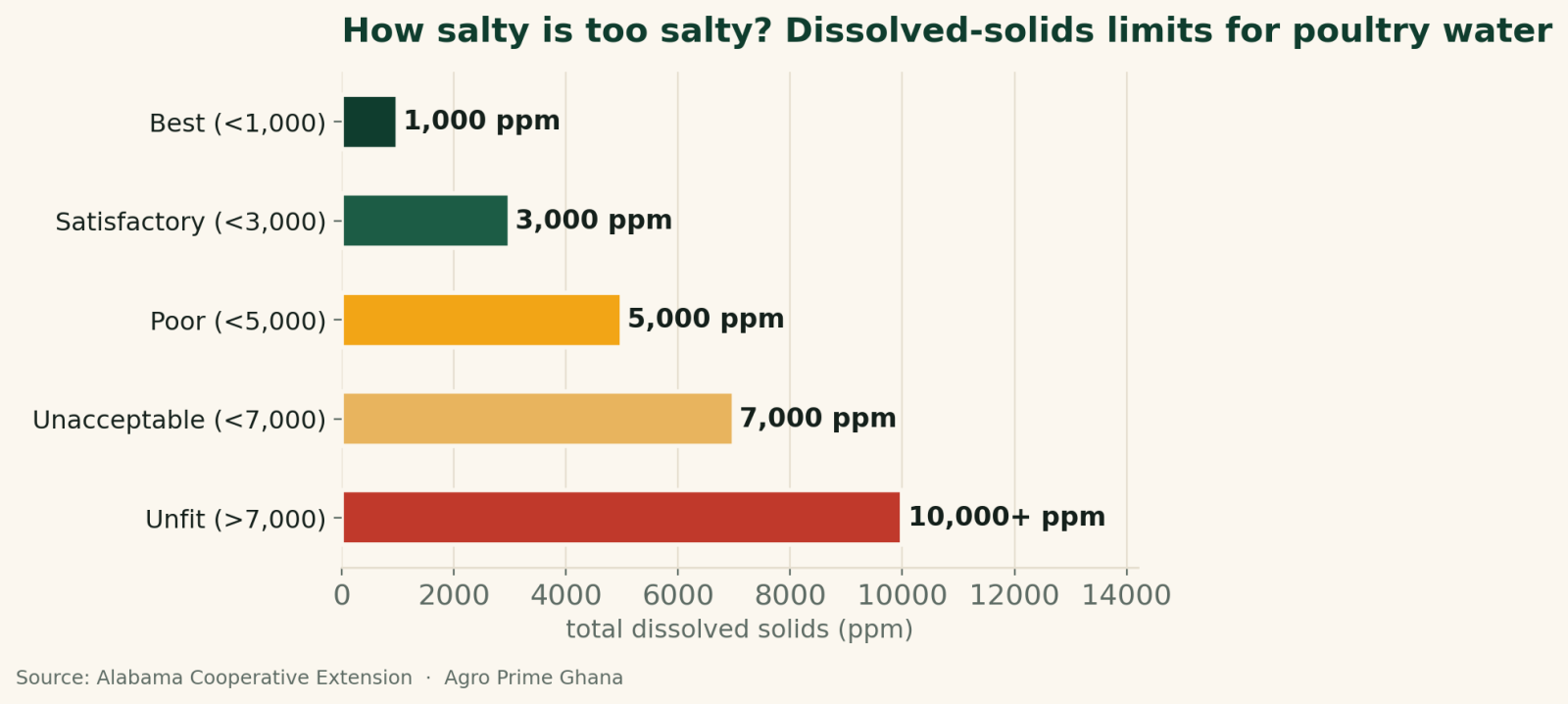
"Clean-looking" is not a standard; water quality is measured, and the thresholds are well established. The first is total dissolved solids (TDS) — the total salts and minerals dissolved in the water. Per the Alabama Extension, water below 1,000 ppm TDS places no serious burden on poultry; from about 1,000–3,000 ppm it is still usable but tends to cause watery droppings; and above 3,000 ppm it becomes progressively poorer, causing wet droppings, reduced growth and higher mortality, until it is unfit above roughly 7,000 ppm. This matters in parts of Ghana where borehole and well water can be hard or brackish. The second is pH: an ideal range of about 6.3–7.5. pH is not just about the birds — it decides whether your chlorine sanitiser works at all, as we will see. The third, and most important for disease, is bacterial load. Ideally drinking water should carry no bacteria; the practical maxima are around 1,000 total bacteria/ml and 50 coliforms/ml, and the presence of coliforms specifically signals faecal contamination. The WHO Guidelines for Drinking-water Quality set the bar plainly: E. coli must not be detectable in any 100 ml sample of water that is safe to drink. Other measures worth knowing — nitrate (pollution indicator), sulfate and sodium (laxative effects, wet litter), and iron (feeds biofilm, blocks lines) — are summarised in the table above.
Where contamination comes from on a Ghanaian farm
Contamination enters at the source and multiplies in the system. At the source, shallow wells and unprotected boreholes near latrines, animal pens or runoff can carry faecal bacteria, nitrate and, in some areas, high dissolved salts; surface water (streams, ponds, dugouts) is worst of all, effectively guaranteed to carry bacteria and parasites unless treated. But even clean source water degrades inside a poorly managed system. Open or uncovered storage tanks collect dust, droppings, lizards, insects and algae, and warm standing water is a bacterial incubator. Header tanks and pipes exposed to the sun heat the water, cutting intake and speeding microbial growth. And every drinking system that carries vitamins, medicines, molasses or milk-based products through the lines is feeding the organisms that build biofilm. The pattern to internalise is that water quality is not fixed at the borehole — it is won or lost between the source and the bird's beak, in the tank, the pipes and the drinkers, which is the part you fully control.
Field note: watch the water meter like a thermometer
The cheapest early-warning system on a layer farm is a simple record of daily water use. Because birds drink to a fairly predictable pattern, a sudden drop in water consumption is one of the first signs of a problem — a blocked line, a failed pump, water gone foul or too hot, or a flock going off-colour before any other sign shows. An unexplained rise can flag a leak, a stuck valve or the onset of heat stress or disease. We treat the day's water figure as a vital sign for the house: when it moves without an obvious reason, we go looking before egg numbers fall.
Biofilm: the slime that undoes your good work
The most damaging water problem is the one you cannot see, because it lives inside the pipes. Biofilm is a slimy layer that forms when bacteria attach to the inner surfaces of drinker lines and produce a sticky matrix of proteins and sugars that traps more bacteria, dirt and organic matter. According to The Poultry Site, biofilm does three expensive things. First, it harbours pathogens — including E. coli and Salmonella — turning your own water lines into a reservoir that continually re-seeds the flock with disease. Second, it physically blocks nipples and restricts flow, so birds cannot drink enough; reduced water intake means reduced feed intake and lost production, and it bites hardest in the heat when birds need the most water. Third — and this catches many farmers out — biofilm and dirty lines bind up and inactivate anything you deliver through the water, so a vaccine or medicine you paid for and dosed correctly reaches the birds weakened or destroyed. Anything sugary or nutrient-rich you run through the lines (vitamin supplements, some vaccines' stabilisers, molasses) actively feeds the biofilm, which is why lines must be flushed clean after every such use. If your in-water Newcastle or Gumboro vaccinations "aren't working," biofilm in the lines is a prime suspect — see poultry biosecurity for how this fits the bigger disease picture.
How to test your water
You cannot manage what you have never measured, and most Ghanaian layer farms have never had their water tested. At minimum, get a bacterial test and a basic chemical panel (TDS, pH, nitrate, key minerals) done at least once a year, and sooner if you sink a new borehole, notice a change in the water, or hit unexplained wet litter, poor performance or repeated in-water vaccine failures. Take the sample properly — from the drinkers at the end of the line, not just at the tank, because the end of the line is where biofilm and stagnation show up and where the birds actually drink. On-farm, cheap pH strips and a TDS meter let you spot-check between lab tests and, crucially, confirm your pH is in the range where chlorine sanitiser can work. Testing at the drinker end also tells you whether your cleaning is reaching the whole system or just the tank.
Cool, clean water is a nutrient — let us help you protect production
If your layers are underperforming despite good feed and vaccination, water is one of the first things worth checking — intake, temperature, salt load and biofilm in the lines. Agro Prime Ghana supplies well-reared point-of-lay pullets and balanced layer feed, and we advise farms on the whole production picture, water and drinker management included, so a hidden water problem is not quietly capping your egg numbers. Message us on WhatsApp (+233 24 915 1503) or book a visit for pullets, feed and practical farm advice.
Cleaning drinker lines and keeping water good
Good water is maintained by routine, not luck. The core practices, drawn from The Poultry Site's drinker-line guidance and standard extension advice:
- Flush the lines regularly. Running water through at higher pressure clears loose biofilm and debris and refreshes stale, warm water sitting in the pipes. Flush especially after any medication, vaccine or supplement has passed through the lines, and daily in hot weather to keep water cool and moving.
- Sanitise the water. Continuous low-level sanitising keeps microbial numbers down. Chlorine is cheap and effective but only if the water is acidic enough — it works well below pH 7 (as hypochlorous acid) and becomes largely useless above pH 7, which is exactly why you must know your pH. Hydrogen peroxide-based products are described as the best chemicals for removing biofilm itself.
- Do a deep clean between flocks. The all-in/all-out gap is your chance to strip out established biofilm — run a strong cleaning solution through the empty lines, let it stand as directed, then flush thoroughly before the next flock arrives. See cleaning and disinfecting the poultry house.
- Protect the storage. Keep tanks covered and shaded/cool, clean them out regularly, and site or insulate pipes to keep water out of direct sun so it stays cool and unappealing to microbes.
- Maintain the drinkers. Clean and check nipples and bell drinkers, fix leaks (which wet the litter and breed disease and coccidiosis), and keep enough drinker space that every bird can reach cool water, especially in the heat. Our feeders and drinkers guide covers layout and numbers.
The bottom line on water quality
Water is the nutrient your layers consume most and the one most farms manage least — a costly mismatch. A hen drinks around twice as much water as feed, far more in Ghana's heat, so its quality sets a ceiling on everything else: feed intake, egg production, disease resistance and even whether your in-water vaccines work. Good water is defined in numbers — low dissolved solids, a pH around 6.3–7.5, and as close to zero bacteria as you can get, with no E. coli in safe water — and the biggest hidden threat is biofilm building unseen inside the pipes, harbouring disease, blocking flow and destroying medicines. The remedy is routine, not expense: test at least yearly at the drinker end, keep tanks covered and cool, sanitise with the right agent for your pH, flush the lines regularly and deep-clean them between flocks. Treat water with the same seriousness as feed and vaccination, and you remove one of the most common invisible reasons good layer flocks quietly fall short of their potential.
Frequently asked questions
How much water does a laying hen drink?
Why is water called the most important nutrient for poultry?
What are the signs of a water quality problem in layers?
What is biofilm and why is it dangerous?
How do I clean my poultry drinker lines?
What TDS and pH are safe for poultry water?
How often should I test my poultry water?
Does warm water reduce how much my birds drink?
Sources & further reading
- Alabama Cooperative Extension System — Evaluating Water Quality for Poultry (water-to-feed ratio, heat effects, TDS, pH, bacteria, nitrate, mineral thresholds, chlorination).
- World Health Organization — Guidelines for Drinking-water Quality (microbial safety: no E. coli detectable in any 100 ml sample).
- The Poultry Site — Cleaning and disinfection: drinker lines (biofilm formation, pathogen harbouring, cleaning agents and flushing).
- Agro Prime Ghana guides: heat stress in poultry, feeders and drinkers guide, and cleaning and disinfecting the poultry house.
About Agro Prime Ghana
Agro Prime Ghana Limited runs a poultry hatchery and mixed agribusiness in Kasoa, supplying day-old chicks and working alongside poultry keepers across the country. We supply healthy day-old chicks (broilers & layers), point-of-lay pullets, quality feed and hands-on farm support across Ghana. This article is general educational information, not a substitute for professional veterinary advice or laboratory water testing — if your flock is underperforming, have your water and feed checked. Need pullets, feed or farm advice? Book a visit or message us on WhatsApp (+233 24 915 1503).