If a batch of three-to-five-week-old birds suddenly goes quiet, huddles in the corners of the pen, stops eating and you start seeing blood-streaked droppings, coccidiosis should be the first thing on your mind. It is one of the most common and most costly diseases in Ghanaian poultry, it moves fast, and it does its worst damage out of sight — inside the gut wall — before many keepers realise anything is wrong. The good news is that it is also one of the most preventable and treatable poultry diseases, provided you understand how it works. This guide explains what coccidiosis is, how to recognise it early, and exactly how to prevent and treat it under Ghanaian conditions.
Written by the Agro Prime Ghana poultry team and reviewed against current veterinary references (MSD Veterinary Manual and peer-reviewed reviews). Last updated September 2026.
Key takeaways
Coccidiosis is caused by microscopic Eimeria parasites that damage the gut lining, and it hits hardest in birds around 3–6 weeks old kept on warm, damp litter. Warning signs are huddling, ruffled feathers, poor growth and, in the worst form, bloody droppings. It spreads through droppings (oocysts) in the litter and moves quickly — a flock can be sick within days. Prevent it with a coccidiostat in the feed or a coccidiosis vaccine, plus dry litter and good hygiene. Treat outbreaks fast with an anticoccidial such as amprolium and supportive care. Globally, coccidiosis is estimated to cost the poultry industry around US$14 billion a year — most of it invisible, in lost growth.
What coccidiosis actually is
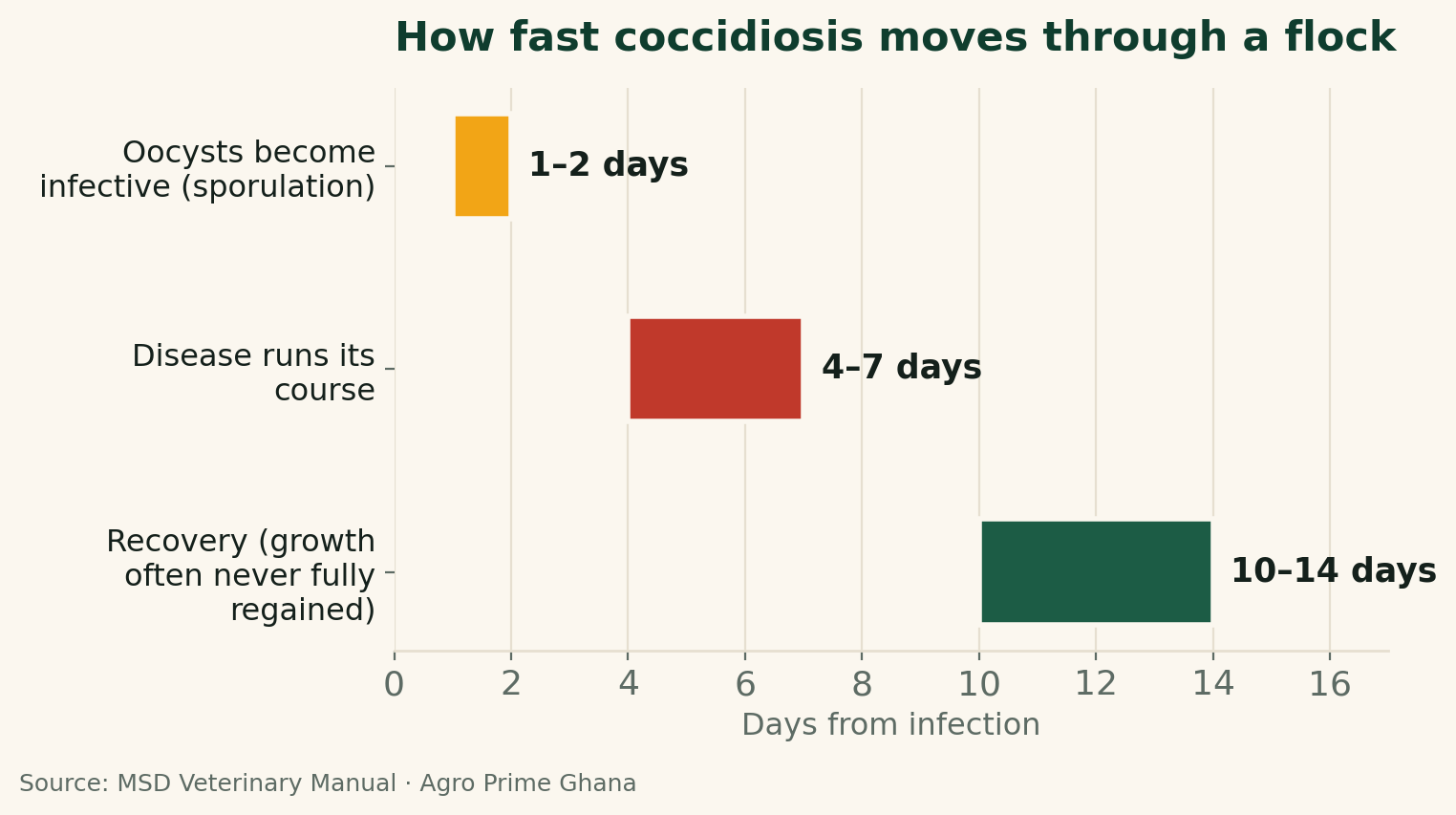
Coccidiosis is not a bacterium or a virus — it is a parasitic disease caused by single-celled protozoa of the genus Eimeria (family Eimeriidae). Several different Eimeria species infect chickens, and each one targets a particular part of the digestive tract, which is why the disease can look different from one outbreak to the next. The parasite invades and multiplies inside the cells lining the gut, destroying that lining as it goes. That damage is the real problem: it stops the bird absorbing nutrients from its feed, opens the door to secondary infections, and in severe cases causes bleeding into the gut. According to the MSD Veterinary Manual, most species affecting poultry belong to Eimeria, and the disease course is rapid — it runs through an affected bird in roughly four to seven days. Because the parasite reproduces in enormous numbers, one sick bird shedding parasites into the litter can quickly contaminate a whole pen.
Why it is such a threat in Ghana
Coccidiosis thrives in exactly the conditions most Ghanaian poultry are raised in: warm temperatures and moist deep litter. The parasite is spread as tough eggs called oocysts, which birds pass in their droppings. Those oocysts are not immediately infective — they first have to "sporulate" (mature) in the litter, and this happens fastest under warm, damp, oxygen-rich conditions. The MSD Veterinary Manual notes that under optimal conditions of about 21–32°C with adequate moisture, sporulation takes only 1–2 days. Those temperatures describe a typical Ghanaian poultry house almost year-round, so any damp patch of litter — under a leaking drinker, in a poorly ventilated corner — becomes a breeding ground within a day or two. This is also why the disease is a bigger problem on deep litter than on raised slatted or wire floors, where droppings fall away from the birds. The economic damage is heavy but mostly hidden: recent research reviews estimate coccidiosis costs the global poultry industry on the order of US$14 billion each year, and the largest share of that is not dead birds but slowed growth, poorer feed conversion and higher feed bills in birds that look "fine."
The species and where they strike
Knowing which part of the gut is affected helps you read what you are seeing, because the different Eimeria species of chickens each favour a different region. The most feared is Eimeria tenella, which infects the caeca (the two blind pouches of the gut) and causes frank bleeding — this is the classic "bloody droppings" form. Others, like E. acervulina and E. maxima, attack the small intestine and cause less dramatic but very costly damage that shows up mainly as poor growth. The table below summarises the main species and what they do, based on the MSD Veterinary Manual.
| Eimeria species | Part of the gut attacked | What you tend to see |
|---|---|---|
| E. tenella | Caeca (blind pouches) | Frank blood in droppings, sudden deaths — the classic severe form |
| E. necatrix | Mid small intestine | Serious damage, "salt and pepper" spots on the gut, deaths in growers |
| E. maxima | Small intestine | Poor growth, mucoid droppings, damage that opens the door to other diseases |
| E. acervulina | Upper small intestine | Very common; white patches in the gut, slowed growth, poorer feed conversion |
How to recognise it early
The birds most at risk are young ones, typically from around three to six weeks of age — old enough to have picked up a heavy dose of parasites from the litter, but not yet old enough to have built natural immunity. Watch for a cluster of signs appearing together over a day or two: birds huddling and looking cold even when the house is warm, ruffled or "starey" feathers, drooping wings, loss of appetite, pale combs, droppings that are loose, mucoid, orange-tinged or — in the caecal form — visibly bloody, and a flock that is suddenly quiet with birds standing hunched. Growth stalls and the flock becomes uneven. The MSD Veterinary Manual lists decreased growth rate, severe diarrhoea and weight loss as typical signs. Blood in the droppings is the most alarming sign and points to E. tenella, but do not wait for blood — by the time you see it, the intestinal-form species may already have been quietly robbing growth for days.
Field note: what we watch for in the brooder house
On our own farm the earliest, most reliable warning is behaviour, not droppings: a group of three-to-four-week-old birds that huddles and hunches while the rest of the flock is active, and a noticeable drop in the sound of the pen at feeding time. We make a habit of walking the litter every morning and looking closely under the drinkers and in the corners — wet spots there are where trouble starts. Turning a suspect bird over and checking for pasted or blood-flecked vent feathers takes seconds and often confirms it before the flock is badly hit.
How coccidiosis spreads
Understanding the spread is what makes prevention make sense. Infected birds shed millions of oocysts in their droppings. Those oocysts land in the litter, sporulate into their infective form within a day or two under warm, moist conditions, and are then picked up by other birds as they peck at the floor, feed and water — the classic faecal–oral cycle. The MSD Veterinary Manual notes oocysts also travel on feed, dust, water, litter and soil, and are carried between houses on equipment, on people's shoes, and by flies and rodents. Oocysts are remarkably tough and can survive in the environment for long periods, which is why a house that has had coccidiosis will keep re-challenging each new batch unless it is cleaned and managed well. This cycle also explains a key point: a small, controlled exposure builds immunity, but a heavy uncontrolled dose causes disease. Good management is about keeping that dose low while birds develop natural resistance.
Prevention: your first and best line of defence
Because coccidiosis is so widespread and moves so fast, the whole game is prevention. There are two main strategies for controlling the parasite itself, and you generally choose one or the other:
- An in-feed coccidiostat (anticoccidial). Most commercial broiler and grower feeds in Ghana already contain a coccidiostat that keeps parasite numbers in check while birds build immunity. If you mix your own feed, this is a decision to make deliberately — see our guide to making poultry feed. Follow the correct inclusion rate and observe the withdrawal period before slaughter.
- A coccidiosis vaccine. Live vaccines made of sporulated oocysts can be given to day-old chicks; they give the birds a tiny, controlled dose so they develop solid natural immunity. The MSD Veterinary Manual confirms live sporulated-oocyst vaccines are administered to day-old chicks. Vaccination is especially useful for layers and breeders that will live a long time, and for antibiotic-free production.
On top of the chosen strategy, management is decisive, and it is free. Keep litter dry and friable — this is the single most powerful thing you can do, because damp litter is what lets oocysts sporulate. Fix leaking drinkers immediately, ventilate to remove moisture, avoid overcrowding (which concentrates droppings), and top up or turn wet litter. Practise good hygiene between batches: clean out, wash and disinfect, and rest the house. Sound litter and hygiene practices are covered in our guides to poultry litter management and poultry biosecurity. Where practical, keeping very young birds off heavily used litter — or on raised floors — dramatically cuts exposure, since the MSD Veterinary Manual notes birds kept on wire floors away from their faeces have far fewer infections.
Treatment: acting fast when it strikes
If an outbreak is underway, move quickly — remember the disease runs its course in only four to seven days, so lost time is lost birds and lost growth. Treatment is with an anticoccidial drug given in the drinking water, most commonly amprolium, or a sulphonamide, used strictly according to the product instructions and, ideally, on veterinary advice. Because sick birds drink even when they stop eating, water medication reaches them better than feed medication during an active outbreak. Support the flock alongside treatment: make sure clean medicated water is easily reachable by weak birds, keep them warm and unstressed, and consider vitamin supplementation (vitamins A and K in particular) to help the gut recover and blood to clot. Attend to the litter at the same time — remove the wettest material — to cut the ongoing dose of parasites. Birds that recover may, as the MSD Veterinary Manual notes, take 10–14 days to bounce back and may never fully regain lost growth, which is exactly why prevention pays.
Field note: don't confuse the causes of bloody or loose droppings
Blood in droppings almost always makes keepers think coccidiosis, and often they are right — but not always. Necrotic enteritis (a bacterial gut disease) frequently follows coccidiosis and needs different treatment, and normal caecal droppings can look dark and unusual to a worried eye. Orange or reddish shed gut lining is also sometimes mistaken for blood. When a flock is genuinely sick and you are not sure, the fastest way to be certain is a post-mortem of a freshly dead or sacrificed bird by someone who knows what a coccidiosis-damaged gut looks like — or a call to a veterinary or extension officer. Treating the wrong disease wastes the narrow window you have.
Building a coccidiosis-resistant routine
The farms that rarely have serious coccidiosis problems are not lucky — they run a consistent routine that keeps the parasite dose low while birds build immunity. That routine looks like this: source healthy chicks and start them on an appropriate coccidiostat-containing feed or a vaccination programme; keep brooding and grower litter dry and well-managed from day one; never let drinkers leak; avoid overcrowding; walk the flock every day and act at the first behavioural signs rather than waiting for blood; keep a suitable anticoccidial on hand so you can treat within hours, not days; and clean, disinfect and rest houses properly between batches so each new flock does not inherit a heavy parasite load. None of this is expensive or complicated, but done consistently it turns coccidiosis from a recurring disaster into a manageable, background risk.
The bottom line on coccidiosis
Coccidiosis is a fast, common and costly gut disease of young poultry, caused by Eimeria parasites that flourish in the warm, damp litter typical of Ghanaian poultry houses. Its damage is mostly invisible — slowed growth and poor feed conversion — punctuated by the dramatic bloody droppings of the caecal form. Because it moves through a flock in days, the winning approach is firmly prevention: control the parasite with an in-feed coccidiostat or a vaccine, and above all keep litter dry, drinkers sound and houses clean, so birds meet only a small dose while they build natural immunity. When it does strike, act within hours with a water-soluble anticoccidial and supportive care. Get this routine right and coccidiosis stops being the silent thief of your flock's growth — and becomes just another risk you have under control.
Frequently asked questions
What are the first signs of coccidiosis in chickens?
What causes coccidiosis in poultry?
Why does coccidiosis affect birds around 3–6 weeks old most?
How do I prevent coccidiosis?
How is coccidiosis treated?
Is coccidiosis contagious to my whole flock?
Can chickens recover from coccidiosis?
Does coccidiosis affect layers and older birds too?
Sources & further reading
- MSD Veterinary Manual — Coccidiosis in Poultry (causative Eimeria species, transmission, sporulation, disease course, prevention).
- Blake et al. and related reviews in Poultry Science — coccidiosis disease mechanisms, control strategies and global economic impact.
- Agro Prime Ghana guides: poultry litter management, poultry biosecurity, and making poultry feed.
About Agro Prime Ghana
Agro Prime Ghana Limited runs a poultry hatchery and mixed agribusiness in Kasoa, supplying day-old chicks and working alongside poultry keepers across the country. These guides draw on that hands-on hatchery and farm experience, checked against current veterinary references. This article is general educational information, not a substitute for diagnosis by a qualified veterinary or extension officer — if your flock is sick, get it seen. Need chicks, feed advice or farm support? Book a visit or message us on WhatsApp (+233 24 915 1503).