To supply eggs to shops and supermarkets in Ghana, you must deliver what a retailer actually needs — eggs graded to a consistent size, clean and sound-shelled, packed in good crates, delivered on a fixed schedule, backed by a proper invoice and, ideally, a simple written agreement. A supermarket does not want the cheapest egg; it wants the dependable one, because a half-empty shelf or a crate of dirty, cracked eggs costs it customers. The farmer who treats a shop like a partner — meeting its standards, honouring its delivery days, invoicing cleanly and offering sensible credit terms — turns a one-off sale into a standing weekly order that outlasts every price war. This guide covers exactly what shops and supermarkets expect, and how a Ghanaian layer farm becomes the supplier they keep.
Written by the Agro Prime Ghana poultry team and reviewed against current industry references (FAO Egg Marketing guide, USDA FSIS shell-egg guidance and Ghana sector reporting). Last updated September 2026.
Key takeaways
Shops and supermarkets buy on consistency and reliability, not lowest price. To win and keep the order you must: grade eggs by size (retailers sort by weight — a large egg is around 57 g, extra-large about 64 g) and by quality (clean, unbroken, sound shells); pack in clean, intact crates and keep eggs cool (shell eggs keep best refrigerated and stay good about 3–5 weeks); deliver on a fixed schedule so the shelf never runs empty; and handle the paperwork — invoices, delivery notes, and a simple written agreement on quantity, quality, price and payment terms. Offer credit carefully with clear terms, because payment delays are common. Do all this and a shop stops shopping around and makes you its default egg supplier.
What does a shop actually want from an egg supplier?
A shop or supermarket wants a supplier it can forget about — one whose eggs are always right and always arrive, so the manager never has to think about eggs or send someone to the market in a panic. FAO's egg-marketing guidance is blunt that supplying retailers and institutions "need negotiation, written contracts, standard quality agreements, and consistent large-quantity supply." Read that as the retailer's checklist. They are not looking for a farmer with the lowest crate price this week; they are looking for one who delivers the agreed quantity, at the agreed quality, on the agreed day, every week, with clean paperwork — because their business depends on a stocked, trustworthy shelf. This is good news for a serious layer farm, because these things are within your control even when the maize price is not. Reliability and consistency are a competitive advantage you can build, and they are exactly what price-chasing competitors cannot match. If you understand the retailer's needs and meet them methodically, you convert your relentless daily egg production (see selling table eggs in Ghana) into a stable, standing order.
Grading: giving a shop consistent size and quality
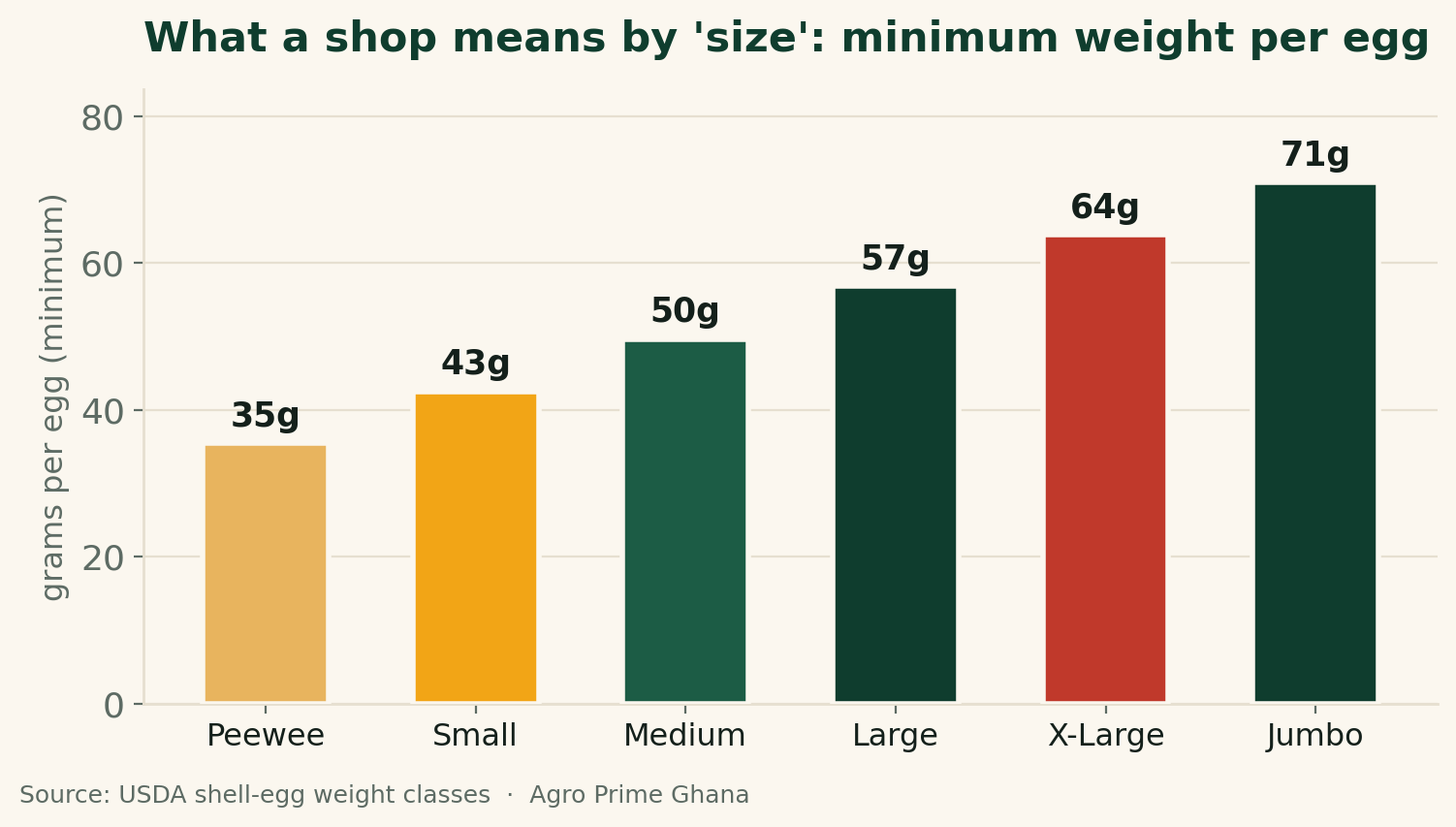
Grading is the first thing that separates a professional egg supplier from a casual one, because shops sell eggs sorted by size and quality and expect every crate to match. Grading has two parts. The first is size: eggs are classed by weight, and a retailer that advertises "large" eggs needs them to actually be large. The internationally recognised weight bands are a useful yardstick — a medium egg is around 50 g, a large around 57 g, extra-large around 64 g and jumbo about 71 g, with small pullet eggs below that. Sorting your eggs into consistent sizes lets a shop price and shelve them properly and lets you earn more on the bigger eggs instead of averaging everything together. The second part is quality: candling and simple inspection to pull out cracked, dirty, misshapen, thin-shelled or internally defective eggs. The grade system used internationally ranks eggs from AA (thick firm whites, high round yolks, clean unbroken shells) down through A to B — and while a Ghanaian shop may not ask for a formal grade letter, it absolutely expects the substance of grade A: clean, sound, uniform eggs. Deliver that consistently and the shop trusts your crate without opening it.
| Size class | Approx. weight per egg | Why it matters to a shop |
|---|---|---|
| Jumbo | ~71 g | Premium price; less common, from older hens |
| Extra-large | ~64 g | High-value; sells at a premium if consistent |
| Large | ~57 g | The mainstream retail egg most shops want |
| Medium | ~50 g | Steady seller; common from younger flocks |
| Small / pullet | <~43 g | Lower price; keep separate rather than mixing in |
Cleanliness and shell quality: the food-safety basics
Clean, sound-shelled eggs are non-negotiable for a shop, because a dirty or cracked egg is both a food-safety risk and an eyesore that drives customers away. The best way to deliver clean eggs is to produce them clean — collect frequently, keep nest boxes and litter clean and dry, and handle eggs with clean hands — rather than trying to wash dirt off afterwards. Washing is a trap for the untrained: as USDA food-safety guidance explains, washing can drive contamination through the shell's pores, and commercial washing uses regulated sanitiser at controlled temperatures — so unless you know the correct method, keeping eggs clean at source beats washing them. Shell strength is the other half of this: thin, weak shells crack in the crate and on the shelf, so feeding your hens properly for shell quality is a marketing issue, not just a hen-health one — see egg shell quality problems and calcium for laying hens. A supplier whose crates routinely arrive with cracks and stains loses the account; one whose eggs are consistently clean and strong keeps it.
Packaging and keeping eggs cool
Good packaging protects your reputation between the farm and the shelf, and temperature protects the egg inside it. Pack in clean, intact crates or cartons — reused crates that are cracked, filthy or crushed make even good eggs look bad and crush the ones underneath. Handle and stack gently; most cracks happen in handling and transport, which FAO specifically flags as a place losses must be prevented. Temperature matters more than most Ghanaian keepers treat it: USDA guidance is that shell eggs keep best refrigerated at or below about 4°C (40°F), and that raw eggs in the shell stay good for roughly three to five weeks when kept cool. In Ghana's heat, few small farms and shops can refrigerate throughout, but the principle still guides you — keep eggs in the coolest, shadiest, best-ventilated spot you can, move them quickly, and never let crates sit in a hot vehicle or in the sun. The fresher and cooler your eggs stay, the longer the shop can sell them, and the more it values you. Our guides to egg storage and handling and transporting eggs cover the practical detail.
Field note: sort ruthlessly — one bad egg costs you the crate's reputation
The temptation when eggs are your income is to slip the odd dirty, cracked or undersized egg into the middle of the crate where the buyer won't see it at a glance. Resist it completely. A shop that finds one dirty or broken egg starts opening and inspecting every crate you bring, and the trust that let them buy your eggs sight unseen is gone. It is far better to pull the seconds out and sell them separately at a lower price — to a baker, a chop bar, or for home use — than to poison your reputation with your best buyer. Grade as if the shop owner is watching you pack, because sooner or later, effectively, they are.
Delivery schedules: never let the shelf run empty
A fixed, reliable delivery schedule is one of the most valuable things you can offer a shop, because an empty egg shelf sends its customers to a competitor. Agree a rhythm that matches the shop's turnover — perhaps twice or three times a week for a busy supermarket, weekly for a small store — and then hold to it religiously, because the whole point is that the manager can stop worrying about eggs. Deliver at a time that suits them, not just you; bring the agreed quantity; and if something goes wrong, warn them early rather than simply failing to show. Consistency of timing compounds with consistency of quality: a shop that knows your clean, graded crates arrive every Tuesday and Friday morning will build its ordering around you and quietly stop entertaining other suppliers. This reliability is worth more to you than a slightly higher price, because it is what converts a casual buyer into a locked-in account — and it is precisely the thing disorganised competitors cannot copy.
Invoicing, records and getting paid
Professional paperwork signals a professional supplier and protects you when money is owed. Every delivery should come with a simple delivery note (date, quantity, size grade, price) that the shop signs, and you should issue a clear invoice for what is due. This is not bureaucracy for its own sake — it prevents the "I already paid you" and "that crate was short" disputes that sour relationships, and it is the backbone of knowing your own business, as covered in record keeping on the poultry farm. Getting paid is where many supply arrangements go wrong: retail and institutional buyers often want credit, and research on the Kasoa poultry cluster found payment delays of more than a week on credit sales are common. Protect yourself with clear terms agreed up front — how much credit, paid within how many days — keep a running record of each buyer's balance, and be willing to pause supply to a shop that keeps falling behind. Credit is a tool to build a good account, not a favour to a slow payer; treat it as a business term, priced and limited, and both sides stay comfortable.
Supply quality eggs — and start with quality Agro Prime pullets
Supplying shops reliably means never running short of good eggs, and that starts with a strong, uniform, productive flock. Agro Prime Ghana supplies vaccinated point-of-lay (POL) pullets and day-old layer chicks bred for steady lay and good shell quality, plus practical advice on layer feeding and grading so your crates stay consistent enough to hold a supermarket account. We also produce and supply quality table eggs, so we know what retailers demand. If you want to set up a layer flock that can supply shops, tighten your grading, or arrange a dependable egg supply, message us on WhatsApp at +233 24 915 1503 or book a visit.
Building a supply agreement that lasts
The strongest shop relationships are written down, even simply, because a clear agreement removes the misunderstandings that break partnerships. FAO explicitly recommends "written contracts" and "standard quality agreements" for supplying retailers and institutions, and you do not need a lawyer to make one useful. A basic egg-supply agreement covers: the quantity and delivery days (e.g. eight crates every Tuesday and Friday), the size grade and quality standard (clean, sound, "large" grade), the price and how it may change when feed costs move, and the payment terms (cash on delivery, or credit paid within an agreed number of days). Writing it down protects both sides, sets the shop's expectations, and gives you a stable base to plan production and pricing around. Start small — prove yourself over a few weeks of flawless delivery before asking for a bigger standing order — and let the relationship grow on the back of demonstrated reliability. A shop that has watched you deliver perfectly for three months will happily commit to a formal weekly order, and that standing order is the foundation of a durable egg business. For the wider strategy of positioning your farm in the market, see poultry marketing in Ghana.
The bottom line on supplying shops and supermarkets
Supplying eggs to shops and supermarkets in Ghana is won on professionalism, not price. Retailers want a supplier they can rely on: eggs graded to a consistent size, always clean and sound-shelled, packed in good crates, kept cool, and delivered on a fixed schedule with proper invoices and a simple written agreement behind them. Meet those needs methodically — grade ruthlessly, produce clean eggs at source, never let the shelf run empty, invoice cleanly and manage credit with firm terms — and you become the default supplier that a shop plans its business around and stops shopping to replace. Every one of these standards is within your control, which is why this is such a strong path for a serious layer farm: while competitors chase the daily price, you build the one thing a retailer will pay a steady premium for and never willingly give up — a supplier who is always, dependably, right.
Frequently asked questions
What do shops and supermarkets require from an egg supplier in Ghana?
How do I grade eggs for a shop?
Should I wash eggs before supplying them?
How should eggs be packaged and stored for delivery?
How do delivery schedules work with shops?
Should I supply eggs to shops on credit?
Do I need a written contract to supply a supermarket?
How do I make my farm a supermarket's default egg supplier?
Sources & further reading
- FAO — Egg Marketing: A Guide for the Production and Sale of Eggs, Ch. 4 (channels, retailers, institutions, contracts) and Ch. 6 (grading, packaging, handling, pricing).
- USDA Food Safety and Inspection Service — Shell Eggs from Farm to Table — grades AA/A/B, sizing by weight, refrigeration and shelf life, egg washing.
- Open Journal of Business and Management (2024) — Bottlenecks and Prospects of Poultry Production in Kasoa, Ghana — credit and payment-delay findings.
- Agro Prime Ghana guides: selling table eggs, egg crate pricing and marketing, egg storage and handling, transporting eggs, egg shell quality problems, and record keeping.
About Agro Prime Ghana
Agro Prime Ghana Limited runs a poultry hatchery and mixed agribusiness in Kasoa, supplying healthy day-old chicks (broilers & layers), point-of-lay pullets, quality feed and hands-on farm support across Ghana — and producing and supplying quality table eggs. This article is general educational information, not a substitute for professional business or food-safety advice tailored to your operation. Want to build a layer flock that can supply shops, tighten your grading, or set up a reliable egg-supply arrangement? Book a visit or message us on WhatsApp (+233 24 915 1503) to order pullets, feed or advice.