A hen in full lay performs one of the most demanding feats of mineral metabolism in all of farming: roughly every 24 to 26 hours she pulls together about two grams of calcium and lays it down as a hard shell, mostly overnight, in the dark, when she is not even eating. Do that for a year and she deposits many times her own skeleton's worth of calcium into eggs. When the feed cannot keep up, the shells go first — thin, rough, cracked, or the dreaded soft-shelled eggs that break in the nest. On many Ghanaian farms this shows up as a slow, expensive drip of downgraded and rejected eggs that nobody traces back to the feed. This guide explains how calcium works in a laying hen, how much she needs and when, which local sources to use, and how to keep shells strong through a long laying cycle.
Written by the Agro Prime Ghana poultry team and reviewed against current layer-nutrition references (Lohmann Breeders management guidance and the Alabama Cooperative Extension System). Last updated September 2026.
Key takeaways
A laying hen needs roughly 4–5 grams of calcium every day, which is why layer feed carries about 3–4% calcium — three to four times more than grower or broiler feed. An eggshell is around 90–96% calcium carbonate, and calcium carbonate is only about 40% calcium by weight, so a hen deposits on the order of two grams of pure calcium into every shell. The catch is timing: shell formation is most intense 12–18 hours after the previous egg was laid — overnight — yet feed passes through the gut in only about 3–4 hours. The fix is coarse limestone or oyster shell (1.5–4 mm) fed in the afternoon, which sits in the gizzard and releases calcium slowly through the night. When the feed falls short, the hen robs her own bones (medullary bone), and shell quality — plus, eventually, her skeleton — pays the price. Vitamin D3 and available phosphorus must be right too, or the calcium cannot be used.
Why calcium is the hardest mineral a hen has to manage
Most nutrients a bird needs in small, steady amounts. Calcium is different: a hen laying near an egg a day must source, absorb and deposit an enormous quantity of one mineral on a punishing daily schedule, mostly at night. According to Lohmann Breeders, she requires about 4 to 5 grams of calcium per day, and the shell is roughly 90 to 95% calcium carbonate in a thin protein matrix — the Alabama Cooperative Extension System puts it at around 96%. Since calcium carbonate is only about 40% elemental calcium by weight, that shell is close to two grams of pure calcium leaving her body each time she lays.
Set that against her body size and the pressure is obvious. There is not enough calcium in a hen's blood at any moment to build a shell; she must be absorbing it from the gut or drawing it from her bones the whole time the shell forms. Get the supply, form and timing right and shells stay hard for a full year; get any one wrong and the shells crack first — literally.
How much calcium, and why the number is so high
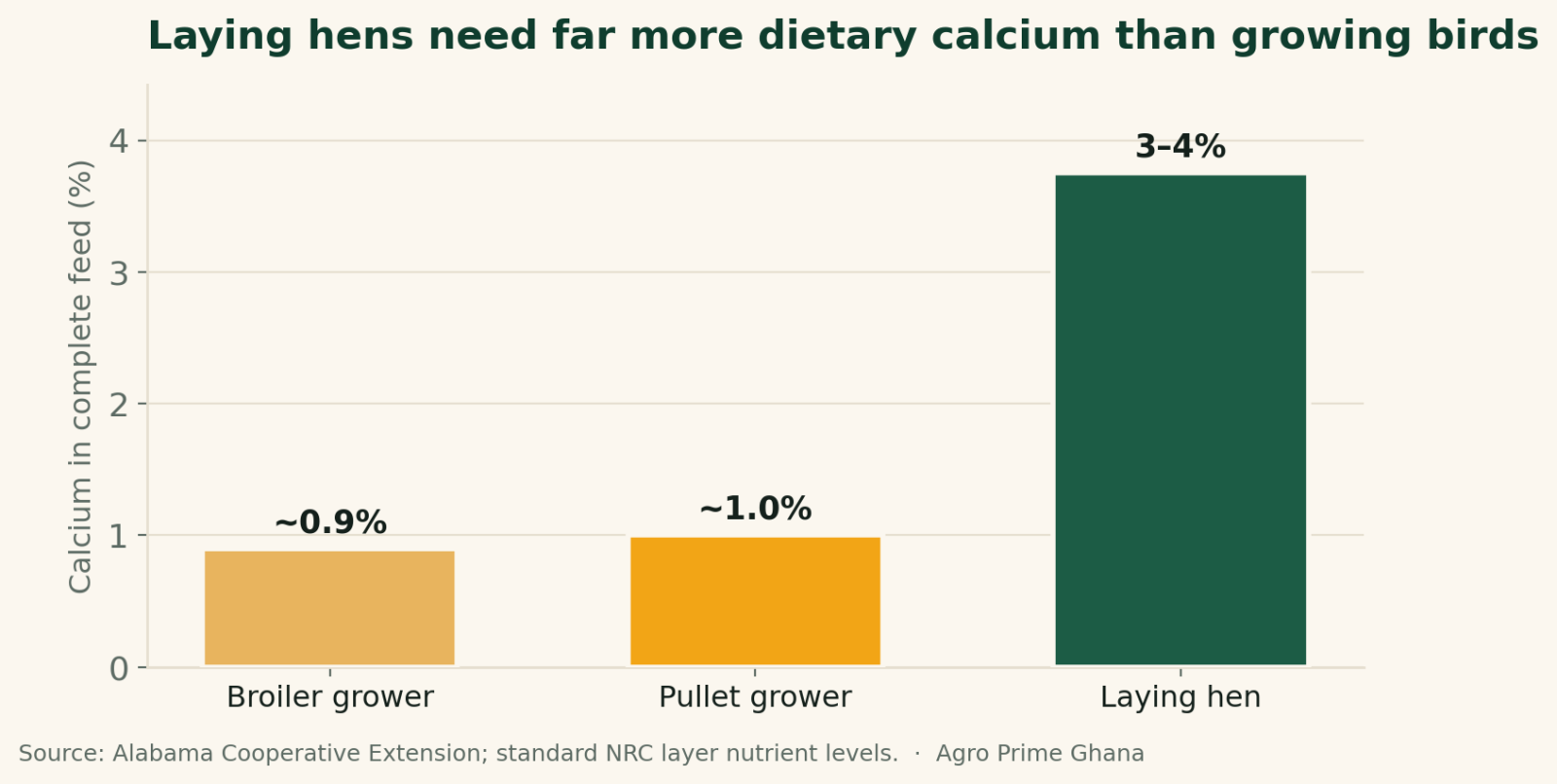
Layer feed is built around this demand. The Alabama Extension recommends a complete layer diet of roughly 3 to 4% calcium with about 16 to 18% protein. Broiler or pullet-grower feed sits closer to 1% calcium — a layer's ration carries three to four times as much. This is why you must not feed layer feed to young growing birds (the excess damages kidneys and bones), nor keep laying hens on grower feed once they come into lay. A hen on 1%-calcium feed is being asked to build shells out of thin air, and she does it by dismantling her own skeleton.
The 3–4% figure is a starting point, not a fixed rule. Demand climbs into peak production and again in older hens, because as a hen ages her ability to use calcium declines while her eggs get larger — the same shell material over a bigger egg means a thinner shell. That is why experienced managers deliberately raise dietary calcium, especially the coarse fraction, as a flock ages. If you mix your own ration, getting this level right is one of your most important decisions; our guides to layer feeding in Ghana and making poultry feed cover where calcium fits in.
Not all calcium is equal: comparing the local sources
The practical calcium sources for layer feed in Ghana are limestone (calcite), oyster shell, snail shell, sun-dried ground eggshell and, less commonly, bone meal. The carbonate sources are chemically similar — pure calcium carbonate is about 40% calcium — but differ in purity, particle size, dissolving speed and price, as the table shows.
| Calcium source | Approx. calcium content | Notes for Ghanaian farms |
|---|---|---|
| Limestone / calcite | ~38% calcium | The workhorse of commercial layer feed. Cheap and consistent when sourced from a reliable supplier. Available in fine (for the mash) and coarse grades (for slow overnight release). |
| Oyster shell | ~38% calcium | Excellent slow-release coarse source; the classic "free-choice" calcium. Dissolves gradually in the gizzard, which suits overnight shell formation. Supply is less reliable inland. |
| Snail shell (local) | Broadly similar (carbonate) | Widely available near markets and eateries; must be cleaned, sun-dried and ground. Quality varies, so screen for grit, sand and contamination before use. |
| Sun-dried eggshell | Broadly similar (carbonate) | A cheap on-farm recycle for small flocks. Must be thoroughly dried and crushed to avoid disease risk and to stop hens learning to eat their own eggs. Not a reliable base for large-scale feeding. |
| Bone meal / DCP | Calcium + phosphorus | Supplies phosphorus as well as calcium; useful for balancing the ration, but not a substitute for a dedicated coarse calcium source for shells. Buy from trusted suppliers to avoid contamination. |
The three-hour problem: timing and particle size
Here is the puzzle at the heart of shell quality. Lohmann's data show shell formation is most active 12 to 18 hours after the previous egg, peaking around 18 hours — for most hens, through the late night and early morning. But feed moves through the gut in only about 3 to 4 hours, so calcium eaten in the morning is long gone by the time she needs it most. If all her calcium is fine limestone in the mash, she runs out overnight and must strip it from her bones to finish the shell.
Nature already solved this, and good management copies it. Lohmann notes hens have a naturally high appetite for calcium in the last 5 to 6 hours of daylight, instinctively loading up before the night's shell-building. The trick is a coarse calcium they can store. Coarse limestone or oyster shell of about 1.5 to 4 mm does not dissolve immediately; it lodges in the gizzard and releases calcium slowly through the night. Fine limestone (below about 0.5 mm) dissolves and passes quickly — good for the daytime background supply but useless as an overnight reserve. So the best-run flocks split their calcium: part fine in the feed, a meaningful part coarse, offered in the afternoon so hens top up before dark.
Field note: feed the coarse calcium late in the day
The change that most reliably firms up shells is not more calcium overall — it is changing when and in what form it arrives. We keep a good share of the day's calcium coarse (grit or ground oyster/snail shell around 2–4 mm) and make sure hens can reach it in the afternoon, before lights-out. Birds with thin, gritty shell-ends on morning collection often tighten up within a couple of weeks once the coarse fraction and timing are sorted, with no change to the base ration.
Bone as a calcium bank: the medullary reserve
A laying hen carries a short-term calcium store other birds lack: medullary bone, a spongy tissue inside her long bones that forms when she comes into lay. Think of it as a rechargeable battery: by day, absorbing calcium faster than she needs it, she banks the surplus there; at night, with the shell gland working and no calcium from the gut, she draws it down to supply the shell. In a well-fed hen this daily charge-and-discharge is normal — and the coarse-calcium trick exists precisely to keep the overnight withdrawal small.
The problem comes when the diet is chronically short of available calcium, or of the vitamin D3 needed to absorb it. Then the hen cannot recharge the battery fully and starts drawing on her structural skeleton to keep making shells. Over months this brings weak, brittle bones (cage layer fatigue or osteoporosis in older hens), more breakages when handling birds, and failing shells that no last-minute supplementation fully fixes. This is the deeper reason to get calcium right from the day a pullet starts laying: you protect not just today's shells but the frame that must carry her through a 70-plus-week laying life.
Vitamin D3 and phosphorus: the supporting cast
Calcium does not work alone, and this is where many "mystery" shell problems live. Vitamin D3 is the switch that lets a hen absorb calcium from her gut and mobilise it from bone; without enough, you can pour calcium into the feed and still get poor shells. Commercial layer premixes include D3 for exactly this reason. Phosphorus is the other partner: too much interferes with shell formation just as too little calcium does. The Alabama Extension notes the shell is only about 0.5% phosphorus, so layer diets deliberately keep available phosphorus moderate while calcium runs high.
For keepers who mix feed: if shells are poor despite adequate calcium, look next at vitamin D3 (a good premix plus some sunlight) and whether the calcium-to-phosphorus balance has drifted. Our rundown of poultry feed ingredients covers where these minerals and premixes fit in a locally mixed ration.
Field note: chase the vitamin D3 and the balance, not just more limestone
When shells stay disappointing after we have fixed the level, timing and particle size, we stop adding limestone and ask two questions. Is the vitamin-mineral premix fresh, correctly dosed and mixed in evenly? And has something crowded the ration — extra bran, a cheaper protein, a change of maize — that knocked the calcium-to-phosphorus balance off? More limestone on top of a D3 or balance problem just wastes money; the cheapest wins are an even mix and a premix you trust.
Reading shell problems back to calcium
Shells are a running report card on a hen's calcium status. Persistent thin or translucent shells across a flock point to a shortfall in usable calcium — the level, form, timing, or the vitamin D3 that unlocks it. Rough, sandpapery or pimpled ends often reflect calcium deposited unevenly, usually a timing-and-particle-size issue. Soft-shelled or shell-less eggs now and then have many causes (stress, disease, a very young or old bird), but if they become common they shout calcium or vitamin D3. A gradual thinning across an ageing flock is the expected pattern of larger eggs plus declining efficiency — the cue to raise the coarse fraction, not to panic.
That said, not every shell fault is a calcium fault. Heat stress is a big one in Ghana: a panting hen blows off carbon dioxide and lays down less shell, which is why complaints spike in the hottest months even on a good diet — our guide to keeping egg production up covers managing that heat. Diseases such as infectious bronchitis also damage shells directly. Fix the calcium fundamentals first, then look at heat and disease if problems persist.
A practical calcium routine for Ghanaian layer flocks
A calcium programme that holds up over a long cycle comes down to six habits: switch birds onto a proper layer ration as they come into lay; split the calcium between a fine fraction in the mash and a coarse fraction (1.5–4 mm) for slow overnight release; offer the coarse calcium in the afternoon; protect vitamin D3 and the calcium-to-phosphorus balance with a fresh, evenly mixed premix; raise the coarse fraction as the flock ages; and manage heat. None of it is expensive — mostly form and timing.
The bottom line on calcium
Calcium is the one nutrient a laying hen handles in bulk, on a nightly deadline, and the shells tell you whether she is winning or losing. She needs about 4–5 grams a day, as roughly 3–4% of a proper layer diet, and — crucially — a good part of it in coarse form, fed late in the day, so it releases slowly through the night while the shell is built. Behind it sit vitamin D3, which lets her use the calcium, and a sensible calcium-to-phosphorus balance, without which extra limestone is wasted. Get the level, form, timing and supporting minerals right, never run her short, and one of layer farming's most expensive nuisances — thin, cracked, rejected eggs — becomes a strength you can count on.
Frequently asked questions
How much calcium does a laying hen need each day?
Why do my hens lay thin or soft shells even on layer feed?
What is the best calcium source for layers in Ghana?
Should I feed oyster or limestone in the morning or evening?
Can I give too much calcium to laying hens?
What role does vitamin D3 play in shell quality?
Why do older hens lay weaker shells?
Do hens take calcium from their own bones?
Sources & further reading
- Lohmann Breeders — Optimal calcium supply for laying hens (daily calcium need, shell carbonate content, particle size, timing of shell formation and calcium appetite).
- Alabama Cooperative Extension System — Feeding the Laying Hen (dietary calcium and protein levels, eggshell composition).
- Agro Prime Ghana guides: layer feeding guide, how to make poultry feed, poultry feed ingredients, and how to increase egg production.
About Agro Prime Ghana
Agro Prime Ghana Limited runs a poultry hatchery and mixed agribusiness in Kasoa, supplying day-old chicks and supporting layer keepers across the country. These guides combine hands-on hatchery and farm experience with current poultry-nutrition references. This article is general educational information, not a substitute for advice from a qualified poultry nutritionist or veterinary officer tailored to your flock and feed. Need chicks, feed advice or farm support? Book a visit or message us on WhatsApp (+233 24 915 1503).