You candled every egg, the shells are clean and the layers are laying beautifully — and then a bad half-hour on a rough road wipes out the profit. A tray tips against the tailgate, the crates were stacked one too high, the eggs sat in a hot boot from Kasoa to Circle at midday, and by the time they reach the buyer a handful are cracked, a few more are "checks" nobody spots until they leak, and the whole consignment has aged faster than it should. For a layer farmer, eggs are only really sold once they arrive whole, clean and fresh. This guide covers how to move eggs to market in Ghanaian conditions with the fewest breakages and the least loss of quality — the packaging, temperature, loading and timing that decide whether your margin survives the journey.
Written by the Agro Prime Ghana poultry team and reviewed against current references (the FAO guide Egg Marketing and the Codex Code of Hygienic Practice for Eggs and Egg Products). Last updated September 2026.
Key takeaways
An egg is a fragile, perishable, living product, and transport is where a lot of layer profit quietly disappears. Two enemies matter most: shock (breakage from rough handling and roads) and heat (quality loss from time spent warm). FAO notes that eggs held a week to ten days at 27–29°C — a normal open-market temperature here — age as much as eggs kept for months near -1°C. A weight loss of 2–3% is normal in marketing, but heat, time and rough handling push losses far higher. The defence is cheap: collect often, keep eggs pointed end down in clean crates, cushion and secure the load, move in the cool of the morning or evening, keep the eggs shaded and dry, and never wash eggs you are storing. Get the journey right and you sell almost every egg you lay.
Why transport is where eggs are won or lost
An egg leaves the hen close to perfect: full, dense, protected by a natural "bloom" over the shell. From that moment everything that happens to it — every hour, every degree of warmth, every bump — can only take quality away, and transport concentrates the risks into a short, high-stakes window. Mechanically, the shell is strong in the right direction but brittle against a knock, so a crate that shifts, a stack that leans, or a pothole taken at speed turns whole eggs into cracked ones. Biologically, the egg is still breathing through thousands of tiny pores; it loses moisture, the air cell grows, the white thins — and if it is warm, all of this happens far faster. FAO puts the temperature effect starkly: eggs kept a week to ten days at 27–29°C change as much as similar eggs held for several months near -1°C. A day baking in a hot vehicle can cost more freshness than a week in a cool store. The journey to market is not a neutral gap between production and sale — it is an active period of ageing and risk that you either manage or pay for.
What actually happens to an egg on the road
It helps to picture the two failures separately, because they have different fixes. The first is physical breakage: outright cracks, and the more treacherous "checks" — hairline fractures under an intact-looking shell that only show up when the egg is candled or when it leaks in the tray. Breakage comes from three things: poor packaging (eggs touching each other or hard surfaces), an unstable load (crates that slide, tip or crush the ones below), and rough handling and roads. The second failure is quality loss: even an unbroken egg arrives older than it left, as warmth speeds the thinning of the white, the enlarging of the air cell and the loss of moisture. FAO notes that a weight loss of 2–3% during marketing is common and hardly noticeable to buyers — but that is under decent handling. Add heat, delay and a jolting ride and both the visible breakage and the invisible ageing climb together.
Collect little and often, and handle from the start
Good transport begins in the laying house, hours before any vehicle is loaded. Eggs that sit in the nest collect dirt, crack under other hens, and start warming and ageing the moment they are laid — so the single most useful habit is frequent collection, several times a day, into clean trays, with cracked and dirty eggs sorted out on the spot. Handle gently, because eggs are damaged as much by careless picking and stacking as by the road itself. Store them before the trip in the coolest, most stable spot you have — shaded, ventilated, off the floor, away from anything strongly smelling (eggs pick up odours of onions, fuel, fish or paint through the shell). And resist the urge to wash: washing strips the natural bloom that seals the shell against bacteria and moisture loss. Codex and FAO both treat shell eggs as a product to keep clean and dry, not washed, unless you have a proper washing-and-drying system. A washed, damp egg going into a warm crate for a bumpy ride is a spoilage risk you created yourself.
Packaging: what goes between the egg and the knock
Packaging exists to do one job — keep each egg from touching anything hard, including the next egg — and to hold the eggs in the position that protects them. The workhorse across Ghana is the moulded 30-egg crate, and it is genuinely good at its job: each egg sits nose-down in its own pocket, cushioned by fibre, with air around it. Two details make a real difference. First, orientation: eggs travel best with the pointed (narrow) end down, which keeps the air cell at the top and the yolk centred and cushioned. Second, never over-stack: crates are strong when interlocked and squared, but a leaning or too-tall stack crushes the bottom layers. FAO describes marketing eggs moving in filler flats grouped into boxes, and the principle holds whatever the local crate size: eggs in fitted flats, flats squared and secured, nothing loose. Good packaging materials to have on hand:
- Clean 30-egg crates in good condition — cracked, crushed or damp crates protect nothing. Reuse plastic ones after washing and drying; discard soggy pulp ones.
- A rigid outer for longer or rougher trips — a sturdy carton or plastic egg-crate carrier that holds several trays squarely and stops them sliding.
- Cushioning — a folded sack, foam or cardboard between the stack and any hard surface, and to fill gaps so nothing shifts.
- A cover to keep sun, rain and dust off, without sealing in heat.
Field note: how we load a vehicle for eggs
On the farm the rule we drum into anyone loading is "square, snug and low." Crates go pointed-end-down, interlocked and stacked no higher than the stack stays genuinely stable — usually well short of what looks possible. We load onto a padded base, not bare metal, and pack out the gaps so nothing can slide when the vehicle brakes or corners. Heavy items never ride on top of eggs. The last thing before closing up is a gentle push-test on every stack: if it rocks, it is not ready to travel. Two minutes of loading care saves more eggs than any amount of careful driving afterwards.
Temperature and timing: beat the heat with the clock
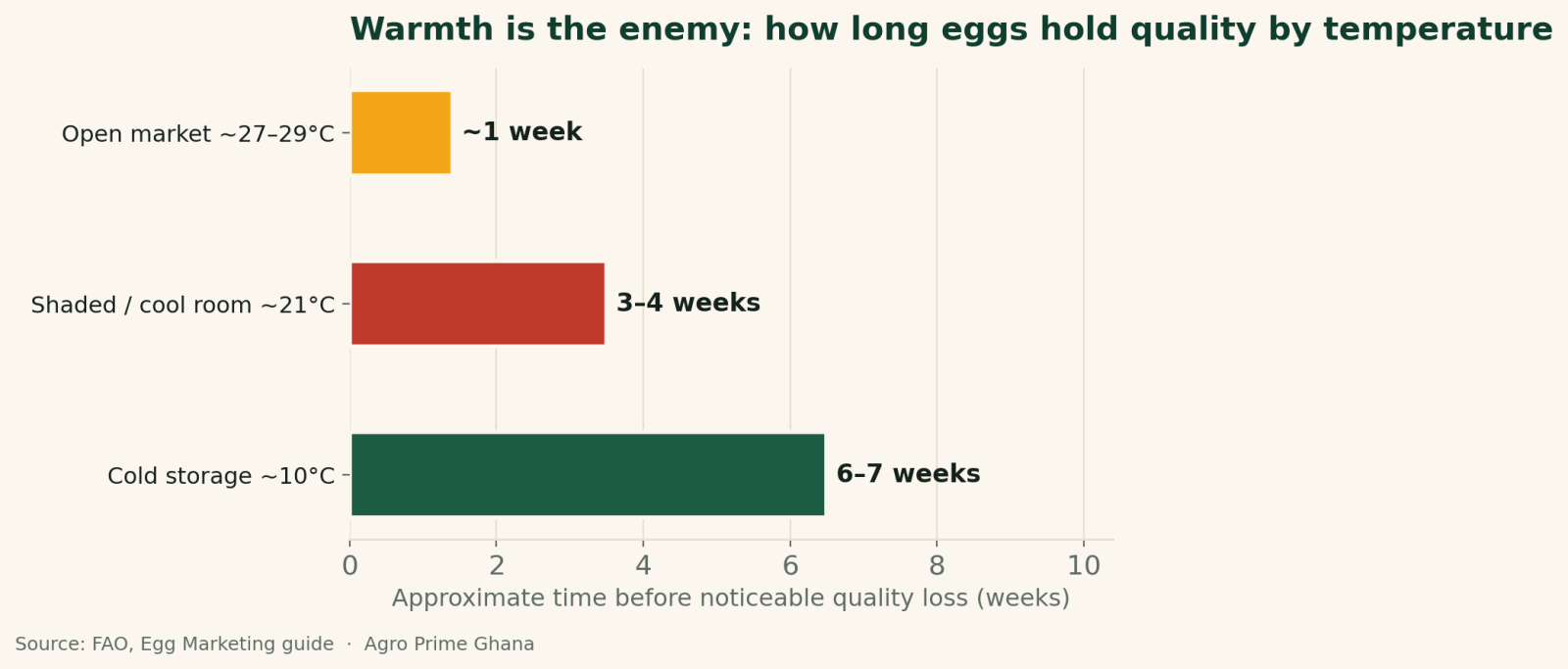
Most Ghanaian egg farmers cannot put a refrigerated truck on the road, and for short local trips they do not need to — but they must respect what heat does. FAO's figures make the case: eggs deteriorate in a week to ten days at 27–29°C as much as in several months near freezing, and flavour goes off in roughly 3–4 weeks at 21°C versus 6–7 weeks at 10°C. You cannot chill on a motorbike, but you can control time and exposure for free. Move eggs in the cool of the day — not the midday heat; keep the load shaded and out of direct sun; and minimise hot stops and the total time between the cool store and the buyer. If you hold eggs before or after transport, FAO's tropical-storage guidance is a cool room around 10–13°C where you can manage it, otherwise the coolest, shadiest, most ventilated spot available. Ventilation matters as much as shade: a covered but airless container traps warmth and can leave you worse off than an open, shaded tray. Think "cool, shaded, moving air, moving fast," not "sealed up."
| Practice | The mistake | The fix |
|---|---|---|
| Timing of the trip | Carting eggs at midday in full heat | Move early morning or evening; keep the load shaded |
| Packaging | Loose eggs, mixed with goods, over-stacked crates | 30-egg crates, pointed end down, squared and no over-stacking |
| Load security | Crates sliding on bare metal, heavy items on top | Padded base, gaps packed, nothing heavy on the eggs |
| Handling | Tossing and dropping crates on and off | Lift and set down gently at every transfer |
| Cleaning | Washing eggs before a warm, damp journey | Dry-clean only; keep eggs clean and dry, never wet |
| Sorting | Cracked/dirty eggs travelling with good ones | Candle and sort before loading; leaks spoil neighbours |
Grade, candle and sort before you sell
Transport and marketing meet at sorting. Before eggs go to a buyer — and again after a rough trip — candle them: held to a light, a good egg shows a small air cell and clean interior, while cracks, large air cells (a sign of age or heat) and internal defects show up clearly. This is the standard graders use: FAO/USDA grading ties top quality to a small air cell (around 3 mm deep for the best grade, up to about 6 mm for the next), which grows as an egg ages or warms. Pulling the cracks and checks before sale protects your buyer from leakers and lets you price honestly — whole, fresh, well-sized eggs command the best price, while cracked ones are best sold cheaply for home use rather than passed off in a tray.
Field note: the checks you cannot see are the ones that cost you
Outright broken eggs are obvious and easy to pull. The ones that quietly damage a farmer's name are the "checks" — hairline cracks under a whole-looking shell that survive the trip, then leak in the buyer's tray a day later and are blamed on freshness. After any journey we treat a quick candling as non-negotiable, watching for the tell-tales: a faint star-shaped crack against the light, a weeping shell, a rough ridge you can feel with a fingertip. It takes seconds per egg and it is the difference between a buyer who trusts your crates and one who starts checking every single one.
Cleanliness and food safety on the move
Eggs are food, and transport is part of the food-safety chain. The Codex code of hygienic practice for eggs treats keeping eggs clean, dry and protected from contamination as a continuous requirement from nest to point of sale. Practically, that means crates that are clean and dry, not caked with old yolk or damp with condensation; eggs kept away from strong odours and from anything toxic (fuel, agrochemicals and cleaning fluids should never share a load with eggs); and clean hands during loading. Keeping eggs cool is a food-safety measure too — warmth that ages an egg also favours any bacteria present, which is why the whole system pushes toward "clean, dry, cool and quick." A farmer who supplies schools, hotels, restaurants or the public is selling trust as much as protein, and safe handling in transport connects directly to the biosecurity thinking you already apply on the farm.
The economics: small losses add up fast
Transport losses feel small per trip and are large per year. Every cracked egg is a full egg's feed, labour and housing cost turned into near-zero value; every batch that arrives visibly aged fetches a lower price; and every leaker that spoils its tray-mates multiplies one loss into several. Against that, the fixes cost almost nothing: good crates you already own, loading care that takes minutes, a departure shifted to the cool hours, a cover and a bit of padding. A layer enterprise runs on thin per-egg margins and large volumes, so shaving breakage and quality loss from several percent toward one or two flows almost entirely to profit. The birds and their feed are the big investment — see our guides to layer feeding and increasing egg production — and transport is the cheap last mile that decides how much of it you collect. There is no faster return in the layer business than not breaking eggs you have already produced.
The bottom line on moving eggs to market
Eggs are fragile and perishable, and the trip to market is where those two facts collide. Breakage comes from touching, shifting and jolting; quality loss comes from heat and time. Both are avoidable with habits that cost next to nothing: collect often and sort early; pack in clean 30-egg crates pointed-end-down; load square, snug and low on a padded base with nothing heavy on top; travel in the cool of the day, shaded and ventilated, and move quickly; keep everything clean and dry; and candle out the cracks and checks before they reach a buyer. Respect what FAO's numbers show — that a hot day can age an egg like a month in a cool store — and let the clock and the shade do the work a fridge would. Deliver whole, clean, fresh eggs every time, and you turn the riskiest half-hour of the layer business into the most reliable part of it.
Frequently asked questions
Which way up should eggs be packed for transport?
How does heat damage eggs during transport?
Should I wash eggs before taking them to market?
What is the best way to stop eggs cracking in transit?
What are "checks" and why do they matter?
Is it safe to carry eggs on a motorbike?
How much egg weight loss is normal during marketing?
How soon after laying should eggs be moved and sold?
Sources & further reading
- FAO — Egg Marketing: Egg packaging, transport and storage (tropical storage temperatures, transport conditions, weight loss, packaging).
- FAO — Egg Marketing: Marketing quality eggs (temperature vs deterioration, air-cell grading, moisture loss).
- Codex Alimentarius — Code of Hygienic Practice for Eggs and Egg Products (CAC/RCP 15) (handling, cleaning and hygiene of shell eggs).
- Agro Prime Ghana guides: poultry biosecurity, layer feeding guide, and how to increase egg production.
About Agro Prime Ghana
Agro Prime Ghana Limited runs a poultry hatchery and mixed agribusiness in Kasoa, supplying day-old chicks and supporting layer and broiler keepers across the country. These guides combine hands-on hatchery and farm experience with current references. This article is general educational information, not a substitute for professional advice tailored to your operation. Need chicks, layer support or help getting your eggs to market? Book a visit or message us on WhatsApp (+233 24 915 1503).