An egg leaves the hen at its very best and only ever gets worse from there — the job of everyone who handles it afterwards is simply to slow that decline. On too many Ghanaian farms, good eggs are quietly downgraded between the nest and the buyer: left in the heat of the laying house for hours, stacked in a warm store room, jolted along rough roads, or washed "to make them clean" in a way that actually shortens their life. Each of those steps costs real money, because a fresher, better-graded egg fetches a better price and a cracked or stale one fetches little or nothing. This guide explains how eggs age, how to store and handle them for maximum freshness and shelf life under our hot climate, how grading adds value, and the simple practices that keep more of your eggs in the top grade — and more money in your pocket.
Written by the Agro Prime Ghana poultry team and reviewed against current references (FAO egg handling and storage guidance and peer-reviewed egg-quality research in Poultry Science). Last updated September 2026.
Key takeaways
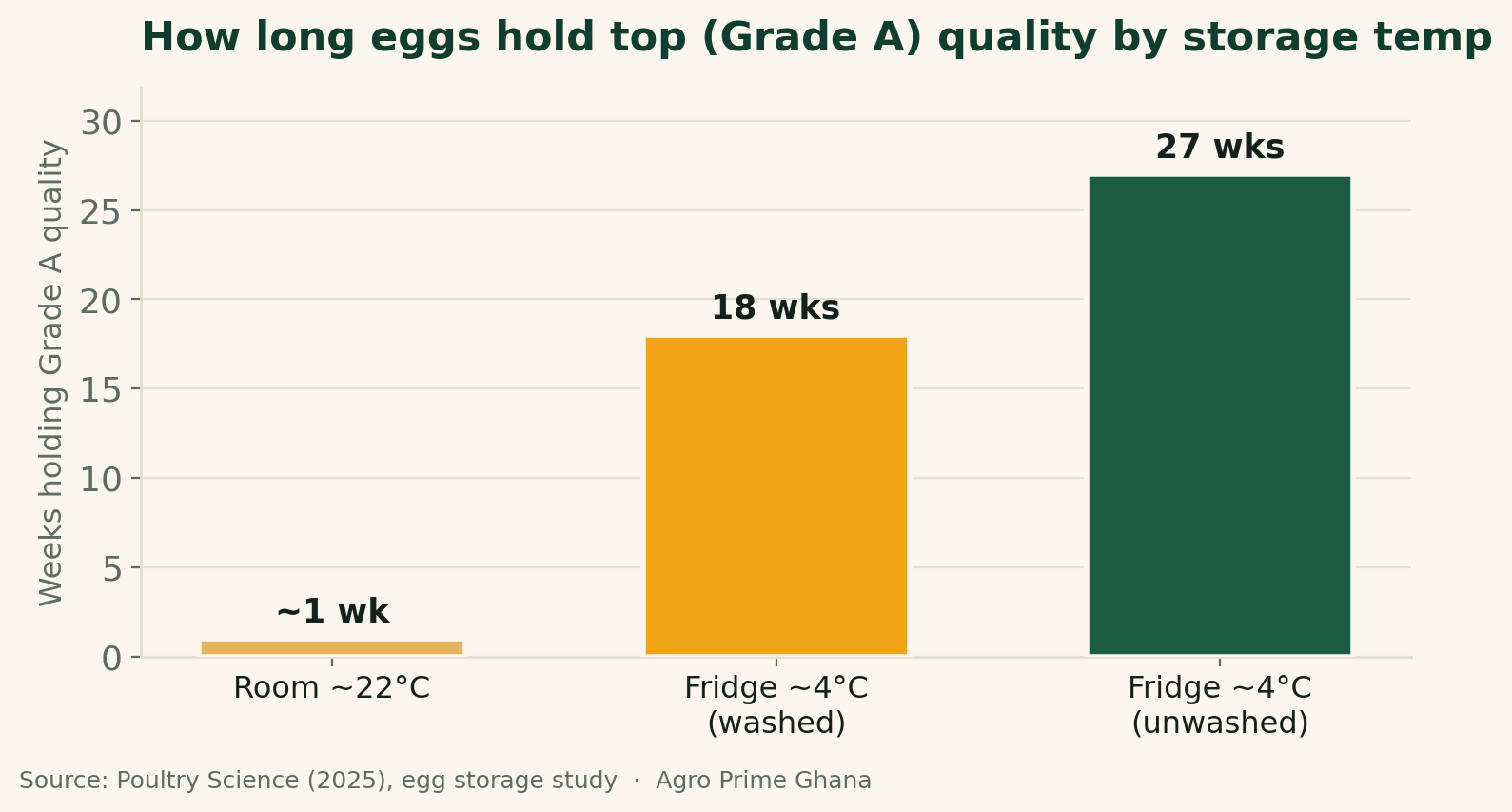
Eggs deteriorate fastest in heat, so temperature is everything. At room temperature (around 22°C) eggs slip from top quality within about a week and fall below Grade A within roughly four weeks; kept cool at about 4°C they can hold Grade A quality for 18 weeks or more. In warm climates FAO advises storing eggs at 13°C or lower (ideally 10–13°C) at 75–85% humidity, where good eggs keep for months. Do not wash eggs — washing strips the natural protective "bloom" and lets in bacteria and moisture. Store them pointed end down, away from strong odours, and collect frequently. Keep eggs clean, cool and unwashed, grade by size and quality, and you protect both shelf life and market value — because a fresh, well-graded egg simply sells for more.
How an egg ages — and why it matters
A freshly laid egg is a sealed, living package designed to protect a developing chick, and understanding that design tells you exactly how to keep it fresh. The shell is not solid: it is riddled with thousands of tiny pores that let air and moisture pass, and it is coated at laying with a thin natural layer called the bloom (or cuticle) that seals those pores and keeps bacteria out. From the moment it is laid, an egg slowly loses moisture and carbon dioxide through those pores. As it does, the contents shrink, the air cell at the blunt end grows, the thick white thins and becomes watery, and the internal quality falls — this is measurable, and it is exactly what egg graders are checking. The faster the egg loses moisture and gas, the faster it ages, and the single biggest driver of that speed is temperature. A warm egg breathes out moisture and CO2 quickly and ages fast; a cool egg does it slowly and stays fresh. Everything in good egg handling flows from this one fact: keep the egg cool and keep its natural seal intact, and you slow the clock.
Temperature: the single biggest lever on freshness
The numbers make the case better than any argument. In a peer-reviewed study tracking shell eggs over months of storage, eggs held at room temperature (about 22°C) dropped from top grade to Grade B within a single week and fell below Grade A altogether by around four weeks, while eggs kept refrigerated at about 4°C held Grade A quality for 18 weeks or more — some treatments right through 27 weeks. The contrast in moisture loss was just as dramatic: room-temperature eggs lost enormous amounts of weight over long storage, while cool-stored eggs lost only a fraction of that. For farmers in Ghana, where a laying house can sit above 30°C for much of the day, the practical message is blunt: every hour an egg spends warm is shelf life thrown away. You may not have refrigeration, and full cold storage is not necessary for eggs sold within days — but the direction is clear, and even modest cooling helps enormously.
For proper storage, FAO's guidance for warm climates is to hold eggs at 13°C or lower — usually between 10 and 13°C — at a relative humidity of about 75–85%, conditions under which good-quality eggs keep for six to seven months with weight loss held to around half a percent per month. The humidity matters as much as the cold: too dry and the egg loses moisture through the shell faster; too damp and you invite mould and spoilage. Most small Ghanaian farms will not hit those laboratory conditions, but the principle scales down perfectly — a cool, shaded, well-ventilated store room, off the ground and away from the sun, is a world better than a hot corner of the poultry house, and it costs nothing but attention.
How storage conditions change egg shelf life
The table below summarises what different handling and storage conditions do to how long an egg stays at top quality, drawn from FAO guidance and egg-quality research. The pattern is consistent: cooler and cleaner means longer, better-value eggs.
| Condition | What happens to the egg | Practical shelf life at top quality |
|---|---|---|
| Left in the laying house (~30°C+) | Rapid moisture & CO2 loss, quick quality drop | Days — ages fastest of all |
| Room temperature (~22°C) | Falls to Grade B in about a week | ~1 week at top grade |
| Cool store (10–13°C, 75–85% RH) | Slow ageing, low weight loss | Months (FAO: up to 6–7 months) |
| Refrigerated (~4°C) | Very slow ageing, minimal weight loss | 18 weeks or more at Grade A |
| Washed / wet egg | Bloom stripped, bacteria & moisture enter | Shortened — spoils faster |
Why you should never wash eggs
It feels wrong, but it is one of the most important rules in egg handling: do not wash your eggs unless you have proper equipment to sanitise, dry and immediately refrigerate them. FAO is explicit that eggs going into storage "must be clean; they must not be washed or wet." The reason is that natural bloom. That thin cuticle is the egg's own defence — it seals the pores and blocks bacteria. Wash it off with water, especially cool water on a warmer egg, and you do two harmful things at once: you remove the protective seal, and you can actually draw bacteria and moisture in through the newly-opened pores as the egg contents contract. A washed egg looks cleaner but spoils faster and is more likely to carry contamination inside. The right answer is to keep eggs clean at the source so they never need washing: clean, well-bedded nest boxes, frequent collection before eggs get soiled or broken, and gentle dry-brushing or a light dry wipe of the occasional dirty egg rather than a wash. Heavily soiled eggs are best sold quickly for immediate use or kept separate, never stored with your clean stock. Good nest and litter hygiene is the foundation here — the same clean-house discipline covered in our guide to poultry litter management is what keeps eggs clean enough not to need washing in the first place.
Field note: collect often, and the house stays cool inside the egg
The cheapest freshness measure on any farm is the collection schedule, and it costs nothing but routine. An egg left sitting in a hot nest all day has already lost much of its shelf life before it ever reaches your store — it has effectively been "stored" at 30-something degrees. On the farm we collect several times a day rather than once, partly to reduce breakage and soiling and pecking, but mostly to get eggs out of the heat and into a cooler store while they are still close to nest-fresh. More frequent collection also means fewer dirty and cracked eggs, which means fewer eggs that tempt you to wash them. It is a small change to the daily rhythm that quietly protects grade and price across the whole flock.
Handling: protecting the shell from nest to buyer
Every crack is a lost sale, and cracks are made by handling, not by hens. A shell that is intact at laying can be starred, hairline-cracked or fully broken by rough collection, over-stacking, a hard-riding trip to market or careless loading — and once the shell is compromised the egg is no longer safe to store or sell as a table egg, because that same broken seal lets bacteria straight in. Careful handling is therefore pure profit protection. Collect gently into proper trays or padded containers rather than buckets; never over-stack cartons or crates; keep eggs away from anything that jolts or vibrates hard; and load and unload transport slowly and deliberately, cushioning against the worst of Ghana's rough roads. Store and carry eggs pointed end down, blunt end up: this keeps the air cell at the top and the yolk centred, which preserves internal quality and reduces the chance of the yolk touching and sticking to the shell as the egg ages. And keep eggs well away from strong-smelling materials — fuel, onions, fish, fresh paint, chemicals — because the porous shell readily absorbs odours, and a batch of eggs that has picked up a smell is hard to sell at full price.
Grading and its effect on market value
Grading is simply sorting eggs by size and by quality, and it is one of the easiest ways to lift the value of what you already produce. Buyers pay more for larger eggs and for eggs of reliable, uniform quality, so a farmer who sorts is a farmer who captures that premium instead of selling everything mixed at an average price. Size grading is straightforward — sorting by weight into small, medium, large and extra-large — and even a simple scale or an egg-sizing gauge lets you present uniform trays that command better prices from hotels, shops and bulk buyers who value consistency. Quality grading means removing what should not be sold as a top-grade table egg: cracked, dirty, misshapen, very thin-shelled or unusually small eggs, and any that fail a quick check. The classic quality check is candling — holding the egg up to a bright light in a dark space, as done in any grading room — to reveal cracks, blood or meat spots, a large or wobbly air cell (a sign of an older egg), and the general clarity of the contents. Grading also gives you a feedback loop on the flock: a rising share of thin-shelled or misshapen eggs is telling you something about nutrition, age or stress, which you can act on. Persistent shell problems are worth investigating rather than just grading out — our guide to layer feeding covers the calcium and nutrition side that underlies good, saleable shells.
Field note: sort your eggs — the market rewards the trouble
Farmers sometimes see grading as extra work for little return, but the market tells a different story. A tray of clean, uniform, correctly-sized eggs sold to a hotel or provision shop earns more, and earns repeat orders, than the same eggs sold mixed and ungraded at a discount. Pulling out the cracked and dirty ones for quick local sale, sizing the rest, and presenting consistent trays turns your best eggs into your best prices instead of dragging them down to an average. The candling and sorting take minutes per crate, and for anyone selling regularly to serious buyers it is some of the best-paid few minutes on the farm.
A simple egg-handling routine that works in Ghana
None of this requires cold-chain investment — it requires routine. A workable system for a small or medium farm looks like this: keep nest boxes clean and well-bedded so eggs come out clean; collect several times a day to get eggs out of the heat quickly and cut breakage; handle gently into trays and set eggs pointed end down; move them promptly to the coolest, shadiest, best-ventilated store you have, off the ground and away from sun, fuel and strong smells; do not wash them; grade for size and quality, candling to catch cracks and internal faults; and, above all, sell in good time — for eggs held only at ambient temperature, fresher is dramatically better, so first-in-first-out stock rotation and quick turnover matter enormously. Where you can add even simple cooling — a cooler room, a shaded and ventilated store, evaporative cooling — do, because every degree cooler buys days of freshness. This routine costs almost nothing beyond discipline, and it is the difference between selling top-grade eggs at top-grade prices and quietly downgrading your own production between the nest and the buyer.
The bottom line on egg storage and handling
Eggs are perishable, and in Ghana's heat they are more perishable than most farmers assume — an egg left warm ages in days what a cool egg takes weeks to lose. The whole art of egg handling is slowing that decline: keep eggs cool (13°C or lower is the storage ideal, but even shade and ventilation help), keep the natural bloom intact by never washing them, handle gently to avoid the cracks that end a sale, store them pointed end down and away from odours, and collect and sell promptly so freshness is on your side. Then grade by size and quality so your best eggs earn their best price. None of it needs heavy investment; all of it needs routine. Get that routine right and you protect both the quality your hens worked to produce and the market value that turns those eggs into profit.
Frequently asked questions
What temperature should eggs be stored at?
How long do fresh eggs last without refrigeration?
Should I wash my eggs before selling or storing them?
Which way up should eggs be stored?
Why do eggs go bad faster in hot weather?
What is egg grading and why does it increase value?
What is candling and how do I do it?
How can I keep more of my eggs from cracking?
Sources & further reading
- FAO — Egg packaging, transport and storage (storage temperature and humidity, storage life, why eggs must not be washed, candling and grading, transport conditions).
- Poultry Science — The impact of egg handling and storage temperature on shell eggs stored for 27 weeks (measured effect of temperature on Haugh unit grade and weight loss over storage).
- Agro Prime Ghana guides: poultry litter management and layer feeding.
About Agro Prime Ghana
Agro Prime Ghana Limited runs a poultry hatchery and mixed agribusiness in Kasoa, supplying day-old chicks and working alongside poultry keepers and egg producers across the country. These guides draw on that hands-on hatchery and farm experience, combined with current agricultural references. This article is general educational information, not a substitute for professional food-safety or veterinary advice. Need chicks, feed advice or farm support? Book a visit or message us on WhatsApp (+233 24 915 1503).