
A layer cage system houses laying hens in tiers of wire cages, each holding a small group of birds with feed, water and a sloping floor that rolls eggs out to a collection channel. On a Ghanaian farm, cages suit keepers who want higher bird numbers on a small footprint, cleaner eggs and easier daily management — but they demand a bigger upfront investment, careful ventilation in our heat, and a calcium-conscious feeding programme to avoid cage layer fatigue. This guide walks through the cage types, how much space and equipment each hen needs, the honest pros and cons, and exactly when cages make sense for a layer flock in Ghana.
Written by the Agro Prime Ghana poultry team and reviewed against current industry references (Lohmann Brown-Classic and Hy-Line management guides, MSD Veterinary Manual, FAO). Last updated September 2026.
Key takeaways
A layer cage (battery) system stacks hens in wire cages, typically in 3 to 4 tiers, and can hold roughly 20 hens per square metre of cage floor against about 3 per square metre on deep litter. Breeder guides recommend around 475–540 cm² of cage floor per bird, at least 5 cm of feeder space per hen and 6–8 birds per drinking nipple. Cages give cleaner eggs, less feed wastage, no floor eggs and easy culling — but cost more to build, still need strong ventilation for Ghana's heat, and carry a real risk of cage layer fatigue (calcium-depletion osteoporosis) unless the ration supplies about 4–5 g of calcium per hen per day, partly as coarse limestone. Cages suit larger, commercial, market-focused flocks; deep litter often remains the better fit for small backyard or free-range operations.
What a layer cage system actually is
A layer cage system is a set of wire-mesh cages, arranged in rows and stacked in tiers, in which laying hens are kept in small groups for their whole production life. Each cage has a gently sloping mesh floor so that eggs roll forward, out of the birds' reach, into an egg-collection channel — which is why cage eggs stay clean and rarely crack. Feed is delivered along a trough at the front (filled by hand or by a travelling hopper), water comes from nipple drinkers running through the cages, and droppings fall through the floor to a pit, a belt or a scraper below. The whole point of the design is control: the birds cannot reach their own droppings, cannot lay on the floor, cannot hide a sick companion, and every hen's feed, water and eggs pass through equipment you manage. Compared with a deep-litter house, where birds roam on bedding, cages trade the birds' freedom of movement for density, hygiene and labour efficiency.
Why farmers in Ghana consider cages
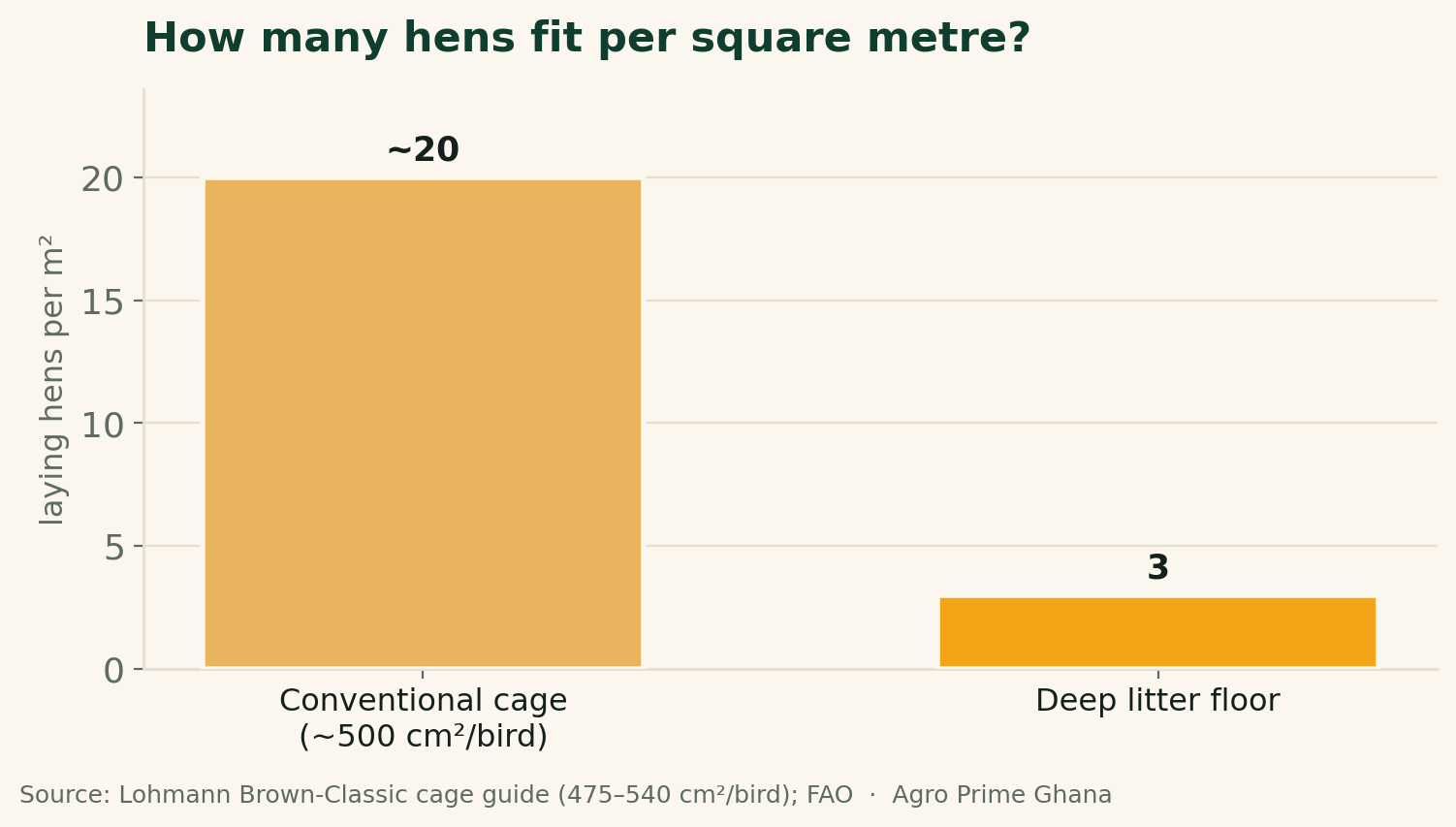
The single biggest reason is density. On deep litter, FAO's small-scale poultry guidance recommends about three layers per square metre of floor. In cages, with roughly 475–540 cm² of cage floor per bird as recommended in the Lohmann Brown-Classic cage management guide, you fit on the order of twenty hens onto the same square metre of cage floor — and because cages stack three or four tiers high, the number of hens under one roof multiplies again. For a keeper near Kasoa or Accra paying for land and a building, that difference is decisive: a modest shed can carry a commercially meaningful flock. Cleaner, less-cracked eggs fetch better prices and store better; feed sits in a trough rather than being scratched into the litter, cutting waste; there are no floor eggs to hunt for; and a sick or non-laying hen is easy to spot and remove. Those advantages are exactly why most large commercial layer operations worldwide, and a growing share in Ghana, run on cages.
Cage types and tiers: which layout suits you
Cage systems are usually described by how the tiers are stacked. Understanding the three common arrangements helps you match a system to your building and your labour.
| Cage arrangement | How it works | Best suited to |
|---|---|---|
| A-frame (stair-step) | Tiers set back like a staircase so droppings fall clear to the floor/pit below; usually 3 tiers | Small to medium farms; simpler, cheaper, easy to inspect every bird; manual or semi-automatic |
| Vertical / battery (H-type) | Cages stacked directly above one another with a dropping belt or scraper between tiers; 3–4+ tiers | Higher bird numbers on a small footprint; needs belt cleaning and usually more automation |
| Enriched / colony | Larger cages giving each hen more space plus a nest area, perch and scratch pad | Welfare-focused or export-oriented producers; higher cost, less common in Ghana |
For most Ghanaian start-ups, a three-tier A-frame is the practical entry point: it is cheaper, needs less automation, and lets you walk the rows and see every bird. As a flock grows and labour becomes the bottleneck, vertical H-type systems with dropping belts and mechanical feeding start to pay off. Whatever the layout, the golden rule in our climate is not to chase the absolute maximum tier count in a poorly ventilated shed — stacked birds generate a lot of heat and moisture, and airflow, not cage count, is usually the limiting factor.
Space and equipment: what each hen needs
Getting the allowances right is the difference between a flock that lays well and one that frays into pecking, poor uniformity and disease. The figures below come from commercial breeder management guides and are the numbers we design to:
- Cage floor space: around 475–540 cm² per bird for brown layers, per the Lohmann Brown-Classic cage guide. Crowd below this and you lose egg numbers, worsen feather condition and raise mortality.
- Feeder space: at least 5 cm of trough per hen (Lohmann recommends chain feeders at 5 m per 100 birds). Every hen must reach feed at the same time, or timid birds fall behind.
- Drinkers: 6–8 birds per nipple. Water is the first thing to limit in the heat — never let a nipple line run dry.
- Tiers and access: keep aisles wide enough to fill feed, collect eggs and inspect birds comfortably, and keep the top tier at a height you can actually work at.
These allowances echo the general provisioning in our guide to feeders and drinkers. Skimping on feeder or drinker space to squeeze in more birds is the most common — and most costly — mistake we see in home-built cage sheds.
Field note: ventilation decides whether cages work in Ghana
The mistake we watch for is a keeper putting three or four tiers of birds into a hot, still shed and then blaming the breed when lay collapses in the afternoons. Stacked cages concentrate body heat and moisture, and hens in the middle and top tiers suffer first. Before adding a tier, make sure air actually moves through the house at bird level — open sides, ridge venting, and fans if the building is wide or deep. In our experience, airflow and water are what make or break a cage flock here, far more than the cage brand. Our note on poultry-house ventilation covers how to get air moving without power where possible.
The honest pros and cons
Cages are neither a miracle nor a mistake — they are a trade-off. Weigh them against your capital, your market and your management style.
| Advantages of cages | Disadvantages / risks |
|---|---|
| Far more birds per square metre and per building | Higher upfront cost for cages and stronger structure |
| Cleaner, less-cracked eggs; no floor eggs | Heat builds up in stacked tiers — ventilation is critical |
| Less feed wastage; feed intake easy to control | Risk of cage layer fatigue (calcium osteoporosis) |
| Easy to spot, cull and remove sick or spent hens | Birds cannot dust-bathe, perch or forage (welfare concern) |
| Birds separated from droppings — less coccidiosis and worms | Equipment failure (water line, belt) hits many birds fast |
| Lower labour per bird once running | Manure handling needs a plan (pit, belt or daily scraping) |
Cage layer fatigue: the risk you must design out
Cage layer fatigue is a calcium-depletion problem specific to high-producing caged hens, and it is the one health risk that cages make worse rather than better. A hen laying almost daily draws roughly 4–5 g of calcium per day to build eggshells, which are 90–95% calcium carbonate. If the diet does not keep up, she strips calcium from her own skeleton. The MSD Veterinary Manual describes the result as osteoporosis — "a major cause of death in high-production flocks" — in which affected hens show hypocalcaemia and paralysis, sometimes found collapsed with an egg still in the shell gland, having "used all available calcium from the bloodstream in an effort to complete the eggshell." Caged birds are more exposed because they cannot move much to maintain bone strength and cannot forage for extra minerals.
The good news is that cage layer fatigue is largely preventable through feeding and management. MSD's prevention advice is direct: feed the recommended calcium levels, use large-particle (coarse) calcium, and provide adequate ventilation and cooling. Practically, that means a properly formulated layer ration supplying about 3.5–4.2% calcium, with a good share of it as coarse limestone or oyster shell (1.5–4 mm particles) fed so hens have calcium available in the afternoon and overnight when the shell is being formed. Grit and shell provision is covered in our guides to calcium for laying hens and grit and oyster shell, and the ration side in our note on layer mash formulation. For a bird collapsed with acute hypocalcaemia, MSD notes recovery can follow supplementing with about 5 g of oyster shell per hen for three days plus vitamin D3.
Get cage-ready layers and the right feed from Agro Prime
Thinking of moving to cages? The birds and the feed matter as much as the steel. Agro Prime Ghana supplies point-of-lay (POL) pullets already reared and vaccinated for the laying house, plus quality layer mash formulated with the calcium and coarse limestone a caged flock needs to avoid cage layer fatigue — and we will talk through cage layout, stocking and ventilation for your building before you invest. Message us on WhatsApp (+233 24 915 1503) or book a visit to order POL pullets, layer feed, or a farm-setup consultation.
What cages cost — and how to think about it
A cage system costs more upfront than a deep-litter house of the same footprint, because you pay for the steel cages, a stronger frame to carry the load, nipple water lines and an egg-collection and manure-handling plan. We avoid quoting fixed cedi prices because cage and steel prices move with the exchange rate and import costs — but the way to judge the spend is per laying place, not per shed. Because cages pack roughly six to seven times more hens onto the same floor as deep litter, the building and land cost per hen falls sharply, which is what makes the higher equipment cost pay back on a commercial flock. The economics only work, though, if the flock lays well: a cage house of underfed, heat-stressed, poorly-ventilated birds is an expensive way to lose money. Run the numbers on birds, feed and expected eggs the way we set out in layer versus broiler profit before committing.
When cages suit a Ghana farm — and when they don't
Cages make the most sense when you are running a commercial layer flock for the egg market, have the capital to build properly, can guarantee good ventilation and reliable water, and want to keep a lot of birds on limited, possibly expensive, land near a city market like Kasoa or Accra. They reward keepers who will feed a correctly formulated layer ration, manage calcium deliberately, and manage manure and heat. They are the standard choice for scaling a serious table-egg business.
Cages are usually the wrong tool if you are keeping a small backyard flock, marketing on welfare or free-range credentials, working with a tight budget in a hot shed with poor airflow, or unwilling to commit to precise feeding. In those cases a well-run deep-litter system — cheaper to build, more forgiving, and easier on the birds — is often the better fit, as we compare in deep litter versus battery cage. Many Ghanaian farms also start on deep litter and graduate to cages once they have proven their market and their management. Whichever you choose, start with good stock: our overview of the best layer breeds for Ghana and the Lohmann Brown in particular explains why a proven brown layer is the safest bet for a first cage flock.
The bottom line on layer cages
Layer cages are a density-and-control system: they let you keep far more hens per square metre, produce cleaner eggs, waste less feed and manage birds individually — at the cost of higher capital, a real ventilation challenge in Ghana's heat, and a calcium-management job you cannot skip. Design to the numbers (about 475–540 cm² of cage floor, 5 cm of feeder and 6–8 birds per nipple), move air through the house at bird level, and feed a calcium-rich layer ration with coarse limestone to keep cage layer fatigue at bay. Do that, and cages become what they are for the commercial farms that run them well: the most efficient way to turn feed, birds and a modest building into a steady flow of clean market eggs. If cages are more than your operation needs today, there is no shame in a well-managed deep-litter house — the best system is the one you can run properly.
Frequently asked questions
How much space does a laying hen need in a cage?
How many tiers can a layer cage system have?
What is cage layer fatigue and how do I prevent it?
Are cages better than deep litter for layers in Ghana?
How many hens can I keep per square metre in cages?
Do caged layers still need grit or oyster shell?
Is it more expensive to set up a cage system?
Can I keep layers in cages without electricity?
Sources & further reading
- Lohmann Breeders — Management Guide, Cage Housing, LOHMANN Brown-Classic (cage area per bird, feeder and nipple ratios, nutrition and calcium).
- Lohmann Breeders — Optimal calcium supply of laying hens (daily calcium need, eggshell composition, coarse limestone particle size).
- MSD Veterinary Manual — Hypocalcemia, Sudden Death, Osteoporosis, or Cage Layer Fatigue in Poultry.
- FAO — Small-scale poultry production: housing (floor stocking density, tropical housing guidance).
- Agro Prime Ghana guides: deep litter vs battery cage, layer mash formulation, calcium for laying hens, poultry-house ventilation.
About Agro Prime Ghana
Agro Prime Ghana Limited runs a poultry hatchery and mixed agribusiness in Kasoa, supplying day-old chicks, point-of-lay pullets and hands-on farm support to poultry keepers across the country. These guides combine practical hatchery and layer-farm experience with current breeder and veterinary references. This article is general educational information, not a substitute for professional veterinary or agronomic advice for your specific flock and building. We supply healthy day-old chicks (broilers & layers), POL pullets, quality layer feed and farm-setup advice nationwide. Ready to start or expand a layer flock? Book a visit or message us on WhatsApp (+233 24 915 1503) to order pullets, feed or advice.