Layer mash is a complete ground ration for laying hens, and a good one in Ghana hits four targets at once: roughly 16–18% crude protein, about 3.5–4.2% calcium, enough energy (around 2,700–2,800 kcal of metabolisable energy per kg), and balanced amino acids led by methionine and lysine. You reach those targets by blending an energy base (maize), a protein concentrate (soya and/or fishmeal), a calcium source (limestone/oyster shell), and a vitamin–mineral premix, then checking the mix against real nutrient values. This guide explains what a layer ration must deliver, the key ingredients and roughly how much of each, a sample balance, and the quality-control checks that keep a home-mixed or bought mash safe and productive under Ghanaian conditions.
Written by the Agro Prime Ghana poultry team and reviewed against current references (Lohmann Brown-Classic management guide, INRAE-CIRAD-AFZ feed tables, MSD Veterinary Manual). Last updated September 2026.
Key takeaways
A layer ration should supply about 16–18% crude protein, 3.5–4.2% calcium (rising as the flock ages), roughly 2,700–2,800 kcal ME/kg of energy, and adequate digestible methionine (~0.34–0.41%) and lysine (~0.68–0.82%), based on the Lohmann Brown-Classic guide. Build it from maize for energy (only ~7.6% protein but ~3,160 kcal/kg), soybean meal and/or fishmeal for protein (about 44–48% and ~65% protein respectively), limestone/oyster shell for calcium, and a vitamin–mineral premix. Feed part of the calcium as coarse limestone (1.5–4 mm) so hens get calcium for the overnight shell. Quality control is non-negotiable: use clean, dry, aflatoxin-free maize, weigh ingredients accurately, mix thoroughly, and store the mash cool, dry and pest-free.
What a layer ration must deliver
A laying hen is not just maintaining herself — she is manufacturing an egg almost every day, and the ration has to fund both jobs. That makes a layer diet distinct from a grower or broiler feed in one respect above all: calcium. According to the Lohmann Brown-Classic management guide, a layer ration is built around a hen eating roughly 105–120 g of feed per day, and it targets a crude protein of about 14–18% depending on production phase and intake, metabolisable energy near 2,725 kcal/kg (about 11.4 MJ/kg), and digestible amino acids led by methionine and lysine. On calcium, the same guide sets intake at about 4.10 g per hen per day at the start of lay, rising to around 4.50 g in later phases — which, at typical feed intakes, works out to roughly 3.4–4.3% calcium in the mash. That calcium demand exists because, as Lohmann notes, an eggshell is 90–95% calcium carbonate and the modern hen needs about 4–5 g of calcium a day to keep making shells. Miss the calcium and you get thin shells, cracks, and eventually the bone-stripping condition known as cage layer fatigue. Get protein, energy, amino acids and calcium all right together, and the flock lays to its genetic potential.
Why you cannot just feed maize
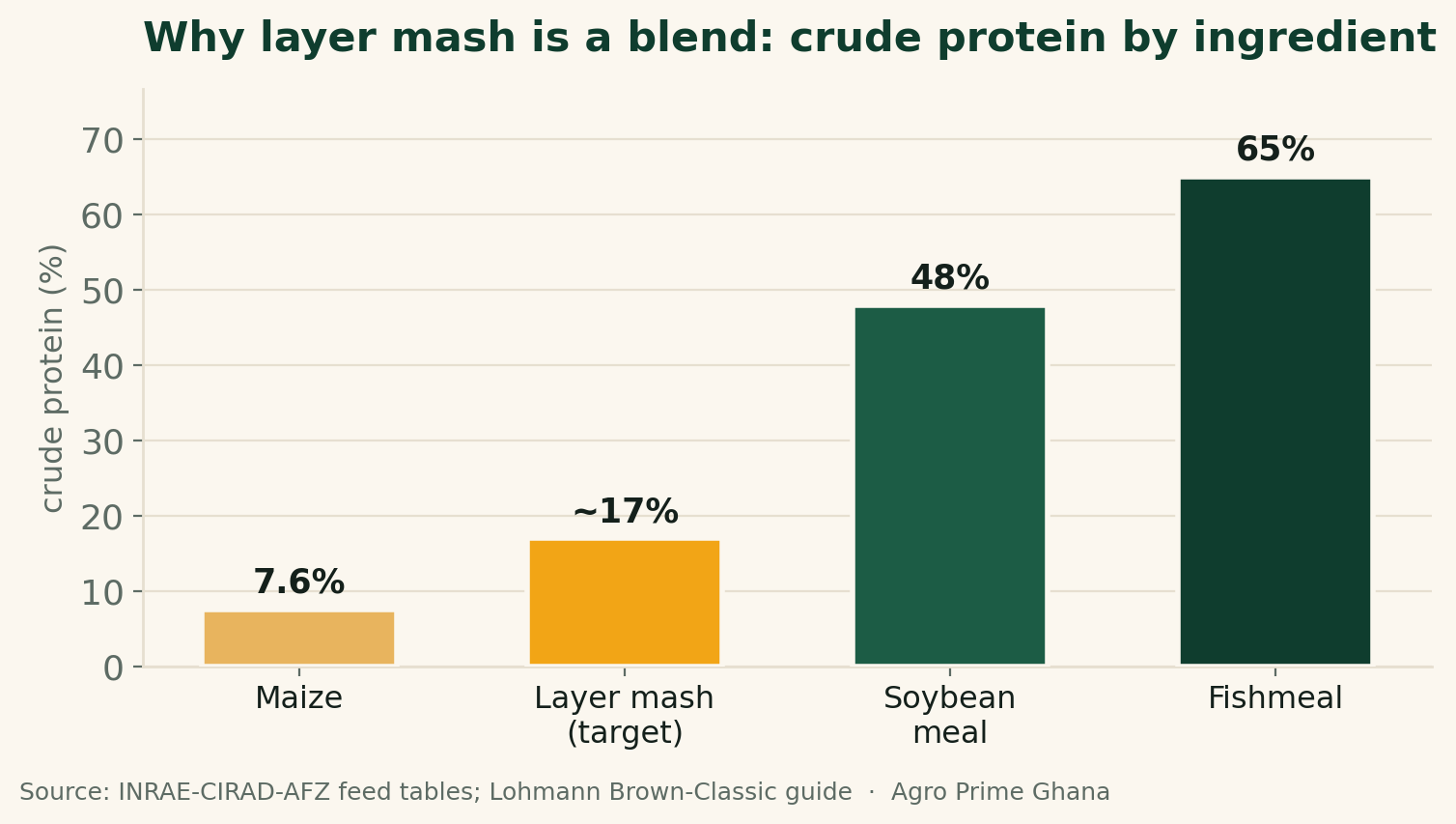
The first thing formulation teaches is that no single Ghanaian feedstuff is a layer diet on its own — you must blend. Maize, the staple energy grain, is energy-dense but protein-poor: the INRAE-CIRAD-AFZ feed tables put maize at about 3,160 kcal/kg of metabolisable energy but only ~7.6% crude protein and very little calcium. Feed maize alone and hens simply cannot get enough protein or calcium to lay. So you add a protein concentrate to lift protein and amino acids, and a mineral source to supply calcium, using the maize as the energy carrier that dilutes everything to the right level. The chart and table below show how the protein content of the main ingredients compares — it is the reason a layer mash is always a mixture, never a single grain.
Key ingredients and roughly how much of each
Most Ghanaian layer mash is built from a familiar short list of ingredients. The table gives typical nutrient values (from the INRAE-CIRAD-AFZ feed tables and breeder guides) and the role each plays; treat the inclusion ranges as a starting point to be balanced, not fixed recipes.
| Ingredient | What it brings | Rough role in a layer mash |
|---|---|---|
| Maize | Energy (~3,160 kcal/kg ME); low protein (~7.6%) | Main energy base — often the largest single part of the mix |
| Soybean meal | Protein (~44–48%); good amino acid balance | Main plant protein source; lifts protein and lysine |
| Fishmeal | Protein (~65%); rich in lysine and methionine; some calcium (~4%) | High-quality protein top-up; use in moderation (cost, quality, taint) |
| Wheat bran / rice bran | Moderate protein, fibre, bulk | Dilutes energy, adds bulk and some protein; keep modest |
| Limestone / oyster shell | Calcium (~38% Ca in limestone) | Main calcium source; feed part as coarse particles (1.5–4 mm) |
| Dicalcium phosphate (DCP) | Phosphorus and calcium | Supplies available phosphorus for bone and shell |
| Vitamin–mineral premix | Vitamins, trace minerals (incl. vitamin D3) | Small inclusion per label; essential for shell and health |
| Salt, methionine (synthetic) | Sodium; the first-limiting amino acid | Small amounts to balance sodium and hit methionine target |
A deeper look at each of these — and where to buy them around Kasoa and Accra — is in our guide to poultry feed ingredients. The two protein sources deserve a note: soybean meal is the workhorse, but Ghanaian soya quality varies, and fishmeal, though excellent, is costly and sometimes adulterated or salty, so use it as a measured top-up rather than the backbone.
A sample balance — and how to build your own
Formulation is really just arithmetic: you choose amounts of each ingredient so the blend hits your protein, energy, calcium and amino-acid targets. For a two-ingredient protein balance (say maize and soybean meal to a protein target), the classic Pearson square does the job on the back of an envelope. A realistic Ghanaian layer mash, by weight, tends to land in these broad zones: maize around 55–62% as the energy base, soybean meal around 18–25% plus a little fishmeal (0–5%) for protein and amino acids, some wheat/rice bran (0–8%) for bulk, limestone/oyster shell around 8–9% to reach the high layer calcium level, about 1.5–2% dicalcium phosphate, and small fixed amounts of salt, premix and synthetic methionine. Those proportions are illustrative, not a prescription — the exact figures depend on your ingredients' real analyses and prices. The discipline is always the same: pick a recipe, calculate its protein, energy and calcium, compare to target, and adjust. Because ingredient quality swings so much locally, our strong advice for anyone home-mixing is to work from a nutritionist-checked formula rather than a fixed online recipe, and to revisit it whenever ingredient quality or price shifts — see how to make poultry feed and reducing feed cost.
Field note: calcium is about timing, not just quantity
Two farms can feed the same 4% calcium and get very different shells, because when the hen gets her calcium matters as much as how much. A hen forms most of the shell overnight, long after the morning feed has passed through, so calcium fed only as fine powder is largely gone by then. The fix, which we build into our layer mash, is to supply a good part of the calcium as coarse limestone or oyster shell of about 1.5–4 mm. Lohmann's work shows these coarse particles sit in the gizzard and dissolve slowly, releasing calcium through the afternoon and night exactly when the shell is being laid down. If your shells are thin or cracking despite "enough" calcium on paper, the particle size and timing are the first things to check — see calcium for laying hens and grit and oyster shell.
Amino acids: protein quality, not just quantity
Hitting "16–18% protein" is only half the job — the hen needs the right amino acids within that protein, and two are usually limiting first. The Lohmann Brown-Classic guide targets digestible methionine around 0.34–0.41% and digestible lysine around 0.68–0.82% in the layer diet. Methionine is typically the first-limiting amino acid in maize–soya diets, which is why a small amount of synthetic DL-methionine is one of the most cost-effective additions you can make: it lets you hit the methionine target without over-feeding total protein (which is expensive and raises heat load and ammonia). Fishmeal is naturally rich in both methionine and lysine, which is part of its value. The practical lesson is that a cheap ration built only to a crude-protein number can still under-perform if it is short on methionine or lysine — balancing the key amino acids often lifts lay and shell quality more than simply pushing protein up. Our note on amino acids in poultry feed covers this in depth.
Order ready-formulated layer mash — or the ingredients to mix your own
Formulating and mixing a balanced, calcium-correct layer mash consistently is real work, and a single bad maize batch can undo it. Agro Prime Ghana supplies quality layer mash already formulated to the protein, energy and calcium targets above — with coarse limestone built in for strong shells — so your hens get a reliable ration without the guesswork. We also supply point-of-lay pullets to eat it and can advise on ingredient sourcing and ration balancing if you prefer to mix your own. Message us on WhatsApp (+233 24 915 1503) or book a visit to order layer feed, POL pullets, or feed-formulation help for your flock.
Quality control: where home-mixed mash goes wrong
A perfect formula on paper is worthless if the mixing and ingredients let you down, and this is where most home-mixed layer mash fails. Four controls matter most. Ingredient quality comes first: use clean, dry, well-stored maize and reject mouldy, musty or insect-damaged grain, because Ghana's warm, humid climate makes aflatoxin a constant threat that quietly wrecks lay, immunity and food safety. Accurate weighing is second — guessing "a bit of this" ruins the balance, especially for calcium, premix and methionine, which are added in small, precise amounts; the difference between 8% and 10% limestone, or a premix under-dosed, shows up as thin shells or deficiencies. Thorough mixing is third: micro-ingredients must be spread evenly through the whole batch, or some hens get too much and others too little. Storage is last: keep finished mash cool, dry, off the floor, pest-free and used in good time, because a fresh ration can spoil or grow mould in storage just as raw grain can. Add a toxin binder as insurance where grain quality is hard to guarantee. Consistency across these four is what separates a mash that supports 90%-plus lay from one that mysteriously "isn't working."
The bottom line on layer mash formulation
A productive layer mash is a deliberate balance, not a casual mix of whatever grain is cheap. Aim for about 16–18% crude protein, 3.5–4.2% calcium that climbs as the flock ages, roughly 2,700–2,800 kcal ME/kg of energy, and balanced methionine and lysine — reached by blending maize for energy, soya and a little fishmeal for protein, limestone and DCP for minerals, and a premix for vitamins and traces. Feed a good share of the calcium as coarse limestone so the hen has it for the overnight shell, balance the first-limiting amino acids rather than just chasing crude protein, and above all control quality: clean aflatoxin-free maize, accurate weighing, thorough mixing and good storage. Do this consistently and your ration becomes the quiet engine of a profitable layer flock. If mixing to this standard every time is more than your operation can guarantee, a reliable ready-formulated layer mash is often the cheaper route to strong shells and steady lay.
Frequently asked questions
What protein percentage should layer feed have?
How much calcium does layer mash need?
What are the main ingredients in Ghanaian layer feed?
Can I make my own layer mash at home in Ghana?
Why are my hens laying thin or soft-shelled eggs?
How much energy should layer feed have?
Is fishmeal necessary in layer feed?
How do I stop my layer feed from spoiling?
Sources & further reading
- Lohmann Breeders — Management Guide (Cage Housing), LOHMANN Brown-Classic (crude protein, energy, calcium intake, digestible methionine and lysine targets).
- Lohmann Breeders — Optimal calcium supply of laying hens (daily calcium need, eggshell composition, coarse limestone particle size and timing).
- INRAE-CIRAD-AFZ Feed Tables — Maize and related entries (metabolisable energy and crude protein of maize, fishmeal and other ingredients).
- Agro Prime Ghana guides: how to make poultry feed, poultry feed ingredients, amino acids in poultry feed, calcium for laying hens, the Pearson square.
About Agro Prime Ghana
Agro Prime Ghana Limited runs a poultry hatchery and mixed agribusiness in Kasoa, supplying day-old chicks, point-of-lay pullets, quality feed and hands-on farm support to poultry keepers across the country. These guides combine practical layer-farm and feed experience with current breeder and feed-composition references. This article is general educational information, not a substitute for professional nutritional or veterinary advice for your specific flock and ingredients. We supply healthy day-old chicks (broilers & layers), POL pullets, quality layer mash and feed advice nationwide. Want reliable layer feed or help formulating your own? Book a visit or message us on WhatsApp (+233 24 915 1503).