Hatchery record-keeping is the habit of writing down, for every batch, how many eggs you set, how many were fertile, how many chicks hatched and how many were good enough to sell — plus the temperature and humidity the machine actually held — so you can calculate your fertility and hatchability and see exactly where eggs are being lost. The two numbers that run a hatchery are fertility (fertile eggs ÷ eggs set) and hatchability (chicks ÷ eggs set, or the tougher measure, saleable chicks ÷ fertile eggs). Without those figures you are flying blind: a bad hatch feels like bad luck instead of a problem you can name and fix. This guide shows Ghanaian hatchery operators what to record, how to do the calculations, and how to turn a breakout of the unhatched eggs into a diagnosis that lifts your next hatch.
Written by the Agro Prime Ghana hatchery team and reviewed against current industry references (Aviagen/Ross hatchery breakout guides and Poultry Site hatchability references). Last updated September 2026.
Key takeaways
Record, per batch: eggs set, breeder source, storage days, candling clears, eggs transferred, chicks hatched, saleable (grade-A) chicks, and daily temperature and humidity logs. From those, calculate fertility % (fertile ÷ set × 100), hatch of set (chicks ÷ set × 100) and hatch of fertile (saleable chicks ÷ true fertile eggs × 100) — the last is the real measure of how well you incubate, with roughly 95% hatch of fertile a strong benchmark. When a hatch disappoints, do a breakout and sort the unhatched eggs into infertile, early dead (0–7 days), mid dead (8–14), late dead (15–19), pipped-not-hatched and contaminated — the pattern tells you whether the fault is the breeder flock, egg storage, the setter or the hatcher. Records turn a mystery into a to-do list.
Why keep hatchery records at all?
You keep hatchery records because you cannot improve — or even honestly diagnose — a hatch you did not measure. Two hatcheries can pull the same weak hatch from the same machine, and only the one with records will know whether the eggs were infertile, died early from bad storage, or died late from a hatcher running too dry. The other guesses and repeats the problem next month. Records convert "the hatch was poor" into specific facts: fertility was fine but late deaths were high, or fertility itself was low, or one breeder source consistently underperforms. In a business where every lost percentage point of hatch is an egg you paid for and a chick you never sold, that clarity is money.
Records also protect your reputation. They let you trace weak chicks back to a specific breeder source or set, spot a machine drifting out of range before it ruins a hatch, and prove your chicks come from a controlled process. They are the hatchery-specific version of the discipline every serious poultry business needs, which we cover in record-keeping on the poultry farm — but here the numbers are unusually revealing, and the machine keeps no secrets from an operator who records everything.
What exactly should you record?
Record enough to reconstruct the whole life of each batch, from the eggs going in to the chicks going out, plus the conditions in between. For every set, capture: the date set and batch number; the breeder source (which farm or flock, and ideally the flock's age, since fertility and egg quality change with breeder age); eggs set; days stored before setting; the results of candling (clears removed); eggs transferred to the hatcher at day 18; chicks hatched; and saleable, first-grade chicks after culling. Alongside those, keep a daily log of temperature and humidity for both setter and hatcher, plus any power interruptions — because when a hatch goes wrong, that log is usually where the answer hides. Targets to log against are in our incubator temperature and humidity guide.
None of this needs fancy software. A ruled notebook or a simple spreadsheet with one row per batch is enough, as long as you fill it in every time. The value is in consistency: a record kept for some batches and skipped for others cannot show a trend. The goal is that months from now you can look back and see, batch by batch, what went in, what came out, and under what conditions.
| Metric | How to calculate it | What it tells you |
|---|---|---|
| Fertility % | (Fertile eggs ÷ eggs set) × 100 | Breeder flock & egg quality (males, nutrition, flock age) |
| Hatch of set (total hatch) | (Chicks hatched ÷ eggs set) × 100 | Overall result — the headline number for the batch |
| Hatch of fertile | (Saleable chicks ÷ true fertile eggs) × 100 | How well you incubate, once infertiles are removed |
| Saleable chick % | (Grade-A chicks ÷ chicks hatched) × 100 | Chick quality — culls, weak or deformed birds |
| Early/mid/late dead % | (Dead embryos in that stage ÷ eggs set) × 100 | Where in incubation embryos are dying (from breakout) |
Formulas follow standard hatchery practice as described by the Poultry Site; breakout categories follow Aviagen/Ross hatchery guidance.
How do you calculate fertility and hatchability?
Fertility and hatchability are simple ratios, and keeping them straight is the whole point of the records. Fertility percentage is fertile eggs ÷ eggs set × 100. Hatchability of eggs set — the "total hatch" — is chicks hatched ÷ eggs set × 100. And hatch of fertile, the number professionals watch most closely, is saleable chicks ÷ truly fertile eggs × 100 — it strips out infertility (a breeder problem) so you can judge how well the incubation itself performed. A generally accepted benchmark for good performance is around 95% hatch of fertile, though real hatcheries vary.
A worked example makes it concrete. Set 100 eggs; a breakout later shows 5 were infertile, so true fertility is 95%. If 86 of the 95 fertile eggs hatched into saleable chicks, your hatch of fertile is 86 ÷ 95 × 100 ≈ 90.5%, while hatch of set is 86%. The two numbers tell different stories: 90.5% says your incubation was decent; the gap down to 86% is explained by that 5% infertility, which points at the breeder flock, not your machine. This is why the Poultry Site cautions against confusing candled "clears" with true infertility — an egg that was fertile but died very early looks clear at candling, and counting it as infertile flatters your incubation while hiding an early-death problem.
Candling clears versus true fertility
Candling tells you which eggs are developing, but not which were fertile — and confusing the two corrupts your numbers. When you candle mid-incubation and remove the "clears," some are genuinely infertile eggs that never started, while others were fertile eggs whose embryos died so early that development is not visible. If you record every clear as "infertile," you overstate fertility, understate early embryonic death, and chase the wrong problem — fiddling with your males and breeder feed when the real fault is storage or setter conditions. The fix is simple: periodically break open a sample of the clears. An infertile egg has a clear, undeveloped germinal disc; a fertile egg that died early shows a ring or speck of tissue. This turns candling from a rough sort into real data — see our guide to egg incubation troubleshooting.
Field note: candle at a set time and write it down before you clean up
The discipline that makes candling data useful is doing it the same way every time and recording it immediately. On our floor we candle at a consistent point in the cycle, count the clears as we pull them rather than trusting memory, and — when a hatch has been disappointing — break the clears open instead of binning them. The ten minutes it takes to separate true infertiles from early deaths often tells us whether to talk to the breeder farm or check our own storage and setter.
Breakout analysis: reading the unhatched eggs
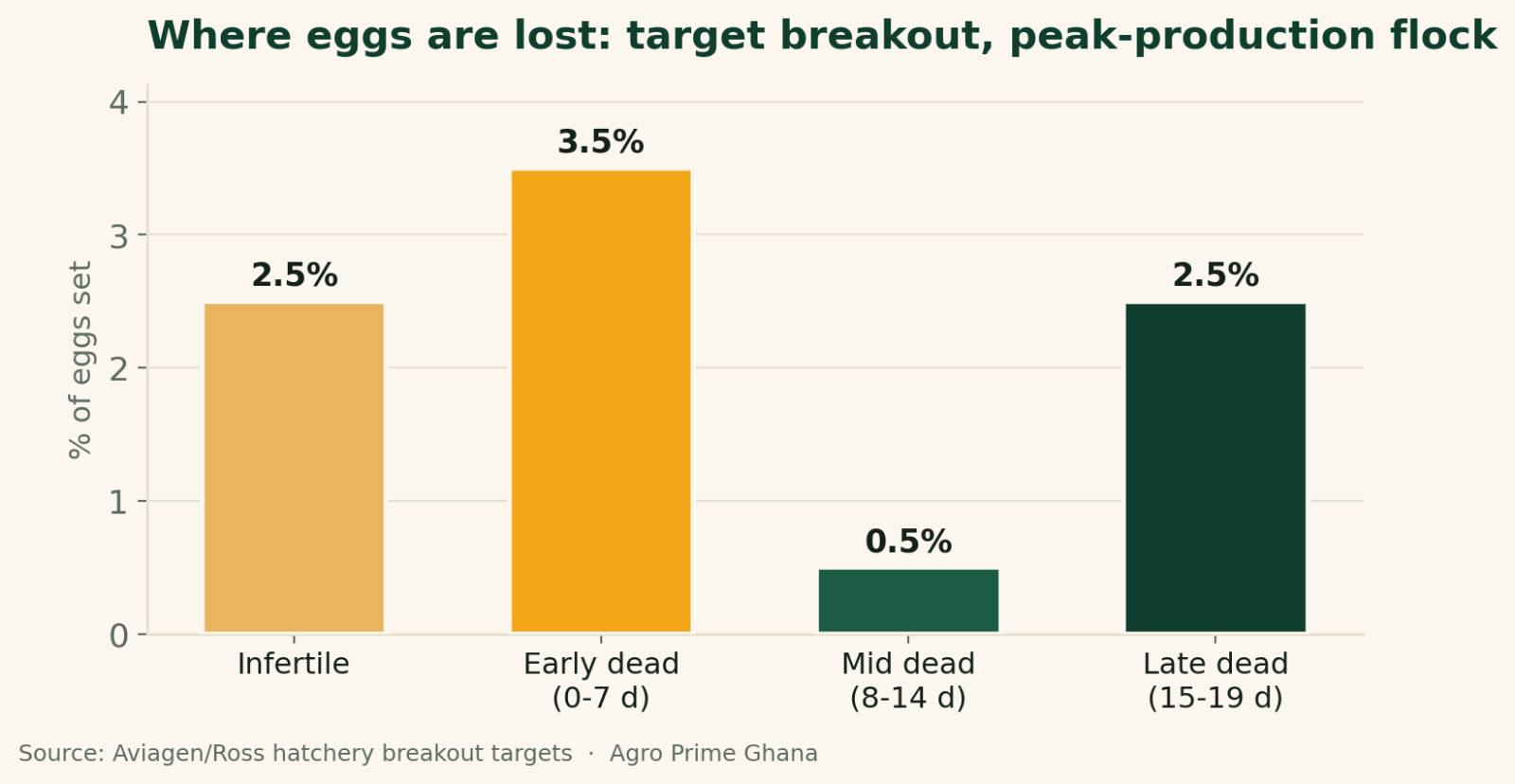
When a hatch disappoints, the unhatched eggs are the evidence, and a breakout is how you read it. A breakout means opening the failed eggs and sorting them by how far they developed, because where the embryos died points to why. Aviagen's guidance sorts hatch debris into standard classes: infertile (no development), early dead at 0–7 days (up to when the egg tooth appears), mid dead at 8–14 days (egg tooth but no feathers), late dead at 15–19 days (a well-feathered embryo filling the shell), external pip at day 20 (beak through the shell but chick never emerged), and contaminated (rotten, foul-smelling eggs). Each pattern has typical causes: a spike in late deaths and dead-in-shell often points to hatcher conditions in the final days; heavy early death follows poor egg storage, rough handling or setter problems; many contaminated eggs point straight back to hygiene. As a yardstick, Aviagen's targets for a peak-production breeder flock are around 2.5% infertile, 3.5% early dead, 0.5% mid dead and 2.5% late dead of eggs set.
A breakout converts a vague failure into a specific direction. "The hatch was bad" becomes "late deaths were triple normal," which becomes "check the hatcher humidity and ventilation for the last three days" — a fixable, testable action. If your breakout keeps showing patterns you cannot resolve, our guide to why eggs don't hatch works through the causes.
Chicks now, or help reading your hatch data?
Agro Prime Ghana runs a hatchery in Kasoa, and we live by these numbers. If you simply need strong, well-graded day-old chicks this cycle — broilers, layers or cockerels — we supply them and back them with brooding and vaccination advice. And if you are running your own incubator and your hatchability has slipped, we are happy to look over your records and a breakout with you and help pin down whether the problem is the breeder eggs, storage, the setter or the hatcher. Message us on WhatsApp (+233 24 915 1503) or book a visit.
Using the data to actually improve
Records only pay off when you act on them, which means reviewing every batch and changing one thing at a time. After each hatch, calculate fertility, hatch of set and hatch of fertile, do a breakout if the result was below normal, and note the likely cause and what you will change. Then look across batches for patterns your eye would otherwise miss: a breeder source that always runs low on fertility, a creep upward in late deaths as the harmattan dries the air, or a run of contaminated eggs after a lapse in cleaning. Because you changed only one variable, the next hatch tells you clearly whether that change helped. This is how good hatcheries climb — not by luck or a new machine, but by a steady loop of measure, diagnose, adjust, measure again. Combined with our guides to hatchery biosecurity and improving hatchability, honest records are the cheapest performance upgrade a hatchery can buy.
Field note: log the machine, not just the result
The record most beginners skip is the boring one — the daily temperature and humidity, and any power cuts. Yet when a hatch goes wrong, that log is almost always where the answer is. We have traced more than one poor hatch to a humidity reading that had quietly drifted for days, or a power cut nobody wrote down, precisely because the log made it visible afterward. A thermometer and hygrometer you actually read and record each day are worth more than any amount of guessing. Log the conditions while they are happening; you will thank yourself at the breakout table.
The bottom line on hatchery record-keeping
Records turn a hatchery from a hopeful gamble into a controlled, improvable business. Write down every batch — eggs set, breeder source, storage days, candling clears, transfers, chicks hatched and saleable chicks — and log temperature and humidity every day. From those figures, calculate fertility, hatch of set and, above all, hatch of fertile, held against a strong benchmark of around 95% hatch of fertile. When a hatch falls short, break out the failed eggs and let the pattern of early, mid, late and contaminated losses point you at the cause; then change one thing and measure again. Kept honestly and used every cycle, these numbers tell you exactly where your chicks are being lost and how to get them back — which, in a hatchery, is the whole game.
Frequently asked questions
How do you calculate hatchability?
What is the difference between fertility and hatchability?
What records should a small hatchery keep?
What is a breakout analysis?
Why can't I just use candling to measure fertility?
What is a good hatchability percentage?
What do high late deaths or dead-in-shell tell me?
Do I need special software to keep hatchery records?
Sources & further reading
- The Poultry Site — Do we understand 'hatch of fertile' correctly? (fertility and hatchability formulas, candling clears vs true fertility, benchmark).
- Aviagen / Ross — How to break out and analyse hatch debris (breakout categories, embryonic death stages, benchmark targets).
- Agro Prime Ghana guides: incubator temperature and humidity, egg incubation troubleshooting, why eggs don't hatch, improving hatchability and record-keeping on the poultry farm.
About Agro Prime Ghana
Agro Prime Ghana Limited runs a poultry hatchery and mixed agribusiness in Kasoa, supplying day-old chicks and supporting poultry keepers across the country. These guides combine hands-on hatchery experience with current industry references. This article is general educational information, not a substitute for tailored technical advice on your specific operation. We supply healthy day-old chicks (broilers & layers), point-of-lay pullets, quality feed and hands-on farm support nationwide. Want strong chicks, or help reading your hatch records? Book a visit or message us on WhatsApp (+233 24 915 1503).