Hatchery biosecurity is the set of practices that keep bacteria, viruses and mould out of your eggs, machines and chicks — and it is the single biggest thing separating a hatchery that sells strong, uniform chicks from one that ships weak birds with infected navels. The core idea is simple: run everything one way, from clean to dirty, so eggs and newly hatched chicks never meet the fluff, dust and mess that hatching creates. In the warm, humid hatcher a single contaminated egg can seed a whole batch, because bacteria multiply explosively at exactly the moment chicks are breaking out of their shells. This guide explains hatchery-specific biosecurity for Ghanaian conditions — egg sanitation, one-way workflow, fumigation, fluff control and visitor management — and why each one directly protects chick quality and hatchability.
Written by the Agro Prime Ghana hatchery team and reviewed against current industry references (hatchery hygiene and biosecurity guidance from the Poultry Site and WOAH). Last updated September 2026.
Key takeaways
Hatchery biosecurity protects chicks by controlling contamination at every step. Design the building to run one way, clean to dirty — egg room → setter → hatcher → chick take-off → dispatch — with staff, air and equipment moving the same direction and never doubling back. Disinfect eggs immediately after collection and again on arrival, keeping any wash or dip water warmer than the egg (roughly 42–47°C) so bacteria are not drawn in through the shell pores. Hatching is the danger point: bacteria can double about every 20 minutes in the warm hatcher, and Salmonella can survive for years in fluff and dust, so hatchers, trays and plenums must be fully cleaned and disinfected after every hatch. Control visitors, use foot dips and dedicated clothing, and keep clean and dirty zones physically separate. Weak, dying, navel-infected chicks are the price of getting this wrong.
What is hatchery biosecurity and why does it matter?
Hatchery biosecurity is the deliberate control of how pathogens enter and spread within a hatchery — through eggs, people, air, water, equipment and waste — so the chicks leaving are clean and healthy. It matters more here than almost anywhere else in poultry production because the hatchery is a single funnel through which chicks from many farms pass at their most vulnerable moment. A disease introduced here does not stay here — it rides out on chicks to dozens of farms at once, so a lapse that would harm one flock on a grow-out farm can, in a hatchery, damage a whole region's placements in a week. That leverage cuts both ways: get it right and you become the trusted clean source; get it wrong and your reputation collapses as fast as your hatchability.
The threats a hatchery must exclude fall into two groups. Some arrive inside or on the egg — vertically transmitted infections from a breeder flock, or bacteria drawn through the shell after lay. Others arrive in the building — on hands, trays, boots, vermin, dust and dirty equipment, or bred in the warm mess of the hatcher itself. Good hatchery biosecurity blocks both. It is a close cousin of general farm poultry biosecurity, but stricter, because the stakes — and the bacterial growth rates — are higher.
How biosecurity drives chick quality and hatchability
Biosecurity drives chick quality because the hatching moment is a bacterial explosion waiting to happen, and clean conditions keep it from starting. A hatcher is warm and humid — perfect for microbes — and as chicks pip, the shell is breached and moisture is everywhere. Industry hygiene guidance notes that under these conditions bacteria can double roughly every 20 minutes, so germ counts "explode logarithmically" around pipping. An egg carrying even a light bacterial load, or a hatcher left dirty from the last batch, contaminates the chicks alongside it. The commonest visible result is omphalitis, or navel ill — infection of the unhealed navel and yolk sac, seen as weak, huddling chicks with wet or smelly navels and high first-week mortality. That condition, which we cover in omphalitis and navel ill in chicks, is very often a hatchery-hygiene problem wearing a farm disguise.
The organisms involved are stubborn. Hygiene guidance warns that Salmonella can survive for years in the fluff a hatch throws off, so a hatcher that is not thoroughly cleaned quietly re-infects every future batch. Clean chicks are not luck — they are the product of eggs disinfected early, machines cleaned after every hatch, and a building where dirty air never drifts back onto clean eggs. Buyers judge you on exactly this: strong, uniform, clean-navelled chicks — see how to choose healthy day-old chicks.
The one-way flow: clean to dirty, in one direction
The foundation of hatchery biosecurity is a building that moves everything one way, from clean to dirty, so the two never mix. Eggs enter at the clean end — receiving, storage and setters — and progress to the dirty end — hatchers, chick take-off, vaccination and dispatch. Four separate flows should all point the same way: product (eggs and chicks, which must never cross paths), personnel (staff moving clean-to-dirty, not back), air (clean rooms under positive pressure so air never blows from the hatch area onto eggs), and wastewater (separate drainage for each). Colour-coded zones, foot dips and dedicated clothing keep people from carrying contamination upstream. The table below shows the control at each stage.
| Stage (clean → dirty) | Main contamination risk | Biosecurity control |
|---|---|---|
| Egg receiving & storage | Dirty, cracked or contaminated eggs from breeders | Grade out dirties/cracks; disinfect on arrival; cool clean store |
| Setter room | Bacteria drawn through shell; cross-contamination | Clean setters between cycles; only disinfected eggs enter |
| Transfer (day 18) | Handling spreads organisms as eggs move | Clean trays and hands; disinfected transfer area |
| Hatcher room | Explosive bacterial growth at pipping; fluff | Full clean & disinfect after every hatch; contain fluff |
| Chick take-off & dispatch | Fluff, dust, staff and boxes carrying pathogens | Dirty-zone clothing/foot dips; clean boxes; separate exit |
Workflow and hygiene practices here draw on hatchery hygiene guidance from the Poultry Site and biosecurity principles set out by the World Organisation for Animal Health (WOAH).
Egg sanitation: the first and cheapest defence
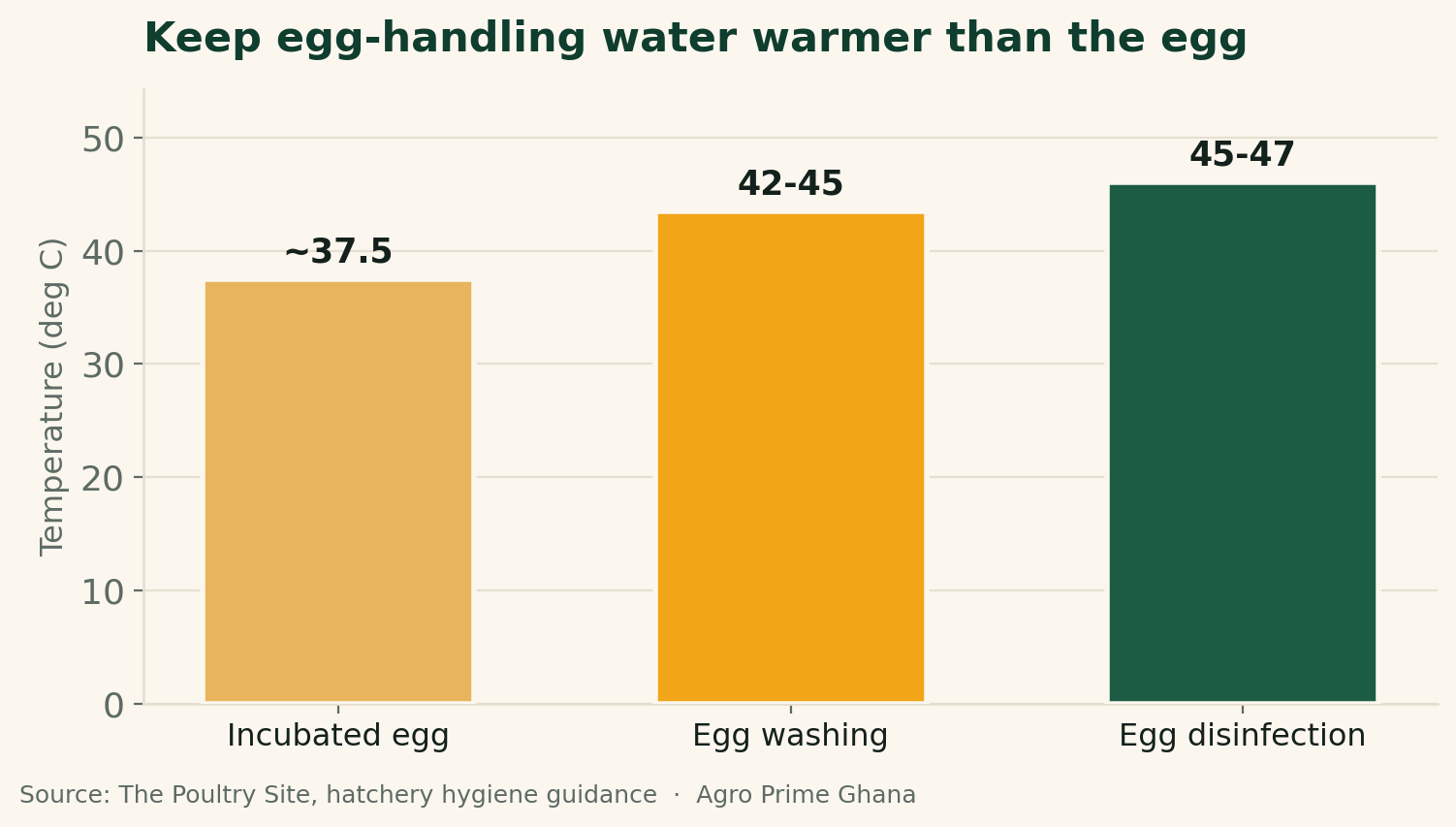
The cheapest way to keep a hatchery clean is to put clean eggs into it, which means sanitising eggs early and handling them gently. Hygiene guidance recommends disinfecting hatching eggs immediately after collection and again on arrival, because the sooner you act, the less time bacteria have to penetrate the shell. It flags a subtle but vital point about water temperature: any washing or dipping should use water warmer than the egg — washing around 42–45°C and disinfection around 45–47°C — because a warm egg placed in cold water contracts and draws contaminated water in through its pores, doing more harm than good. Contact time should be short. Just as important is what you refuse: reject dirty, cracked or hairline-cracked eggs entirely, since a hairline crack is an open door for bacteria. Prompt sanitation at the egg stage prevents problems no downstream fumigation can undo. Our guide to egg storage and handling covers the gentle-and-cool side of the same discipline.
Field note: when in doubt, the egg stays out
The single cheapest biosecurity decision we make each day is at the egg table: a cracked, dirty or hairline-cracked egg gets rejected, not "wiped and set." One dirty egg can contaminate the whole tray around it in the hatcher, and the few pesewas it seems to save are trivial next to a batch of weak, navel-infected chicks. In a hatcher, one bad egg does not fail quietly; it takes its neighbours with it.
Fumigation and disinfection: doing it properly
Fumigation and disinfection kill the pathogens that survive selection and washing, but only on a physically clean surface and at the right time. The traditional agent is formaldehyde fumigation, long used to sanitise eggs and machines; it is effective but has real limitations — hygiene guidance notes it must not be applied during roughly the 24–96-hour window of embryo development and that it has no residual action, so it does nothing to prevent re-contamination afterward. So fumigation is one tool in a system, not the whole system. Alternatives such as fogged disinfectants can match formaldehyde without harming hatchability, and the cleaning that comes before disinfection matters more than the chemical: you cannot disinfect dirt. The proper sequence for a dirty room or hatcher is remove visible debris → high-pressure wash with detergent/foam → rinse → dry (often skipped, but essential) → disinfect. Skip the cleaning and the disinfectant is wasted on a film of organic matter shielding the germs beneath. For product choices, see our guide to hatchery hygiene and fumigation.
Field note: dry the room before you disinfect it
The step almost everyone rushes is drying. On our floor we treat "wash, rinse, dry, then disinfect" as four steps, not three — because disinfectant on a wet surface is instantly diluted, and standing water in a warm hatcher is itself a place for bacteria to regroup. We also clean in order: shovel and brush out the fluff and shell debris first, because disinfecting over a layer of hatch waste is like mopping a floor you never swept. The chemical gets the credit, but the brush and dry cloth do most of the work.
Controlling fluff, dust and the hatch's own waste
Fluff is the hatchery's most underestimated enemy, because it is the vehicle that carries pathogens from the dirty end back toward the clean one. Every hatch throws off a cloud of down, shell fragments, dried membrane and dust, and that fluff is not sterile — it is exactly where organisms like Salmonella can persist for years. If it settles in the plenum, ductwork or on clothing and drifts upstream, it re-seeds the whole operation. Controlling it means containing the hatch (sealing hatcher and take-off areas off from clean rooms), cleaning fluff out of hatchers, trays and plenums after every hatch, exhausting dirty-end air rather than recirculating it toward eggs, and never letting take-off staff or their clothing wander back into the egg or setter rooms. Rodents, flies and wild birds must be excluded too. Treat fluff as if it were the pathogen itself, because functionally it is.
Buy clean chicks — or build a cleaner hatchery
Agro Prime Ghana runs a hatchery in Kasoa where this one-way, clean-to-dirty discipline is the daily routine, and it shows in the chicks. If you want strong day-old chicks with clean, healed navels that brood well, we supply broilers, layers and cockerels and back them with brooding and vaccination advice. And if you are setting up or fixing your own hatchery and struggling with navel ill, weak chicks or falling hatchability, we are glad to talk through your egg handling, workflow and cleaning — often the fix is in the layout, not the machine. Message us on WhatsApp (+233 24 915 1503) or book a visit.
People, visitors and the human factor
People are the commonest way pathogens enter a hatchery, so controlling human movement is as important as any disinfectant. Everyone entering should pass through a clear clean/dirty boundary: change into dedicated clothing and footwear, wash and sanitise hands, and use foot dips between zones. Visitors should be limited, logged and kept away from clean areas and open eggs — a well-meaning buyer wandering from the chick room into the egg store can carry fluff exactly the wrong way. Staff should follow the same one-way rule the eggs do: those working the dirty hatch end should not drift back to the clean egg and setter end during a shift. None of this is expensive; it is mostly discipline and a well-thought-out layout. But because a hatchery amplifies whatever enters it across every farm it supplies, that discipline is worth more here than almost anywhere in poultry. Keeping honest records of what enters makes the system auditable, which is why we pair biosecurity with hatchery record-keeping.
The bottom line on hatchery biosecurity
Hatchery biosecurity is not a checklist you complete once — it is the daily habit of moving everything one way, from clean to dirty, and never letting the mess of hatching reach the eggs and chicks that must stay clean. Disinfect eggs early and gently, with water warmer than the egg; keep setters and hatchers separate and clean the hatcher completely after every hatch; treat fluff as the pathogen-carrier it is; fumigate and disinfect on physically clean, dry surfaces; and control the people and pests that carry infection in. Do this and your chicks leave strong, clean-navelled and uniform. Skip it, and you ship weak chicks and navel ill to every customer at once. In a hatchery, hygiene is not overhead; it is the product.
Frequently asked questions
What is hatchery biosecurity?
Why does biosecurity affect chick quality so much?
How should hatching eggs be disinfected?
Is formaldehyde fumigation still necessary?
Why is fluff such a big problem in hatcheries?
What is omphalitis and how is it linked to the hatchery?
How should a hatchery be laid out for good biosecurity?
How do I control visitors and staff movement in a hatchery?
Sources & further reading
- The Poultry Site — Hatchery hygiene: product choices and procedures (one-way flow, egg sanitation temperatures, fluff, fumigation, bacterial growth).
- World Organisation for Animal Health (WOAH) — Biosecurity procedures in poultry production (biosecurity principles).
- Agro Prime Ghana guides: hatchery hygiene and fumigation, poultry biosecurity, omphalitis and navel ill and hatchery record-keeping.
About Agro Prime Ghana
Agro Prime Ghana Limited runs a poultry hatchery and mixed agribusiness in Kasoa, supplying day-old chicks and supporting poultry keepers across the country. These guides combine hands-on hatchery experience with current industry and animal-health references. This article is general educational information, not a substitute for professional veterinary advice on a specific disease outbreak. We supply healthy day-old chicks (broilers & layers), point-of-lay pullets, quality feed and hands-on farm support nationwide. Want clean, strong chicks or help tightening your hatchery hygiene? Book a visit or message us on WhatsApp (+233 24 915 1503).