To improve hatchability, control the whole chain from the breeder hen to the hatcher: set only clean, well-shaped eggs from a healthy flock, hold them briefly at 13–18°C before setting, and run the incubator at a steady 37.5–37.8°C with 55–60% humidity, turning the eggs often — then lift humidity to 65–70% for the final three days. Do those things consistently and a well-run hatch should turn 85–92% of fertile eggs into chicks. In Ghana this is where many small hatcheries quietly lose money: the machine runs, the eggs go in, but far too few chicks come out — and the causes are almost always ordinary, fixable management. This guide walks through every lever that moves the hatch, in the order it matters, for conditions here.
Written by the Agro Prime Ghana hatchery team and reviewed against current industry references (Mississippi State University Extension, The Poultry Site and breeder-genetics guidance). Last updated September 2026.
Key takeaways
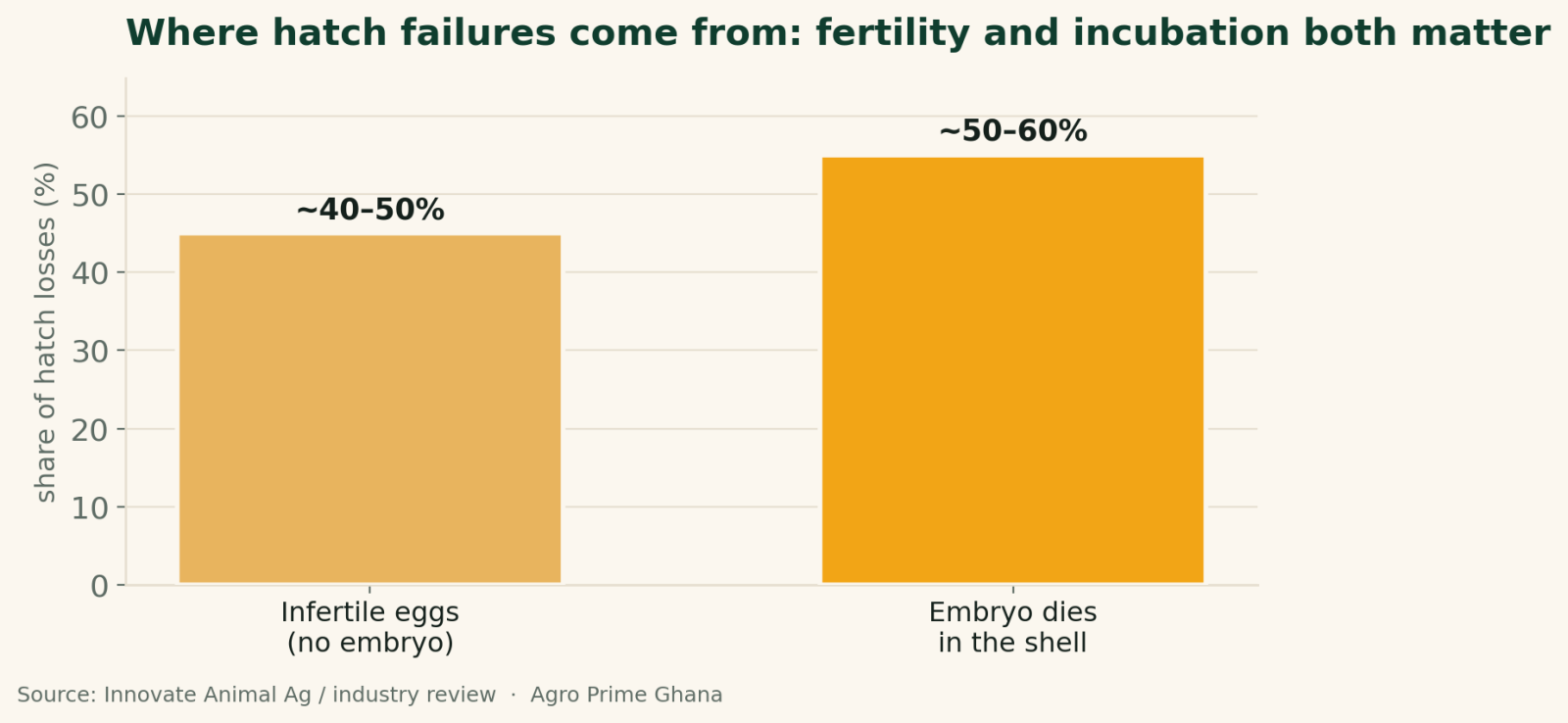
Hatchability is decided long before the eggs go in the machine. Set eggs from a healthy, well-fed breeder flock at its best age (hatchability peaks around 35 weeks), choose clean, sound-shelled eggs of 50 g and above, and set them within 7 days — after a week, hatchability falls by roughly 0.5–1.5% per day and is near zero by three weeks. Run the incubator at a stable 37.5–37.8°C (99.5–100°F) and 55–60% relative humidity for the first 18 days, turn the eggs at least 4–6 times a day (hourly is better), then raise humidity to 65–70% and stop turning for the last three days. Aim for about 12% egg weight loss over incubation. Keep everything scrupulously clean. Roughly 40–50% of hatch failures are simply infertile eggs — so fertility and incubation both have to be right.
What "good" hatchability actually looks like
Hatchability is usually measured two ways, and confusing them causes a lot of needless worry. Hatch of set is chicks hatched as a percentage of all eggs put in the machine; hatch of fertile is chicks as a percentage of the eggs that were actually fertile. A well-managed flock and hatchery should convert about 85–92% of fertile eggs into good chicks. Hatch of set is always lower, because infertile eggs and early dead embryos are in the denominator — even excellent commercial operations rarely exceed the high 80s. For perspective, the US broiler industry, with world-class equipment, averaged around 79% hatch in 2024, down from about 85% a decade earlier, according to Innovate Animal Ag. The lesson for a Ghanaian hatchery is grounding: do not chase a mythical 100%, but if you are hatching only half or two-thirds of your fertile eggs, there is real, recoverable money on the table. The same review notes that 40–50% of all hatch losses are simply infertile eggs — no embryo ever started — which means the breeder flock deserves as much attention as the incubator.
Why hatchability is harder to get right in Ghana
The physics of incubation do not change with geography, but our operating conditions make several steps harder. Ambient heat means eggs left on the collection bench or in a warm store begin to "pre-incubate" and age faster, so casual egg handling costs more here than in a temperate country. Unstable grid power — the familiar dumsor — interrupts temperature and turning, and every hour a machine sits cold or unturned chips away at the hatch. High humidity in the coastal south and bone-dry harmattan air in the north both pull incubator humidity away from target in opposite seasons. And many farms set eggs from young backyard or mixed breeder flocks of uncertain age, nutrition and disease status. None of this makes good hatchability impossible — our own hatchery floor is proof it is achievable — but it does mean the discipline around egg handling, power backup and sanitation has to be tighter, not looser, than the textbook assumes.
Start with the breeder flock: fertility you cannot fake
You cannot hatch a chick from an egg that was never fertile, so hatchability begins with the parent flock. Fertility depends on healthy, correctly-fed breeders, enough active males, and the flock being at a good age. Expected hatchability peaks around 35 weeks of age and then declines steadily as the flock gets older, and very young flocks lay small eggs that hatch smaller, weaker chicks. Keep enough males working — roughly 8–9% males in floor-mated flocks — and cull infertile or lazy cockerels, because a handful of non-working males quietly drags the whole hatch down. Feed breeders a proper breeder ration, not leftover layer or broiler feed: fertility and embryo quality depend on adequate protein, vitamins (especially A, E and the B group) and trace minerals. Control disease, since infections like mycoplasma and salmonella pass straight into the egg and kill embryos. If you buy in hatching eggs rather than keeping your own parents, the flock's age and health are still your problem — ask, and prefer eggs from flocks between about 30 and 50 weeks. Our guides to breeder flock management and the right rooster-to-hen ratio go deeper on getting fertility high before the eggs ever reach the machine.
Select and store the eggs properly
Egg selection and storage are the cheapest, highest-return levers a small hatchery has, and the ones most often neglected. Set only eggs that are clean, sound-shelled and normally shaped. Reject cracked, thin-shelled, misshapen, oversized, undersized, dirty or "wrinkled" eggs — every one of those either fails to hatch or hatches a poor chick, and a hairline crack is an open door for the bacteria that cause exploding "rotten" eggs and navel infections. Size matters too: breeder-genetics guidance recommends using eggs of about 50 g and above and rejecting eggs below 45 g, because very small eggs hatch weak, undersized chicks. Never wash dirty eggs in cold water — it drives contamination through the shell; lightly dry-clean a slightly soiled egg or discard it. On storage, the rule is simple: the fresher the better. Hold eggs at about 13–18°C (55–65°F) and 75% relative humidity, large end up, and set them within a week. Hatchability holds well for the first 5–7 days, then falls by roughly 0.5–1.5% for every extra day, and by three weeks of storage it is close to zero. If you must hold eggs a little longer, add about one hour of incubation for each storage day beyond the first three, as aged eggs are slower to hatch. Full detail is in our guides to selecting hatching eggs and storing hatching eggs before setting.
Field note: the collection bench is where most Ghana hatches are lost
On our floor, the single change that lifts a struggling farm's hatch fastest is almost never the incubator — it is egg handling before setting. Eggs left sitting in the sun on a warm collection tray, stacked dirty, or held three weeks "until we have enough" are already half-spoiled when they go in. We collect several times a day, keep eggs off the hot ground, cool them gently to storage temperature rather than leaving them at pen heat, and we would rather set a smaller batch of fresh, clean eggs than a full machine of tired ones. Fresh eggs forgive a lot; stale eggs punish everything else you do right.
| Lever | Target / best practice | Why it moves hatchability |
|---|---|---|
| Breeder age | Set eggs from flocks ~30–50 weeks; peak ~35 weeks | Young flocks lay small eggs; old flocks lose fertility and shell quality |
| Egg size | ≥50 g; reject <45 g | Small eggs hatch weak, undersized chicks |
| Storage time | Set within 7 days (1–3 best) | After 7 days, ~0.5–1.5% hatchability lost per day |
| Storage climate | 13–18°C, ~75% humidity, large end up | Slows embryo ageing and moisture loss before setting |
| Incubation temp | 37.5–37.8°C (forced-air), steady | Even ±0.5°C off-target for long kills embryos or deforms chicks |
| Humidity (day 1–18) | 55–60% RH; aim ~12% egg weight loss | Controls the air cell; too wet or too dry both cut hatch |
| Humidity (day 19–21) | 65–70% RH, stop turning | Stops chicks sticking ("shrink-wrapping") at hatch |
| Turning | 4–6×/day min; hourly ideal; stop last 3 days | Prevents the embryo sticking to the shell membrane |
Nail the incubation temperature
Temperature is the master control of incubation, and small, sustained errors do the most damage. For a forced-air incubator (fan-driven, as most cabinet and modern tabletop machines are), the target is about 37.5–37.8°C (99.5–100°F) held steady throughout the 18-day setting period; Mississippi State University Extension advises keeping fluctuation under one degree Fahrenheit total. Still-air incubators (no fan) run hotter at the reading point — about 38.9°C (102°F) measured at the top of the eggs — because heat layers without a fan to mix it. Too warm and embryos develop too fast, hatch early, and you see weak chicks, unhealed navels and higher dead-in-shell; too cool and they develop slowly, hatch late and weak, or die. Two practical Ghana points: first, calibrate your thermometer — cheap incubator displays are often 1–2°C out, so cross-check with a known-good thermometer before you trust the machine. Second, mind the room. An incubator in a hot, unshaded, poorly-ventilated room struggles to shed heat on a 34°C afternoon and can overheat; one in a cold harmattan night can run cool. A stable, shaded, ventilated incubation room is part of temperature control.
Get humidity and ventilation right
Humidity governs how much moisture the egg loses through its shell, and that moisture loss has to be about right — not too much, not too little. Over the whole incubation an egg should lose roughly 12% of its weight as water evaporates, forming an air cell big enough for the chick to breathe into before it pips. Run 55–60% relative humidity for the first 18 days; then, for the final three days in the hatcher, raise it to 65–70%. That late lift is critical: it stops the membranes drying and "shrink-wrapping" the chick, one of the commonest reasons a fully-formed chick pips but dies without hatching. Ventilation matters just as much and is easy to forget — a developing embryo takes in oxygen and gives off carbon dioxide through the shell, so the machine must breathe. Open the vents gradually as incubation progresses and keep them well open during hatching, when oxygen demand peaks. In a tightly-sealed room or an overstuffed machine, CO₂ builds up and late embryos suffocate. If your hatches show many fully-developed chicks dead in the shell, suspect humidity, ventilation or turning before you blame the breed. Our incubator temperature and humidity guide and incubation troubleshooting guide break these settings down day by day.
Turn the eggs — and stop at the right time
Turning keeps the embryo from sticking to the shell membrane and helps it develop evenly, and skipping it is one of the surest ways to wreck a hatch. Turn eggs at least 4–6 times a day through the first 18 days; automatic turners that tilt hourly do better still, and hand-turners should turn an odd number of times a day so eggs do not rest on the same side every night. Mark one side of each egg with a pencil "X" so you can see at a glance that every egg has moved. Then stop turning for the last three days (from day 18): the chick is positioning itself to hatch, and turning now hinders it. If you rely on hand-turning, a power-cut-proof routine and a written turning log prevent the "who turned them last?" gaps that quietly cost chicks. This is exactly where unreliable power hurts — an automatic turner idle through a long outage is a batch turned too little.
Order strong day-old chicks — or get your own hatch running right
Chasing a better hatch is worth it, but you do not have to carry every risk yourself. Agro Prime Ghana runs a hatchery in Kasoa and supplies healthy, vaccinated day-old broiler and layer chicks from managed breeder stock — so you can stock your brooder now while you build your own hatching skill. And if you run your own incubator, we are happy to help you troubleshoot poor hatches, set up egg storage and turning routines, and choose the right machine for your flock size. Message us on WhatsApp (+233 24 915 1503) or book a visit to order chicks or get hands-on hatchery advice.
Keep everything clean: sanitation and biosecurity
A warm, humid incubator is a perfect incubator for bacteria and fungi too, so hygiene is not optional — dirty eggs and dirty machines cause exploding eggs, fungal "brooder pneumonia" (aspergillosis) in the chicks, and navel infections. Collect eggs frequently onto clean trays, keep nests clean and bedded so eggs are laid clean in the first place, and never set visibly dirty or manure-smeared eggs. Between every batch, empty the machine and wash and disinfect it thoroughly — trays, walls, fan, water pans and all — and let it dry, because leftover fluff, shell and down from the last hatch is where mould and bacteria breed. Keep the setting and hatching areas separate if you can, since the hatcher is the dirtiest point in the cycle. Fumigating or sanitising hatching eggs soon after collection, done correctly, further cuts the microbial load. Our hatchery hygiene and fumigation guide covers safe, practical routines for small Ghanaian hatcheries.
Protect the hatch from power cuts
In Ghana, power reliability is a hatchability factor in its own right, and pretending otherwise costs chicks. A single long outage during setting means hours of falling temperature and missed turns; an outage during the final three days can be fatal to a whole hatcher of ready-to-pip chicks. Plan for it: a good incubator holds heat for a while thanks to the thermal mass of the eggs and machine, but for the outages we get, you need backup — an inverter and battery bank sized to at least run the fan and turner, a standby generator, or a machine designed around solar and battery. Good insulation and a stable room buy you time during a cut. If power is your binding constraint, it is worth reading our comparison of cabinet versus tabletop incubators and our honest assessment of solar-powered incubators in Ghana before you buy — the right machine and backup can turn power from your biggest hatch risk into a managed one.
The bottom line on hatchability
Better hatchability is not one trick but a chain of ordinary disciplines done consistently: fertile eggs from a healthy breeder flock at a good age; clean, sound, properly-sized eggs set fresh; a steady 37.5–37.8°C and 55–60% humidity with frequent turning; a lift to 65–70% humidity and no turning for the last three days; scrupulous cleanliness; and reliable power. Get the eggs and the flock right and you have removed the causes of nearly half of all hatch failures before the machine even starts. Get the incubation right and you save the embryos the eggs contain. A small hatchery in Kasoa working to these standards can reasonably expect to hatch 85–92% of its fertile eggs — and the gap between that and a struggling 50–60% hatch is pure, recoverable profit.
Frequently asked questions
What is a good hatchability rate for chicken eggs?
What temperature and humidity should I set my incubator to?
How long can I store hatching eggs before setting them?
Why are my fertile eggs not hatching?
How often should hatching eggs be turned?
Does breeder flock age affect hatchability?
Why do chicks die in the shell after fully forming?
Should I wash dirty hatching eggs before setting?
Sources & further reading
- Mississippi State University Extension — Important Incubation Factors (temperature, humidity, turning and ventilation setpoints).
- The Poultry Site — Care and Incubation of Hatching Eggs (egg storage, humidity, weight loss, turning).
- Texas A&M AgriLife Extension — Incubating and Hatching Eggs (storage duration effect on hatchability, setpoints).
- Hendrix Genetics — Considerations for Better Hatchability (egg size, storage, breeder age and male ratio).
- Innovate Animal Ag — The Hatchability Crisis (industry hatchability trends, share of losses from infertility, breeder-age peak).
- Agro Prime Ghana guides: incubator temperature & humidity, incubation troubleshooting, selecting hatching eggs, hatchery hygiene & fumigation.
About Agro Prime Ghana
Agro Prime Ghana Limited runs a poultry hatchery and mixed agribusiness in Kasoa, supplying day-old chicks and supporting poultry keepers across the country. These guides draw on that hands-on hatchery and farm experience, checked against current industry and veterinary references. This article is general educational information, not a substitute for professional advice on your specific flock and equipment. We supply healthy day-old chicks (broilers & layers), point-of-lay pullets, quality feed and hands-on farm support. Ready to start or expand? Book a visit or message us on WhatsApp (+233 24 915 1503) to order chicks, feed or hatchery advice.