To buy the right egg incubator in Ghana, match the machine's egg capacity to how many chicks you actually need, choose a forced-air (fan-assisted) model with automatic turning and a reliable, adjustable thermostat, and — because grid power is unreliable — insist on a backup power plan before anything else. A good incubator has to hold a chicken egg at about 37.5 °C (99.5 °F) and the correct humidity for the full 21 days without wandering, and the two things that ruin hatches here are temperature swings and power cuts. Whether you are hatching a few eggs from your own birds or setting up a small hatchery business, the incubator is the single piece of equipment that decides whether you get a pen full of chicks or a tray of dead-in-shell eggs. This guide explains the sizes, the still-air versus forced-air choice, why auto-turn and backup power matter so much in Ghana, and exactly what to check before you hand over your money.
Written by the Agro Prime Ghana hatchery team and reviewed against current extension references (Texas A&M AgriLife Extension and Mississippi State University Extension). Last updated September 2026.
Key takeaways
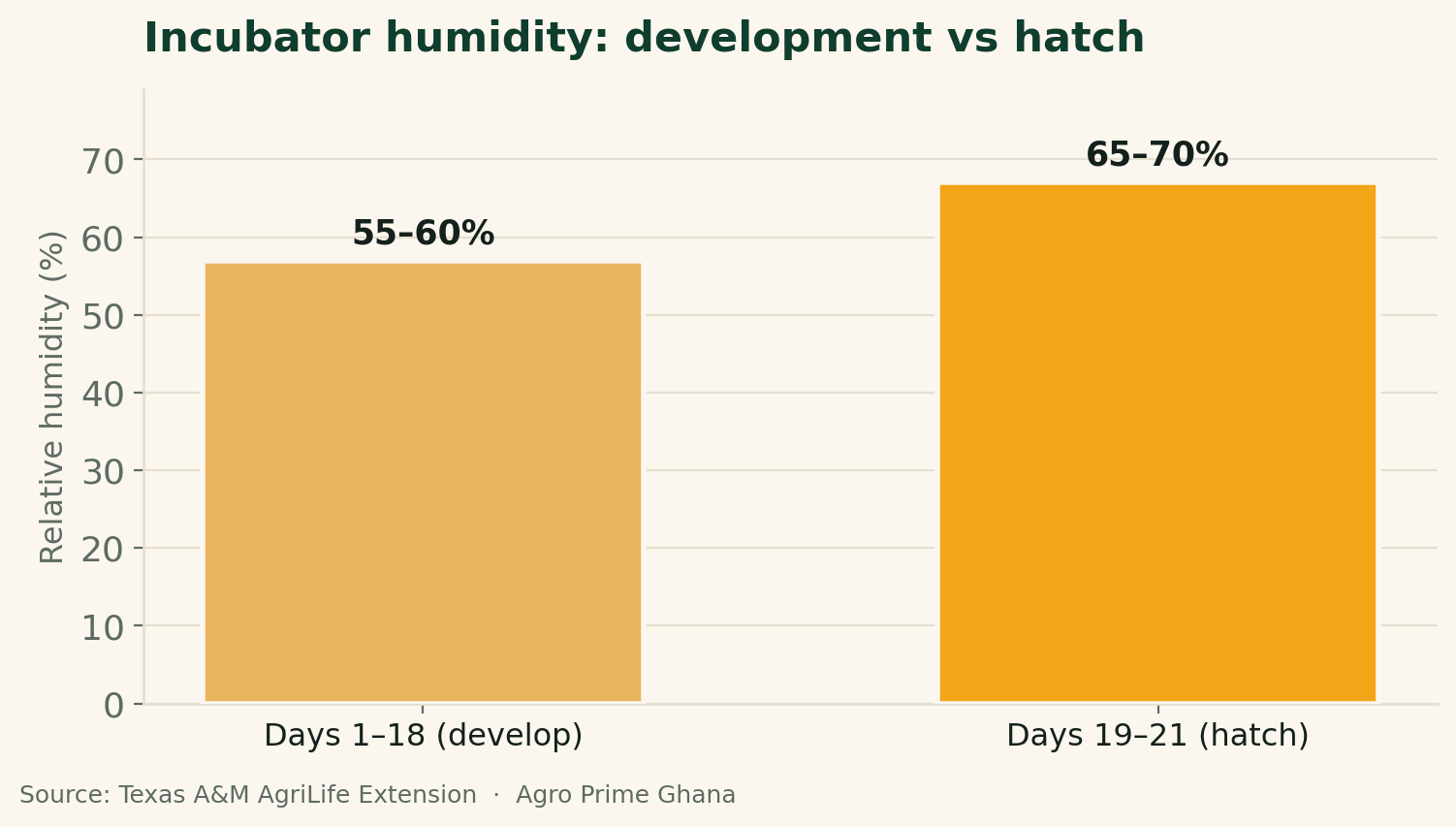
A chicken egg incubates in 21 days at about 37.5 °C (99.5–100 °F) in a forced-air machine; a still-air machine needs a slightly higher reading — around 38.9–39.4 °C (102–103 °F) at the top of the egg — because heat is uneven. Keep relative humidity at about 55–60% for the first 18 days, then raise it to 65–70% for the final three days (hatch). Turn eggs at least 5 times a day until day 18 — automatic turning is worth paying for. Buy capacity you will actually fill, a forced-air fan for even heat, an accurate adjustable thermostat, and — critically for Ghana — a machine that survives power cuts (low wattage, good insulation, and a generator, inverter or battery backup). Test-run any incubator empty for 24–48 hours before trusting eggs to it.
What an egg incubator has to do
An egg incubator is a machine that replaces a broody hen, and its whole job is to hold four things steady for 21 days: temperature, humidity, air (ventilation) and egg-turning. Get all four right and a fertile egg develops into a healthy chick; let any one drift and hatch rates collapse. The temperature window is unforgivingly narrow — Texas A&M AgriLife Extension puts the forced-air setpoint for chicken eggs at 99.5 °F to 100 °F (about 37.5–37.8 °C), and even a degree or two off for a sustained period will kill embryos or throw the hatch off badly. Humidity governs how much moisture the egg loses through its shell, which is why it is set lower during development and raised at hatch. Turning stops the embryo sticking to the shell membrane. When you buy an incubator, you are really buying how reliably that box can hold those four conditions — especially under Ghanaian power and climate. Everything else is secondary. For the day-to-day targets we go deeper in our incubator temperature and humidity guide.
Why the incubator choice is harder in Ghana
Buying an incubator in Ghana is not the same decision as in a country with stable power, and pretending otherwise costs people their hatches. The defining problem is electricity: an unplanned outage of a few hours can chill a tray of developing eggs enough to kill or weaken every embryo, and outages here are common and unannounced. That single fact should shape your whole purchase — favouring low-wattage, well-insulated machines that hold heat longer, and building in a generator, inverter-and-battery, or even a solar setup so the incubator never goes cold (see our note on the solar-powered incubator option and general backup power planning). The second issue is climate: our humid south makes it easy to keep incubation humidity up but harder to run the higher hatch-time swings without condensation, while the dry harmattan can pull humidity down fast, so you want good humidity control and a way to add water surface. The third is servicing and spares — a fancy imported machine is useless if you cannot get a replacement thermostat or fan locally. A grounded buyer in Ghana weighs power resilience, humidity control and repairability at least as heavily as headline capacity.
Still-air vs forced-air: the first real decision
The most important technical choice is whether the incubator is still-air or forced-air, because it changes how you set and trust the temperature. A forced-air incubator has a fan that circulates warm air so the temperature is even throughout the cabinet; you set it to about 37.5 °C (99.5 °F) and every egg experiences roughly the same heat. A still-air incubator has no fan, so warm air rises and the box is hotter at the top than the bottom; because the reading depends on height, extension guidance is to run a still-air machine 2–3 °F hotter, around 102–103 °F (about 38.9–39.4 °C) measured at the top of the eggs, to compensate. For anyone hatching more than a handful of eggs, or new to incubation, a forced-air machine is far more forgiving and gives more even hatches. The table below lays out the trade-offs.
| Feature | Forced-air (fan) | Still-air (no fan) |
|---|---|---|
| Temperature setpoint (chicken) | ~37.5 °C (99.5–100 °F), even throughout | ~38.9–39.4 °C (102–103 °F) at top of egg |
| Temperature evenness | Even everywhere — every egg the same | Uneven; hotter at top, cooler at bottom |
| Ease for beginners | More forgiving, more consistent hatches | Trickier; reading height matters a lot |
| Capacity suited to | Small to large batches | Usually small tabletop batches |
| Cost | Usually a little more (has a fan) | Usually cheaper, simpler |
What size incubator should you buy?
Buy the capacity you will genuinely fill on a regular cycle, not the biggest box you can afford. Incubators are rated by how many chicken eggs they hold — from tiny tabletop units of 7–24 eggs, through mid-range 48–100-egg machines, up to cabinet incubators holding several hundred or more. The temptation is to over-buy, but a half-empty incubator is harder to run well and wastes power, while a machine that is always overflowing means you are hatching in awkward part-batches. Work backwards from your goal: if you want, say, 50 good pullets a cycle, remember that not every egg is fertile and not every fertile egg hatches, so you need to set noticeably more eggs than 50 — a realistic hatch of fertile eggs is often in the 70–85% range under good management, and lower when conditions slip. For a growing operation, a single-stage cabinet machine you fill and empty as one batch also makes hygiene and record-keeping easier. We compare the formats in cabinet vs tabletop incubators, and if you are aiming at a business, read how to start a hatchery first.
Field note: buy the thermometer before you trust the incubator
The number on an incubator's own display is not gospel — cheap built-in sensors can read a degree or more off, and a degree is enough to hurt a hatch. Before we trust any machine with eggs, we run it empty for a full day or two and check it against a separate, accurate thermometer (ideally a calibrated one) placed at egg height, plus a hygrometer for humidity. If the built-in display says 37.5 °C but your reference says 38.5 °C, you now know to adjust — and you have caught it before a single embryo paid for the error. This dry-run habit has saved us more hatches than any expensive feature. Treat the incubator's own readout as a guide and your independent thermometer as the truth.
Automatic turning: pay for it if you can
Eggs must be turned regularly so the embryo does not stick to the shell membrane and develops evenly, and how the incubator handles this is a major buying decision. AgriLife Extension advises turning eggs at least five times every 24 hours up to about day 18, after which turning stops for the hatch. Doing that by hand — five-plus times a day, every day, without missing the night turns — is a genuine commitment, and forgotten turns are a common reason home hatches fail. An automatic turning incubator does it for you on a timer or rolling cradle, which improves consistency and frees you from being tied to the machine, and it is one of the features most worth paying extra for, especially for anyone with a job or a farm to run. If you buy a manual-turn machine to save money, mark the eggs with an “X” and “O” on opposite sides so you can see they have all been turned, and set alarms. Our egg turning guide covers the technique either way.
Backup power: the feature Ghanaian buyers must not skip
No incubator feature matters more in Ghana than what happens when the power goes off, so plan for it as part of the purchase, not later. Developing eggs have some thermal buffer — a well-insulated, full incubator loses heat slowly — but a few hours cold, especially in the harmattan or overnight, can wreck a hatch. Three practical layers protect you. First, choose a low-wattage, well-insulated machine that holds temperature longer and is cheap to run on backup. Second, provide backup power: a small generator, or an inverter-and-battery (UPS-style) setup sized to carry the incubator through typical outages, or a solar-charged battery bank. Third, have a manual emergency plan — in a prolonged blackout, wrapping a full incubator in blankets and not opening the lid buys precious time. Whatever you buy, ask the seller its wattage and how long it holds heat unpowered, and build the backup before you set your first eggs. This one discipline separates hatcheries that survive dumsor from those that lose batches to it.
Sourcing chicks while you learn to incubate
Incubating well takes practice, and your first few batches may hatch below their potential while you dial in temperature, humidity and turning — that is normal. In the meantime, you do not have to gamble a production cycle on an unproven machine. Agro Prime Ghana supplies strong, uniform, vaccinated day-old broiler and layer chicks from our managed hatchery in Kasoa, so you can keep your pens stocked while you build incubation skill on the side. We are also happy to talk through what machine suits your goals, and to supply quality hatching eggs and incubation advice as you scale up. Message us on WhatsApp (+233 24 915 1503) or book a visit to see a working hatchery setup before you buy your own.
What to check before you buy — the practical checklist
Before paying for any incubator in Ghana, work through a concrete checklist rather than the sales patter. Confirm it is forced-air if you want even, forgiving hatches. Check the thermostat is accurate and adjustable, and plan to verify it against your own thermometer. Confirm automatic turning (or accept the daily manual commitment) and that it stops or can be stopped at day 18. Ask the wattage and how long it holds heat unpowered, and line up your backup power. Check the humidity system — how you add water, and whether it can reach 65–70% for hatch in your local climate. Make sure it has adequate ventilation (adjustable vents), since embryos need oxygen and give off carbon dioxide. Confirm the capacity matches your real cycle. And crucially, check local servicing and spare parts — a thermostat or fan you can actually replace here. Finally, insist on a test run: a machine you can run empty and watch hold steady for 24–48 hours before eggs go in. If the seller cannot answer these, keep looking. Once running, our incubation troubleshooting guide helps you read a poor hatch.
Field note: a stable cheap machine beats a fancy unstable one
Buyers often chase features — digital displays, app control, big capacity — and overlook the one thing that decides hatches: does the box hold a rock-steady 37.5 °C and correct humidity, hour after hour, including overnight and through a short power blip? We have seen simple, well-insulated forced-air machines out-hatch expensive units that could not hold temperature in a warm room. When you test-run a candidate, watch it for a full day and note how far it drifts as the room warms and cools and when it briefly loses power. Stability and repairability beat gadgetry every time. Buy the machine that stays boring at 37.5 °C.
The bottom line on buying an egg incubator in Ghana
The right incubator for Ghana is the one that holds a chicken egg at about 37.5 °C and the correct humidity, steadily, for 21 days — through warm afternoons, cold harmattan nights and the power cuts you know are coming. Prefer a forced-air machine for even, forgiving heat; pay for automatic turning if you can; size the capacity to what you will actually fill; and treat backup power and local servicing as non-negotiable rather than optional. Verify every machine against your own thermometer and test-run it empty before you trust eggs to it. Buy on stability and resilience rather than gadgets, and your incubator becomes a dependable source of chicks instead of a tray of expensive disappointments.
Frequently asked questions
What temperature should an egg incubator be for chicken eggs?
Should I buy a still-air or forced-air incubator?
What humidity does a chicken egg incubator need?
How important is automatic egg turning?
How do I protect my incubator from power cuts in Ghana?
What size incubator should I buy?
How long does it take to hatch chicken eggs?
What should I check before buying an incubator?
Sources & further reading
- Texas A&M AgriLife Extension — Incubating and Hatching Eggs (21-day period, forced-air temperature, humidity for incubation and hatch, turning frequency, egg storage).
- Mississippi State University Extension — Hatchery Management Guide for Small Flock Owners (forced-air vs still-air temperature, humidity, turning and ventilation).
- Agro Prime Ghana guides: incubator temperature and humidity guide, cabinet vs tabletop incubators, incubation troubleshooting and how to start a hatchery.
About Agro Prime Ghana
Agro Prime Ghana Limited runs a poultry hatchery and mixed agribusiness in Kasoa, supplying day-old chicks and supporting poultry keepers nationwide. These guides combine hands-on hatchery experience with current extension references. This article is general educational information, not a substitute for professional advice on a specific incubator or setup. We supply healthy day-old chicks (broilers & layers), point-of-lay pullets, quality feed and hands-on farm support across Ghana. Thinking of hatching your own? Book a visit to see a working hatchery, or message us on WhatsApp (+233 24 915 1503) for chicks, hatching eggs or advice.