To start a poultry hatchery in Ghana you need four things working together: a steady supply of fertile eggs from a healthy breeder flock, an incubation system (a setter for days 1–18 and a hatcher for the last three days) sized to a market you have already lined up, a clean building laid out so eggs and chicks only ever move one way, and the know-how to run and record it all. Get those four right and a hatchery is one of the most profitable links in the poultry chain, because every broiler and layer farm starts with a day-old chick — and Ghana does not produce nearly enough of them. This guide walks through the business case, the fertile-egg supply, the machines, the building and the money, from the perspective of a working Kasoa hatchery.
Written by the Agro Prime Ghana hatchery team and reviewed against current industry references (University of Missouri and Mississippi State Extension incubation guides, Aviagen/Ross hatchery guides and USDA/Poultry Site sector data). Last updated September 2026.
Key takeaways
A hatchery turns fertile eggs into day-old chicks and sells them to farmers. The core kit is an incubator running about 37.5°C (99.5°F) at 60–65% humidity for the first 18 days, then a hatcher at 70% humidity for the final 3 days of the 21-day cycle. Fertile eggs must come from a managed breeder flock or a trusted supplier; the building must run clean-to-dirty in one direction (egg room → setter → hatcher → chick processing → dispatch). The opportunity is real: domestically produced broilers have fallen to roughly 2% of the chicken meat Ghana eats, and the country consumes around 460,000 tonnes of poultry meat a year — every bird of which needs a chick to start. Your two make-or-break numbers are hatchability (chicks out ÷ eggs set) and chick quality. Start small, prove your hatch, then scale.
Why is a hatchery a good business in Ghana?
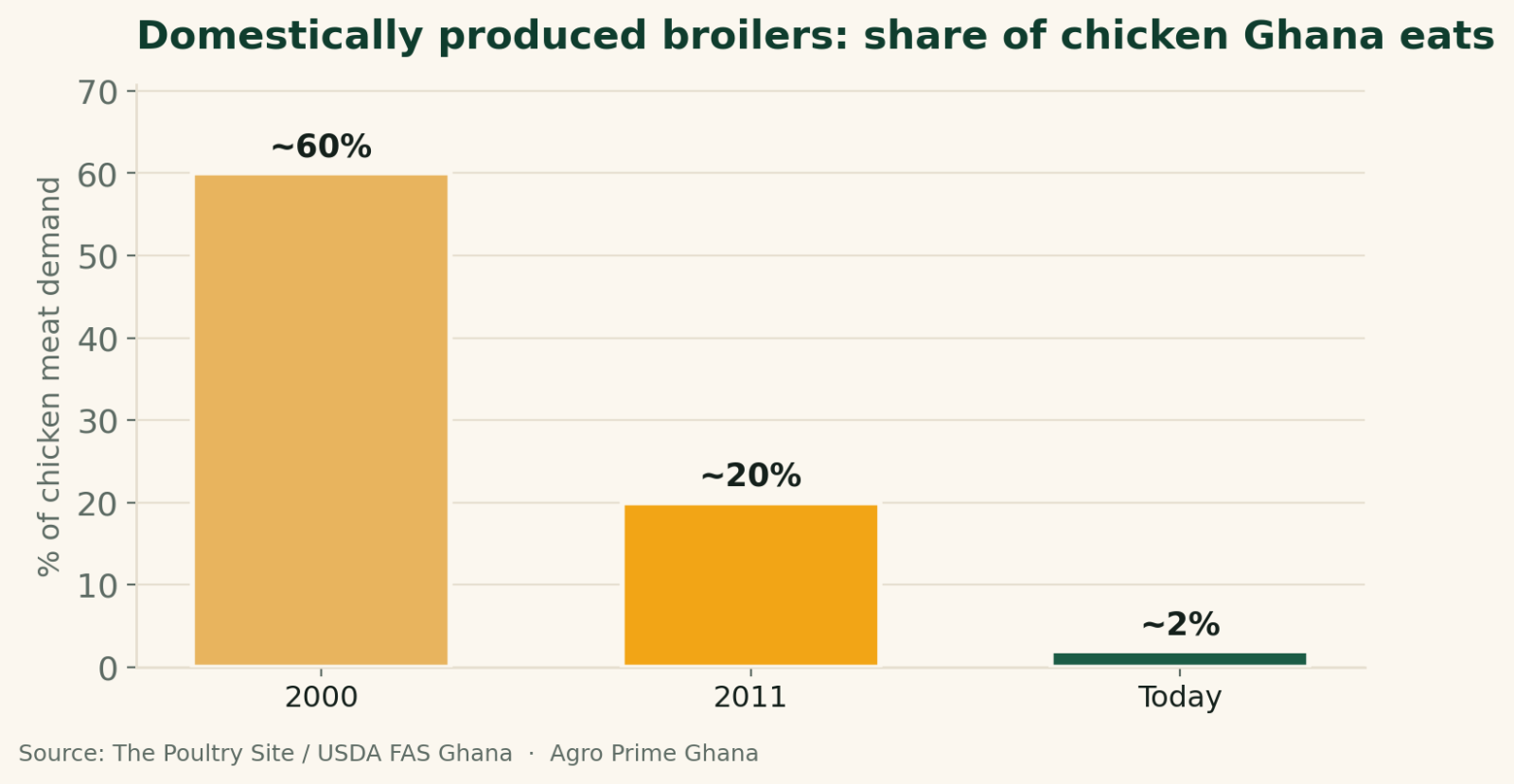
A hatchery is a good business in Ghana because demand for chicken vastly outstrips what the country hatches and rears, and every one of those birds begins as a day-old chick somebody must produce. Ghana consumes on the order of 460,000 tonnes of poultry meat a year, yet domestically produced broilers have collapsed from close to 60% of the market in 2000 to about 20% by 2011, and today meet only around 2% of chicken-meat demand, the rest arriving as frozen imports — a shift the Poultry Site's overview of Ghana's sector documents. That import wall is a headwind for broiler growers, but not for the chick business: layers, cockerels, dual-purpose birds, backyard flocks and surviving broiler farms all still need chicks. A well-run local hatchery delivering strong chicks fills a real hole.
The second reason is position in the value chain. A healthy chick leaving your hatchery is worth many times the cost of the egg it came from, and — unlike a broiler grower — you are not exposed to the price of frozen imported chicken. Your customers are farmers, and their appetite for good chicks is steady because they restock all year, with predictable surges before the festive season. Our guides to starting a poultry farm and building a poultry business plan are good companions.
What does it actually take to start a hatchery?
At its simplest, a hatchery needs a reliable source of fertile eggs, incubation equipment, a suitably laid-out building, reliable power, and someone who understands incubation well enough to hit a good hatch every set. The order matters: secure your egg supply and prove you can hatch well on a small machine before sinking money into a large one. Ghana's poultry sector has been punished by feed-cost inflation — maize has jumped from around GH₵120 to GH₵500–600 per 50-kg bag, and roughly 80% of farms in some assessments have closed under that pressure — so the operators who last start lean and grow from cash flow rather than debt. A hatchery is capital-light but knowledge-heavy: the machine does not forgive sloppy egg handling or a dirty building.
| Hatchery zone | What happens there | Key condition |
|---|---|---|
| Egg receiving & storage (cool room) | Fertile eggs received, graded, disinfected and held before setting | Cool: ~10–18°C (50–65°F), ~70% humidity, held ideally under 7 days |
| Setter room | Eggs incubated and turned, days 1–18 | ~37.5°C (99.5°F), 60–65% humidity, turned at least 3× daily |
| Hatcher room | Eggs transferred at day 18; chicks pip and hatch, days 19–21 | ~37.5°C, humidity raised to ~70%, no turning |
| Chick processing / take-off | Chicks removed, counted, graded, sexed, vaccinated, boxed | Warm, draught-free; the "dirty" end of the one-way flow |
| Dispatch / wash-up | Chicks loaded for delivery; trays and rooms cleaned and disinfected | Separate exit; equipment washed before returning to clean end |
That table is the blueprint of the whole business: eggs enter cool and clean at one end and chicks leave warm and boxed at the other, and the two streams never cross. Incubation conditions are drawn from University of Missouri Extension's incubation guide and storage conditions from Mississippi State Extension.
Where do the fertile eggs come from?
Every chick begins as a fertile egg, so your egg supply is the single most important decision you will make, and you have two broad routes. The first is to buy hatching eggs from an established breeder farm or integrator: this lets you start without keeping breeders, but makes you dependent on someone else's flock health, fertility and honesty, and hatching eggs travel poorly — every knock, temperature swing and delay costs hatchability. The second is to keep your own breeder flock and control the eggs from lay to set. That gives the freshest, most traceable eggs, but is a serious commitment: you must manage a correct rooster-to-hen ratio for fertility (commonly around one cock to eight to twelve hens), feed and light them properly, and accept that their genetics dictate your product. Many small Ghanaian hatcheries begin by buying eggs and move toward their own breeders as they scale — see our guides on sourcing fertile eggs and breeder flock management.
Whatever the route, only good eggs deserve a place in the machine: set clean, well-shaped eggs of the right size and reject cracked, dirty, misshapen or oddly sized ones. Mississippi State Extension recommends holding hatching eggs at roughly 50–65°F (10–18°C) and about 70% humidity, and warns that while chicken eggs can be held for about three weeks, hatchability falls the longer they sit — most should be set within a week, turned daily even in storage. Cool, prompt and gentle is the rule; a hatchery is only as good as the eggs going into it.
Choosing your incubation system: setter, hatcher, single- or multi-stage
Incubation happens in two stages, which is why professional hatcheries use two kinds of machine. Eggs spend their first 18 days in a setter, held near 37.5°C (99.5°F) at 60–65% relative humidity and turned several times a day; they then move to a hatcher for the final three days, where turning stops and humidity is raised to about 70% so membranes stay moist as chicks pip and hatch. As Incubator Warehouse explains, the temperature setpoint stays roughly the same but humidity and turning differ — and the hatcher must be fully cleaned after every hatch, because the mess of hatching cannot sit in the chamber where your next batch develops. Keeping setting and hatching apart is the first rule of a clean hatch; our incubator temperature and humidity guide goes deeper.
You will also choose between single-stage operation — one batch of the same age per machine, run on a tailored profile then emptied and disinfected before the next, cleaner but hatching in big blocks — and multi-stage, where eggs of different ages share a machine and balance each other's heat, using space and energy efficiently but never allowing a full disinfection. Smaller Ghanaian hatcheries often favour single-stage for hygiene; large continuous operations lean multi-stage for throughput. Either way, size the machine to a market you can actually sell into.
Field note: prove your hatch before you scale the machine
The mistake we see most often is a newcomer buying the biggest incubator they can afford before ever hitting a good hatch. On our floor the discipline that pays is the opposite: run a modest setter, learn your eggs, power and humidity, and get hatchability consistently strong on small sets first. Reliable power matters as much as the machine — a few hours of unmanaged heat loss can wreck a whole set — so plan your backup before your capacity. Once you can hatch well at small scale, scaling up is mostly buying more of what already works.
Laying out the building: one-way, clean to dirty
A hatchery building should be designed so that eggs and chicks move in one direction only, from clean to dirty, and never double back. The clean end holds egg receiving, storage and setters; the dirty end holds hatchers, chick take-off, vaccination and dispatch; staff, air and equipment flow the same way. This is the core of chick quality. Hatching is a moment of enormous bacterial opportunity: in the warm, humid hatcher contamination multiplies explosively (bacteria can double roughly every 20 minutes), and organisms like Salmonella survive for years in the fluff a hatch throws off. If that fluff drifts back onto clean eggs, you seed every future batch with infection. A one-way layout, separate clean and dirty rooms, foot dips, and thorough cleaning of hatchers after every cycle keep navel infections and early chick mortality down — a discipline we detail in our guides to hatchery biosecurity and hatchery hygiene and fumigation.
Need chicks now, or help setting up your own hatchery?
Agro Prime Ghana runs a working hatchery in Kasoa, and we help two ways. If you need strong, well-handled day-old chicks — broilers, layers or cockerels — to stock your farm this cycle, we supply them and advise on brooding and vaccination. And if you are an aspiring hatchery operator, we are happy to talk through egg supply, incubator sizing, layout and the numbers before you commit capital — mistakes are far cheaper to avoid than to fix. Message us on WhatsApp (+233 24 915 1503) or book a visit.
The numbers: capital, running costs and what makes it profitable
Hatchery profitability comes down to two ratios: hatchability (the share of eggs set that become saleable chicks) and chick quality (the share strong enough to sell and thrive). A machine that hatches 85–90% of fertile eggs into first-grade chicks is a business; one limping along at 60% with weak chicks is a slow way to lose money, because you pay for every egg, kilowatt and hour whether a chick hatches or not. Each lost percentage point of hatch is money that came in as an egg and left as waste.
Your big cost items are the incubation equipment, the building and power supply, fertile eggs (or breeder-flock upkeep), electricity and standby power, labour, and consumables. Track your economics from day one — set eggs, fertile eggs, chicks hatched, chicks sold, cost per chick — because you cannot improve what you do not measure. Our guide to hatchery record-keeping shows which numbers to keep and how to turn them into a better hatch and a healthier margin.
Field note: line up your buyers before you set the eggs
Chicks are perishable inventory — a day-old chick not sold within its first day or two is a growing cost and a falling asset, not stock you can warehouse. The hatcheries that thrive plan sales before they plan sets: they know roughly how many chicks each customer takes and when, time larger sets to demand, and build a repeat base through consistent quality. Treat every set as a promise you have already sold, and you will rarely be caught with unsold chicks.
The bottom line on starting a hatchery in Ghana
A hatchery is one of the most defensible businesses in Ghanaian poultry: it sits upstream of the frozen-import problem, serves farmers who restock all year, and rewards skill more than raw capital. To start one, secure a dependable supply of good fertile eggs, buy an incubation system — a setter and a separate hatcher — sized to a market you have already lined up, house it in a clean building that runs one way from egg room to dispatch, and protect it all with strict hygiene and honest record-keeping. Begin small enough to prove a strong, repeatable hatch, then scale from cash flow. Do that, and you become the reliable source of healthy chicks that every farm around you depends on.
Frequently asked questions
How much money do I need to start a hatchery in Ghana?
What equipment do I need for a poultry hatchery?
Where do I get fertile eggs for a hatchery?
How long does it take to hatch chicks?
What is the difference between single-stage and multi-stage incubation?
Is a hatchery profitable given Ghana's cheap chicken imports?
How important is electricity supply for a hatchery?
Should I sell broiler chicks, layer chicks or both?
Sources & further reading
- University of Missouri Extension — Incubation of Poultry (incubation temperature, humidity, turning and duration).
- Mississippi State University Extension — Hatching egg storage period (storage temperature, humidity and duration).
- Incubator Warehouse — Incubator vs Hatcher: why use two separate machines (setter/hatcher conditions and sanitation).
- The Poultry Site — Overview of Ghana's struggling poultry sector (import share, consumption and cost data).
- Agro Prime Ghana guides: sourcing fertile eggs, incubator temperature and humidity, hatchery biosecurity and hatchery record-keeping.
About Agro Prime Ghana
Agro Prime Ghana Limited runs a poultry hatchery and mixed agribusiness in Kasoa, supplying day-old chicks and supporting poultry keepers across the country. These guides combine hands-on hatchery experience with current industry and extension references. This article is general educational and business information, not a substitute for professional veterinary, agronomic or financial advice tailored to your situation. We supply healthy day-old chicks (broilers & layers), point-of-lay pullets, quality feed and hands-on farm support nationwide. Ready to start or expand? Book a visit or message us on WhatsApp (+233 24 915 1503) to order chicks, feed or advice.