Turning hatching eggs during incubation means regularly tilting or rolling them from side to side so the developing embryo does not stick to the shell membrane and dies. For chicken eggs you should turn at least 4–6 times a day, and ideally much more often — commercial incubators turn roughly every hour — through an angle of about 45 degrees to each side, and you must stop turning at day 18 when the egg goes into lockdown for hatching. Turning is not a minor nicety: eggs that are never turned hatch at only around 20–30% at best, because the embryo adheres to the inner shell membrane and the yolk sac fails to develop properly. This guide explains why turning works, how often and how far to turn, why you alternate directions, why the first week matters most, and exactly when and why to stop — all grounded in the way a Ghanaian hatchery actually runs a machine.
Written by the Agro Prime Ghana hatchery team and reviewed against current incubation references (Mississippi State University Extension, Brinsea and peer-reviewed poultry science). Last updated September 2026.
Key takeaways
Turn chicken eggs at least 4–6 times a day from setting to day 18; more is better, and automatic turners doing it roughly hourly give the best results. Turn through about 45 degrees each side of vertical — research shows turning only 30 degrees drops hatchability by around 5–10% compared with 45 degrees. Turning stops the embryo sticking to the shell membrane (which is fatal), brings it fresh nutrients and oxygen, moves wastes away, and helps the yolk sac and blood vessels form. Always alternate the direction of turning so the chalaza (the cords holding the yolk) do not wind up and break. Turning matters most in the first week. Stop turning at day 18 (lockdown) so the chick can position itself, draw down the yolk and pip. Eggs never turned at all hatch at only about 20–30%.
Why do you have to turn eggs during incubation?
You turn eggs because a developing embryo that is left still will drift up against the inner shell membrane and stick to it — and once it adheres, it dies. Inside the egg, the tiny embryo floats on top of the yolk, and the yolk naturally rises toward the warmest point near the top of the egg. If nothing moves the egg, the embryo keeps floating upward until it presses against and fuses with the membrane just under the shell. As Brinsea explains, if the egg "is not turned, it will eventually touch and stick to the inner shell membrane, which is fatal." Regular turning constantly repositions the yolk and embryo so this cannot happen. But preventing adhesion is only part of the story. Turning also, in Brinsea's words, "allows the embryo to encounter fresh nutrients and oxygen" and "moves metabolic wastes away from the embryo." It helps the network of blood vessels spread properly across the yolk, aids the formation of the sub-embryonic fluid the chick relies on, and encourages even development. In short, turning keeps the embryo mobile, fed, oxygenated and clean — which is why it is one of the three pillars of incubation alongside temperature and humidity, and why our guide to setting eggs treats turning as non-negotiable from day one.
How often should you turn hatching eggs?
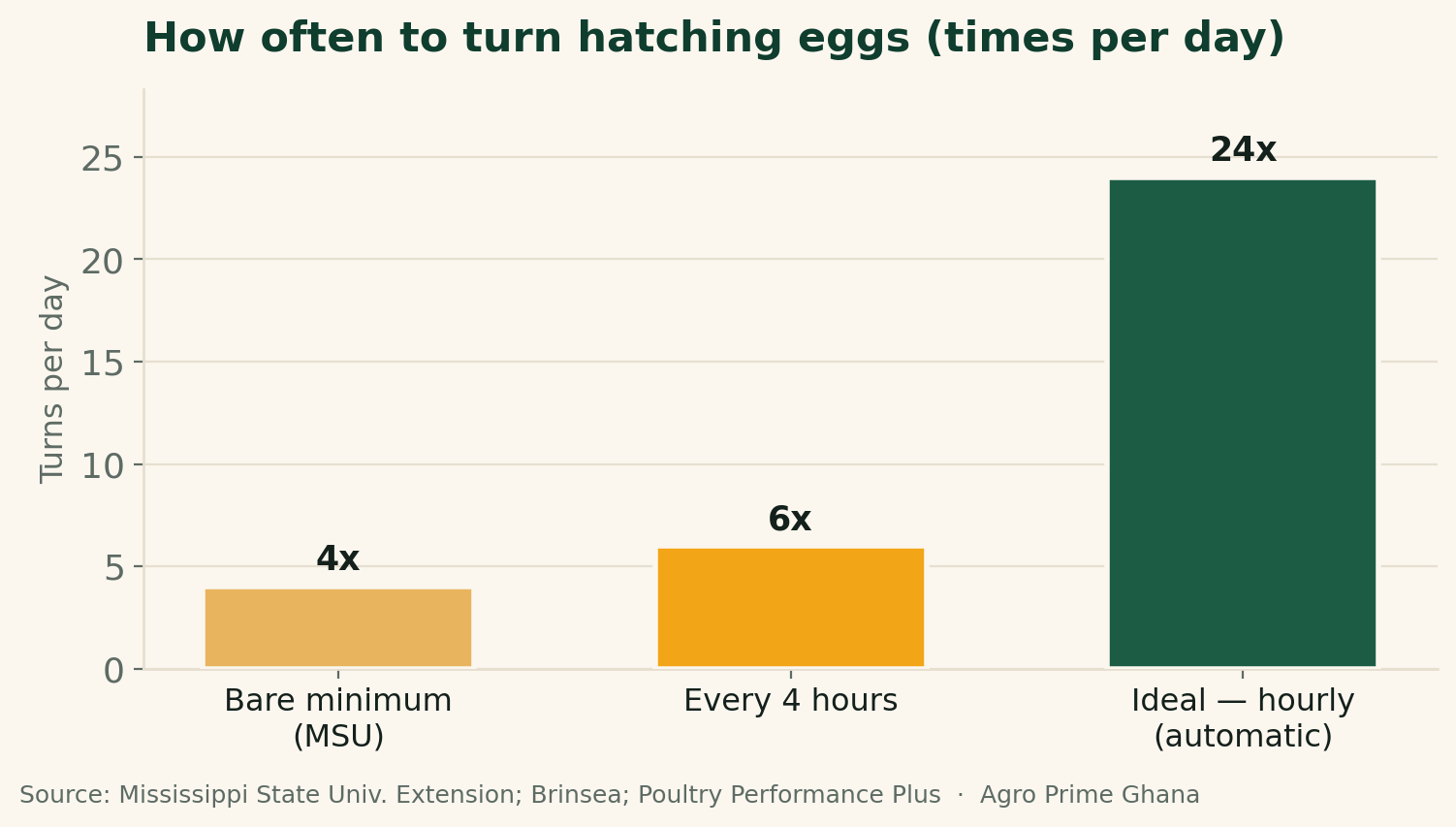
Turn chicken eggs a minimum of 4 to 6 times per day, and understand that this is a floor, not a target — more frequent turning is consistently better. Mississippi State University Extension states plainly that "eggs must be turned at least 4–6 times daily during the incubation period." Turning an odd number of times a day (say 5) is a small, clever trick that means the egg does not spend every single night resting on the same side. But the research points higher: incubation specialists note the practical minimum is about once every four hours (roughly 6 times a day), while commercial hatchery incubators turn eggs about once every hour — around 24 times a day — and that frequency produces the strongest results. This is exactly why a good automatic turner is such a worthwhile investment: it quietly turns the eggs hourly, day and night, without you having to remember or open the machine. If you are hand-turning in a tabletop incubator, aim for at least 4–6 well-spaced turns across your waking hours, mark the eggs with an X and O so you never lose track, and wash your hands first to avoid pushing bacteria through the shell.
| Turning practice | Effect on the hatch |
|---|---|
| Not turned at all | Hatchability collapses to about 20–30% maximum; embryos stick to the membrane and die |
| Turned only 30° each side | Hatchability roughly 5–10% lower than turning at 45° |
| Turned ~45° each side, 4–6×/day | Good hatch; the practical home/small-farm standard |
| Turned ~45°, hourly (automatic) | Best results; commercial-hatchery standard, strongest chicks |
| Turned in the same direction every time | Chalaza winds up and can break — embryo death; always alternate direction |
How far should you turn the egg — and why 45 degrees?
Turn each egg through roughly 45 degrees to each side of vertical — a total sweep of about 90 degrees — because that angle gives the best hatchability, and turning less costs you chicks. Poultry incubation research is clear on this: turning eggs through only a 30-degree angle is reported to reduce hatchability by around 5–10% compared with a 45-degree turn, and studies summarised by The Poultry Site found that "hatch of fertiles was significantly better in eggs turned over an angle of 45° either side of the short axis of the egg, as compared to turning of 30° and 15°." In those trials the chicks from the 45-degree group even weighed more and had less unused yolk left over — a sign of better development. In practice, if you use a reputable automatic turner set up correctly, it already delivers close to this angle. If you hand-turn eggs lying on their sides, roll each egg a firm half-turn (about 180 degrees of roll on a horizontal egg achieves a similar repositioning of the contents) or, in a turner with tilting trays, ensure the trays tilt a good way each direction rather than barely rocking. The takeaway for a small hatchery is simple: a lazy, shallow turn is almost as bad as forgetting; turn decisively.
Why must you alternate the direction of turning?
Always alternate the direction you turn the eggs, because turning the same way every single time will slowly wind up the chalaza — the twisted cords of egg white that suspend the yolk in the centre of the egg — until it tightens and breaks, killing the embryo. Brinsea is emphatic that eggs "must not be turned in the same direction every time," warning that otherwise "the chalaza (the membrane holding the yolk) will wind up and eventually break, causing embryo death." Think of the chalaza like two springs holding the yolk centred; gentle back-and-forth keeps them healthy, but always twisting one way ratchets them tighter and tighter. This is another reason the X-and-O marking system matters for hand-turners: turning so all the X's face up, then next time so all the O's face up, then back to X's, naturally alternates your direction. Automatic turners with tilting trays alternate direction by design, tilting one way then the other. It is an easy detail to overlook, but a serious one — a whole batch can be quietly lost to over-wound chalazae from careless one-direction turning.
Field note: an odd number of hand-turns, and never on a full stomach of eggs you forgot
When we hand-turn, we do an odd number of turns a day — five rather than four — so an egg that spent last night resting on its left side spends tonight resting on its right. It is a tiny habit that spreads the "long rest" fairly across both sides over the incubation. We also keep turning on a written schedule stuck to the machine, because the single most common cause of a poor hand-turned hatch we see is not the wrong angle — it is simply forgetting, especially the evening and early-morning turns. If you cannot reliably turn 4–6 times a day yourself, an automatic turner pays for itself in one or two good hatches. Consistency beats heroics every time.
When is turning most important during incubation?
Turning matters most during the first week of incubation, and especially the first few days, when the embryo is establishing its membranes and blood supply. Research by Elibol and Brake, summarised by The Poultry Site, confirmed that "the most critical period for turning broiler hatching eggs is during the first week of incubation." They found the damage from not turning depends on when it happens: a lack of turning in the very first days (roughly days 0–2) tends to cause early embryo death, while poor turning a little later (around days 3–8) tends to cause late death, with the embryo failing near hatch. Incubation specialists similarly note that turning is extremely important early, but that stopping turning after about day 10–12 has little further effect on hatchability. The practical lesson is not to relax turning early on — the first week is precisely when your discipline pays off. If a batch of eggs will be neglected for any window, the first week is the worst possible time for it. This early-development sensitivity is one reason careful setting and turning go hand in hand with avoiding the problems covered in incubation troubleshooting and dead-in-shell analysis.
Let our hatchery do the turning — order strong day-old chicks
Turning is the part of incubation that most often goes wrong on small farms, simply because it demands consistency day and night for 18 days. If that is more than you want to manage, you do not have to: Agro Prime Ghana runs a hatchery in Kasoa with proper turning equipment and supplies healthy, vaccinated day-old chicks (broilers and layers) ready for you to brood. And if you would rather incubate your own eggs, we are happy to advise on turners, angles, frequency and the rest of your set-up so your hatches improve. Message us on WhatsApp at +233 24 915 1503 or book a visit to order chicks, buy hatching eggs, or get practical incubation help.
Field note: check the turner actually turned — especially after a power cut
An automatic turner only helps if it is running, and in Ghana the thing that most often stops one is a power outage. We make a daily habit of confirming the trays have physically changed position since the last check, not just that the machine has power now — a turner can trip, jam or sit idle through a long outage while the display looks normal. If the lights go for hours, we turn the eggs by hand in the meantime and note it. A turner you assume is working, but is not, quietly recreates the worst case: unturned eggs sticking to the membrane.
Why do you stop turning at day 18?
Stop turning chicken eggs at day 18 — the start of "lockdown" — because the chick now needs to be left still to position itself for hatching. Mississippi State University Extension instructs keepers plainly: "do not turn eggs during the last 3 days before hatching." By day 18 the embryo is a nearly complete chick that must do three things it cannot do while being tumbled: rotate so its head lies up in the air cell at the large end, draw the remaining yolk sac into its body for nourishment during and after hatch, and break into the air cell to take its first breath (the "internal pip") before pipping through the shell. Turning during this window disrupts that positioning and can cause malpositions, failed pips and chicks that drown or die in the shell. Lockdown is also when you raise the humidity to 65% or more to keep the membranes from drying and shrink-wrapping the chick, and stop opening the machine. So day 18 is a clean switch: turning off, humidity up, lid closed. From then on the chicks do the work; your job is to leave them undisturbed until they hatch around day 21, a timing we cover in our note on the hatch window.
The bottom line on turning eggs
Turning is the quiet workhorse of incubation. It keeps the embryo from sticking fatally to the shell membrane, feeds and oxygenates it, clears its wastes and helps it develop evenly — which is why eggs that are never turned hatch at only 20–30% while well-turned eggs thrive. Turn at least 4–6 times a day (ideally hourly with an automatic turner), through about 45 degrees each side, always alternating direction so the chalaza does not wind up and break, and concentrate your discipline on the critical first week. Then stop cleanly at day 18, raise the humidity, and let the chick take over for lockdown and hatch. It costs nothing but attention, yet no other free habit does more to turn fertile eggs into strong, live day-old chicks. Turn faithfully, and the incubator rewards you.
Frequently asked questions
How many times a day should I turn hatching eggs?
What happens if you don't turn eggs in an incubator?
What angle should I turn eggs to?
Why do you alternate the direction when turning eggs?
When should I stop turning eggs before they hatch?
Is turning more important early or late in incubation?
Do I need an automatic egg turner?
Can I turn eggs too much?
Sources & further reading
- Mississippi State University Extension — Important Incubation Factors (turn at least 4–6 times daily; stop turning the last 3 days before hatching).
- Brinsea — Turning Eggs During Incubation (embryo adhesion to the shell membrane, chalaza winding, alternating direction).
- The Poultry Site — Relevance of Turning (45° vs 30°/15° hatchability, Elibol & Brake first-week critical period, Cutchin et al.).
- Agro Prime Ghana guides: setting eggs in the incubator, egg candling guide, and egg incubation troubleshooting.
About Agro Prime Ghana
Agro Prime Ghana Limited runs a poultry hatchery and mixed agribusiness in Kasoa, supplying day-old chicks and supporting poultry keepers nationwide. These guides combine hands-on hatchery experience with current incubation references. This article is general educational information, not a substitute for advice tailored to your own machine and eggs. Want to improve your hatch, set up turning properly, or skip the machine and buy strong day-old chicks? Book a visit or message us on WhatsApp (+233 24 915 1503) for chicks, hatching eggs or incubation support.