Backup power for a poultry farm in Ghana means having a way to keep heat, ventilation, water and (if you hatch) incubation running the moment ECG power fails — usually a standby generator, a solar-plus-battery system, or an inverter-battery bank, chosen according to which loads absolutely cannot stop. In a country where "dumsor" can cut a house for hours without warning, this is not a luxury. A single overnight outage in the brooder can chill day-old chicks to death; a few hot hours with the fans off can suffocate a house of finishing broilers; a stalled pump can leave thousands of birds without water. This guide explains why power cuts threaten poultry, which loads you must protect, and how generators, solar and inverters compare so you can build backup that actually saves birds.
Written by the Agro Prime Ghana poultry team and reviewed against current industry references (Cobb brooding guidance and Ghana energy reporting). Last updated September 2026.
Key takeaways
Power cuts hurt poultry most through lost heat in the brooder, lost ventilation, stopped water pumps and interrupted incubation. Day-old chicks cannot regulate their own body temperature for the first 5 days and need brooder temperatures around 35°C in week one, so even a short outage on cold nights is dangerous. The three main backup options are a diesel/petrol generator (best for large, sustained loads like tunnel fans), solar panels with a battery (silent, no fuel, ideal for daytime heat and steady loads), and an inverter with batteries (cheap, instant, best for lights, small fans and short outages). What must never lose power: brooder heat for young chicks, ventilation fans in hot houses, drinking-water supply, and any running incubator. Size backup from a real list of watts, not guesswork.
Why power cuts (dumsor) are a real threat to poultry in Ghana
Unreliable electricity is a recurring feature of poultry farming in Ghana, and it strikes exactly the systems birds depend on to survive. The country's on-and-off supply crisis — known locally as dumsor ("off-on") — has flared repeatedly. In March 2024 the Executive Director of the Institute for Energy Security, Nana Amoasi VII, warned that "from 2025, the situation is going to get worse" because sector debt "is increasing every day," as reported by Citi Newsroom. The problem is not new: analysis by the Energy for Growth Hub notes that during past crises nearly half of small-scale industries lost several hours of production a month, and outages shaved an estimated 2% off GDP in 2014. Ghana leans heavily on the 1,020 MW Akosombo hydro dam and on gas that has arrived unreliably, so a dry season or fuel hitch can quickly mean blackouts.
For most businesses an outage is an inconvenience. For a poultry farm it can be a mass-casualty event, because birds' environment must be held steady. When the power drops, four things fail at once — heating, ventilation, water and incubation — and each can kill on its own timescale. That is why experienced keepers treat backup power not as an optional upgrade but as core biosecurity, and a central part of climate-resilient poultry keeping.
What a power cut does to your birds, hour by hour
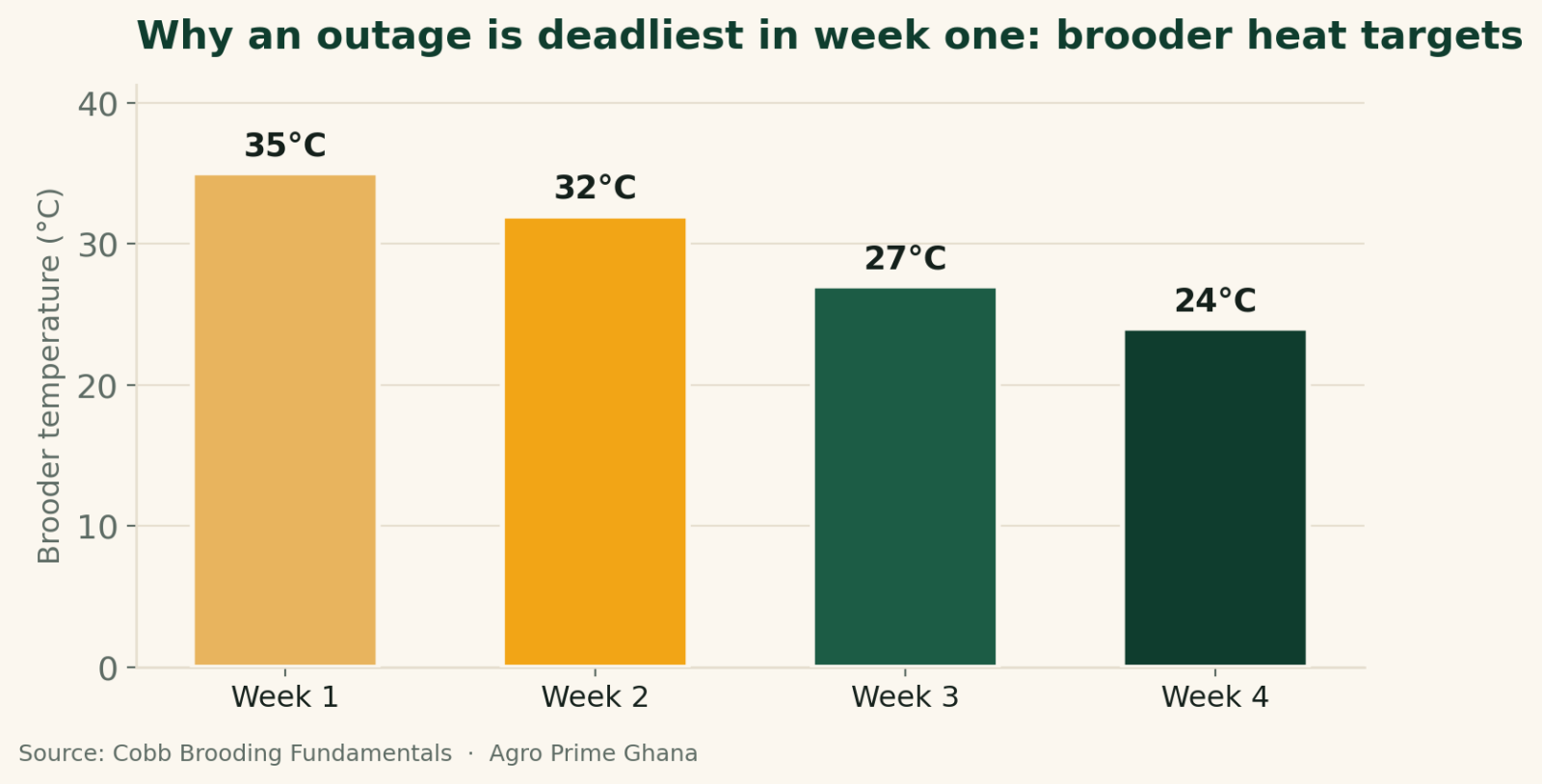
The danger of an outage depends on the age of the birds and the time it strikes. The most fragile stage is brooding. According to Cobb's Brooding Fundamentals guide, chicks "do not have the ability to regulate body temperature for the first 5 days," and thermoregulation is not fully developed until about two weeks of age. Week-one brooder temperature should sit around 35°C (falling to roughly 32°C in week two and 27°C in week three). Take the heat source away on a cool harmattan night and the temperature under the brooder can slide out of the safe zone within an hour; chilled chicks stop eating, pile up, and by morning you can lose much of the batch to chilling and smothering. Our guide to brooding day-old chicks covers the targets in full.
At the other end of the age range, the killer is heat. Grown broilers and caged layers in a closed or tunnel-ventilated house rely on fans to shed heat; cut the fans on a hot afternoon and temperature and humidity climb fast, birds pant, and heavy finishing broilers can begin dying of heat stress within a couple of hours. In between, a stopped water pump silently threatens every bird — poultry drink far more in the heat, and thousands of thirsty birds empty tanks quickly. The table below summarises which birds are threatened by which failure.
| What fails in an outage | Birds most at risk | How fast it becomes dangerous |
|---|---|---|
| Brooder heat | Day-old to ~2-week chicks (can't self-regulate) | Within an hour on a cool night — chilling, piling, smothering |
| Ventilation fans | Grown broilers & caged layers in closed/tunnel houses | 1–3 hours on a hot day — heat stress, suffocation |
| Water pump / supply | All ages, worst in heat | Hours — birds stop drinking, then eating; layers crash |
| Incubator | Eggs mid-incubation | Prolonged loss of heat lowers hatch; short dips are survivable |
| Lights (layers) | Laying flock on a lighting programme | Days — disrupted lighting depresses lay over time |
What must stay powered — and what can wait
Before buying any equipment, separate your critical loads (things that kill birds if they stop) from your convenience loads (things you can live without for a few hours). Backup power is expensive per watt, so protect the essentials first. For most Ghanaian farms the critical list is short:
- Brooder heat for young chicks. If you brood with electric lamps or heaters, this is your number-one priority whenever chicks are under two weeks old. (Farms that brood with gas or charcoal have an advantage — see inverter and battery backup for keeping even those systems' controls and fans alive.)
- Ventilation fans in any closed or tunnel house, especially in heat and for heavy birds — often the largest single backup load, bound up with good poultry house ventilation.
- Water pumping and delivery — a borehole or booster pump filling header tanks, and pressure-fed nipple lines.
- Any incubator or hatcher currently running eggs.
Convenience loads — office equipment, security lights, feed mixers, egg-room appliances — can usually ride out a cut. Being honest about this list keeps a system affordable: a farm protecting only chick heat and a pump gets by with a modest inverter-battery setup, while one running banks of tunnel fans needs a generator.
Field note: stored water is the cheapest backup of all
Before spending on any electrical backup, fill your header tanks. A day's drinking water held in raised tanks costs almost nothing and keeps birds watered through most outages even if the pump never comes on — buying you hours to start a generator or ride out a short cut. We treat full header tanks as the first layer of dumsor protection.
Field note: the outages that catch farmers out
The dangerous cut is rarely the daytime one, when someone is in the house. It is the one that starts at 1am, on a cool night, with a fresh batch of chicks in the brooder and everyone asleep — by the time anyone notices, the chicks have been cold for hours. That is why automatic backup, which switches itself on without a human, is worth far more for brooding than a generator someone has to wake up and start.
Generator, solar-battery or inverter: which backup fits your farm?
There is no single best backup for every poultry farm; the right choice depends on how big your critical load is, how long your outages last, and your budget. The three mainstream options in Ghana each solve a different part of the problem. A generator (diesel or petrol) is the workhorse for large, sustained loads — the only practical way to run banks of fans and pumps for hours, for as long as you have fuel — but it burns fuel continuously, needs maintenance, and (without an automatic transfer switch) must be started by hand. Solar panels with a battery shine for daytime heat and steady loads: in Ghana's strong sunlight, solar runs ventilation and pumping through the hottest part of the day for no fuel cost, silently and instantly, though upfront cost is high and stored energy is finite; it also pairs naturally with hatching, as in the solar-powered incubator. An inverter with a battery bank is the cheapest, simplest and fastest-reacting option, converting stored power to AC the instant the grid fails — ideal for lights, brooder controls, small fans and short outages, though limited by battery capacity (see our inverter and battery backup and generator-sizing guides).
| Option | Best for | Strengths | Limits |
|---|---|---|---|
| Generator (diesel/petrol) | Large sustained loads: tunnel fans, pumps, whole house | Handles big loads for as long as fuel lasts | Fuel cost, noise, maintenance, manual start unless ATS fitted |
| Solar + battery | Daytime heat & steady loads; cutting running cost | No fuel, silent, instant, strong in Ghana's sun | High upfront cost; stored energy is finite |
| Inverter + battery | Lights, small fans, brooder controls, short cuts | Cheapest, instant, silent, automatic | Limited capacity; not for heavy fans over long outages |
Backup power sizing basics: start from watts, not wishes
Whichever route you choose, sizing begins the same way: list every load you must protect and add up its watts, reading the wattage off each nameplate. Then allow headroom, because motors draw a large surge the instant they start. A common rule for generators is to multiply the summed running watts by about 1.25; that same surge is why an inverter must be chosen on its surge rating, not just its continuous rating. A few principles save money: protect the critical load, not the whole farm; size a generator against its continuous (not peak) rating and a battery system by how many watts for how many hours; build in automatic changeover wherever chicks or fans are involved; and plan fuel, maintenance and battery replacement.
As a rough orientation, suppliers put small backyard flocks (under ~500 birds) at roughly 5–7 kW and commercial houses of a few thousand birds at around 9.5–15 kW — but these are starting points only. Your own watt list always beats a generic figure, which is why we walk every load in the generator-sizing guide.
Plan your farm's power before you place your next chick order
At Agro Prime Ghana we advise farmers on farm setup — including how to protect brooding, ventilation and water against dumsor — and supply the healthy day-old chicks, point-of-lay pullets and feed to stock the farm. If you are building or expanding, talk to us before you place a large chick order, so your backup plan is sized around the birds you intend to keep. Message us on WhatsApp at +233 24 915 1503 or book a farm-setup consultation, and we will help you match backup, housing and stocking to your budget.
Getting the most from backup power on a Ghanaian farm
Good equipment still fails birds if it is badly managed. Keep a generator fuelled, serviced and test-run regularly — one that will not start when dumsor hits is worse than useless. Keep batteries charged and cool and replace them on schedule, since a tired bank quietly loses capacity. Design houses to fail gracefully: a naturally cross-ventilated open-sided house survives a fan outage far better than a sealed one. Above all, layer your defences — the farms that never lose birds to dumsor rarely rely on a single device, but combine an inverter for instant cover of small loads, a generator for the heavy load, stored water, and housing that vents naturally when all else fails. Each layer covers a different failure, so no single fault becomes a catastrophe.
The bottom line on backup power
In Ghana, where dumsor can return with little warning, backup power is part of keeping birds alive. Power cuts threaten poultry through four channels: lost brooder heat that chills fragile chicks, lost ventilation that overheats grown birds, stopped pumps that leave flocks thirsty, and interrupted incubation. Decide which you must protect, add up the watts of those loads, then choose the tool that fits — a generator for big sustained loads, solar-plus-battery for daytime heat and lower running costs, and an inverter-battery for instant cover of small loads. Build in automatic changeover wherever chicks or fans are at stake, and layer your defences. Do that, and the next blackout becomes a non-event.
Frequently asked questions
Do I really need backup power for a poultry farm in Ghana?
Which is better for a poultry farm: a generator, solar, or an inverter?
What must stay powered during an outage?
How quickly do chicks die if the brooder loses power?
How do I size backup power for my farm?
Can solar power run a whole poultry farm through dumsor?
Is an inverter enough, or do I need a generator too?
What is the cheapest way to protect chicks from power cuts?
Sources & further reading
- Cobb-Vantress — Brooding Fundamentals (chick thermoregulation, brooding temperature targets by week).
- Citi Newsroom — Dumsor: power situation to worsen from 2025 (Institute for Energy Security).
- Energy for Growth Hub — Is Ghana's Dumsor Over? (history, economic impact, generation mix).
- Agro Prime Ghana guides: sizing a generator, inverter & battery backup, and poultry house ventilation.
About Agro Prime Ghana
Agro Prime Ghana Limited runs a poultry hatchery and mixed agribusiness in Kasoa. We advise on farm setup — including protecting birds against dumsor — and supply healthy day-old chicks (broilers & layers), point-of-lay pullets, quality feed and hands-on farm support across Ghana. This article is general educational information, not a substitute for professional electrical advice; have power installations sized and wired by a qualified electrician. Ready to build or expand a farm that can ride out power cuts? Book a visit or message us on WhatsApp (+233 24 915 1503) to order chicks, feed or advice.