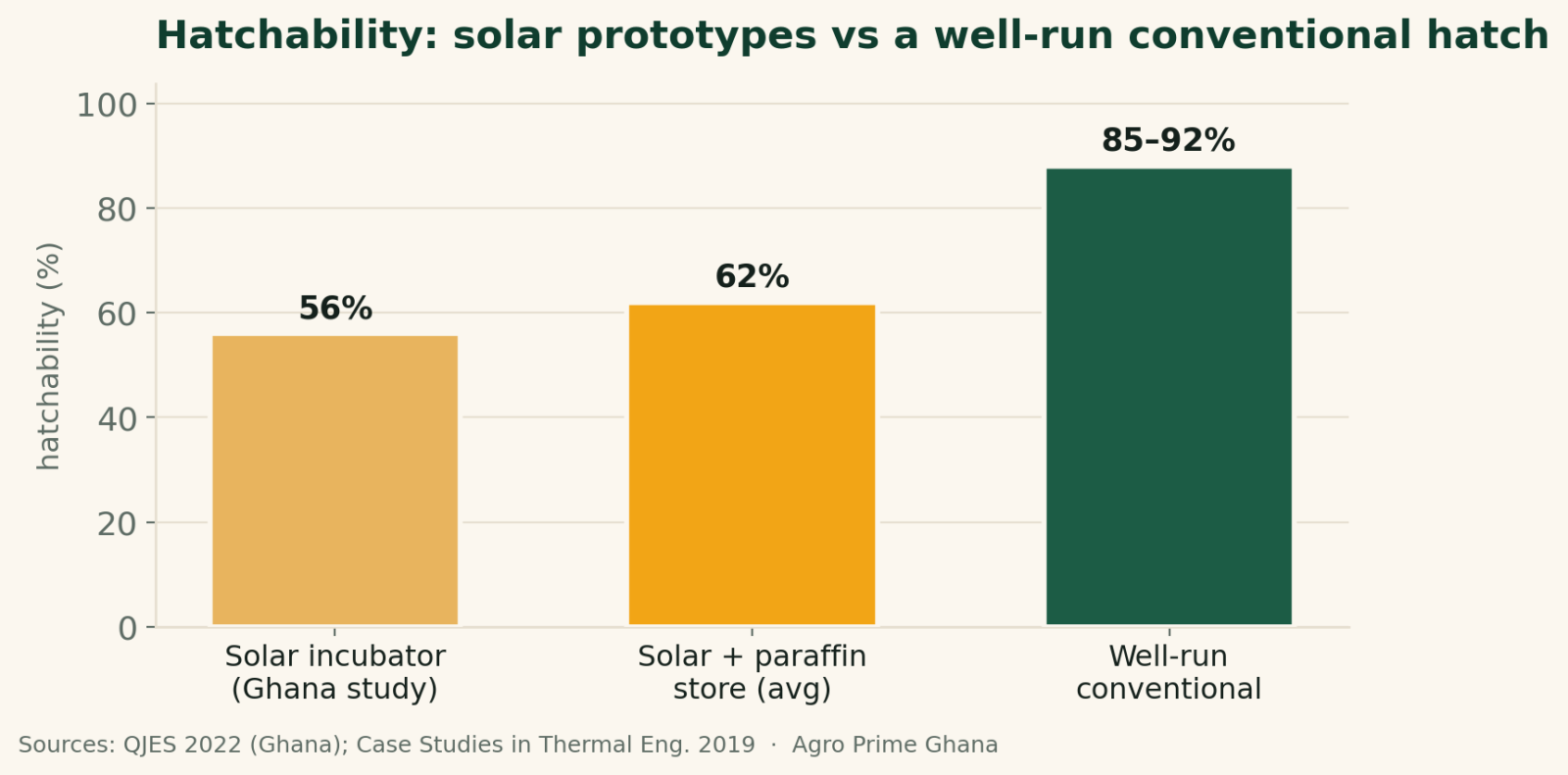
Yes — solar-powered incubators do work in Ghana, and a well-sized solar-and-battery system can hold hatching temperature straight through dumsor, which is exactly the problem that ruins so many grid-dependent hatches. But "works" comes with honest conditions: the panels and battery must be sized for a full 21-day cycle including cloudy days, the machine needs enough thermal mass to coast through the night and short gaps, and the research prototypes tested so far hatch fewer chicks than a well-run mains machine — around 56–62% of eggs versus the 85–92% of fertile eggs a good conventional setup should reach. So the technology is real and genuinely useful here; it is not magic, and it is not an excuse to skip the incubation basics. This guide gives you the honest case, the sizing logic and the limitations.
Written by the Agro Prime Ghana hatchery team and reviewed against current engineering research on solar incubation, including a Ghana-based field study. Last updated September 2026.
Key takeaways
Solar incubation solves Ghana's real hatchery problem — unreliable grid power — by running the machine from PV panels and a battery, with thermal mass (water or a phase-change material) to hold heat through nights and outages. Published designs use modest hardware — for example a 55 W panel, a 60 Ah 12 V battery and low-wattage backup heaters in one study — and a Ghana-based system cost about US$617 to build with a payback near 15 months and running cost around US$0.69 per chick. The honest limitation is hatch rate: these research prototypes achieved roughly 56–62% hatchability, well below a well-managed conventional hatch, largely because of temperature and humidity swings. Solar works best as a battery-backed, thermally-buffered system sized generously for cloudy days — not a bare panel wired to a heater.
Why solar makes real sense for Ghanaian hatcheries
The strongest argument for solar incubation in Ghana is not "green energy" — it is reliability. An incubator's one non-negotiable job is to hold a steady temperature for 21 days, and every hour the grid drops during dumsor is an hour the eggs cool and the turner stops. A mains-only incubator without backup is therefore hostage to the grid; a solar-and-battery system carries its own power supply and, properly sized, simply does not notice a grid outage. Ghana also has the raw resource — strong, fairly consistent sunshine across most of the country for much of the year — which is why engineers have repeatedly tested solar incubators for exactly this setting. One field study explicitly designed and costed its solar incubator as a suitable architecture for promoting poultry farming in Ghana, using water as thermal mass and a 12 V battery to keep the fan and heat running through nights and cloudy spells. For a rural farm far from reliable power, or any hatchery tired of losing batches to outages, that independence is the whole point.
How a solar incubator actually works
A solar incubator is a normal incubator with an energy system built to ride out gaps in supply, and it has three parts working together. First, photovoltaic (PV) panels convert sunlight to electricity during the day. Second, a battery stores enough of that energy to run the machine overnight and through outages — this is what makes the system dependable, because bare panels alone stop the moment a cloud passes. Third, and easy to overlook, is thermal mass: a heat store such as sealed containers of water, or a phase-change material (PCM) like paraffin wax, that absorbs heat while power is plentiful and slowly releases it when it is not, smoothing out temperature between charge and discharge. In one published design the thermal store was 50 kg of paraffin paired with a 55 W solar module, a 60 Ah 12 V battery and two small 15 W DC backup bulbs, which together held the egg chamber at roughly 36–39°C with humidity in the 50–75% band across the cycle. The thermal mass is what lets the system coast through a night or a short outage without the temperature crashing — the same principle that makes a large cabinet incubator more stable than a small box.
Do they hatch well? The honest numbers
This is where honesty matters most: the solar incubators tested in the research so far hatch fewer chicks than a well-run mains machine, and any seller who claims otherwise is overselling. The Ghana-based study reported about 60% fertility and 56% hatchability; a separate design using paraffin thermal storage averaged about 62% hatchability across three runs (individual runs of 56%, 67% and 64%). Compare that with the 85–92% of fertile eggs a well-managed conventional hatchery should convert to chicks, as we discuss in our guide to improving hatchability, and the gap is real. But read the gap correctly. These were experimental prototypes, and the losses came mainly from the very things good incubation controls — temperature and humidity swings wider than ideal (chambers drifting across a 35–41°C range in one study rather than sitting at a steady 37.5°C). That tells you the solar power concept works; the shortfall is in control precision, which better thermostats, more thermal mass and tighter humidity management can close. A solar system built to hold a genuinely steady 37.5–37.8°C should hatch far closer to a conventional machine — the physics of the embryo does not care where the electricity came from.
| Feature | Solar / battery incubator | Mains-only incubator (no backup) |
|---|---|---|
| Power source | PV panels + battery (+ optional grid/generator) | Grid electricity only |
| Rides out dumsor | Yes, if battery and thermal mass are sized right | No — temperature falls during every outage |
| Upfront cost | Higher (panels + battery + controller) | Lower to buy |
| Running cost | Very low (sunlight); ~US$0.69/chick in one Ghana study | Ongoing electricity bills + fuel if generator backup |
| Hatchability (prototypes vs well-run) | ~56–62% in trials; higher achievable with tight control | 85–92% of fertile eggs when well managed |
| Main weakness | Temperature/humidity control & cloudy-day sizing | Total dependence on unreliable grid |
| Best for | Off-grid or outage-prone farms wanting power independence | Sites with reliable power, or with separate backup |
Sizing the panels and battery
Solar incubation lives or dies on sizing, and under-sizing is the commonest mistake — a system that works on a sunny test day but fails on the third cloudy harmattan morning is worse than useless when embryos are three weeks in. Work it out in the right order. First, find the machine's real electrical demand: the heater, fan and turner together, in watts, and remember the heater cycles on and off, so the average draw is lower than the peak. Second, decide your autonomy — how many hours (ideally days) the battery must run the machine with little or no sun; for Ghana, size for at least a cloudy day or two, not just one night. Multiply average watts by those hours to get the battery energy you need in watt-hours, then add a generous margin, because you should not deep-discharge batteries and they lose capacity with age and heat. Third, size the panels to run the daytime load and fully recharge the battery within the sunlight hours you can count on, again with margin for cloud. The published Ghana-scale designs used small hardware for small machines — panels in the tens of watts and a 60 Ah battery — but your numbers depend entirely on your incubator; do the calculation, and if in doubt, oversize. A good solar installer can turn your machine's wattage and desired autonomy into a panel and battery specification.
Thermal mass: your free buffer against gaps
Thermal mass is the quiet hero of solar incubation, and building enough of it in is one of the cheapest ways to improve results. Because a battery is expensive and finite, you do not want to spend all your stored electricity fighting temperature swings — so you let a heat store do part of the work. Sealed jugs or bottles of water inside or around the chamber, or a proper phase-change material like the paraffin used in the research, soak up heat when power is plentiful and release it slowly when the sun is gone or the grid is down, flattening the temperature curve exactly when you need it. This is the same reason a full cabinet incubator holds temperature better than an empty one, and why the eggs themselves add stability. Practical steps: insulate the incubator and its room well, keep it shaded from direct afternoon sun so it does not overheat, add water or PCM thermal mass, and keep the machine reasonably full. Every degree of swing you remove with passive thermal mass is a degree your battery and thermostat do not have to chase — and swings are exactly what cost the prototype hatchers their chicks.
Field note: solar power is not a shortcut past the basics
We see real enthusiasm for solar incubators, and rightly so for outage-prone farms — but the temptation is to think the solar part is the whole job. It is not. A solar incubator still has to hold a steady 37.5–37.8°C, sit at the right humidity, turn the eggs, breathe, and be kept clean, and it still needs fresh, fertile eggs from a good flock. The studies that hatched only half to two-thirds of their eggs did not fail because of the sun — they failed on temperature and humidity control. Solar solves your power problem; it does nothing for your egg-handling, sanitation or thermostat. Get the incubation fundamentals right first, then let solar make them reliable.
The honest limitations
A fair assessment has to name the drawbacks, because solar is not the right answer for everyone. The biggest is upfront cost: panels, a decent battery and a charge controller add real money on top of the incubator, even if running costs are then very low — one Ghana study built its unit for about US$617 and estimated a payback near 15 months, but that is still capital you must find first. Second, batteries are the weak link — they are the part most likely to fail or degrade, especially in heat, and replacing them is an ongoing cost that erodes the "free power" story. Third, cloudy and rainy spells test an under-sized system, so honest sizing and some fallback (a generator or grid top-up) matter. Fourth, the control precision issue seen in the prototypes is real: cheap systems that let temperature drift will hatch poorly, so invest in a good thermostat and thermal mass, not just panels. None of these are reasons to avoid solar — they are reasons to do it properly, with realistic expectations and honest sizing, rather than bolting a panel onto a heater and hoping.
Want reliable chicks while you build a solar setup?
Going solar is a worthwhile project, but it takes planning and capital — and your flock needs chicks in the meantime. Agro Prime Ghana runs a hatchery in Kasoa with backup power, so we supply healthy, vaccinated day-old broiler and layer chicks reliably, outage or not. We are also happy to talk through incubator choice, backup power and whether a solar, battery or generator setup fits your farm before you spend. Message us on WhatsApp (+233 24 915 1503) or book a visit to order chicks or get hatchery and power advice.
Is a solar incubator right for you?
Solar incubation is the right choice when power reliability is your binding constraint — an off-grid farm, a rural site with frequent long outages, or a hatchery that keeps losing batches to dumsor and is tired of it. For those situations, a properly sized solar-and-battery incubator with good thermal mass turns power from your biggest risk into a non-issue, and the low running cost pays back the hardware over time. It is a weaker choice if you already have reliable power or a solid generator, if capital is very tight, or if you are not ready to invest in the control precision (good thermostat, thermal mass, careful humidity management) that a solar machine needs to hatch well. As with the wider equipment decision in our cabinet vs tabletop guide, the honest rule is to match the system to your real conditions — here, your sunlight, your outages and your budget — and to build in generous margin for the cloudy days that Ghana's harmattan and rainy season will send.
The bottom line on solar incubation
Solar-powered incubators genuinely work in Ghana, and they answer the single hardest problem a local hatchery faces: keeping eggs warm when the grid will not. The concept is proven — PV panels, a well-sized battery and thermal mass can hold hatching temperature through nights and outages, at very low running cost. The honest caveat is that success depends on doing it properly: size the battery and panels for cloudy days, build in water or phase-change thermal mass, and invest in tight temperature and humidity control, because the research prototypes that hatched only 56–62% failed on control, not on sunlight. Treat solar as a reliable power supply for a well-run incubator — not a substitute for good incubation — and it becomes one of the smartest investments an outage-plagued Ghanaian hatchery can make.
Frequently asked questions
Do solar-powered incubators actually work in Ghana?
How does a solar incubator keep eggs warm at night?
What size solar panel and battery do I need for an incubator?
How well do solar incubators hatch compared to normal ones?
Are solar incubators worth the cost?
What is thermal mass and why does it matter for solar incubation?
What are the main drawbacks of solar incubators?
Can I add solar backup to my existing incubator?
Sources & further reading
- Al-Sammarraie et al., Al-Qadisiyah Journal for Engineering Sciences — Performance assessment of a solar powered egg incubator with a backup heater (Ghana-oriented design: cost, payback, fertility and hatchability, water thermal mass).
- Case Studies in Thermal Engineering — Performance study of a solar poultry egg incubator with phase change heat storage subsystem (PV/battery/PCM specifications, chamber temperature, hatchability).
- Mississippi State University Extension — Important Incubation Factors (target incubation temperature and humidity).
- Agro Prime Ghana guides: improving hatchability, cabinet vs tabletop incubators, starting a hatchery in Ghana.
About Agro Prime Ghana
Agro Prime Ghana Limited runs a poultry hatchery and mixed agribusiness in Kasoa, supplying day-old chicks and supporting poultry keepers across the country — with backup power so our hatches run whether or not the grid does. These guides combine hands-on hatchery experience with current engineering and veterinary references. This article is general educational information, not a substitute for professional engineering or veterinary advice on your specific setup. We supply healthy day-old chicks (broilers & layers), point-of-lay pullets, quality feed and practical farm support. Ready to start or expand? Book a visit or message us on WhatsApp (+233 24 915 1503) to order chicks or get hatchery and power advice.