To build a premium, branded egg business in Ghana you sell consistency and trust, not just eggs: grade your eggs by weight and quality, pack them in clean, printed cartons that carry your name, keep them cool and fresh, and charge a modest premium above loose "table egg" crates because the buyer knows exactly what they are getting every time. A crate of unsorted eggs from an anonymous seller and a neatly graded, dated, branded half-dozen are two different products, even if the hens are the same — and the second one can command a better price from supermarkets, hotels, hostels and health-conscious households. Most Ghanaian layer farmers still sell the first way, into a crowded market where every 30-egg crate looks identical and price is the only lever. This guide shows how grading, cartoning, branding and honest quality claims let you step out of that commodity fight and build eggs people ask for by name.
Written by the Agro Prime Ghana poultry team and reviewed against current industry references (FAO egg marketing guidance, USDA egg grade standards and Lohmann layer performance data). Last updated September 2026.
Key takeaways
A premium egg brand is built on grading, cleanliness, freshness and honest labelling — not gimmicks. Grade by weight into clear classes (roughly: Large ~57 g, Extra Large ~64 g, Jumbo ~71 g per egg by USDA minimums) and by quality (clean, sound shell; small air cell; firm white) using candling. A good commercial layer like the Lohmann Brown peaks at 92–94% production and lays eggs averaging 63.5–64.5 g, so with the right flock you have premium-size eggs to sell. Protect quality with cool storage — keep eggs below 13°C where you can, with high humidity — because eggs lose 2–3% of their weight and their grade as moisture escapes through the shell. Pack in clean, printed cartons with your name, a lay/pack date and grade. Price a modest premium above loose crates, justified by consistency and service, never by fake claims. Ghana's labelling rules (L.I. 1541) apply to your cartons.
What makes an egg "premium" rather than just an egg?
A premium egg is not a different egg — it is the same egg sold with grading, cleanliness, freshness and a trustworthy name attached, so the buyer pays for certainty. In Ghana's mass market, eggs move in 30-egg crates of mixed sizes and unknown age, and the seller competes almost entirely on price per crate. A premium proposition flips that: you promise a buyer that every carton is a known size, clean-shelled, recently laid, correctly stored and consistent week after week — and you back the promise with your name on the pack. That certainty is worth money to specific buyers. A supermarket needs uniform cartons that scan and shelve neatly; a hotel or restaurant needs eggs of a predictable size so recipes and plating are consistent; a hostel or caterer buying in volume wants reliable freshness; and health-conscious urban households will pay a little more for eggs they trust. None of this requires a rare breed or an exotic claim. It requires discipline in four areas — grading, handling, packaging and branding — applied consistently. The eggs your Lohmann Brown or ISA hens already lay are premium raw material; the value you add is in how you sort, protect and present them.
Why grading is the foundation of a branded egg
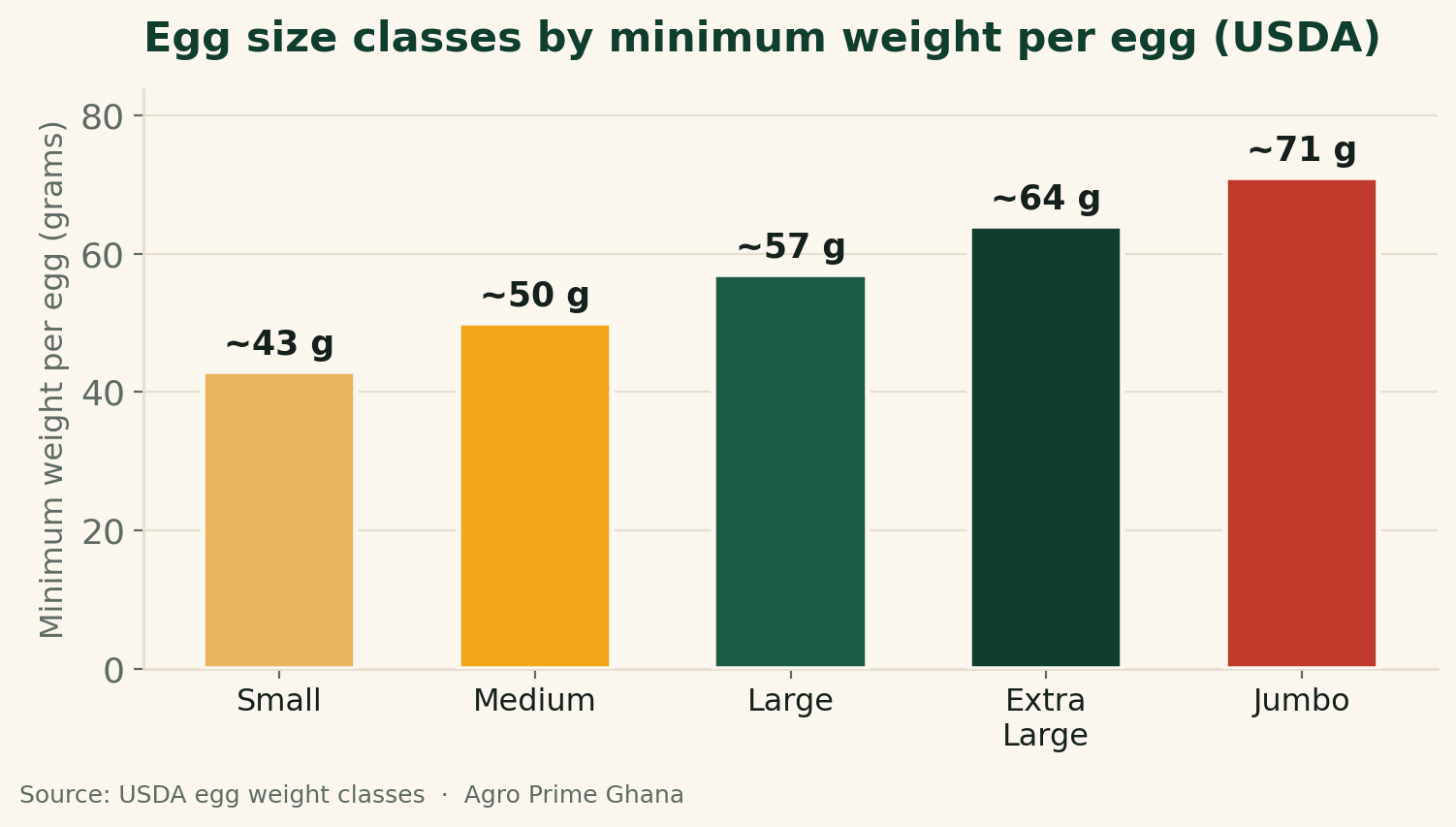
Grading — sorting eggs by weight and by quality — is the single practice that turns a mixed crate into a branded product, because a brand is a promise of consistency and grading is how you keep it. Eggs are graded on two axes. The first is size by weight: the USDA weight classes give a useful scale, with minimum weights per egg of roughly Jumbo 71 g, Extra Large 64 g, Large 57 g, Medium 50 g and Small 43 g (USDA sizing); the EU scale is similar, with Large 63–73 g and Medium 53–63 g. The second is quality, assessed largely by candling — shining a light through the egg to judge the shell, the air cell and the interior. The FAO's egg marketing guidance explains the grade thresholds clearly: a top Grade AA egg has an air cell no more than about 3 mm (1/8 inch) deep with a clean, sound shell and a firm white; a Grade A egg allows an air cell up to about 6 mm (3/16 inch); and larger air cells, cracks, blood or meat spots drop the egg to Grade B or out of the premium pack entirely. A fresh egg has a small air cell; as it ages and loses moisture, that cell grows — so air-cell size read by candling is essentially a freshness gauge. Selling by grade means a "Large" carton always holds Large eggs and a "premium" carton never hides a cracked or stale one. That reliability is the whole product.
What size eggs will your flock give you?
A well-managed modern layer flock produces a high proportion of premium-size eggs, which is what makes branding viable — you need enough Large, Extra Large and Jumbo eggs to fill premium cartons reliably. Breed management data shows what to expect: the Lohmann Brown-Classic, one of the most common layers in Ghana, reaches 50% production at around 140–150 days, peaks at 92–94% lay, and produces eggs averaging 63.5–64.5 g over a 12-month cycle — squarely in the Extra Large band. Ghana's commercial layers overall are estimated to produce on the order of 230–250 eggs per hen a year. Two management realities shape your size mix: eggs start small when a flock first comes into lay and grow larger as the birds mature, and nutrition and body weight drive egg size, so a well-fed flock (see how to increase egg production) shifts more of its output into the premium size classes. This matters commercially because the premium and the demand often sit at different sizes — so knowing your flock's actual size distribution, week by week, tells you which cartons you can fill and price up, and which eggs are better sold as standard.
| Egg class | Approx. min weight per egg | Positioning for a Ghanaian brand |
|---|---|---|
| Jumbo | ~71 g | Top premium; scarce, from older hens — command your highest price |
| Extra Large | ~64 g | Premium mainstream; typical of a peaking Lohmann/ISA flock |
| Large | ~57 g | Solid premium; the everyday branded carton |
| Medium | ~50 g | Standard; younger flock or value line |
| Small | ~43 g | Pullet eggs from new layers — sell as budget, not premium |
Protecting freshness so the brand means something
A premium egg brand collapses if the eggs are stale, so cool, clean, prompt handling is not a luxury add-on — it is the product. Egg quality begins declining from the moment of lay: the FAO notes eggs lose moisture and carbon dioxide through the porous shell, the air cell enlarges, the white thins, and a marketed egg typically loses 2–3% of its weight before that loss becomes obvious. Slowing that decline is straightforward and mostly about temperature and time:
- Collect frequently — several times a day — so eggs spend less time in the warm nest, get dirty or cracked less, and start cooling sooner.
- Keep them cool. The FAO advises holding eggs below 13°C to slow deterioration, with ideal keeping conditions much colder and humid (around -1°C at 80–85% relative humidity for long storage). Few small Ghanaian farms can hit those extremes, but even a cool, shaded, ventilated store — and, better, a cold room — dramatically extends the window a "fresh" brand can honestly claim.
- Protect the cuticle. The shell's natural "bloom" seals its pores against bacteria; harsh washing strips it, so handle eggs so they stay clean rather than needing heavy washing (more on this in egg storage and handling).
- Sell quickly. The freshest eggs earn the premium; move stock first-in-first-out and date your cartons honestly.
Field note: the air cell tells the customer's story before they crack the egg
When we candle eggs, the size of the air cell at the blunt end is the first thing we read, because it quietly records how the egg has been handled. A tight, small air cell means a fresh egg that was cooled promptly; a large, wobbly one means an egg that has sat too long or too warm and lost moisture. A customer will eventually read the same story in the kitchen — a very fresh egg sinks and lies flat in water and is hard to peel when boiled, while an old one stands up or floats. If you are building a "fresh" brand, candling before packing is how you make sure the eggs on your shelf actually deserve the word. It takes seconds per egg and protects the promise your carton makes.
Cartons and packaging: your brand you can hold
The carton is where your brand becomes physical, and for a premium egg it does three jobs at once: it protects the eggs, it communicates quality, and it carries the legally required information. Moving from loose 30-egg crates to printed cartons of six, ten, twelve or fifteen is often the single biggest step from commodity to brand. A good premium carton is clean and undamaged, protects eggs from cracking in transit, and presents them blunt-end-up so the air cell stays stable. On it, print your brand name and logo, the egg size/grade, and, crucially, a lay or pack date and a best-before window — freshness is your headline claim, so date it and stand behind it. Ghana's General Labelling Rules (L.I. 1541), enforced by the FDA, apply to packaged food, so a branded carton should also carry your business name and address, the net content or number of eggs, storage instructions ("keep refrigerated / store cool"), and a batch identifier for traceability. Consistent, professional packaging is also what gets you onto a supermarket shelf, where loose crates cannot go. The carton is not a cost to minimise; it is the most-seen piece of marketing you own.
Start your branded line with the right layers
A premium egg brand needs a flock that lays plenty of large, strong-shelled, uniform eggs — and that starts with good pullets and good feeding, not marketing. Agro Prime Ghana supplies healthy layer chicks and point-of-lay (POL) pullets of proven brown-egg breeds, plus layer-feeding and calcium guidance to keep shells strong and egg size in the premium classes. If you are planning a graded, branded egg line and want help choosing breeds (see best layer breeds for Ghana), planning flock size, or setting up grading and storage, message us on WhatsApp +233 24 915 1503 or book a visit to talk it through.
How much premium can you actually charge?
Charge a modest, defensible premium — enough to reward the extra grading, packaging and cooling you do, but grounded in real value the buyer receives, never in invented health claims. The honest justification for a higher price per egg than a loose table-egg crate is fourfold: consistency (a known size and grade every time), freshness (dated, cool-stored eggs), convenience and presentation (clean cartons that shelve and transport well), and reliability of supply and service (you deliver on time, in the same pack, week after week). Those are things a supermarket, hotel or caterer will genuinely pay for because they reduce the buyer's own risk and effort. What you should not do is chase a premium with claims you cannot prove — "organic", "omega-rich", "free-range" or health benefits — unless you truly meet those standards and can substantiate them, because a false claim is both illegal under labelling rules and fatal to a trust-based brand the moment it is exposed. Set your premium by looking at what your target buyers already pay for comparable branded or imported eggs, cost your grading and packaging honestly, and price so the premium covers that added cost with a margin — then defend it with relentless consistency rather than discounting. Different sizes carry different premiums, too: reserve your best pricing for the scarce Jumbo and Extra Large cartons and sell smaller eggs as a value line rather than dragging your whole brand down to crate prices.
Field note: the premium lives in what you refuse to sell
The hardest discipline in a branded egg line is not grading the good eggs — it is holding back the ones that don't make the grade. When a batch comes through candling with a few cracks, thin shells or oversized air cells, the temptation is to slip them into the premium carton to fill it and hit the number. That one shortcut is exactly how a brand dies: the buyer who finds a stale or cracked egg behind your name stops trusting every carton after it. We treat the reject pile as the price of the premium, not a loss — downgraded eggs go into a plainly-sold value line or the kitchen, and only eggs that earn the carton get your name. A premium is something you protect by what you leave out.
Finding and keeping premium buyers
Premium eggs need premium buyers, so build the business around the channels that value consistency over the lowest price. The strongest targets are institutional and retail buyers who buy regularly and care about quality: supermarkets and provision shops that need cartoned, dated, scannable stock; hotels, restaurants and chop bars that need predictable size and reliable delivery; hostels, schools and caterers buying volume; and health-conscious urban households reachable directly or through delivery. The way you win and keep them is by being boringly dependable — same size, same quality, same clean carton, delivered on the day promised — which is exactly the thing the anonymous crate market cannot offer. Relationships matter more than one-off sales here: a hotel that trusts your Wednesday delivery will not switch to save a few pesewas, because your reliability saves them hassle. Sample your cartons with prospective buyers, ask what size and pack they prefer, and let their needs shape your grading. General guidance on reaching buyers is in poultry marketing in Ghana. And protect the eggs on the way — a cracked carton undoes the brand, so handle delivery as carefully as production (see transporting eggs).
The bottom line on building a branded egg business
A premium egg brand in Ghana is not built on a special hen or a clever claim — it is built on doing four ordinary things consistently: grading eggs by weight and quality so every carton is what it says; handling them clean, cool and fresh so the brand's freshness promise is real; packing them in professional, dated, labelled cartons that protect the eggs and carry your name; and charging a modest, honest premium that specific buyers gladly pay for the certainty you give them. The market is wide open precisely because most farmers still sell undifferentiated crates and fight on price. Step out of that fight by making your eggs recognisable and trustworthy, target the supermarkets, hotels and households that value consistency, and defend your premium with reliability rather than discounts. Do that and you stop selling a commodity that anyone can undercut, and start selling eggs that customers ask for by name.
Frequently asked questions
What makes an egg "premium" versus a normal table egg?
How are eggs graded by size and quality?
What egg size will a Ghanaian layer flock produce?
How do I keep branded eggs fresh enough to justify the price?
How much more can I charge for branded eggs?
What must a branded egg carton show in Ghana?
Do I need a special breed to sell premium eggs?
Who buys premium branded eggs, and how do I reach them?
Sources & further reading
- FAO — Marketing quality eggs (candling, grades, air-cell depth, storage temperature and humidity, weight loss during marketing).
- USDA egg sizing via chicken egg size classes (weight classes and minimum weights; EU size bands).
- Lohmann Breeders — Lohmann Brown-Classic management guide (peak production, egg weight, eggs per hen housed).
- The Poultry Site — Overview of Ghana's poultry sector (layer focus, eggs per hen per year).
- Agro Prime Ghana guides: egg storage and handling, increasing egg production, and poultry marketing.
About Agro Prime Ghana
Agro Prime Ghana Limited runs a poultry hatchery and mixed agribusiness in Kasoa, supplying day-old chicks and point-of-lay pullets and supporting poultry keepers nationwide. We supply healthy day-old chicks (broilers & layers), point-of-lay pullets, quality feed and hands-on farm support — everything a branded egg line needs to start well. This article is general educational information, not a substitute for professional agronomic or food-safety advice; register your food business and cartons with the FDA before selling packaged eggs. Ready to start or expand? Book a visit or message us on WhatsApp (+233 24 915 1503) to order pullets, feed or advice.