Every layer keeper knows the sinking feeling: the birds are healthy, the feed bill is high, but the egg trays are coming in half empty. On paper a good commercial layer should be filling a tray a day for most of her first year — yet plenty of Ghanaian flocks never reach that potential, or slide off it far too early. The frustrating truth is that egg production is rarely lost to one dramatic cause. It leaks away through a dozen small, fixable things: an hour of light missed each morning, calcium fed at the wrong time, a drinker running warm and low by noon, a week of heat that no one adjusted for. This guide walks through the levers that actually raise and sustain lay under Ghanaian conditions — nutrition, calcium, lighting, water, heat and health — and how to pull each one properly.
Written by the Agro Prime Ghana poultry team and reviewed against current veterinary and poultry-science references (MSD Veterinary Manual and university extension sources). Last updated September 2026.
Key takeaways
A hen needs a steady 14–16 hours of light a day to sustain and maximise lay; production begins to fall once day length drops below about 12 hours. She must eat roughly 4 g of calcium every day, and around 2 g of that goes into each shell — so calcium and its timing matter enormously. Layer rations should carry about 16–18% protein and 3.5–4.0% calcium, with most of that calcium fed as coarse particles (oyster shell or large-grit limestone) the birds can draw on overnight. Cool, clean water in front of the birds at all times is non-negotiable — hens drink roughly twice as much water as feed by weight. The laying comfort zone is only 19–22°C, so Ghana's heat is a constant drag on output that must be managed, not ignored. And because a drop in lay is often the first sign of disease, a sound vaccination and biosecurity routine protects production as much as any feed tweak.
What "good" production actually looks like
Before you can raise output, you need an honest target to measure against. A modern commercial layer comes into lay at about 18–20 weeks of age, climbs to a peak over the next month or two, and — when everything is right — holds that peak with the flock laying an egg roughly every 24 to 26 hours. Over a full first laying year a well-managed hen produces on the order of 250–280 eggs, and a good flock stays in lay for a productive cycle of around 50–60 weeks before it is worth considering a molt or replacement, according to Virginia Cooperative Extension. If your flock is well past 20 weeks and still crawling along at a fraction of that, the birds are almost always telling you that one or more of the levers below is out of adjustment. Egg production is a demanding, finely balanced process, and the hen quietly sacrifices it whenever her diet, environment or health falls short.
Why Ghanaian layer flocks underperform
The reasons a Ghanaian flock lays below potential are usually environmental and managerial rather than genetic — the stock coming out of good hatcheries is capable of far more than most farms get from it. Heat is the single biggest structural handicap. The laying comfort zone (the thermoneutral range where a hen performs best) is only 19–22°C, and once ambient temperatures climb past the mid-20s the bird starts eating less, and less feed means fewer nutrients for eggs. A review in the journal Animals confirms that optimum performance sits in that narrow 19–22°C band — a range Ghana exceeds for much of the day, most of the year. On top of heat come the everyday leaks: irregular lighting, feed that is either poorly formulated or gone stale and mouldy, calcium fed carelessly, drinkers that run dry or hot in the afternoon, worm and mite burdens, and the ever-present threat of Newcastle and other diseases that knock a flock off peak in days. Fix these and the genetics do the rest.
| Production lever | What to aim for | Why it matters |
|---|---|---|
| Light | 14–16 h/day, ≥10 lux at bird level, never decreasing | Day length drives the laying signal; falling light shuts lay down |
| Protein | ~16–18% in the layer ration | Egg white and body upkeep both draw on dietary protein |
| Calcium | 3.5–4.0% of diet; ~4 g/hen/day; mostly coarse particles | ~2 g of calcium is locked into every shell |
| Water | Clean, cool, unlimited; ~2× feed intake by weight | An egg is ~70% water; even brief shortage cuts lay fast |
| Temperature | Keep as close to 19–22°C as possible | Heat suppresses feed intake and therefore output |
| Health | Full vaccination, deworming, biosecurity | A production drop is often the first sign of disease |
Feed the hen for the egg she is trying to make
An egg is an expensive thing for a hen to build, and she can only build it from what you put in front of her. A proper layer ration should carry roughly 16–18% crude protein to supply the amino acids that go into egg white and to maintain the bird's own body, and it must be dense enough in energy that a hen eating less in the heat still gets what she needs. The commonest home-mixing mistakes we see in Ghana are diluting the ration with too much cheap maize (pushing protein down), and — more dangerous — using maize or groundnut that has gone mouldy. Mould-derived aflatoxin quietly suppresses lay and hatchability long before it kills anything, so storage discipline is part of egg production, not separate from it. If you formulate your own feed, get the balance right rather than the cost alone: our layer feeding guide and our notes on making poultry feed walk through the ratios. Feed fresh, feed consistently, and never let birds run out — a hen that empties the feeder by mid-morning and stands hungry until evening will not lay to potential.
Get calcium right — and get the timing right
Calcium is where a lot of otherwise-good flocks lose shells and, eventually, lay. The numbers are striking: a single egg contains almost 2 grams of calcium, and because a hen only absorbs and uses part of what she eats, she needs to consume around 4 grams a day to keep up, roughly four to six times the requirement of a non-laying bird, according to poultry-science guidance summarised by The Poultry Site. A layer ration should therefore contain about 3.5–4.0% calcium. But quantity is only half the story — form and timing are the other half. The shell is laid down mostly overnight, in the dark, when the hen is not eating. Fine, powdery limestone passes through her quickly and is gone by the time she needs it; coarse particles — oyster shell or large-grit limestone — sit in the gizzard and release calcium slowly through the night, exactly when the shell gland is working. The MSD Veterinary Manual recommends that around 65–70% of supplemental calcium be given as coarse limestone (2–4 mm) with the rest as fine particle. Offering an extra scoop of oyster shell or coarse grit in the afternoon is one of the cheapest, most reliable ways to firm up shells and hold production.
Field note: the afternoon calcium habit
On the farm the calcium routine we trust most is simple: build the base calcium into the ration, then top-dress a little coarse oyster shell or large limestone grit in a separate feeder in the mid-to-late afternoon. The logic is that the birds carry that coarse calcium into the night in the gizzard, and the shell gland — which does most of its work in the small hours — has a slow supply to draw on instead of pulling calcium out of the hen's own bones. When we see shell quality slipping in an older flock, the first thing we check is not the calcium percentage but the particle size and whether the birds are actually getting coarse calcium late in the day.
Manage light like a switch, never let it fall
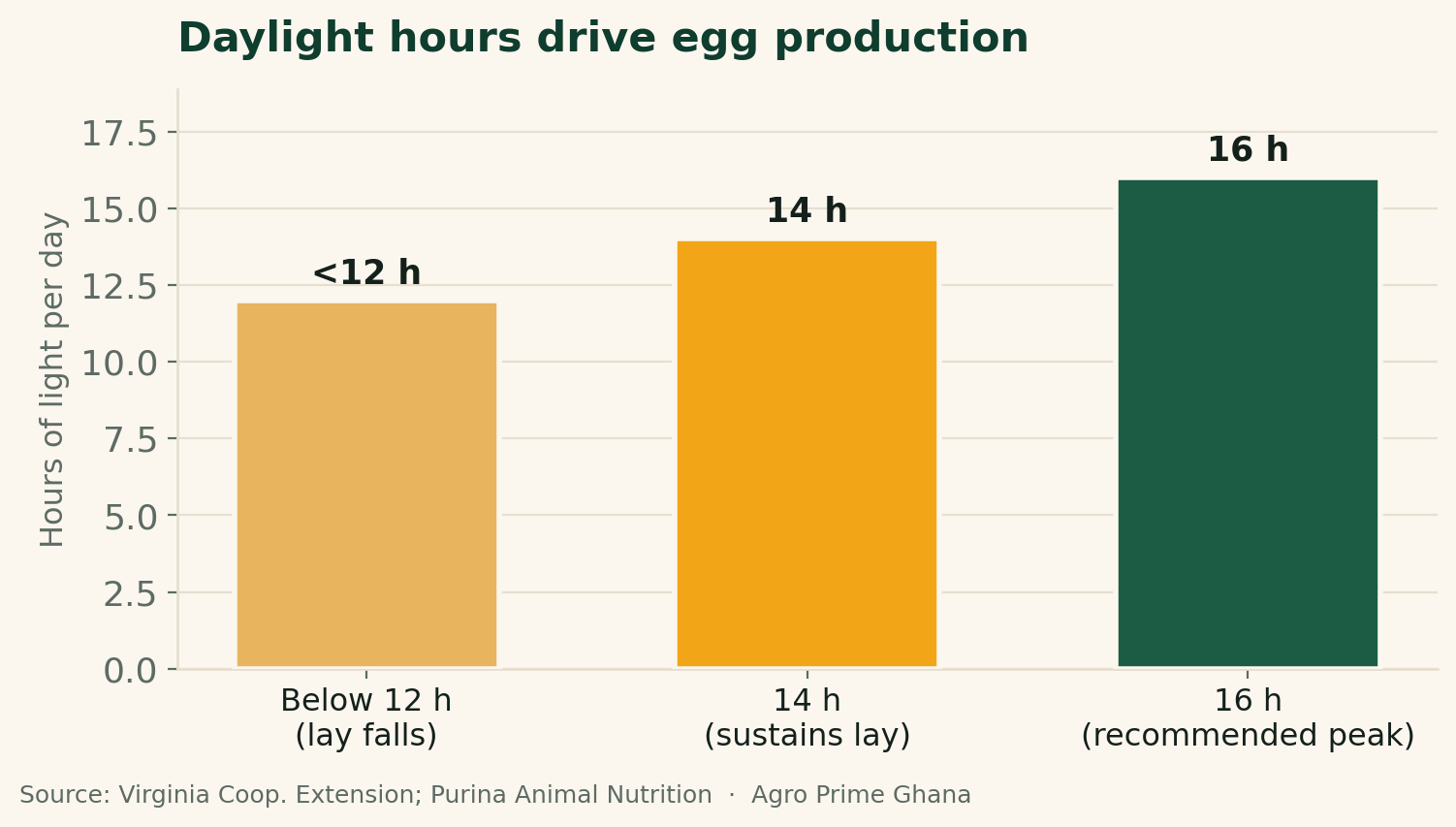
Day length is the master signal that tells a hen's body to lay, which is why lighting is the single most powerful free tool you have. Layers need a steady 14–16 hours of light per day to sustain strong production; once day length falls below about 12 hours, lay drops off, and many advisers recommend holding hens at a firm 16 hours for peak output. The MSD Veterinary Manual notes that intensity matters too — you want at least 10 lux (about one foot-candle) at the level of the birds, roughly the light of a single 60-watt bulb per 9 square metres hung above them. Ghana's natural day sits close to 12 hours year-round, which is on the low edge for a laying flock, so a modest lighting programme pays for itself. Two rules matter more than any other: light hours must never decrease while a flock is in lay (a drop in day length tells the bird to stop, exactly the wrong message), and the schedule must be consistent — the same on and off times every day. A cheap timer on a few LED bulbs, adding an hour or two before dawn and after dusk to reach a steady 15–16 hours, is one of the best-value investments a layer farm can make. Do not chase ever-longer days; more than about 17 hours brings no benefit and stresses the birds.
Water: the nutrient everyone forgets
An egg is roughly 70% water, and a hen drinks about twice as much water as she eats feed by weight — more in the heat. Water is the first thing a bird cuts back on when it is warm, dirty or hard to reach, and lay falls almost immediately when water runs short. In Ghanaian conditions this is a daily battle: drinkers left in the sun heat up and birds drink less; low reservoirs run dry by afternoon; and warm, dirty water grows bacteria and algae that put birds off drinking and can spread disease. The fixes are unglamorous but decisive — site drinkers in shade, check and refill through the day (especially the hot afternoon window), clean them daily, and provide enough drinking space that timid birds low in the pecking order still get their fill. If you want a single high-leverage habit to raise production, it is often this: make sure every hen can get all the cool, clean water she wants, all day.
Beat the heat before it beats your egg count
Because the laying comfort zone tops out around 22°C and Ghana routinely runs hotter, heat management is not optional here — it is a permanent part of running a layer flock. As the house warms past the comfort zone the hen eats less to avoid generating body heat, and reduced feed intake directly reduces the raw material for eggs; sustained heat also thins shells and can knock production down measurably. The tools are ventilation, water and timing. Maximise airflow so hot, humid air is moved out and cooler air drawn through — our guide to poultry house ventilation covers the practicalities. Provide shade and, where feasible, roof insulation or sprinkler/misting cooling in the worst of the day. Feed during the cooler parts of the morning and evening when birds will eat more, keep water cool and abundant, and avoid handling or disturbing the flock in the peak afternoon heat. For a fuller treatment see our dedicated guide to heat stress in poultry. Every degree you keep out of the house is feed the hen will actually eat, and eggs she will actually lay.
Field note: read the flock at 2 p.m., not 6 a.m.
A flock almost always looks fine in the cool of early morning. The honest test of whether your housing and water are up to the job is what the birds are doing in the heat of the early afternoon. If a lot of hens are standing with wings held away from the body, panting, crowding the walls and off their feed at 2 p.m., you are losing eggs to heat whether or not the tray count has caught up yet. That afternoon walk-through — checking water temperature, airflow you can actually feel, and how many birds are distressed — tells you more about your production ceiling than any morning inspection.
Protect production with health and calm
A sudden or creeping drop in lay is one of the first signs of disease, because a bird fighting infection diverts energy away from making eggs. In Ghana, Newcastle disease is the standing threat that can collapse a laying flock, and several viral diseases specifically attack egg output and shell quality — so a disciplined vaccination programme is a production tool, not just a health one. Keep vaccinations current (see our guide to Newcastle disease), control internal parasites through sensible deworming, and watch for external parasites like mites and lice that drain birds and depress lay. Underpinning all of it is biosecurity — keeping disease out is far cheaper than fighting it. Beyond disease, hens are creatures of routine, and stress suppresses laying: sudden noise, predators, rough handling, moving birds, overcrowding, or running out of feed or water will all cost eggs. Keep the flock's world steady and predictable, handle birds gently and only when necessary, give them adequate space and nesting boxes, and you remove a whole category of avoidable losses.
Don't ignore age and molt
Even a perfectly managed flock will not lay at peak forever. Production is highest in the first laying year and declines as hens age, and older birds naturally molt — dropping feathers and pausing lay — typically from around 18 months. A flock past its productive cycle of roughly 50–60 weeks that is now laying poorly may be telling you it is time to plan a controlled molt for a second cycle, or to replace it. That is a business decision as much as a husbandry one: at some point the feed a tired flock eats is worth more turned into fresh point-of-lay pullets. Knowing where your flock sits in its laying life stops you spending money chasing production that age, not management, has taken away.
The bottom line on raising egg production
Sustained, high egg production in Ghana is not a secret formula — it is a stack of ordinary things done consistently. Give the hen a well-formulated, uncontaminated ration with enough protein and the right calcium fed at the right time; hold her at a steady 14–16 hours of light that never falls; keep cool, clean water in front of her every hour of the day; fight the heat with ventilation, shade and smart feeding times; and defend the flock with vaccination, parasite control and biosecurity so disease never gets the chance to knock her off peak. None of these levers is expensive on its own. Pulled together and kept up, day after day, they are the difference between trays that come in half empty and a flock that lays to the potential you paid for.
Frequently asked questions
How many hours of light do laying hens need in Ghana?
How much calcium does a laying hen need each day?
Why did my hens' egg production suddenly drop?
Does heat really reduce egg production?
What protein level should layer feed have?
How much water do laying hens need?
At what age do hens start and stop laying well?
Can stress lower egg production?
Sources & further reading
- MSD Veterinary Manual — Management of Laying Chickens (lighting hours and intensity, laying-flock management).
- MSD Veterinary Manual — Mineral Deficiencies in Poultry (calcium levels, coarse vs fine limestone, manganese).
- The Poultry Site — Factors Influencing Shell Quality (calcium per egg, daily requirement, shell formation, age and temperature effects).
- Virginia Cooperative Extension — Why Have My Hens Stopped Laying? (light needs, laying cycle length, nutrition, disease).
- Impact of Temperature and Humidity on Laying Hens — review in Animals (PMC) (thermoneutral zone, temperature-humidity index).
- Agro Prime Ghana guides: layer feeding guide, heat stress in poultry, and poultry house ventilation.
About Agro Prime Ghana
Agro Prime Ghana Limited runs a poultry hatchery and mixed agribusiness in Kasoa, supplying day-old and point-of-lay stock and working alongside layer keepers across the country. These guides draw on that hands-on hatchery and farm experience, checked against current veterinary and poultry-science references. This article is general educational information, not a substitute for advice from a qualified veterinary or extension officer — if production falls sharply or birds look unwell, get the flock seen. Need chicks, feed advice or farm support? Book a visit or message us on WhatsApp (+233 24 915 1503).