Automatic feeders and drinkers are equipment that deliver feed and clean water to your birds continuously, with far less daily labour than hand-feeding and topping up buckets — chiefly pan or chain feeding lines for feed and nipple or bell drinker lines fed from a header tank for water. They start to pay for themselves once a flock is big enough that carrying feed and water by hand eats your time, wastes feed on the floor and lets birds run short of water in the heat — for most Ghanaian keepers, from a few hundred birds upward. This guide explains the main types, when they earn their cost, how much labour and water they save, and how to set them up correctly under Ghanaian conditions.
Written by the Agro Prime Ghana poultry team and reviewed against current industry references (Cobb-Vantress and Aviagen broiler management guides and university extension). Last updated September 2026.
Key takeaways
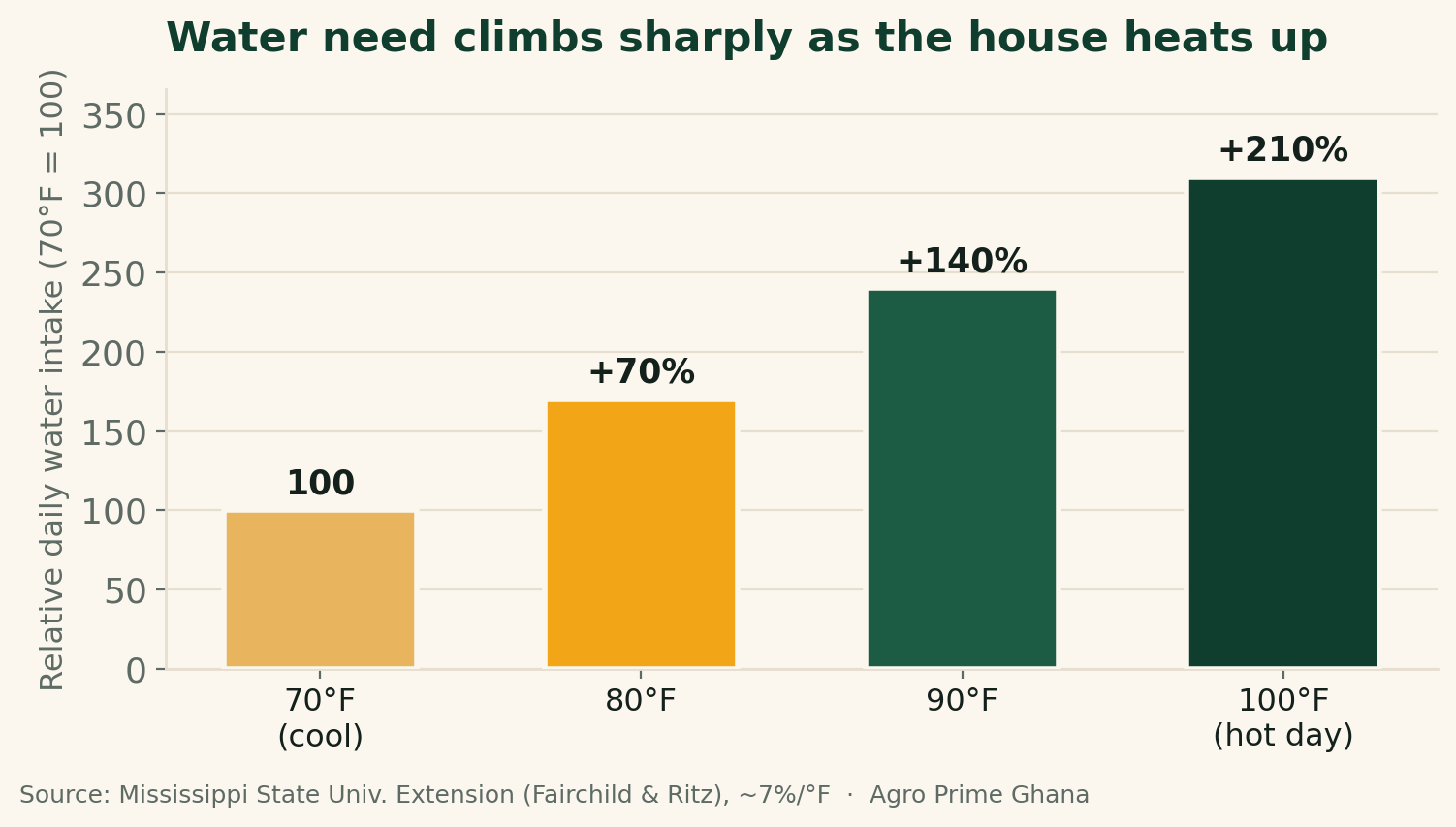
Automatic feeders (pan or chain lines) and drinkers (nipple or bell lines) cut daily labour, reduce feed spillage and keep water in front of birds around the clock — which matters most in our heat, where broilers drink roughly 1.6–1.8 times as much water as feed by weight and water intake climbs about 7% for every 1°F rise in temperature. A single 33 cm pan feeder serves 50–70 birds; a nipple serves about 10–12 birds. They pay off best on flocks of a few hundred birds and up, and wherever labour is scarce or water runs short by midday. Nipple lines also keep litter drier and water cleaner than open drinkers — but only if pressure and height are set right. The start-up cost is real; the return comes from saved labour, less wasted feed and water, better hygiene and steadier growth.
What counts as an automatic feeder or drinker?
An automatic system is any equipment that presents feed or water to birds without someone refilling each unit by hand every few hours. For feed, the two workhorses are pan (plate) feeding lines — circular pans hung along the house, fed from a central hopper by auger or gravity — and chain feeders, where a flat chain drags feed along a trough. Both refill from a bulk hopper, so you fill the hopper occasionally instead of scooping into dozens of tube feeders all day. For water, the main options are nipple drinker lines (birds peck a metal pin to release droplets, fed from a header tank that sets the pressure) and bell (float) drinkers (a hanging bell that refills automatically as birds drink it down). The Cobb and Aviagen guides treat these as standard equipment, and the space rules they publish hold whether you keep 300 birds or 30,000.
Why they matter so much in the Ghanaian heat
Water is the most important nutrient, and in our climate an automatic drinker line is as much a heat-management tool as a labour-saver. Birds cool themselves largely by drinking and panting, so intake rises steeply as the house warms: university extension work summarising commercial data (Fairchild & Ritz) reports that broilers increase water consumption by about 7% for each degree Fahrenheit the temperature rises — so a flock comfortable in the cool morning may need far more water by a hot Kasoa afternoon. Birds also naturally drink around 1.6 to 1.8 times as much water as feed by weight under moderate conditions, per the Aviagen water brief, with the Cobb Broiler Management Guide giving roughly 1.6–2 times feed by mass. If watering depends on someone remembering to refill open drinkers, the flock will run short exactly when the day is hottest — and thirsty birds stop eating, stop growing and become far more vulnerable to heat stress. An automatic line that never empties removes that single biggest daily risk.
Pan, chain, nipple or bell — how the options compare
There is no single "best" system; the right choice depends on flock size, bird type, water quality and budget. The table compares the four common automatic options against the hand-filled equipment most keepers start with, using the space figures published by Cobb and Aviagen.
| Equipment | Capacity / space rule | Best for | Watch-outs |
|---|---|---|---|
| Tube feeder (manual) | Refill by hand several times a day | Very small flocks, brooding backup | Labour-heavy, feed spillage, uneven access at scale |
| Pan feeding line | 50–70 birds per 33 cm (12 in) pan | Broilers & layers, most house sizes | Set pan height to back level; needs power or good gravity feed |
| Chain feeder | Min. 2.5 cm (1 in) trough per bird | Long houses, uniform feeding | Trough hygiene; motor and chain maintenance |
| Bell (float) drinker | At least 0.6 cm drinking edge per bird | Any flock; simple to understand | Open water — spills, wets litter, needs daily cleaning |
| Nipple drinker line | About 10–12 birds per nipple | Broilers, layers, cleaner water & drier litter | Needs correct pressure & height; filter the water |
For most commercial Ghanaian flocks the practical combination is a pan feeding line plus a nipple drinker line: pans give clean, low-waste feeding and nipples give closed water that keeps litter dry. Bell drinkers remain a cheaper option — especially where water pressure is hard to guarantee — but they demand daily washing and wet the litter more. We go deeper in our feeders and drinkers guide and nipple drinker system guide.
How much labour do they actually save?
The saving is real but scales with flock size. With hand-filled tube feeders and open drinkers, someone must walk the house and refill units several times a day, wash drinkers daily and sweep up spilled feed — a workload that grows in direct proportion to bird numbers. With a pan line fed from a bulk hopper and a nipple line fed from a header tank, the same person fills a hopper occasionally and checks that lines flow, then spends their time on the work that matters: walking the flock, watching behaviour and catching problems early. The saving is largest on all-in-all-out batches. Automation does not remove the stockperson — it moves them from carrying buckets to observing birds, which is where the money is made.
Field note: automation frees your eyes, not just your hands
The change we notice most when a farm moves from buckets to automatic lines is not fewer hours worked — it is better hours. When you are no longer carrying buckets, you actually stand and watch the flock: which corner is quiet, which birds are not reaching a drinker, whether the litter under a line is going damp. Most flock problems announce themselves in behaviour long before they show in the record book, and you only catch them if you have time to look. Treat the freed-up labour as time reinvested in observation.
The savings go beyond time. Over-filled hand-scooped tube feeders let birds bill feed onto the litter; pan feeders with a proper lip, filled shallow and set at back height, sharply cut that spillage — and with feed the biggest cost in any Ghanaian poultry enterprise, every gramme kept off the floor adds up (see reducing feed cost). On water, nipple lines are the standout: because the water is enclosed, almost none is spilled or fouled, whereas bell and open drinkers lose water to spillage and evaporation and must be dumped when dirty.
When do they pay off? Reading your own numbers
Automatic equipment is a capital cost, so the question is when the saving outweighs it. The practical signals that you have reached that point:
- Flock size. Once you run a few hundred birds and up per batch, the labour and waste of hand equipment start to justify a pan and/or nipple line — and the bigger your batches, the faster it pays.
- Labour is scarce or costly. If you are paying someone mainly to carry feed and water, that wage is what automation replaces.
- Water runs short in the heat. If open drinkers empty or go warm and dirty by midday and birds pant and go off-feed, a line that never empties pays for itself in saved growth.
- Litter goes wet, or you are going all-in-all-out. Nipple lines fix wet litter directly, and equipment set once per batch rewards you every cycle.
Weigh the up-front cedis against the full return: saved labour, feed and water, drier litter, healthier birds and more birds grown with the same staff. For many keepers the drinker line pays back faster than the feeder line. If you are still planning, our guides to starting a poultry farm and building an affordable poultry house set equipment in the whole budget.
Setting up feeders correctly
Good equipment set up badly performs worse than simple equipment set up well. For pan feeders, hang them so the feed lip sits at about the height of the birds' backs and raise them as the flock grows — too low and birds spill and foul the feed, too high and smaller birds cannot reach. Respect the capacity rule: Cobb recommends 50–70 birds per 33 cm pan, so count your pans against your bird numbers, and keep the feed level shallow ("little and often", not brimming) to minimise billing-out. For chain feeders, allow at least 2.5 cm of trough per bird and keep the chain and motor maintained so feed moves evenly to the far end. During brooding, Cobb advises one supplemental feeder per 50 chicks plus feed spread on chick paper for the first days before birds graduate onto the main line.
Grow with the right equipment from Agro Prime Ghana
Kitting out a new house or upgrading from buckets? We can help you match feeder and drinker capacity to your flock size using the same Cobb and Aviagen space rules in this guide — how many pans, how many nipples, what header-tank height — and we supply strong, vaccinated day-old chicks (broiler and layer), point-of-lay pullets and quality feed. Message us on WhatsApp (+233 24 915 1503) or book a visit to talk it through.
Setting up drinkers correctly
Drinker set-up is where most water problems begin and end. For a nipple line, two things decide success — height and pressure. Set the pin at about the birds' eye level at day one, then raise the line as they grow so that from about day two a bird drinks with its head at roughly a 45-degree angle, as Cobb advises. Pressure is set by the height of water in the header tank: start low for chicks and raise it every day or two, watching litter moisture, aiming for a nipple that shows a bright droplet but does not drip. Provide about 10–12 birds per nipple and make sure no bird travels more than about 3 metres to reach water. For bell drinkers, allow at least 0.6 cm of drinking edge per bird, set the rim at back height, adjust the float so water does not spill, and wash daily. During brooding, Cobb recommends 14–16 drinkers per 1,000 chicks including supplemental units plus about 6 mini-drinkers per 1,000 for the first days. We cover this in depth in our nipple drinker system guide.
Water quality and maintenance — the part people skip
Automatic drinkers deliver whatever water you put into them, so the system is only as clean as your source and maintenance. Nipple lines need filtration — sediment and biofilm block the tiny orifice and restrict flow, and restricted flow cuts intake. Flush lines between batches, filter the header-tank inlet, and sanitise the lines where water quality is doubtful. Watch the flow: the Cobb and Aviagen guides give flow-rate targets that rise with age (from around 40 ml/min in the first week to 90 ml/min or more for finishing broilers), and a line below target is usually partly blocked or under-pressured. Bell and chain systems need daily cleaning. Tie this into your wider biosecurity routine, and keep simple records of water and feed use, since a sudden change in either is one of the earliest signs of flock trouble.
Field note: in the heat, make sure the water is actually cool
Birds drink less when water is warm, and in our climate a tank or a pipe run left in full sun can heat the supply until birds turn away from it in the hottest part of the day — exactly when they most need to drink. We keep header tanks shaded and, on very hot afternoons, flush the warm standing water out of the lines so cooler water reaches the nipples. It is a small habit that quietly protects intake, and it costs nothing but a few minutes.
The bottom line on automatic feeders and drinkers
In Ghana's heat, automatic feeders and drinkers are one of the most reliable ways to protect growth and reduce risk. Pan and chain feeders cut labour and feed spillage; nipple and bell drinker lines keep water constantly in front of birds that need it most when the house is hot. The equipment pays off soonest on flocks of a few hundred birds and up. Buy to the published space rules — 50–70 birds per pan, 10–12 birds per nipple — set height and pressure correctly, filter and maintain the water, and reinvest the freed-up labour in watching your birds. Do that, and automation quietly turns into steadier flocks, cleaner litter and better returns.
Frequently asked questions
Are automatic feeders and drinkers worth it for a small Ghanaian farm?
How many birds does one pan feeder or nipple drinker serve?
Which is better in Ghana’s heat — nipple or bell drinkers?
How much water do broilers drink compared with feed?
What is the correct height and pressure for a nipple drinker line?
Do automatic feeders really reduce feed waste?
What maintenance do automatic drinker lines need?
Can I use automatic equipment for both broilers and layers?
Sources & further reading
- Cobb-Vantress — Cobb Broiler Management Guide (pan and chain feeder space, bell and nipple drinker space, brooding equipment per 1,000 chicks, water:feed ratio).
- Aviagen — Water Utilisation in Broilers (water:feed ratio on nipple drinkers, nipple flow rates and birds per nipple).
- Mississippi State University Extension — Water-Related Factors in Broiler Production (water intake rise per degree of temperature, nipple flow-rate guidance).
- Agro Prime Ghana guides: feeders and drinkers guide, nipple drinker systems, heat stress in poultry, and reducing feed cost.
About Agro Prime Ghana
Agro Prime Ghana Limited runs a poultry hatchery and mixed agribusiness in Kasoa, supplying day-old chicks and working alongside poultry keepers across the country. These guides combine hands-on hatchery and farm experience with current industry references. We supply healthy day-old chicks (broilers and layers), point-of-lay pullets, quality feed and hands-on farm support, and we can help you size and set up feeders and drinkers for your flock. This article is general educational information, not a substitute for professional advice. Ready to equip or expand your farm? Book a visit or message us on WhatsApp (+233 24 915 1503) to order chicks, feed or advice.