A nipple drinker system is a closed watering line in which birds get water by pecking a small stainless-steel pin that releases droplets on demand, fed from a header tank or pump that sets the pressure — replacing open bell drinkers with a sealed supply that keeps water clean and litter dry. In Ghana's heat, that closed, always-full supply is one of the most effective upgrades a keeper can make, because it removes the two biggest problems of open drinkers: fouled water that cuts intake, and spilled water that soaks the litter and breeds disease. This guide explains how nipple systems compare with bell drinkers, why hygiene, water pressure and nipple height decide whether they work, and what they cost to run locally.
Written by the Agro Prime Ghana poultry team and reviewed against current industry references (Cobb-Vantress nipple-drinker guidance and Aviagen broiler management). Last updated September 2026.
Key takeaways
A nipple drinker line gives each bird clean, enclosed water on demand and keeps litter drier than open bell drinkers. Provide about 10–12 birds per nipple, place nipples no more than 35 cm (14 in) apart, and keep every bird within 3 metres of water. Set the pin at chick eye level on day one, then raise the line so birds drink with the head at a 45-degree angle. Pressure comes from header-tank height: start low for chicks and raise it gradually, aiming for a nipple that shows a droplet but does not drip. Run a header tank at about 2 bar (30 psi) minimum; too little pressure can cut water intake by as much as 20%. Filter and flush the line, because a blocked nipple restricts flow and thirsty birds stop growing. The reward is cleaner water, drier litter, less disease and less daily washing.
What a nipple drinker system is and how it works
A nipple drinker system is a length of pipe carrying water to a row of small valves — the "nipples" — each with a stainless-steel pin hanging below it. When a bird pecks the pin, a measured droplet is released; when it lets go, the valve seals again. Because the water stays inside the pipe until the moment a bird drinks, it never sits in an open dish collecting droppings, dust, feed and litter. The line is fed from a header tank (a small raised tank whose water height sets the pressure) or a pressure-regulated pump, through a filter and regulator, usually with a standpipe at the end to read pressure and flush the line, and often a drip cup under each nipple to keep stray droplets off the litter. The genius of the system is its simplicity: no floats to jam, no open water to foul, and water delivered in the exact small amounts a bird needs. The trade-off is that it only works if pressure, height and cleanliness are managed — get those wrong and the same closed design that keeps water clean will quietly starve birds of it.
Nipple versus bell drinkers — the real comparison
The honest comparison is not that one is simply "better"; it is that they fail in different ways. Bell (float) drinkers are cheap, easy to understand and forgiving of low pressure — but they hold open water, which in our climate fouls within hours, must be scrubbed daily, spills easily and soaks the litter, the root of ammonia, footpad burns, higher parasite loads and dirtier eggs. Nipple lines eliminate open water almost entirely: cleaner water means birds drink more freely, and a dry floor means healthier feet and less disease. The cost is that nipples are unforgiving of neglect — they demand correct pressure, height and clean water, or they under-deliver. The table sets out the trade-offs using the figures published by Cobb and Aviagen.
| Feature | Nipple drinker line | Bell (float) drinker |
|---|---|---|
| Water hygiene | Enclosed — stays clean until the bird drinks | Open — fouls with droppings, dust, feed |
| Litter under drinker | Dry (with correct pressure & drip cups) | Prone to wet, capped litter from spills |
| Daily labour | Low — check flow, no daily scrubbing | High — empty, wash and refill daily |
| Birds served | About 10–12 birds per nipple | At least 0.6 cm drinking edge per bird |
| Water pressure | Needs a header tank (~2 bar) or pump | Works at low pressure |
| Main risk | Blocked/under-pressured nipples cut intake | Dirty water and wet litter cut performance |
| Up-front cost | Higher; pays back in labour, hygiene, litter | Lower; higher running labour |
For most commercial broiler and layer houses in Ghana the closed hygiene of a nipple line is worth the extra setup and discipline. Bell drinkers remain a sensible choice where water pressure is genuinely hard to provide, or as a familiar starting point for smaller keepers, and many farms keep a few as brooding backup. We weigh the options side by side in our feeders and drinkers guide and cover the broader case in our guide to automatic feeders and drinkers.
Why hygiene is the whole point
Water is the nutrient birds consume most, and dirty water quietly wrecks performance. Open drinkers sit at bird level all day in a warm house collecting droppings, feed, dust and litter, and the resulting bacterial soup both discourages drinking and spreads gut disease around the flock. A nipple system breaks this cycle: the water is sealed inside the pipe, so the only place it can be fouled is inside the line itself — which is why line hygiene matters so much. Biofilm (a slimy bacterial layer) and mineral scale build up inside pipes over time, harbour pathogens, and narrow the nipple orifice so flow drops. The discipline that makes nipple systems pay is non-negotiable: filter the incoming water, flush the lines between batches, and sanitise them periodically. Skip it and you get the worst of both worlds — a closed system that is quietly dirty inside and under-flowing. Water hygiene sits alongside your wider biosecurity and is one of the cheapest ways to protect a flock.
Getting the pressure right
Pressure is the single most important adjustment on a nipple line, and it is set by the height of water in the header tank (or a regulator on a pumped system). Too little pressure and the nipple gives up its water grudgingly — Cobb warns that low water pressure can cut consumption by as much as 20%, and a bird that cannot drink freely will not eat or grow freely either. Too much and the nipple drips between pecks, wetting the litter and undoing the system's main advantage. The working target is a nipple that yields a bright droplet when triggered but does not drip. Manage this by age: start with low pressure for day-old chicks — a couple of centimetres of water column — so small birds can trigger the nipple easily, then raise the pressure gradually every day or two as birds grow, watching the litter (if it goes damp under the line, you have gone too high). Cobb suggests a header-tank supply of around 2 bar (30 psi) minimum, with pumped systems delivering about 2.8 bar and reducing it at the house. Exact settings vary with your nipples and floor slope, so read the manufacturer's chart and, above all, watch your birds and litter.
Field note: let the litter and the birds set the pressure
The published pressure charts are a starting point, not gospel — every house, nipple brand and water source behaves a little differently. We rely on two things you can see with your own eyes. First, the birds: when pressure is right, they drink easily and the flock is calm and eating well; when it is too low, you see restless birds crowding the line. Second, the litter directly under the line: it should stay dry and friable, and if it darkens and caps, the pressure is too high or a nipple is leaking. Walk the line daily, trigger a few nipples with your finger to check for a clean droplet, and adjust by feel. The chart tells you where to begin; the flock tells you where to settle.
Getting the nipple height right
Height decides whether birds can drink comfortably without spilling, and it must change constantly as the flock grows. At placement, set the pin at about the chicks' eye level so day-old chicks meet water without straining. From about day two onward, raise the line so a bird reaches up and drinks with its head at roughly a 45-degree angle — the position that lets it work the pin cleanly and swallow without spilling. Keep raising the line little and often; too low makes birds stoop and splash the litter, too high leaves smaller birds unable to reach and falling behind. On sloped floors, fit a slope regulator (Cobb suggests one roughly every 10 cm of fall) so pressure stays even. Correct height and correct pressure together are what keep water going into birds rather than onto the floor.
Spacing and how many nipples you need
Enough nipples, close enough together, is what guarantees every bird can drink. The standard figures are consistent across the breed guides: allow about 10–12 birds per nipple (roughly 12 for high-flow systems and lighter birds, closer to 9–10 for low-flow systems and heavier broilers, per Aviagen), place nipples no more than 35 cm (14 in) apart, and keep every bird within about 3 metres of water. Under-providing nipples creates competition — dominant birds monopolise the line and shy birds under-drink, so the flock grows unevenly. Count nipples against your actual bird numbers, and during brooding add supplemental water: Cobb recommends about 14–16 drinkers per 1,000 chicks including supplemental units and around 6 mini-drinkers per 1,000 for the first days, so no chick is far from a drink while it learns the line.
Field note: watch that day-old chicks actually find the nipples
A chick that has never seen a nipple does not automatically know to peck it, and in the first 24 hours a chick that fails to drink falls behind fast. When we place chicks on a nipple line we lower it right down, run gentle pressure so a bright droplet hangs on each pin to catch the eye, and add a few supplemental mini-drinkers as a familiar backup. Then we check within the first hours that crops are filling — a chick with a soft, rounded crop has found feed and water. That simple crop check is the surest sign the line is working for the smallest birds.
Set up your nipple line right with Agro Prime Ghana
Planning a nipple system for a new house, or troubleshooting one that is wetting the litter or leaving birds thirsty? We can help you work out how many nipples your flock needs, what header-tank height to run and how to stage the pressure through brooding — and we supply the strong, vaccinated day-old chicks, point-of-lay pullets and quality feed to go into that well-watered house. Message us on WhatsApp (+233 24 915 1503) or book a visit and we will help you get the watering and the stock right together.
Flow rate: matching water to the bird
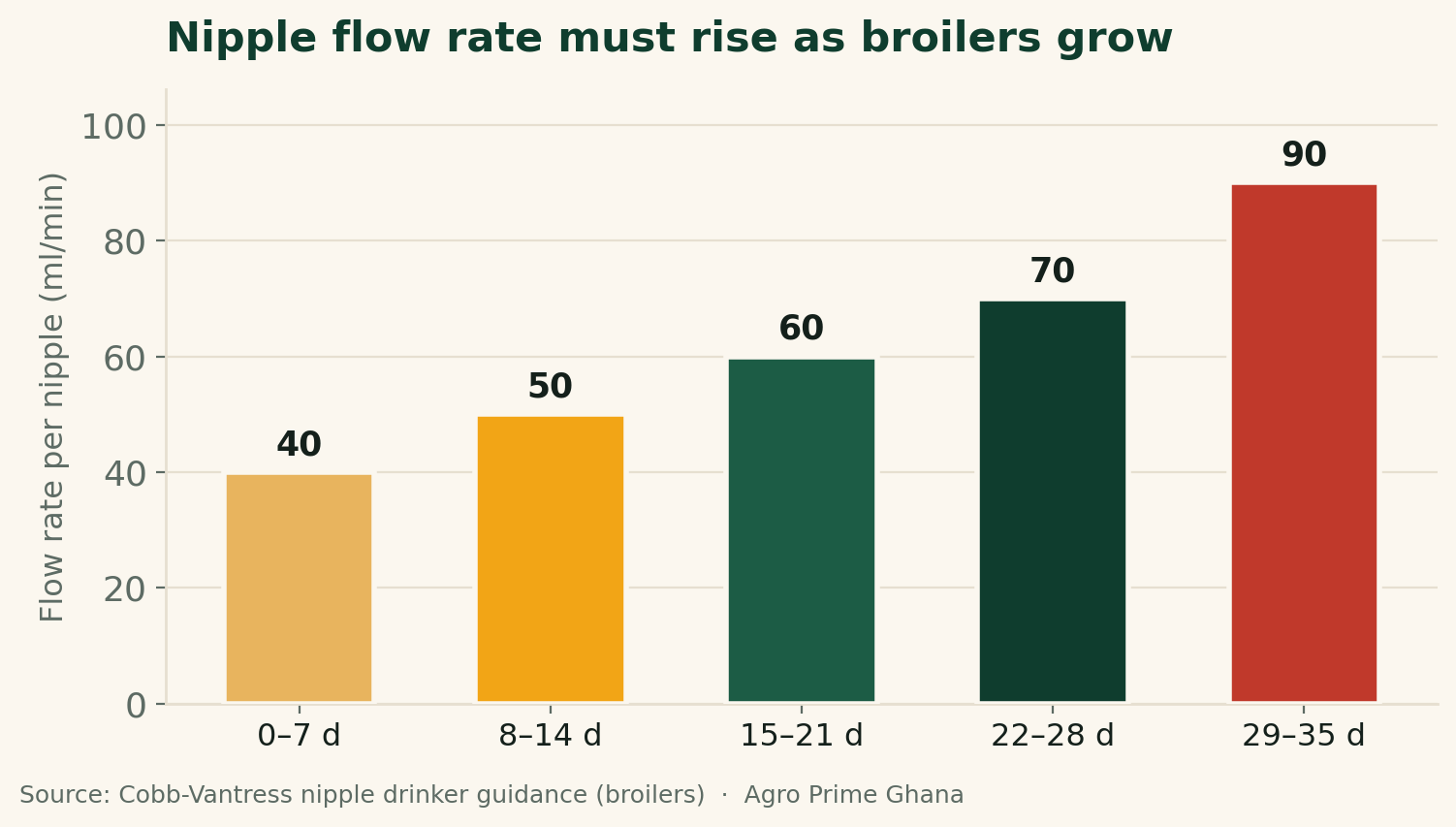
Beyond pressure and height, the water a nipple delivers per minute — its flow rate — has to match the bird's growing thirst. Cobb's nipple guidance gives broiler flow rates of about 40 ml/min in the first week, rising through 50, 60 and 70 ml/min to about 90 ml/min by finishing; Aviagen gives a similar ramp from roughly 20–29 ml/min in week one to 70–100 ml/min after 28 days. A common extension field rule is flow rate (ml/min) ≈ 7 × age in weeks + 20, which lands in the same range. A line delivering well below the age-appropriate flow is failing your birds even if water is technically "on" — the usual causes being low pressure or a partly blocked orifice. Check flow occasionally by timing what a nipple delivers into a cup, and treat a fallen flow rate as a prompt to check pressure and clean the line — especially in the heat, when a broiler's water need climbs far above its cool-morning baseline.
What a nipple system costs to run
The up-front cost of a nipple line — pipe, nipples, header tank or pump, regulator, filter and fittings — is higher than a set of bell drinkers, and that is the honest headline. But the running economics favour the nipple system: labour falls sharply, because there is no daily emptying and scrubbing; water is used more efficiently, because almost none is spilled or dumped; litter stays drier, cutting losses on ammonia damage, footpad problems, disease and, for layers, dirty eggs; and birds drink and grow better on clean water. The exact cedi payback depends on flock size, water source and labour cost, but the pattern is consistent: a nipple system is a capital cost that buys down your running costs and disease risk every batch. For most commercial-scale keepers it is the more economical choice over the equipment's life; for very small flocks, cheaper bell drinkers may still make sense. Our guide to starting a poultry farm gives the wider budget context.
The bottom line on nipple drinker systems
A nipple drinker system is the closest thing to a "set it and watch it" watering solution for a Ghanaian poultry house: clean, enclosed water on demand, dry litter beneath the line, and far less daily washing than open drinkers. It rewards discipline and punishes neglect. Get the fundamentals right — about 10–12 birds per nipple, nipples within 35 cm and no bird more than 3 metres from water; the pin at eye level on day one rising to a 45-degree drinking angle; pressure started low and raised gradually to give a droplet without a drip; and the line filtered, flushed and sanitised — and you deliver clean water to every bird, protect the litter, and cut both labour and disease. Get pressure, height or hygiene wrong and the same closed system will quietly under-water your flock. Manage those three things well, and a nipple line becomes one of the best returns on equipment you can buy.
Frequently asked questions
Are nipple drinkers better than bell drinkers for poultry in Ghana?
How many birds should there be per nipple drinker?
What water pressure should a nipple drinker line run at?
What height should nipple drinkers be set at?
How do I keep nipple drinker lines clean?
What flow rate should each nipple deliver?
Do nipple drinkers save water and money?
Can I use nipple drinkers during brooding for day-old chicks?
Sources & further reading
- Cobb-Vantress — Nipple Drinker guidance (birds per nipple, header-tank pressure, nipple height and 45-degree drinking angle, flow rates, spacing) and the Cobb Broiler Management Guide.
- Aviagen — Water Utilisation in Broilers (birds per nipple by weight, age-based flow rates, water:feed ratio).
- Mississippi State University Extension — Water-Related Factors in Broiler Production (nipple flow-rate rule, water quality and intake).
- Agro Prime Ghana guides: feeders and drinkers guide, automatic feeders and drinkers, and poultry biosecurity.
About Agro Prime Ghana
Agro Prime Ghana Limited runs a poultry hatchery and mixed agribusiness in Kasoa, supplying day-old chicks and supporting poultry keepers nationwide. These guides combine hands-on hatchery and farm experience with current industry references. We supply healthy day-old chicks (broilers and layers), point-of-lay pullets, quality feed and practical farm support, and we can help you size and set up a nipple drinker line for your flock. This article is general educational information, not a substitute for professional advice. Ready to equip or expand your farm? Book a visit or message us on WhatsApp (+233 24 915 1503) to order chicks, feed or advice.